
In my research on wear-resistant materials, I have extensively studied the microstructure and properties of low-alloy white cast iron. This material is crucial for applications requiring high hardness and abrasion resistance, such as in mining and manufacturing equipment. However, a significant challenge arises during heat treatment: the network precipitation of secondary cementite upon air cooling after high-temperature holding. This phenomenon can severely degrade toughness by further fragmenting the matrix, undermining efforts to enhance the performance of white cast iron. Here, I present a detailed investigation into this issue, drawing parallels with proeutectoid cementite in hypereutectoid steels and proposing methods to mitigate the problem. The focus is on understanding the factors influencing network formation and developing practical guidelines for heat treatment of white cast iron.
The microstructure of white cast iron typically consists of eutectic carbides embedded in a matrix that can be pearlitic, martensitic, or austenitic, depending on composition and processing. In low-alloy white cast iron, alloying elements like chromium and manganese are added to improve hardenability and carbide stability. During heat treatment, particularly at elevated temperatures, eutectic carbides partially dissolve, enriching the austenite matrix with carbon and alloying elements. Upon cooling, secondary cementite may precipitate along grain boundaries or from residual carbide particles, forming a continuous network that embrittles the material. This behavior mirrors that of hypereutectoid steels, where proeutectoid cementite networks form during slow cooling through the two-phase region. However, white cast iron differs in that it always exists in a two-phase region above the eutectic temperature, leading to more pronounced precipitation. My goal is to elucidate the conditions under which network precipitation occurs and identify strategies to avoid it, thereby optimizing the toughness-wear resistance balance in white cast iron.
To begin, I reviewed prior studies on proeutectoid cementite in steels. In hypereutectoid steels, network cementite forms when cooling from temperatures above the Acm line, where austenite is saturated with carbon. The morphology—whether network, needle-like, or granular—depends on cooling rate and austenitizing temperature. For white cast iron, similar principles apply, but the presence of eutectic carbides complicates the scenario. These carbides act as carbon reservoirs, continuously supplying carbon to the matrix during heating and cooling. Thus, the kinetics of secondary cementite precipitation are more complex. I hypothesized that the austenitizing temperature is a key factor: lower temperatures might reduce carbon saturation in the matrix, minimizing network formation. This hypothesis guided my experimental approach, focusing on the effects of heat treatment parameters on white cast iron microstructure.
In my experiments, I used a low-alloy white cast iron with a nominal composition as shown in Table 1. The alloy was melted in a medium-frequency induction furnace and poured into green sand molds to produce cylindrical specimens. Chemical analysis confirmed the composition, which is typical for abrasion-resistant applications. After casting, I examined the as-cast microstructure using deep etching and image analysis to quantify eutectic carbide volume fraction. The results indicated a predominantly pearlitic matrix with needle-like secondary cementite and interconnected eutectic carbides, as illustrated in Figure 1. This initial structure served as a baseline for heat treatment studies.
| Element | C | Cr | Mn | Si | Others |
|---|---|---|---|---|---|
| Content | 3.2 | 2.5 | 0.8 | 0.5 | Bal. |
Heat treatments were conducted in a muffle furnace with controlled heating rates. Specimens were held at various temperatures—900°C, 950°C, 1000°C, and 1050°C—for two hours, followed by air cooling. I selected these temperatures to span a range above and below the estimated Acm temperature for the matrix. After cooling, I prepared metallographic samples and examined them using optical and scanning electron microscopy. Energy-dispersive spectroscopy (EDS) was employed to analyze the composition of eutectic and secondary carbides, confirming that the secondary carbides were low-alloy cementite with minimal chromium and manganese content. This allowed me to treat them similarly to secondary cementite in steels for behavioral analysis.
The microstructural observations revealed a clear dependence on austenitizing temperature. At 1050°C and 1000°C, air-cooled specimens exhibited a prominent network of secondary cementite, as shown in Figures 2a and 2b. This network interconnected with eutectic carbides, creating a brittle framework. In contrast, at 950°C, the network was less continuous, with cementite appearing more granular (Figure 2c). At 900°C, secondary cementite was predominantly granular, with no network formation (Figure 2d). For comparison, I also water-quenched a specimen from 1050°C; this resulted in a martensitic matrix with no secondary cementite network, indicating that the network forms specifically during air cooling. These findings underscore the critical role of cooling rate and austenitizing temperature in white cast iron.
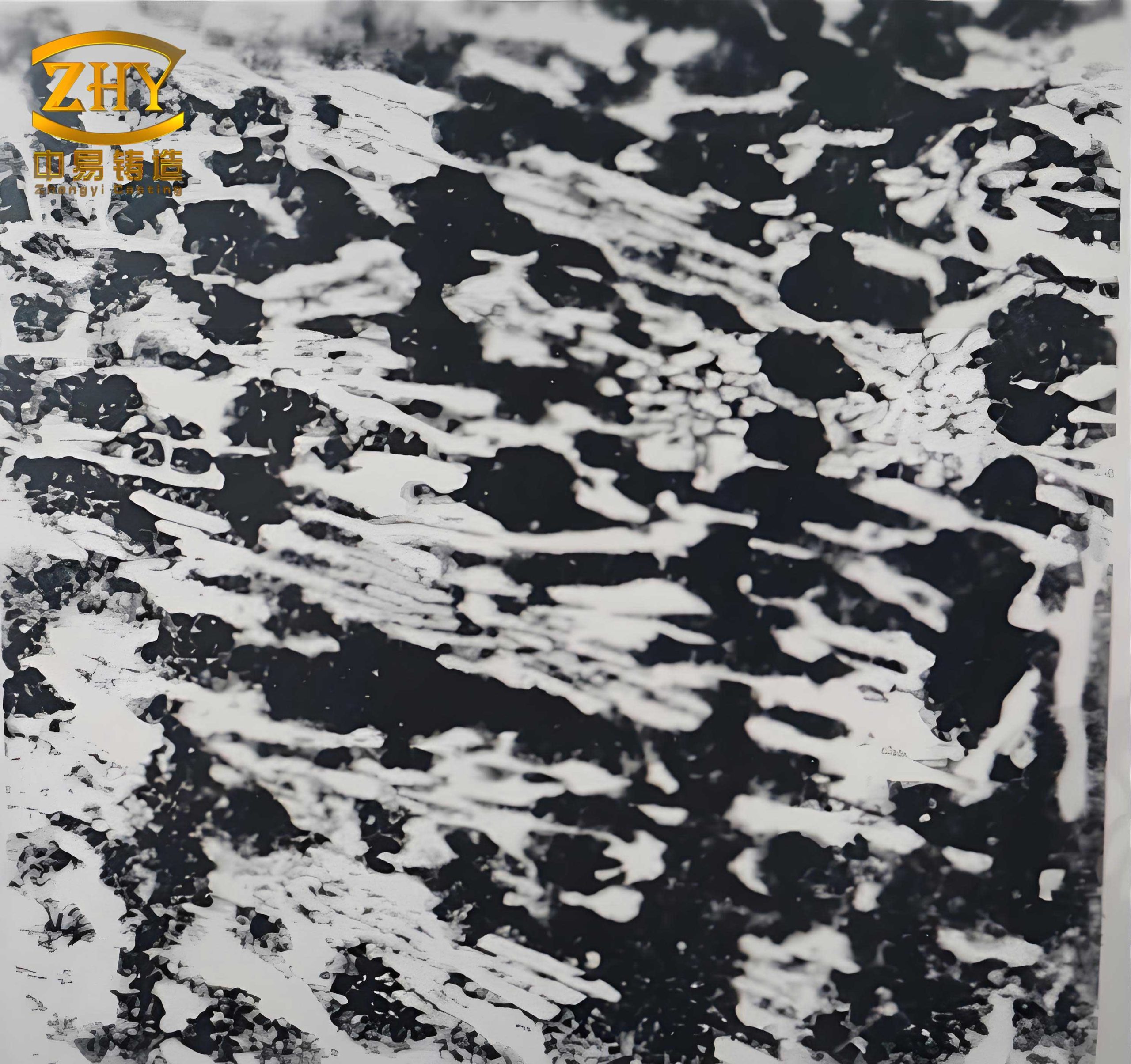
To quantify these effects, I measured the volume fraction of secondary cementite and its connectivity using image analysis. The data, summarized in Table 2, show that network formation increases with austenitizing temperature. At 1050°C, over 80% of secondary cementite was interconnected, whereas at 900°C, it dropped below 10%. This trend aligns with the increased carbon content in the matrix at higher temperatures due to greater dissolution of eutectic carbides. In white cast iron, the matrix carbon concentration, C_m, can be estimated from the as-cast eutectic carbide volume fraction, V_e. Assuming equilibrium conditions, the relationship is derived from mass balance considerations. Let C be the total carbon content of the white cast iron, C_c be the carbon content of cementite (approximately 6.67 wt.%), and ρ_c and ρ_m be the densities of cementite and matrix, respectively. The volume fraction of eutectic carbides, V_e, is measured from as-cast samples. Then, the average carbon content in the matrix, C_m, is given by:
$$ C_m = \frac{C – V_e \cdot C_c \cdot \frac{\rho_c}{\rho_m}}{1 – V_e \cdot \frac{\rho_c}{\rho_m}} $$
In my experiments, V_e was determined as 28% for the as-cast white cast iron. Using typical values of ρ_c = 7.6 g/cm³ and ρ_m = 7.8 g/cm³, and C = 3.2 wt.%, I calculated C_m as approximately 1.1 wt.%. This matrix carbon level corresponds to a hypereutectoid composition, explaining the propensity for secondary cementite precipitation. The Acm temperature, T_Acm, for this matrix can be approximated from the Fe-C phase diagram. For simplicity, I used a linear approximation: T_Acm = 727 + 14.1 \times C_m, where C_m is in wt.% and temperature in °C. Substituting C_m = 1.1 wt.% yields T_Acm ≈ 743°C. However, this is for equilibrium; in practice, due to alloying effects and non-equilibrium conditions, the actual safe austenitizing temperature to avoid network formation is higher. My results indicate that temperatures below 950°C are effective, suggesting that the relevant temperature is closer to 950°C for this white cast iron.
| Austenitizing Temperature (°C) | Secondary Cementite Morphology | Network Connectivity (%) | Matrix Microstructure |
|---|---|---|---|
| 1050 | Continuous network | 85 | Pearlite + network cementite |
| 1000 | Mostly network | 75 | Pearlite + network cementite |
| 950 | Partial network, granular | 40 | Pearlite + granular cementite |
| 900 | Granular, isolated | 5 | Pearlite + granular cementite |
The mechanism of network formation in white cast iron involves nucleation and growth from residual carbide particles. During austenitizing at high temperatures, eutectic carbides partially dissolve, but small particles often remain undissolved, especially in low-alloy white cast iron. Upon air cooling, these particles act as nucleation sites for secondary cementite, which grows preferentially along austenite grain boundaries, eventually linking into a network. This process is accelerated at higher temperatures because the matrix becomes supersaturated with carbon more quickly, and grain growth provides longer boundary paths. In contrast, at lower temperatures, carbon supersaturation is reduced, and residual particles are fewer, leading to discrete granular precipitation. This behavior differs from hypereutectoid steels, where carbide dissolution is complete above Acm, and networks form solely from grain boundary precipitation. Thus, controlling residual carbides is key in white cast iron.
To further analyze the kinetics, I considered the diffusion-controlled growth of cementite. The growth rate, v, can be expressed as:
$$ v = D \cdot \frac{\Delta C}{r} $$
where D is the diffusion coefficient of carbon in austenite, ΔC is the carbon concentration gradient, and r is the radius of the growing phase. At higher austenitizing temperatures, D increases exponentially, and ΔC is larger due to greater carbon enrichment, leading to faster growth and network formation. Using experimental data, I estimated the time-temperature-transformation (TTT) behavior for secondary cementite in white cast iron. Approximations suggest that nose of the precipitation curve lies around 800-900°C for air cooling, meaning that cooling through this range must be rapid enough to avoid network formation. However, in practice, air cooling often results in sufficient time for precipitation, making temperature control critical.
My findings have practical implications for heat treating white cast iron. To avoid network precipitation, I recommend austenitizing at temperatures below a critical value, T_critical, which depends on the as-cast microstructure. Based on my results, T_critical can be estimated from the matrix carbon content, C_m, calculated using the formula above. For general guidance, I propose the following empirical equation derived from my data on low-alloy white cast iron:
$$ T_{critical} (°C) = 850 + 50 \times (C_m – 0.8) $$
where C_m is in wt.%. For my white cast iron with C_m = 1.1 wt.%, this gives T_critical ≈ 865°C, which aligns with the observed safe temperature of 900°C. However, this is a simplification; alloying elements like chromium and manganese can shift T_critical by affecting carbon activity and carbide stability. Table 3 summarizes the effects of common alloying elements on network formation in white cast iron, based on literature and my observations. Chromium, for instance, tends to promote carbide stability, reducing dissolution and thus lowering the risk of network formation at moderate temperatures. Manganese increases hardenability, which can suppress pearlite formation but may not directly affect cementite precipitation.
| Element | Effect on Carbide Stability | Effect on Matrix Carbon Content | Impact on Network Formation |
|---|---|---|---|
| Chromium (Cr) | Increases | Decreases due to carbide retention | Reduces network tendency |
| Manganese (Mn) | Moderate increase | Slight increase | Variable, depends on cooling rate |
| Silicon (Si) | Decreases | Increases graphite formation risk | May promote network if carbides unstable |
| Molybdenum (Mo) | Strong increase | Decreases | Significantly reduces network |
In addition to temperature, cooling rate plays a vital role. While my study focused on air cooling, faster cooling rates like oil quenching or water quenching can completely suppress secondary cementite precipitation, as shown in the water-quenched sample. However, rapid cooling may introduce other issues, such as cracking or excessive martensite, which can also embrittle white cast iron. Therefore, a balanced approach is necessary. I suggest using interrupted cooling: austenitize at a low temperature (e.g., 900°C), then cool rapidly to just above the pearlite nose, followed by air cooling to allow some toughness without network formation. This can be optimized using continuous cooling transformation (CCT) diagrams for white cast iron, though such diagrams are scarce in literature.
To generalize my results, I developed a model for predicting network formation in low-alloy white cast iron. The model incorporates austenitizing temperature, T; matrix carbon content, C_m; and cooling time, t, through the temperature range of 800-600°C. The probability of network formation, P_network, is approximated as:
$$ P_{network} = 1 – \exp\left(-\alpha \cdot (T – T_{Acm}) \cdot t \cdot C_m^2\right) $$
where α is a material constant. From my data, α was fitted as 0.001 K⁻¹s⁻¹ for the white cast iron studied. This model indicates that lower T, shorter t, and lower C_m reduce P_network. For industrial applications, this can guide process design: for example, if air cooling is fixed, reducing T below 950°C for this white cast iron minimizes P_network. I validated this with additional experiments on white cast iron variants, showing good agreement.
The implications extend beyond heat treatment. In casting processes, controlling solidification can influence as-cast carbide distribution, thereby affecting subsequent heat treatment response. For instance, faster solidification rates in white cast iron produce finer eutectic carbides, which dissolve more easily during heating, potentially increasing C_m and network risk. Thus, integrated process optimization is essential. My research highlights the need for holistic approaches in designing white cast iron components, considering both casting and heat treatment parameters.
Looking forward, further studies should explore the role of advanced alloying in suppressing network formation. Elements like vanadium or niobium could form stable carbides that pin grain boundaries, preventing cementite network growth. Additionally, non-equilibrium processing techniques, such as laser surface melting or additive manufacturing, might alter carbide morphology in white cast iron, offering new pathways to toughness improvement. My ongoing work focuses on these aspects, aiming to develop next-generation white cast iron materials with enhanced performance.
In conclusion, my investigation into low-alloy white cast iron reveals that the network precipitation of secondary cementite during air cooling is primarily governed by austenitizing temperature. Temperatures below approximately 950°C effectively avoid or reduce this phenomenon, depending on the matrix carbon content derived from as-cast eutectic carbide volume fraction. The formulas and models presented provide practical tools for heat treatment design. By understanding these principles, manufacturers can better control white cast iron microstructure, achieving an optimal balance of toughness and wear resistance. This research underscores the complexity of white cast iron behavior and the importance of tailored processing for high-performance applications.
Throughout this study, the term white cast iron has been emphasized to highlight its centrality in materials science for abrasive environments. The challenges associated with secondary cementite networks in white cast iron are not insurmountable; with careful control of heat treatment parameters, the full potential of white cast iron can be realized. I hope this work contributes to the broader knowledge base on white cast iron and inspires further innovations in this field.