
In my extensive experience working with white cast iron, particularly chromium-based varieties, I have consistently encountered the challenge of shrinkage defects at the riser roots. These defects are critical because white cast iron, due to its hard and brittle nature, is often unsuitable for repair welding, especially when defects appear in wear or impact zones. This can lead to reduced service life or outright rejection of castings. This article delves into the root causes of riser root shrinkage in white cast iron and presents practical, proven solutions. The focus is on two prevalent types of shrinkage, and I will elaborate on the metallurgical principles, process parameters, and corrective actions. Throughout, I will emphasize the unique behavior of white cast iron during solidification, and the keyword ‘white cast iron’ will be frequently reiterated to underscore its significance in this context.
White cast iron, especially chromium-alloyed white cast iron, has been a material of choice for abrasive wear applications since the early 20th century. Its microstructure, dominated by hard carbides in a martensitic or pearlitic matrix, provides excellent resistance to abrasion. However, the very properties that make it desirable also make it prone to certain casting defects. Shrinkage porosity, a dispersion of tiny voids formed during solidification, is among the most troublesome. When localized at the riser root—the junction between the casting and the feeding riser—it can be particularly detrimental. My observations in production environments have categorized these defects into two distinct types, each with its own characteristics and underlying mechanisms.
Classification of Riser Root Shrinkage in White Cast Iron
Based on numerous case studies and metallurgical examinations, I classify riser root shrinkage in white cast iron into two primary types. The distinction is crucial for diagnosing the problem and applying the correct remedy.
| Type | External Riser Appearance | Nature of Shrinkage at Riser Root | Typical Visibility | Hypothesized Primary Cause |
|---|---|---|---|---|
| Type I | Pronounced central pipe or sinkhole on the riser top surface. | Concentrated, often larger cavities in the central region of the riser root. | Usually visible immediately after riser removal. | Insufficient liquid metal feeding due to excessive overall contraction or gas evolution. |
| Type II | Minimal or no visible external sink; riser top may appear flat or slightly convex. | Dispersed, fine porosity scattered throughout the riser root region. | Often hidden, only revealed after machining or extensive grinding. | Premature freezing of the riser, blocking the feeding path before solidification is complete. |
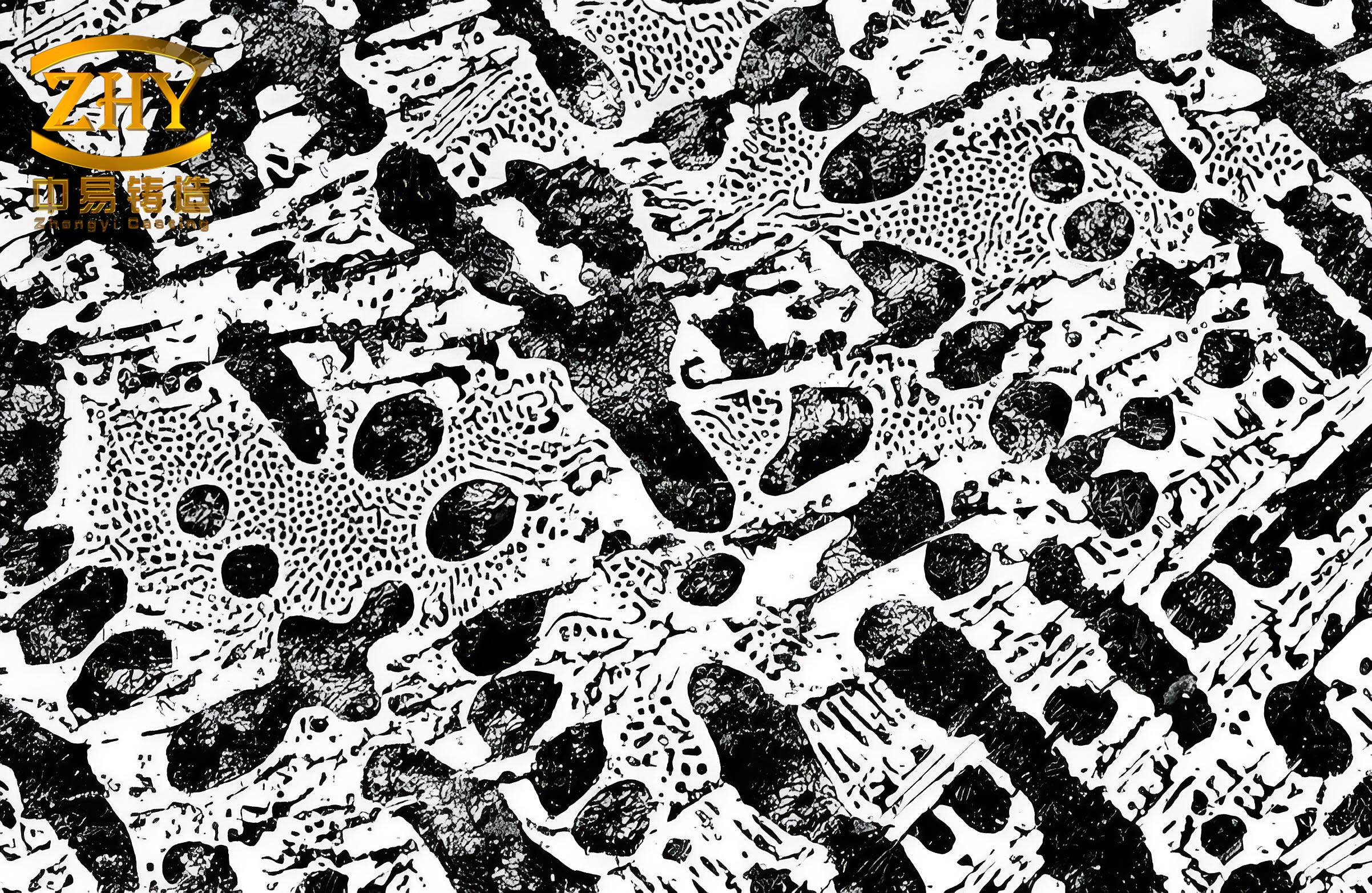
The image above provides a visual reference for the typical microstructure and casting context of white cast iron, which is essential for understanding the solidification dynamics that lead to these defects.
Fundamental Causes of Shrinkage Porosity in White Cast Iron
To effectively combat shrinkage, one must first understand the solidification process of white cast iron. Unlike ductile iron or steel, white cast iron has a wide freezing range. It solidifies as a mushy zone where dendrites of austenite (which later transforms to martensite or pearlite) and carbides grow extensively. This dendritic network can isolate pockets of liquid metal, creating micro-reservoirs. As these pockets solidify and shrink, they require feed metal from surrounding areas. If the feeding path is blocked by the dendritic maze or if insufficient feed metal is available, microscopic voids—shrinkage porosity—form.
The formation of microscopic shrinkage cavities is governed by a pressure balance. For a pore to form or persist, the internal pressure must overcome the external pressures and surface tension. This can be expressed by the following inequality, which is critical for understanding defect formation in white cast iron:
$$P_g + P_s > P_a + \frac{2\sigma}{r} + P_H$$
Where:
\(P_g\) = Partial pressure of gas evolving from the solidifying white cast iron.
\(P_s\) = Pressure drop due to shrinkage (negative pressure).
\(P_a\) = Atmospheric pressure on the melt surface.
\(\sigma\) = Surface tension at the liquid-gas interface in the white cast iron.
\(r\) = Radius of a potential pore.
\(P_H\) = Metallostatic pressure from the liquid metal head above the point in question.
If the sum of \(P_g\) and \(P_s\) exceeds the right-hand side, a pore will form or expand. In white cast iron, factors that increase \(P_g\) (high gas content) or \(P_s\) (high shrinkage) or decrease the right-hand side (e.g., low \(P_H\) from a small riser) promote shrinkage porosity.
The total volumetric contraction of white cast iron from pouring to room temperature is significant and can be broken down as:
$$V_{total} = V_{liquid} + V_{liquidus-solidus} + V_{solid}$$
For typical high-chromium white cast iron, the liquid contraction (\(V_{liquid}\)) is around 1-1.5%, the contraction during the liquidus-to-solidus transformation (\(V_{liquidus-solidus}\)) is approximately 3-4%, and the solid contraction (\(V_{solid}\)) is about 1-2%. The mushy zone contraction is particularly critical and must be fed efficiently.
Detailed Analysis of Type I Shrinkage in White Cast Iron
Type I shrinkage, characterized by a visible external sink and a concentrated cavity, points to a macroscopic feeding failure. My analysis attributes this to three interconnected factors prevalent in white cast iron production:
- Excessive Gas Content: Moisture from charge materials, sand molds, or atmosphere dissolution can lead to high hydrogen and nitrogen levels in white cast iron. Upon solidification, these gases precipitate, increasing \(P_g\). The rising gas bubbles can obstruct the flow of feed metal from the riser, creating channels and cavities. The relationship between gas solubility and temperature in white cast iron is given by Sieverts’ Law:
$$S = k \sqrt{P}$$
where \(S\) is solubility, \(k\) is a constant dependent on the alloy (specific to white cast iron), and \(P\) is the partial pressure. The decrease in solubility during cooling drives gas evolution. - Excessively High Pouring Temperature: While necessary for fluidity, an overly high pouring temperature for white cast iron increases the liquid contraction volume (\(V_{liquid}\)). The required feed volume from the riser increases proportionally. If the riser volume is marginal, it may be exhausted before the critical white cast iron sections solidify, leaving a shrinkage cavity.
- Inadequate Riser Volume or Design: This is a cardinal sin in feeding white cast iron. The riser must contain enough liquid metal to compensate for the total contraction of the casting section it feeds. An undersized riser will show a deep pipe but still leave the root unfed.
Detailed Analysis of Type II Shrinkage in White Cast Iron
Type II shrinkage is more insidious. The riser looks full, suggesting adequate feed, but fine porosity lurks beneath. My investigations trace this to premature isolation of the riser from the casting:
- Low Pouring Temperature: A low temperature reduces fluidity and accelerates the solidification of the white cast iron. The riser neck (the connection to the casting) can freeze off early, terminating feed while the casting section is still in the vulnerable mushy stage.
- Poor Gating Design: If the ingate is positioned such that metal flows into the mold cavity without adequately heating the riser, the riser’s top layers may cool and solidify first. This creates a solid “lid,” sealing off the atmospheric pressure and reducing the effective feeding pressure (\(P_H\) approaches zero).
- Delayed or Ineffective Riser Insulation: White cast iron risers lose heat rapidly from the top surface. Without prompt application of exothermic or insulating covers, a solid crust forms. This crust prevents the riser from acting as a liquid reservoir and breaks the pressure transmission link.
- Incorrect Riser Neck Geometry: A neck that is too long or has too small a cross-sectional area will solidify before the casting’s hot spot, creating a thermal barrier. The modulus of the neck \(M_n\) must be greater than the modulus of the casting section \(M_c\) at the junction to ensure it remains open longer. The modulus is calculated as Volume/Surface Area.
Comprehensive Solution Strategies for White Cast Iron
Addressing shrinkage in white cast iron requires a holistic approach, targeting the specific type of defect. Below, I synthesize my recommended practices into actionable strategies, supported by formulas and comparative data.
Solutions for Type I Shrinkage in White Cast Iron
| Target Issue | Specific Action | Technical Rationale & Formula | Expected Outcome |
|---|---|---|---|
| High Gas Content | Pre-dry all charge materials (scrap, ferroalloys). Perform pre-deoxidation in the furnace (e.g., with Al) and final deoxidation in the ladle (e.g., with CaSi). Use dry, low-nitrogen bonding systems (e.g., thermally cured resins) and apply mold coatings properly dried. | Reduces \(P_g\) in the pressure balance equation. Aim for hydrogen content < 2 ppm in the white cast iron melt. The gas content can be estimated from the melt chemistry and process parameters. | Minimizes gas-induced pore formation and improves feed metal fluidity. |
| High Pouring Temperature | Optimize pouring temperature based on casting geometry and white cast iron grade. For typical Cr-white cast iron (liquidus ~1320°C), aim for 1380-1420°C for thin sections, and 10-20°C lower for heavy sections. | Reduces \(V_{liquid}\) contraction. The required riser volume \(V_r\) is directly proportional to the total contraction volume \(V_{contraction}\) of the fed casting: $$V_r \propto V_{contraction} = V_{casting} \times (\alpha_{liquid} \Delta T_{pour-liq} + \beta_{mushy} + \alpha_{solid} \Delta T_{solid-room})$$ where \(\alpha\) and \(\beta\) are contraction coefficients for white cast iron. |
Decreases total volumetric demand on the riser, reducing risk of premature exhaustion. |
| Inadequate Riser Design | Use scientific risering methods. The Modulus Extension Principle (MEP) or the Feeding Resistance Method are suitable for white cast iron. A commonly adapted formula is: $$V_r = a \cdot M_c^3 + b \cdot V_z$$ where \(V_r\) is riser volume, \(M_c\) is casting modulus, \(V_z\) is volume of casting zone fed, and \(a\), \(b\) are coefficients. For white cast iron, \(a \approx 200\) and \(b \approx 0.15\). Ensure riser height-to-diameter ratio is sufficient (often 1.5:1). |
Ensures the riser solidifies after the casting and contains sufficient feed metal. The modulus of the riser \(M_r\) must satisfy \(M_r > 1.2 \times M_c\) for white cast iron. | Provides adequate feed metal reservoir, resulting in a sound riser root and a visible, centralized pipe. |
Solutions for Type II Shrinkage in White Cast Iron
| Target Issue | Specific Action | Technical Rationale & Formula | Expected Outcome |
|---|---|---|---|
| Low Pouring Temperature / Early Freezing | Increase pouring temperature within the optimal range. Enlarge riser neck cross-sectional area \(A_n\) to delay its solidification. A rule of thumb: \(A_n > (0.6 \text{ to } 0.8) \times A_{hot-spot}\) for white cast iron. | Increases fluidity and extends feeding time. The solidification time of the neck \(t_n\) is governed by Chvorinov’s Rule: $$t_n = k \left( \frac{V_n}{A_n} \right)^2 = k \cdot M_n^2$$ where \(k\) is the mold constant for the white cast iron system. Increasing \(M_n\) increases \(t_n\). |
Maintains an open feeding channel longer, allowing the riser to feed the casting’s mushy zone. |
| Poor Gating Design | Use gating that directs hot metal through or into the riser (e.g., horn gates, riser gates). For tall white cast iron castings, employ step gating with the top gate entering the riser. | Direct thermal enrichment of the riser, keeping it hotter than the casting and promoting directional solidification toward the riser. The temperature gradient \(G\) is maximized: $$G = \frac{dT}{dx}$$ |
Prevents riser top from freezing first, ensuring it remains an active pressure source. |
| Ineffective Riser Topping | Apply exothermic insulating riser sleeves or powder immediately after the riser is filled (e.g., when 50-75% full). For open risers on white cast iron, use a compound that reacts exothermically and forms an insulating slag layer. | Reduces heat loss from the riser top. The heat balance equation for the riser: $$Q_{loss} = Q_{radiation} + Q_{convection} + Q_{conduction}$$ Topping materials drastically reduce \(Q_{loss}\), extending the riser’s liquid life. |
Prevents crust formation, maintains atmospheric pressure \(P_a\) on the liquid, and enhances feeding efficiency. |
| Riser Crusting | If a crust forms, physically puncture it with a heated rod and stir the riser contents to re-establish liquid contact and pressure transmission. | Manually restores the condition \(P_H > 0\) in the pressure balance equation for the underlying white cast iron. | Provides a last-chance remedial action to salvage a casting by enabling final stage feeding. |
Advanced Modeling and Process Control for White Cast Iron
Beyond these practical steps, modern foundries can leverage simulation software to predict shrinkage in white cast iron. The Niyama criterion is a useful index for predicting microporosity. It is defined as:
$$Niyama = \frac{G}{\sqrt{\dot{T}}}$$
where \(G\) is the temperature gradient and \(\dot{T}\) is the cooling rate at the solidus front. Regions in a white cast iron casting with a Niyama value below a critical threshold (specific to the alloy) are prone to shrinkage porosity. Simulation helps optimize riser placement, size, and gating design virtually before making costly prototypes.
Furthermore, controlling the solidification morphology of white cast iron is key. The dendrite arm spacing (DAS) influences feeding difficulty. A finer DAS, achieved through faster cooling or inoculation, can actually worsen interdendritic feeding resistance. For white cast iron, a balance must be struck. The relationship between local solidification time \(t_f\) and DAS is often expressed as:
$$\lambda = k \cdot t_f^n$$
where \(\lambda\) is the secondary dendrite arm spacing, and \(k\) and \(n\) are material constants for the specific white cast iron composition.
Application Case Study: A Large White Cast Iron Ring
To illustrate the application of these principles, I will detail a case involving a large chromium white cast iron ring. The ring had an outer diameter of 1100 mm, a height of 500 mm, and a wall thickness of 60 mm. The casting modulus \(M_c\) was approximately 2.7 cm. Initial trials using a conventional gating system with side ingates and a top riser resulted in Type II shrinkage—the riser showed no significant sink, but machining revealed dispersed porosity at the root.
My team and I diagnosed the issue: the riser was cooling too quickly, and the gating did not thermally manage the riser effectively. We implemented a multi-pronged solution specific to this white cast iron component:
- Revised Gating: We introduced a ceramic transfer tube that channeled the incoming white cast iron directly into the bottom of the riser. This ensured the hottest metal entered the riser, keeping it liquid longest.
- Optimized Pouring Temperature: We increased the pouring temperature from 1410°C to 1430°C to improve fluidity and delay solidification of the riser neck.
- Active Riser Topping: An exothermic riser cover was added as soon as the riser was two-thirds full.
- Riser Neck Enlargement: We increased the neck cross-section by 25% to increase its modulus.
The results were evaluated quantitatively. The table below compares key parameters and outcomes:
| Parameter | Initial Process | Corrected Process | Impact on White Cast Iron Solidification |
|---|---|---|---|
| Pouring Temperature | 1410°C | 1430°C | Increased fluidity, reduced early freezing risk. |
| Ingate to Riser Path | Indirect, through mold cavity | Direct, via ceramic tube into riser base | Maximized riser thermal enrichment. |
| Riser Neck Modulus \(M_n\) | ~2.9 cm | ~3.5 cm | Ensured \(M_n > M_c\), extending feeding time. |
| Riser Topping | Applied late (after fill) | Applied early (during fill) | Prevented top crust formation, maintained \(P_a\). |
| Resultant Shrinkage | Type II (dispersed porosity) | Type I (clean sound root, central pipe in riser) | Achieved controlled, sound solidification of white cast iron. |
The corrective process successfully transformed the defect from harmful Type II shrinkage to a benign, centralized pipe in the riser, which was subsequently removed during machining. The white cast iron ring met all quality and service life specifications.
Conclusion and Broader Implications for White Cast Iron Foundry Practice
In conclusion, riser root shrinkage in white cast iron castings is a manageable challenge when approached with a systematic understanding of solidification mechanics. The dichotomy between Type I and Type II shrinkage provides a clear diagnostic framework. Type I defects in white cast iron primarily call for actions that enhance the total feed metal volume and reduce gas interference—such as melt degassing, temperature control, and adequate riser sizing using scientific principles. Type II defects in white cast iron demand measures that prolong the feeding capability of the riser—through thermal management of the riser via gating design, prompt exothermic topping, and proper riser neck geometry.
The overarching goal in producing sound white cast iron castings is to establish and maintain a strong positive temperature gradient from the casting’s hot spot toward the riser, ensuring directional solidification. The pressure balance equation and the various thermal and geometric formulas presented serve as vital tools for the process engineer. It is also imperative to recognize that white cast iron, with its specific thermal and physical properties, requires tailored solutions; practices successful in steel or gray iron may not directly translate.
Continuous improvement through simulation, careful process documentation, and metallurgical analysis of defects will further refine the production of high-integrity white cast iron components. By meticulously controlling every variable from charge drying to riser puncturing, the incidence of costly shrinkage defects can be minimized, ensuring that white cast iron continues to be a reliable and high-performing material in demanding wear-resistant applications. The journey to perfecting white cast iron casting is iterative, but with the right knowledge, consistent quality is an achievable standard.