
In the field of wear-resistant materials, white cast iron has long been valued for its high hardness and excellent abrasion resistance. However, the inherent brittleness and low toughness associated with its microstructure have limited its broader application. The primary cause of this brittleness is the continuous network of carbides, specifically cementite (Fe3C), which disrupts the continuity of the metallic matrix. To overcome this limitation, chromium is introduced as a key alloying element, leading to the development of low-chromium, medium-chromium, and high-chromium white cast irons. The addition of chromium fundamentally alters the type, morphology, and distribution of carbides, transforming them from a interconnected, brittle network into isolated, blocky, or rod-like structures. This transition significantly enhances the toughness and wear resistance of the material. This article, from our research perspective, delves deeply into the mechanisms behind this transformation, focusing on how varying chromium content affects both the nucleation and growth processes of carbides in white cast iron. We will explore the thermodynamic and kinetic principles governing these changes, utilizing mathematical models and empirical data to provide a comprehensive understanding.
The microstructure of conventional white cast iron is characterized by a ledeburitic structure, where the hard, brittle cementite (Fe3C) forms a continuous, honeycomb-like network surrounding the austenite (or its transformation products like martensite). This structure imparts high hardness but poor impact resistance. Chromium, when added to the iron melt, dissolves in the matrix and participates in carbide formation. Depending on the chromium content, different types of carbides are stabilized. At low levels (Cr < 5%), chromium primarily substitutes for iron in the cementite lattice, forming (Fe,Cr)3C. As chromium content increases, a transition occurs, leading to the formation of the more thermodynamically stable (Fe,Cr)7C3 carbide at higher chromium levels (typically Cr > 10-12%). This M7C3-type carbide possesses a hexagonal crystal structure and tends to grow as isolated rods or blocks rather than a continuous network, thereby improving the material’s mechanical properties. The critical chromium content for this phase transition, and the underlying mechanisms driving it, are central to optimizing the performance of chromium-alloyed white cast iron for demanding applications in mining, mineral processing, and other industrial sectors.
Our investigation centers on the sequence of carbide transformation: Fe3C → (Fe,Cr)3C → (Fe,Cr)3C + (Fe,Cr)7C3 → (Fe,Cr)7C3. We analyze this progression from two fundamental viewpoints: the thermodynamics of nucleation and the kinetics of growth. The nucleation stage is influenced by how chromium alters the chemical potential and atomic activity in the melt, affecting the critical undercooling required for carbide formation. The growth stage is governed by the interfacial energy and atomic attachment kinetics at the solid-liquid interface, which can be described by factors such as the Jackson factor. By integrating these perspectives, we aim to elucidate the comprehensive transformation mechanism.
Experimental Overview
To study these phenomena, a series of white cast iron alloys with near-eutectic compositions were prepared. The base composition was maintained with approximately 0.70% Si, 0.11% Mn, S<0.03%, and P<0.06%, while the chromium content was systematically varied across six levels: 0%, 7%, 10%, 12%, 15%, and 28%. The raw materials included high-carbon ferrochromium and scrap steel. Melting was conducted in an induction furnace, with the superheat temperature carefully controlled. After deoxidation, the molten iron was poured into sand molds at a consistent temperature. The as-cast samples were then prepared for metallographic examination using standard grinding and polishing techniques. Microstructural analysis was performed using optical microscopy and X-ray diffraction (XRD) to identify the phases present and observe the carbide morphology. This experimental framework allowed us to correlate chromium content directly with microstructural evolution.
Microstructural Evolution with Chromium Content
The optical micrographs of the samples reveal a clear and progressive change in carbide morphology and type with increasing chromium. The sample with 0% Cr exhibits the classic ledeburite structure, with a continuous, interwoven network of Fe3C carbides. At 7% Cr, the carbide network remains largely interconnected but begins to show signs of fragmentation or “necking off.” At the critical composition of 10% Cr, a duplex carbide structure is observed. XRD analysis confirms the coexistence of two distinct phases: the metastable (Fe,Cr)3C and the stable (Fe,Cr)7C3. The morphology at this stage is mixed, featuring both the remnant honeycomb network and isolated, rod-like carbides. For chromium contents of 12% and above, the microstructure is dominated by the rod-shaped or blocky M7C3 carbides, which are discretely distributed within the matrix. This visual evidence underscores the transformative effect of chromium.
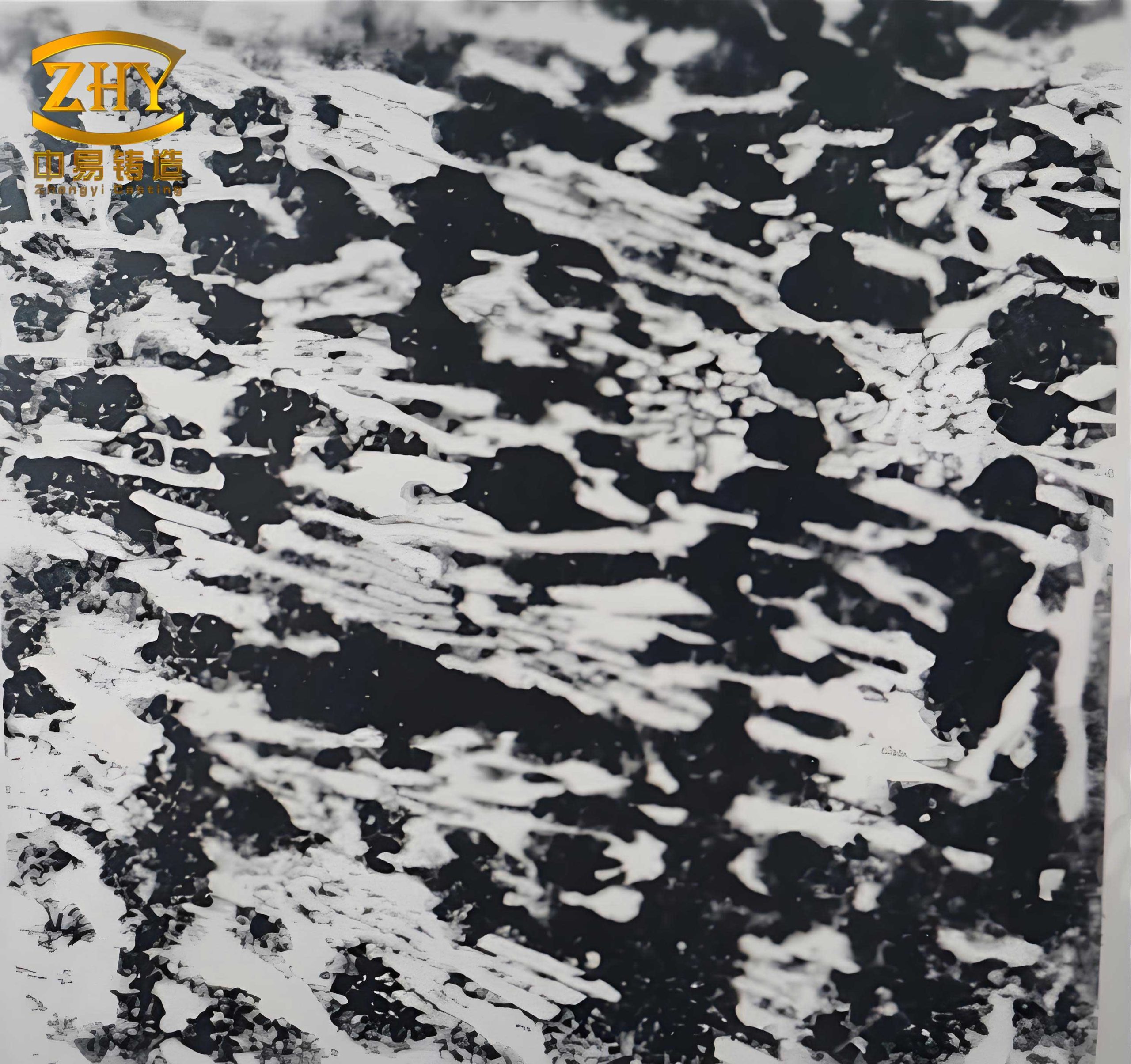
The transition in carbide type is not abrupt but occurs over a range of chromium concentrations. To summarize our findings, the following table categorizes the relationship between chromium content, primary carbide type, and the resulting morphology in these near-eutectic white cast iron alloys.
| Chromium Content (wt.%) | Dominant Carbide Type(s) | Typical Carbide Morphology | Microstructural Characterization |
|---|---|---|---|
| 0 – ~5 | Fe3C → (Fe,Cr)3C | Continuous Honeycomb Network | Classic Ledeburite |
| ~5 – ~10 | (Fe,Cr)3C | Fragmented Network, Beginning to Disconnect | Modified Ledeburite |
| ~10 (Critical Region) | (Fe,Cr)3C + (Fe,Cr)7C3 | Mixed: Network and Isolated Rods | Duplex Carbide Structure |
| >12 (e.g., 12, 15, 28) | (Fe,Cr)7C3 | Isolated Rods or Blocks | Discrete Carbides in Matrix |
This table clearly illustrates the paradigm shift in white cast iron microstructure driven by chromium alloying. The key technological benefit lies in the shift from a continuous, brittle network to isolated, hard phases that act as wear-resistant particles without providing easy crack propagation paths.
Thermodynamics of Carbide Nucleation: The Role of Chromium
The formation of carbides from the liquid melt is first and foremost a nucleation event. Chromium profoundly alters the thermodynamic landscape of this process. In the Fe-C binary system, cementite (Fe3C) nucleates with an orthorhombic crystal structure. When chromium is added, it dissolves in the liquid iron. Due to the similar atomic radii of iron and chromium (Cr: 0.128 nm, Fe: 0.124 nm), chromium atoms can readily substitute for iron atoms in the developing carbide crystal lattice. This substitution forms (Fe,Cr)3C, a solid solution carbide.
The stability of a carbide is related to its free energy of formation. The chromium-containing carbides, especially (Fe,Cr)7C3, have a lower free energy of formation compared to plain Fe3C. This increased stability can be understood by considering the binding energy between atoms. Chromium has a stronger affinity for carbon than iron does. The enthalpy of formation for Cr7C3 is more negative than that for Fe3C, making the mixed carbides more stable. The change in Gibbs free energy for nucleation, ΔG*, is given by the classical nucleation theory:
$$ \Delta G^* = \frac{16\pi\gamma_{sl}^3}{3(\Delta G_v)^2} $$
where $\gamma_{sl}$ is the solid-liquid interfacial energy and $\Delta G_v$ is the volumetric free energy change driving the transformation. Chromium addition affects both terms. First, by increasing the stability of the carbide phase, it increases the magnitude of $\Delta G_v$ (makes it more negative), thereby reducing the critical nucleation barrier $\Delta G^*$. This promotes a higher nucleation rate. Second, chromium changes the interfacial energy $\gamma_{sl}$ by modifying the atomic bonding and local order at the interface.
Furthermore, chromium increases the liquidus and eutectic temperatures of the iron-carbon system. For a fixed pouring temperature, this elevation effectively increases the undercooling ($\Delta T$) at which solidification occurs. Since the driving force $\Delta G_v$ is approximately proportional to undercooling ($\Delta G_v \approx \frac{\Delta H_f \cdot \Delta T}{T_m}$, where $\Delta H_f$ is the latent heat of fusion and $T_m$ is the equilibrium melting temperature), the increased undercooling further enhances the nucleation rate. Consequently, in high-chromium white cast iron, a greater number of carbide nuclei form, leading to a finer dispersion.
The lattice distortion caused by chromium substitution is a crucial factor in the eventual type transition. The orthorhombic lattice of M3C can accommodate a certain amount of chromium by distorting its parameters (a, b, c). As the chromium content within the carbide increases, this distortion becomes more severe. Eventually, at a critical chromium concentration (which we found to be around 10% in the bulk alloy), the accumulated strain destabilizes the M3C structure. The system then favors the nucleation of the M7C3 structure, which has a different crystal symmetry (hexagonal) and can incorporate a much higher fraction of chromium in a more stable configuration. This explains why at 10% Cr, both types of carbides can nucleate from the melt: regions with local chromium fluctuations below the critical level form M3C, while regions above it form M7C3. At higher bulk chromium levels (≥12%), the melt composition is uniformly favorable for M7C3 nucleation, eliminating the M3C phase.
Kinetics of Carbide Growth: Interface Structure and the Jackson Factor
Once nucleation occurs, the subsequent growth of carbides determines their final morphology—whether they form a continuous network or isolated particles. The growth kinetics are intimately linked to the atomic-scale structure of the solid-liquid interface. A powerful concept for describing this structure is the Jackson factor (α), originally developed for crystal growth from melt. The Jackson factor is defined as:
$$ \alpha = \frac{\Delta S_m}{R} \cdot \frac{\eta}{\nu} = \frac{L_m}{k T_m} \cdot \frac{\eta}{\nu} $$
where:
$\Delta S_m$ is the entropy of fusion (J/mol·K),
$R$ is the universal gas constant (8.314 J/mol·K),
$L_m$ is the latent heat of fusion (J/mol),
$k$ is Boltzmann’s constant (1.38 × 10⁻²³ J/K),
$T_m$ is the melting point (K),
$\eta$ is the coordination number at the interface (for a given crystal plane),
$\nu$ is the coordination number within the bulk solid.
The ratio $\eta/\nu$ is always less than 1 and depends on the crystallographic orientation of the growing face. The value of α dictates the interface morphology:
– If α ≤ 2, the interface is “rough” at an atomic scale, allowing atoms from the liquid to attach easily at many sites. Growth is fast and diffusion-controlled, leading to non-faceted, rounded morphologies.
– If α ≥ 5, the interface is “smooth” or faceted. Growth requires the formation of new atomic layers (e.g., by 2D nucleation or screw dislocation mechanisms), making it slower and anisotropic, resulting in faceted, geometric crystal shapes.
– For 2 < α < 5, the interface can exhibit intermediate or mixed behavior.
In the context of white cast iron, the growing carbides (M3C and M7C3) are intermetallic compounds. Their entropy of fusion, $\Delta S_m$, is a key parameter. Chromium addition significantly impacts $\Delta S_m$. The entropy of fusion is the difference between the entropy of the solid ($S_s$) and the liquid ($S_l$): $\Delta S_m = S_s – S_l$. Chromium, as an alloying element, increases the configurational entropy of the liquid ($S_l$ increases) due to the increased disorder from mixing different atom types. At the same time, in the solid carbide phase, chromium strengthens the metal-carbon bonds and promotes greater order, potentially decreasing the solid’s entropy ($S_s$ may decrease slightly or increase less than $S_l$). The net effect is that the absolute value of $\Delta S_m$ increases. Since $\alpha$ is proportional to $\Delta S_m$, the Jackson factor increases with chromium content.
We can estimate the trend for the different carbides. For pure Fe3C, the Jackson factor is relatively low, placing it in the intermediate range (likely between 2 and 4). This allows for relatively fast growth, which can become unstable, leading to dendritic or cellular morphologies that easily interconnect and form the honeycomb network characteristic of ordinary white cast iron. For (Fe,Cr)3C, the substitution of chromium increases α. For the (Fe,Cr)7C3 carbide, the crystal structure is more complex and the bonding is stronger, leading to an even higher entropy of fusion and thus a higher Jackson factor. Therefore, we have the inequality:
$$ \alpha_{\text{Fe}_3\text{C}} < \alpha_{(\text{Fe,Cr})_3\text{C}} < \alpha_{(\text{Fe,Cr})_7\text{C}_3} $$
As chromium content rises and the dominant carbide shifts from M3C to M7C3, the Jackson factor increases, pushing the solid-liquid interface toward a smoother, more faceted character. A faceted interface grows more slowly and in a more anisotropic manner. Atoms from the liquid have fewer favorable sites for attachment, so growth proceeds preferentially along certain crystallographic directions. This results in the formation of distinct rods or blocks rather than a rapidly advancing, interconnected front. The slower growth rate of M7C3 carbides allows the surrounding austenite to nucleate and grow more freely, encapsulating the carbides and preventing them from forming a continuous network.
This kinetic analysis is supported by our microstructural observations. In low-chromium white cast iron, the fast-growing M3C carbides create a network that confines the later-forming austenite to the interstices. In high-chromium white cast iron, the slower-growing, faceted M7C3 rods develop while austenite solidifies concurrently, leading to a more uniform, composite-like microstructure where hard carbides are embedded in a tougher matrix.
The effect of chromium on the growth of the austenite phase should also be considered. Austenite, being a metallic solid solution, has a very low Jackson factor (α < 2), corresponding to rough interface growth. Chromium in solid solution increases α for austenite as well, but the increase is modest and saturates once the solubility limit is reached. This slight increase may reduce the degree of continuous austenite growth, but its primary influence remains on the carbide phases.
Mathematical Modeling of the Transition
To further quantify the influence of chromium, we can consider a simplified model for the critical chromium content required for the M3C to M7C3 transition. This transition is governed by the relative stability of the two carbide phases. The free energy of formation per mole of carbide, $\Delta G_f$, can be expressed as a function of composition and temperature. For a mixed carbide like (Fe,Cr)3C, the free energy includes a regular solution term:
$$ \Delta G_{(\text{Fe,Cr})_3\text{C}} = X_{Cr} \cdot \Delta G^0_{\text{Cr}_3\text{C}} + X_{Fe} \cdot \Delta G^0_{\text{Fe}_3\text{C}} + RT(X_{Cr} \ln X_{Cr} + X_{Fe} \ln X_{Fe}) + \Omega \cdot X_{Cr} X_{Fe} $$
where $X_{Cr}$ and $X_{Fe}$ are mole fractions of Cr and Fe in the metal sublattice of the carbide, $\Delta G^0$ are standard free energies of formation for the end-member carbides, and $\Omega$ is an interaction parameter. A similar expression can be written for (Fe,Cr)7C3. The transition occurs when the free energy of the M7C3 phase becomes lower than that of the M3C phase for the given overall alloy composition. Solving this equilibrium condition numerically or using thermodynamic software (like CALPHAD) typically yields a critical chromium content around 10-12% for near-eutectic carbon levels, which aligns with our experimental findings.
Furthermore, the growth velocity $v$ of a faceted crystal can be related to undercooling $\Delta T$ by a power law: $v \propto (\Delta T)^n$, where the exponent $n$ is larger for faceted growth (often $n > 2$) compared to non-faceted growth ($n \approx 1$ or 2). The increased Jackson factor for high-chromium carbides implies a larger $n$, meaning growth is more sensitive to undercooling and generally slower at moderate undercoolings. This reinforces the morphological shift.
Practical Implications and Applications
The understanding of chromium’s role in modifying carbide type and morphology is directly applicable to the design and production of superior white cast iron components. High-chromium white cast iron, with its isolated M7C3 carbides in a martensitic or austenitic matrix, offers an exceptional combination of hardness (often 600-800 HB) and improved toughness. It is the material of choice for liners in ball mills, slurry pump impellers, crusher jaws, and other parts subjected to severe abrasive wear. By precisely controlling the chromium content—ensuring it exceeds the critical threshold of about 10-12%—foundries can guarantee the formation of the desirable rod-like M7C3 carbides. Additional elements like molybdenum, nickel, and copper are often added to control the matrix microstructure (e.g., ensuring martensite formation upon cooling) without altering the fundamental carbide transformation mechanism driven by chromium.
The transition mechanism also explains why intermediate chromium levels (e.g., 5-10%) can sometimes yield inconsistent properties. In this range, the microstructure may contain a mixture of carbide types and morphologies, leading to variable wear resistance and fracture behavior. Therefore, for applications demanding reliable performance, a clear choice is made between low-chromium alloys (for less severe, lower-cost applications) and high-chromium alloys (for maximum wear life).
Summary and Conclusions
Based on our comprehensive study, we can draw the following conclusions regarding the influence of chromium content on the carbide transformation mechanism in white cast iron:
- Carbide Type Transition: The addition of chromium sequentially transforms the carbide phases in near-eutectic white cast iron according to the path: Fe3C → (Fe,Cr)3C → (Fe,Cr)3C + (Fe,Cr)7C3 → (Fe,Cr)7C3. The critical bulk chromium content for the complete transition to M7C3-type carbides is approximately 10-12%.
- Nucleation Thermodynamics: Chromium alters the thermodynamic conditions for carbide nucleation in the iron melt. It increases the stability of chromium-rich carbides, raises the eutectic temperature (effectively increasing undercooling), and promotes a higher nucleation rate. The substitution of Cr for Fe in the M3C lattice causes progressive distortion, which culminates in a structural instability that triggers the formation of the more stable M7C3 phase at a critical Cr concentration within the carbide.
- Growth Kinetics and Interface Structure: Chromium increases the Jackson factor (α) for carbide growth by increasing the entropy of fusion. This shifts the solid-liquid interface structure from relatively rough/intermediate (for M3C) toward smoother, more faceted (for M7C3). A higher Jackson factor corresponds to slower, more anisotropic growth. Consequently, the carbide morphology evolves from a rapidly formed, interconnected honeycomb network to slowly growing, isolated rods or blocks. This kinetic change is fundamental to the microstructural refinement and improved mechanical properties of high-chromium white cast iron.
- Microstructural Outcome: The combined thermodynamic and kinetic effects result in a white cast iron microstructure where hard carbides are no longer a continuous brittle network but discrete, hard particles embedded in a tougher matrix. This transformation is the key to unlocking the high wear resistance coupled with acceptable toughness that defines premium chromium alloyed white cast irons.
In essence, chromium acts as a powerful microstructural engineer in white cast iron. By understanding the detailed mechanisms—from atomic substitution and lattice distortion to interfacial energy modifications—we can better tailor this family of alloys for ever more demanding service conditions. Future research may focus on further refining these models, exploring the effects of other alloying elements in combination with chromium, and developing advanced processing techniques to control carbide distribution even more precisely.