
In my research, I explore the critical role of crystallization cooling rate in shaping the microstructure and performance of rare-earth low-chromium white cast iron. This type of white cast iron has garnered significant attention as a wear-resistant material due to its cost-effectiveness, reasonable toughness, and耐磨性. My study specifically investigates how varying cooling rates, achieved through different molding techniques, influence carbide morphology, mechanical properties, and abrasion resistance. The white cast iron under examination is a hypoeutectic alloy, and understanding its solidification behavior is paramount for optimizing its application in industrial components like磨球.
To systematically alter the crystallization cooling rate, I employed four distinct molding methods: green sand mold (Method A), green sand mold with thin chill (Method B), green sand mold with thick chill (Method C), and metal mold (Method D). The chemical composition of the rare-earth low-chromium white cast iron was carefully controlled, with key elements including carbon, chromium, and rare-earth additions. The melt was prepared using industrial raw materials in a medium-frequency induction furnace, and modification treatment was applied using rare-earth-silicon-iron alloy and boron iron. The pouring temperature was maintained between 1380°C and 1420°C to ensure consistency.
The cooling curves during solidification were recorded using快速热电偶 and a function recorder placed within the mold cavity. The cooling rate, defined as the temperature drop per unit time during the austenite crystallization range, was derived from these curves. The values are summarized in Table 1. Notably, the cooling rate increases substantially from sand molds to metal molds, providing a broad spectrum for analysis.
| Molding Method | Cooling Rate (°C/s) | Relative Cooling Ratio |
|---|---|---|
| Green Sand Mold (A) | ~1.2 | 1.0 |
| Green Sand Mold with Thin Chill (B) | ~3.5 | 2.9 |
| Green Sand Mold with Thick Chill (C) | ~6.8 | 5.7 |
| Metal Mold (D) | ~15.0 | 12.5 |
The density of the cast specimens was measured using the buoyancy method, and the volume fraction of eutectic carbides was quantified using an image analyzer. Mechanical properties were assessed via hardness measurements and impact toughness tests using unnotched specimens. Abrasion resistance was evaluated under impact wear conditions with cement clinker as the abrasive. The wear loss was measured, and耐磨性 was defined as the inverse of the weight loss.
My findings reveal that the crystallization cooling rate profoundly affects the density and carbide characteristics of this white cast iron. As the cooling rate increases, the density of the white cast iron improves significantly. This can be attributed to a shift from mushy to directional solidification. In slower cooling scenarios, such as in sand molds, the wide solidification temperature range (approximately 1230°C to 1150°C for this alloy) promotes糊状凝固, leading to interdendritic shrinkage porosity. Faster cooling reduces this porosity, enhancing densification. The relationship between cooling rate (v) and density (ρ) can be approximated by: $$ \rho = \rho_0 + k_{\rho} \cdot v $$ where $\rho_0$ is the base density at very slow cooling and $k_{\rho}$ is a positive constant. Data for density and carbide parameters are consolidated in Table 2.
| Molding Method | Cooling Rate (°C/s) | Density (g/cm³) | Carbide Volume Fraction (%) | Average Carbide Size (μm) | Porosity Level |
|---|---|---|---|---|---|
| A | 1.2 | 7.65 | 28.5 | 12.3 | High |
| B | 3.5 | 7.72 | 30.1 | 9.8 | Medium |
| C | 6.8 | 7.78 | 32.4 | 7.2 | Low |
| D | 15.0 | 7.85 | 35.2 | 4.5 | Very Low |
The carbide morphology undergoes dramatic changes with increasing cooling rate. In white cast iron, the eutectic carbides are primarily of the M3C type. As cooling accelerates, the undercooling (ΔT) rises, which intensifies伪共晶 behavior, suppressing primary austenite formation and promoting eutectic solidification. This leads to an increase in carbide volume fraction. Simultaneously, higher undercooling boosts the nucleation rate (N), which can be described by classical nucleation theory: $$ N = N_0 \exp\left(-\frac{\Delta G^*}{k_B T}\right) $$ where $\Delta G^*$ is the activation energy for nucleation, $k_B$ is Boltzmann’s constant, and T is temperature. The increased nucleation refines the carbide size, as evidenced by the decrease in average carbide dimension from 12.3 μm in sand-cast white cast iron to 4.5 μm in metal-mold white cast iron.
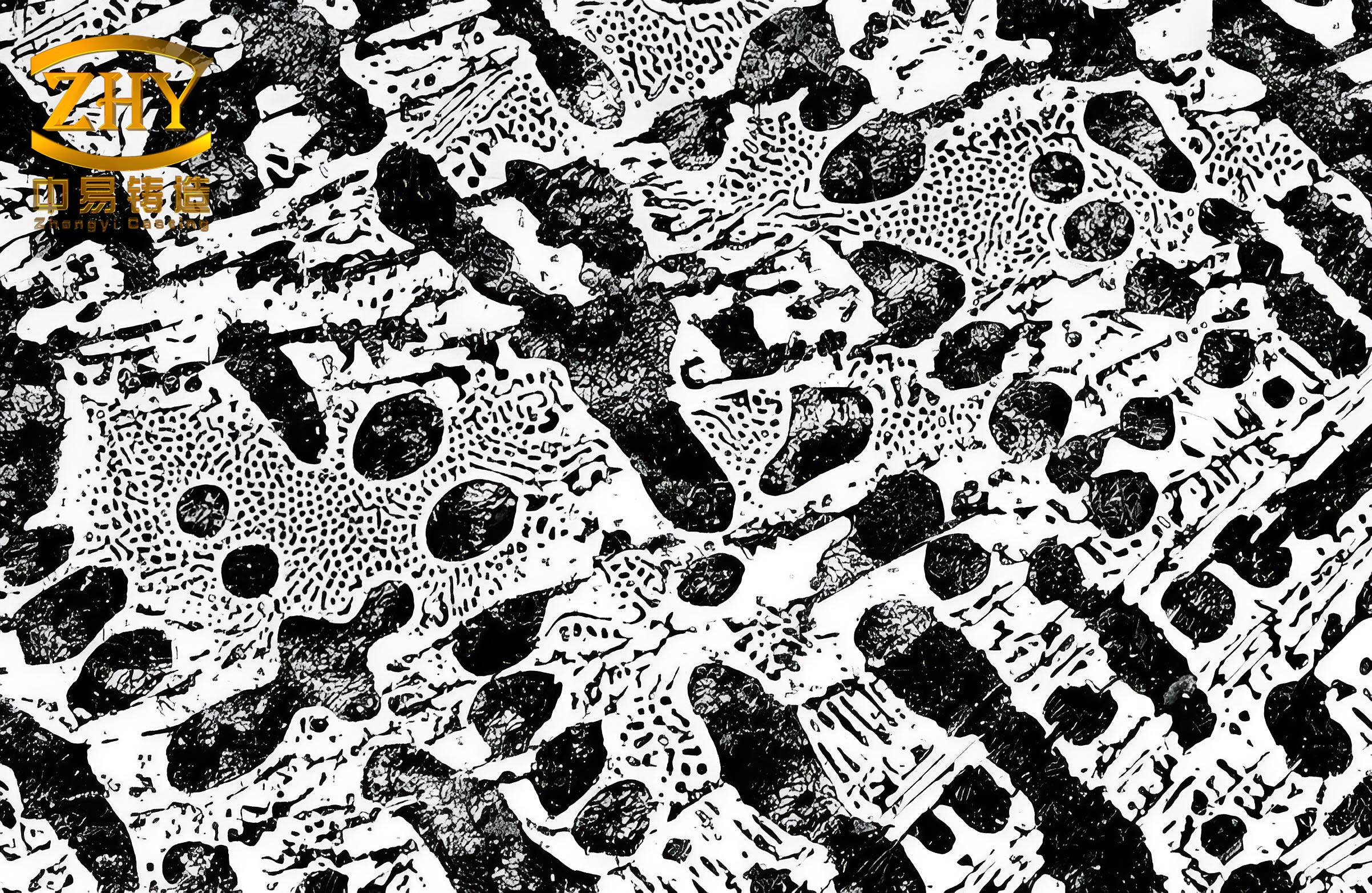
Furthermore, the distribution of carbides becomes more directional with faster cooling. In metal-mold white cast iron, the carbides align perpendicular to the cooling surface, exhibiting a fibrous or rod-like morphology. This directional arrangement diminishes with distance from the chill. The orientation effect can be linked to the thermal gradient (G) during solidification, where a high G promotes directional growth. The aspect ratio of carbides (length-to-width ratio) increases with cooling rate, contributing to anisotropy in properties. Additionally, the austenite dendrite structure is refined, which improves the uniformity of the martensitic matrix after heat treatment (quenching at 920°C and tempering at 200°C), further enhancing the wear resistance of the white cast iron.
The mechanical properties of this white cast iron are intricately tied to the cooling-induced microstructural changes. Hardness, measured on the HRC scale, remains relatively stable across different cooling rates because the carbide crystal structure and matrix hardness are similar. However, impact toughness (ak) shows a complex trend. Initially, as cooling rate increases from very low values, toughness improves due to reduced porosity and carbide refinement. But beyond a certain threshold (around 6-8°C/s in this study), the increased carbide volume fraction and strong directional alignment introduce mechanical脆弱 planes. Fracture tends to propagate along these carbide fibers, causing a decline in impact energy. This relationship can be modeled as: $$ a_k = a_{k0} – k_1 \cdot f_c + k_2 \cdot d^{-1/2} – k_3 \cdot A $$ where $a_{k0}$ is base toughness, $f_c$ is carbide volume fraction, $d$ is carbide size, $A$ is a factor for anisotropy, and $k_1$, $k_2$, $k_3$ are constants. The data for mechanical and耐磨 properties are presented in Table 3.
| Molding Method | Hardness (HRC) | Impact Toughness (J/cm²) | Wear Loss (g) | Relative Wear Resistance |
|---|---|---|---|---|
| A | 62.5 | 8.2 | 0.152 | 1.00 |
| B | 62.8 | 8.9 | 0.138 | 1.10 |
| C | 63.0 | 8.5 | 0.121 | 1.26 |
| D | 63.2 | 7.8 | 0.105 | 1.45 |
The abrasion resistance of the white cast iron exhibits a clear positive correlation with cooling rate. The wear resistance improves by up to 45% when shifting from sand-cast to metal-mold white cast iron. This enhancement can be explained through multiple mechanisms related to carbide morphology and integrity. First, the increased volume fraction of carbides provides more hard-phase constituents to resist abrasive penetration. Second, carbide refinement reduces the mean free path between carbides (λ), which is critical in impact wear. If the abrasive particle size (da) is comparable to or larger than λ, the softer matrix is preferentially worn, leading to carbide protrusion and fracture. With finer carbides, λ decreases,改善 the protective action. The wear rate (W) can be expressed as: $$ W \propto \frac{d_a}{\lambda} \cdot \sigma_m^{-1} $$ where $\sigma_m$ is the matrix strength. Third, directional carbide alignment allows the carbide fibers to be deeply embedded in the matrix, making them less prone to fracture and spalling. During wear, these fibers protrude to shield the matrix. Fourth, the reduction in shrinkage porosity minimizes macroscopic fatigue剥落 under impact, further boosting durability. Thus, the overall耐磨性 of white cast iron is a synergistic outcome of these factors.
To validate the laboratory findings, I conducted a模拟磨损 test using磨球 cast via metal mold and green sand mold. The results, summarized in Table 4, confirm that metal-mold white cast iron磨球 exhibit approximately 25% higher wear resistance than sand-cast ones and over twice the耐磨性 of forged steel balls. This underscores the practical significance of controlling cooling rates in producing high-performance white cast iron components.
| Type of Grinding Ball | Relative Wear Resistance | Notes |
|---|---|---|
| Forged Steel Ball | 1.00 | Baseline |
| Green Sand Mold White Cast Iron Ball | 1.85 | Laboratory specimen |
| Metal Mold White Cast Iron Ball | 2.31 | Laboratory specimen |
The interplay between cooling rate and microstructure in white cast iron can be further elucidated through thermodynamic and kinetic considerations. The solidification path for hypoeutectic white cast iron involves primary austenite formation followed by eutectic reaction: $$ L \rightarrow \gamma + M_3C $$ where L is liquid, γ is austenite, and M3C is carbide. The cooling rate affects the phase diagram locally by increasing undercooling, which shifts the effective composition towards the伪共晶 point. This shift promotes more eutectic product, i.e., carbides. The growth velocity of carbides (V) is related to undercooling by: $$ V = \mu (\Delta T)^n $$ where μ is a kinetic coefficient and n is an exponent. Faster cooling raises ΔT, leading to higher V but also to morphological instability, resulting in finer structures.
Moreover, the role of rare-earth elements in this white cast iron cannot be overlooked. They modify the carbide morphology by influencing nucleation and growth, but their effect is intertwined with cooling conditions. At high cooling rates, the refining effect of rare earths is amplified, contributing to the overall improvement in white cast iron properties.
In summary, my investigation demonstrates that increasing the crystallization cooling rate in rare-earth low-chromium white cast iron leads to: (1) a significant rise in eutectic carbide volume fraction, (2) substantial refinement of carbide size, (3) a more directional and弥散 distribution of carbides, and (4) reduced interdendritic shrinkage porosity. These microstructural changes collectively enhance the abrasion resistance of the white cast iron, albeit with a slight trade-off in impact toughness at very high cooling rates. The hardness remains largely unaffected. The optimal cooling rate for balancing toughness and耐磨性 depends on specific application requirements, but metal-mold casting generally offers superior wear performance. This research provides a foundation for tailoring the solidification process of white cast iron to achieve desired service properties, emphasizing the critical role of cooling control in metallurgy of white cast iron.
Future work could explore the effect of cooling rate on other grades of white cast iron, such as high-chromium white cast iron, or investigate the interplay with alloying elements like molybdenum and nickel. Additionally, computational modeling of heat transfer during casting could predict cooling rates and optimize mold design for industrial production of white cast iron parts. The enduring relevance of white cast iron in耐磨 applications ensures that such studies will continue to drive innovations in material science and engineering.