
In the pursuit of enhancing the performance of abrasion-resistant alloys, the modification of carbide morphology in white cast iron has been a central focus of my research. The continuous, brittle carbide network typical of conventional white cast iron is a primary source of its low toughness. My work investigates the potent role of vanadium (V) in fundamentally altering this microstructure, particularly within a low-chromium white cast iron system. The objective was to systematically study the influence of vanadium content on the fragmentation, isolation, and spheroidization of carbides, and to evaluate the resulting mechanical properties in both the as-cast and heat-treated conditions.
The base material for this investigation was a low-chromium white cast iron. The iron was melted in a medium-frequency induction furnace. Vanadium was added to the melt to achieve targeted compositions. The melt was treated using a rare earth inoculant via the ladle addition method to further influence solidification characteristics. Five distinct vanadium levels were designed: 0%, 1.0%, 2.0%, 3.0%, and 4.0% (by weight). Corresponding sample identifiers were assigned as V0, V1, V2, V3, and V4. The chemical composition of the produced samples is detailed in Table 1.
| Sample ID | C | Si | Mn | Cr | V |
|---|---|---|---|---|---|
| V0 | 3.2 | 0.8 | 0.8 | 2.5 | 0.0 |
| V1 | 3.2 | 0.8 | 0.8 | 2.5 | 1.0 |
| V2 | 3.2 | 0.8 | 0.8 | 2.5 | 2.0 |
| V3 | 3.2 | 0.8 | 0.8 | 2.5 | 3.0 |
| V4 | 3.2 | 0.8 | 0.8 | 2.5 | 4.0 |
The cast samples underwent two specific heat treatment cycles. The first was a normalizing treatment: heating to 950°C, holding for 2 hours, followed by air cooling. The second was a quenching and tempering process: heating to 950°C, holding for 2 hours, oil quenching, and then tempering at 200°C. Mechanical testing was conducted on samples in the as-cast, normalized, and quenched & tempered states. Impact toughness was measured using a standard impact tester, with reported values representing the average of four tests. Hardness was measured as the average of five indentations taken across the cross-section of the tested samples. The results are consolidated in Table 2.
| Sample ID | Condition | Impact Toughness (J/cm²) | Hardness (HRC) |
|---|---|---|---|
| V0 | As-Cast | 4.5 | 62 |
| Normalized | 5.8 | 58 | |
| Quenched & Tempered | 6.2 | 56 | |
| V1 | As-Cast | 5.2 | 60 |
| Normalized | 6.5 | 57 | |
| Quenched & Tempered | 7.1 | 55 | |
| V2 | As-Cast | 6.8 | 58 |
| Normalized | 8.0 | 55 | |
| Quenched & Tempered | 8.9 | 53 | |
| V3 | As-Cast | 8.5 | 55 |
| Normalized | 10.2 | 52 | |
| Quenched & Tempered | 11.5 | 50 | |
| V4 | As-Cast | 9.0 | 53 |
| Normalized | 11.0 | 50 | |
| Quenched & Tempered | 12.8 | 48 |
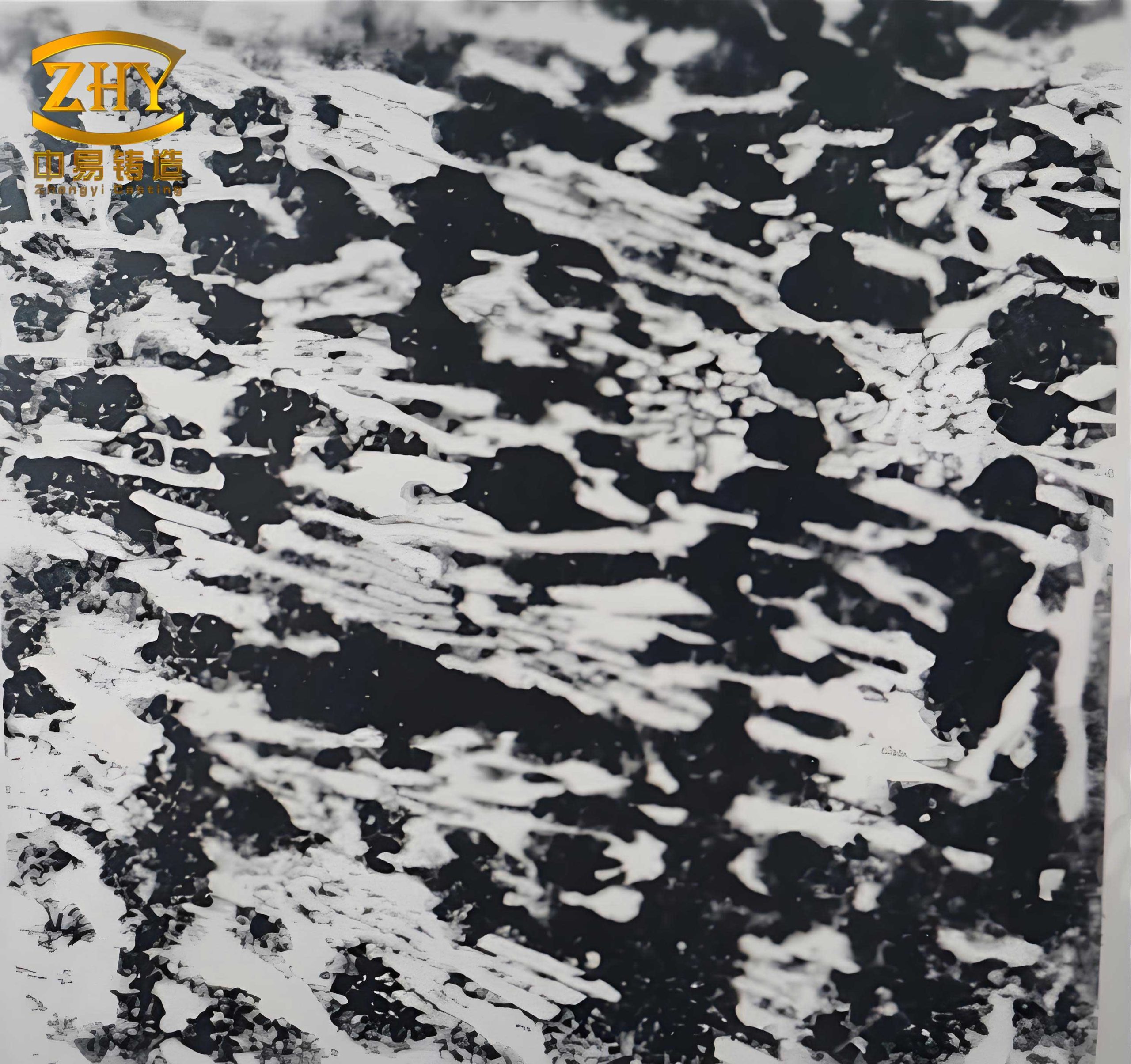
The analysis of the mechanical data reveals clear and consistent trends. The impact toughness of the vanadium-alloyed white cast iron increases monotonically with vanadium content across all three material conditions—as-cast, normalized, and quenched & tempered. Conversely, the hardness shows a steady decrease with increasing vanadium addition. This inverse relationship between toughness and hardness highlights the microstructure modification driven by vanadium. Furthermore, heat treatment consistently improves the toughness and reduces the hardness compared to the as-cast state for any given vanadium level. Among the tested compositions, the sample with 3.0% V (V3) demonstrated the most favorable balance of properties, offering significantly enhanced toughness while retaining considerable hardness. The microstructural evolution underpinning these property changes was dramatic. In the base, vanadium-free white cast iron (V0), the microstructure exhibited a continuous network of sharp, angular carbides typical of M3C-type (e.g., (Fe,Cr)3C). With the addition of 1.0% V, the carbide network began to break up and become discontinuous. At 2.0% V, the network was completely fragmented into isolated, blocky carbides. Remarkably, at 3.0% and 4.0% V, the predominant carbide morphology transformed into discrete, near-spherical particles. This spheroidization effect was observed not only in the as-cast condition but was also present after both normalizing and quenching & tempering treatments. The heat-treated samples differed from the as-cast ones primarily by the presence of numerous fine carbide precipitates within the matrix.
To understand the mechanism, microanalysis was performed on different carbide morphologies present in a sample containing vanadium. The analysis revealed a critical trend: while the iron (Fe), chromium (Cr), and manganese (Mn) content decreased sequentially from polygonal/blocky carbides to elongated carbides to spherical carbides, the vanadium (V) content showed the opposite trend, increasing significantly in the spherical carbides. This indicates that the different morphologies correspond to different types of carbides. The polygonal carbides are predominantly M3C type (e.g., (Fe,Cr)3C), the spherical carbides are rich in vanadium carbide (VC), and the elongated forms are likely a mixture of the two.
The driving force for this transformation lies in the extreme affinity of vanadium for carbon. Vanadium is a powerful carbide-forming element, and its addition alters the solidification sequence and phase stability. Vanadium preferentially reacts with carbon to form very stable vanadium carbides (primarily VC). The free energy of formation for VC is significantly more negative than that for cementite (Fe3C) or complex carbides like M3
$$ [V] + [C] \rightarrow (VC) $$
$$ 3[Fe] + [C] \rightarrow (Fe_3C) \quad \text{(or with Cr/Mn substituting for Fe)} $$
Given the higher stability of VC, vanadium effectively “scavenges” carbon from the melt, inhibiting the formation of the continuous M3C network. The VC carbides nucleate and grow with a more isotropic, spherical shape. The reduction in available carbon for the M3C formation leads to its fragmentation. The remaining alloying elements like chromium and manganese are then largely partitioned into the metallic matrix, contributing to solid solution strengthening. The hardness decrease with increasing V can be attributed to the replacement of the hard, continuous M3C network with isolated, spherical VC particles and a softer, more ductile matrix. The dramatic improvement in toughness is a direct consequence of this microstructural refinement: the spheroidal carbides blunt crack propagation much more effectively than a continuous brittle network.
The property changes upon heat treatment can be described by considering the diffusion and precipitation processes. During austenitizing at 950°C, carbon and alloying elements dissolve. Upon subsequent cooling (air cooling or quenching), secondary carbides precipitate from the supersaturated matrix. The general kinetics can be related to diffusion-controlled growth, where the mean particle radius \( r \) after time \( t \) is often approximated by:
$$ r \propto (Dt)^{1/2} $$
where \( D \) is the diffusion coefficient. The finer dispersion of secondary carbides after quenching and tempering contributes to a modest increase in toughness over the normalized condition. The matrix itself transforms to different constituents (e.g., pearlite, martensite, tempered martensite) depending on the cooling rate, further influencing the final properties of the white cast iron.
In conclusion, this investigation demonstrates that vanadium is a profoundly effective modifier for low-chromium white cast iron. It fundamentally transforms the microstructure by promoting the spheroidization of carbides through the formation of stable vanadium carbides. This microstructural change leads to a systematic increase in impact toughness and a decrease in hardness, with the 3.0% V alloy offering an excellent compromise. The beneficial effect of vanadium is evident in the as-cast state and is retained after various heat treatments. The mechanism is rooted in the superior thermodynamic stability of VC, which alters the solidification pathway and carbide precipitation sequence in white cast iron. This research provides a pathway for designing a new class of white cast iron with a unique combination of wear resistance and improved toughness.