
In my extensive work with sand casting parts, I have encountered numerous defects that can compromise the integrity and performance of cast components. Among these, endogenous reaction porosity stands out as a particularly challenging issue due to its internal nature and the complex chemical reactions involved. This article delves into the formation mechanisms, visual characteristics, and preventive measures for endogenous reaction porosity in sand casting parts, drawing from practical experience and metallurgical principles. I will use tables and formulas extensively to summarize key points, ensuring a comprehensive understanding for practitioners in the field.
Sand casting parts are widely used in various industries, but their quality can be severely affected by gas porosity defects. Endogenous reaction porosity occurs when dissolved elements or compounds in the molten metal react during solidification, generating gases that form bubbles within the casting. Unlike other porosity types, this defect is inherent to the metal melt itself, making it crucial to address during the melting and pouring stages. Throughout this discussion, I will emphasize the importance of proper processing to mitigate these issues in sand casting parts.
To begin, let’s explore the visual characteristics of endogenous reaction porosity in sand casting parts. Based on my observations, this defect has distinct features that aid in diagnosis. The pores are typically large, often reaching several millimeters in diameter, and their shape is irregular—ranging from spherical to elongated cavities. They are dispersed throughout the entire cross-section of the sand casting parts, giving a honeycomb appearance when machined. The pore walls are smooth and exhibit a metallic luster, indicating that they formed internally during solidification. This defect is prevalent across all sand casting parts from the same melt batch, highlighting its endogenous origin. Below is a table summarizing these characteristics for quick reference:
| Characteristic | Description |
|---|---|
| Size | Large, up to several millimeters |
| Shape | Irregular (spherical,团球形, or异形) |
| Distribution | 弥散性, throughout the casting |
| Pore Wall | Smooth and metallic bright |
| Location | Internal, often exposed after machining |
| Prevalence | 流行性, affects all parts from the same melt |
Understanding these features is essential for correctly identifying endogenous reaction porosity in sand casting parts and distinguishing it from other defects like shrinkage porosity or subsurface gas holes. In my practice, I have found that careful inspection of machined surfaces and cross-sections is key to accurate diagnosis.
Now, let’s delve into the formation mechanisms of endogenous reaction porosity in sand casting parts. This defect arises from chemical reactions within the molten metal during solidification. I categorize it based on the gas produced: carbon monoxide (CO) reaction porosity and water vapor (H₂O) reaction porosity. Each type has specific causes rooted in metallurgical processes.
For CO reaction porosity, common in steel sand casting parts, the primary cause is inadequate deoxidation during melting. When the molten steel contains high levels of dissolved oxygen [O], it reacts with carbon [C] during solidification. The reaction can be expressed as:
$$[C] + [O] \rightarrow CO$$
This CO gas is insoluble in the steel, so it forms bubbles at the solid-liquid interface, leading to弥散性 porosity. The equilibrium between carbon and oxygen is critical; if the product of their concentrations exceeds the solubility limit, CO bubbles nucleate and grow. Additionally, dissolved hydrogen and nitrogen can diffuse into these bubbles, exacerbating the defect. To illustrate, consider the following table comparing factors for CO porosity in sand casting parts:
| Factor | Effect on Porosity |
|---|---|
| High [O] concentration | Increases CO formation risk |
| Low [C] content | Can still trigger reactions in某些 alloys |
| Solidification rate | Slower rates allow more bubble growth |
| Alloy composition | Steel and white iron are susceptible |
In my experience, controlling deoxidation is paramount for preventing CO reaction porosity in sand casting parts. For instance, adding deoxidizers like silicon铁 or aluminum can reduce dissolved oxygen levels significantly.
For water vapor reaction porosity, which affects copper-based sand casting parts such as pure copper or tin bronzes, the mechanism involves reactions with hydrogen. During melting, copper can react with water vapor in the atmosphere, forming cuprous oxide (Cu₂O) and atomic hydrogen [H]. If deoxidation is insufficient, Cu₂O remains dissolved in the melt, and upon solidification, it reacts with hydrogen to produce water vapor:
$$Cu_2O + [H] \rightleftharpoons 2Cu + H_2O$$
This reaction generates H₂O bubbles, causing porosity in the sand casting parts. The solubility of hydrogen in copper is high, so improper melting practices can lead to excessive hydrogen pickup. I often use the following formula to describe the equilibrium:
$$K = \frac{[H]^2 \cdot [O]}{P_{H_2O}}$$
where K is the equilibrium constant, and P_{H_2O} is the partial pressure of water vapor. This highlights the interplay between hydrogen and oxygen in copper melts for sand casting parts. A table summarizing key aspects of water vapor porosity is provided below:
| Aspect | Details |
|---|---|
| Common Alloys | Pure copper, tin bronzes (e.g., ZCuSn10Zn2) |
| Reaction | Cu₂O + [H] → 2Cu + H₂O |
| Hydrogen Source | Atmospheric moisture, electrolytic copper |
| Deoxidation Need | Critical to remove Cu₂O |
| Prevention Methods | 富氧脱氢, flux covering, vacuum degassing |
From my perspective, managing hydrogen and oxygen levels is essential for producing high-quality copper sand casting parts free from this porosity.
Having outlined the mechanisms, I now turn to preventive measures for endogenous reaction porosity in sand casting parts. These strategies focus on melt treatment and process control. For CO reaction porosity in steel sand casting parts, effective deoxidation is the cornerstone. I recommend using a combination of deoxidizers, such as ferromanganese and ferrosilicon, followed by aluminum for final deoxidation. This reduces dissolved oxygen to low levels, minimizing CO formation. The reaction can be represented as:
$$3[O] + 2Al \rightarrow Al_2O_3$$
where Al₂O₃ forms inclusions that can be removed from the melt. Additionally, controlling pouring temperature and solidification conditions helps reduce porosity in sand casting parts. Below is a comprehensive table of preventive actions for CO porosity:
| Measure | Implementation | Expected Outcome |
|---|---|---|
| Deoxidation | Add Si, Mn, or Al deoxidizers | Low [O] concentration |
| Melt Covering | Use protective fluxes | Reduce reoxidation |
| Pouring Control | Maintain optimal temperature | Minimize gas dissolution |
| Alloy Design | Adjust C and O levels | Avoid critical thresholds |
In my practice, I have found that implementing these measures consistently improves the quality of steel sand casting parts.
For water vapor reaction porosity in copper sand casting parts, a multi-step approach is necessary. One effective method is富氧脱氢, where an oxidizing flux is used to增加 oxygen concentration in the melt, thereby reducing hydrogen through the formation of water vapor. The flux may contain compounds like CuO or MnO₂, which decompose to release oxygen:
$$4CuO \rightarrow 2Cu_2O + 2[O]$$
$$2MnO_2 \rightleftharpoons Mn_2O_3 + [O]$$
The released oxygen reacts with hydrogen to form H₂O, which escapes. After this, deoxidation with phosphorus铜 or similar agents removes any remaining Cu₂O. This process ensures low hydrogen and oxygen levels in the melt for sand casting parts. Alternatively, vacuum degassing or inert gas flushing can be employed. Here’s a table summarizing preventive strategies:
| Strategy | Description | Applicability |
|---|---|---|
| Oxidizing Flux | Add CuO/MnO₂ to富氧脱氢 | Pure copper and某些 alloys |
| Deoxidation | Use P-Cu after富氧脱氢 | All copper sand casting parts |
| Vacuum Treatment | Degas under reduced pressure | High-quality requirements |
| Melt Protection | Cover with charcoal or salts | Prevent hydrogen pickup |
Based on my experience, tailoring these methods to the specific alloy and casting conditions is crucial for defect-free sand casting parts.
To further illustrate the importance of these concepts, consider the role of process parameters in sand casting parts. The gating system design, mold material, and cooling rate all influence gas evolution and porosity formation. For instance, a well-designed riser can help vent gases, but for endogenous porosity, melt quality is paramount. I often use mathematical models to predict porosity risk, such as the following equation for gas solubility:
$$S = k \sqrt{P}$$
where S is solubility, k is a constant, and P is partial pressure. This emphasizes the need to control atmospheric exposure during melting of sand casting parts.
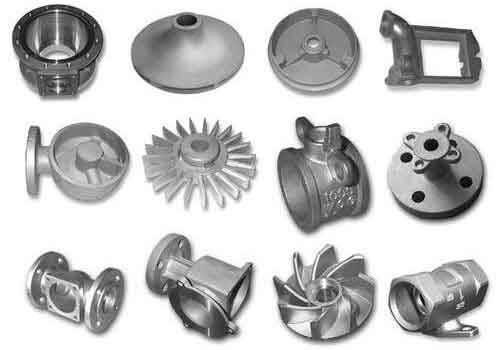
This image showcases a typical sand casting part, highlighting the complexity of shapes that can be produced. However, without proper control, such parts are susceptible to endogenous reaction porosity, as discussed. In my work, I emphasize rigorous quality checks to ensure that sand casting parts meet specifications.
Another aspect to consider is the economic impact of porosity in sand casting parts. Rejections due to internal defects can lead to significant waste and increased costs. Therefore, implementing preventive measures not only enhances performance but also improves profitability. I advocate for regular melt analysis using techniques like光谱rometry to monitor oxygen and hydrogen levels in sand casting parts production.
In conclusion, endogenous reaction porosity in sand casting parts is a critical defect that stems from chemical reactions during solidification. Through my experience, I have learned that understanding the visual characteristics, formation mechanisms, and preventive measures is essential for producing high-quality castings. By employing effective deoxidation, melt treatment, and process controls, manufacturers can mitigate this porosity and enhance the reliability of sand casting parts. The use of tables and formulas, as demonstrated in this article, aids in summarizing complex information for practical application. As technology advances, continued research into melt dynamics and gas-solid interactions will further improve the quality of sand casting parts across industries.
Finally, I stress the importance of a holistic approach in sand casting parts manufacturing. From raw material selection to final inspection, every step must be optimized to minimize defects. Endogenous reaction porosity, while challenging, can be managed through knowledge and diligence, ensuring that sand casting parts perform reliably in their intended applications. I hope this comprehensive discussion serves as a valuable resource for engineers and foundry professionals working with sand casting parts.