
As a researcher in the field of metallurgy, I have long been fascinated by the challenges and opportunities presented by white cast iron, particularly the low-chromium variants. White cast iron is widely recognized for its exceptional wear resistance, making it a material of choice in demanding applications such as mining, cement production, and power generation. However, its inherent brittleness, primarily due to the continuous network of hard carbides within the microstructure, has limited its use in scenarios requiring both耐磨 and impact toughness. This study focuses on addressing this limitation through a specialized heat treatment process aimed at spheroidizing the carbides in low-chromium white cast iron. The transformation of carbides from a continuous,网状 morphology into isolated, fine spheroids or团块 can significantly enhance the material’s mechanical properties. In this article, I will detail my investigation into the effects of heat treatment parameters on this spheroidization process and present the resultant improvements in toughness and wear resistance.
The fundamental issue with conventional low-chromium white cast iron lies in its as-cast microstructure. The carbides, predominantly of the M3C type (where M is primarily iron with some chromium), form a interconnected network or coarse plate-like structures, often described as part of the ledeburite constituent. This configuration acts as stress concentrators and crack propagation paths, severely compromising ductility and impact strength. My objective was to develop a post-casting heat treatment—termed “spheroidizing heat treatment”—that could modify this carbide morphology without compromising the inherent hardness and wear resistance of the white cast iron. The underlying theory is based on interfacial energy minimization and diffusion-controlled phase transformation. When heated to elevated temperatures below the eutectic temperature, the system tends to reduce its total interfacial energy by transforming high-surface-area plate-like or network carbides into lower-surface-area spheroidal particles. This process is governed by Ostwald ripening, where smaller particles dissolve and larger ones grow, driven by the reduction in Gibbs free energy. The kinetics can be described by the Lifshitz-Slyozov-Wagner (LSW) theory for diffusion-controlled growth:
$$ \bar{r}^3 – \bar{r}_0^3 = \frac{8\gamma D C_\infty V_m^2 t}{9RT} $$
where \(\bar{r}\) is the average particle radius at time \(t\), \(\bar{r}_0\) is the initial average radius, \(\gamma\) is the interfacial energy, \(D\) is the diffusion coefficient, \(C_\infty\) is the solubility of the carbide-forming elements in the matrix at equilibrium, \(V_m\) is the molar volume, \(R\) is the gas constant, and \(T\) is the absolute temperature. This formula highlights that both temperature and time are critical parameters: higher temperatures increase \(D\) and \(C_\infty\), accelerating spheroidization, while longer times allow the process to proceed further towards equilibrium.
To systematically study this, I designed and conducted a series of experiments. The first step involved melting and casting the low-chromium white cast iron. The charge materials included pig iron, scrap steel, ferrosilicon (containing approximately 75% Si), ferrochromium (containing approximately 60% Cr), and crushed graphite electrodes for carbon adjustment. Melting was carried out in a 50 kg medium-frequency induction furnace, with a tapping temperature of approximately 1500°C. The chemical composition of the final alloy, determined via光谱 analysis, is summarized in Table 1. This composition is typical for industrial low-chromium white cast iron, designed to balance cost, castability, and wear performance.
| Element | C | Si | Mn | Cr | P | S | Fe |
|---|---|---|---|---|---|---|---|
| Content | 2.8 – 3.2 | 0.6 – 1.0 | 0.5 – 0.8 | 2.0 – 3.0 | <0.10 | <0.05 | Bal. |
Casting was performed using green sand molds to produce specimens for subsequent testing. For impact toughness evaluation, unnotched Charpy specimens with dimensions of 10 mm × 10 mm × 55 mm were cast. To minimize scatter in impact values due to casting defects, a carefully designed gating system promoting directional solidification was employed, as illustrated schematically below. This ensured adequate feeding and reduced shrinkage porosity, which could otherwise affect the fracture behavior. The浇注 system, while effective for feeding, lacked slag-trapping capability, necessitating careful skimming and slag control during pouring.
The as-cast specimens were then subjected to the spheroidizing heat treatment. The primary variables investigated were heating temperature and holding time. Specimens were divided into groups and heated in a muffle furnace to target temperatures of 950°C, 1000°C, 1050°C, and 1100°C, respectively. All groups were held at their respective temperatures for 2 hours, followed by furnace cooling to room temperature. This range of temperatures was selected based on the phase diagram of Fe-C-Cr systems, aiming to be within the austenite + carbide region but below the solidus to avoid melting. To study the effect of time, another set of specimens was heated to 1050°C and held for different durations: 0.5 h, 2 h, 4 h, and 8 h. After heat treatment, the microstructures were examined using optical and scanning electron microscopy, and the mechanical and tribological properties were evaluated.
The properties assessed included impact toughness, macrohardness, and wear resistance. Impact tests were conducted on a 300 J pendulum impact tester with a 40 mm support span. Hardness was measured using a Rockwell hardness tester (scale C) on the surface of the broken impact specimens. Wear tests were performed on a custom-built reciprocating plane wear tester. The parameters were: pin specimen diameter 6 mm, fixed load 50 N, abrasive medium 80-grit brown alumina sandpaper fixed to a moving platform with a speed of 0.2 m/s, total wear distance of 1000 m, and a transverse shift of 2 mm per stroke to ensure contact with fresh abrasive. Wear loss was determined by weight loss measured on an analytical balance with 0.1 mg sensitivity. The wear rate \(W_r\) was calculated as weight loss per unit distance (mg/m), and wear resistance \(W_R\) was defined as its inverse:
$$ W_R = \frac{1}{W_r} $$
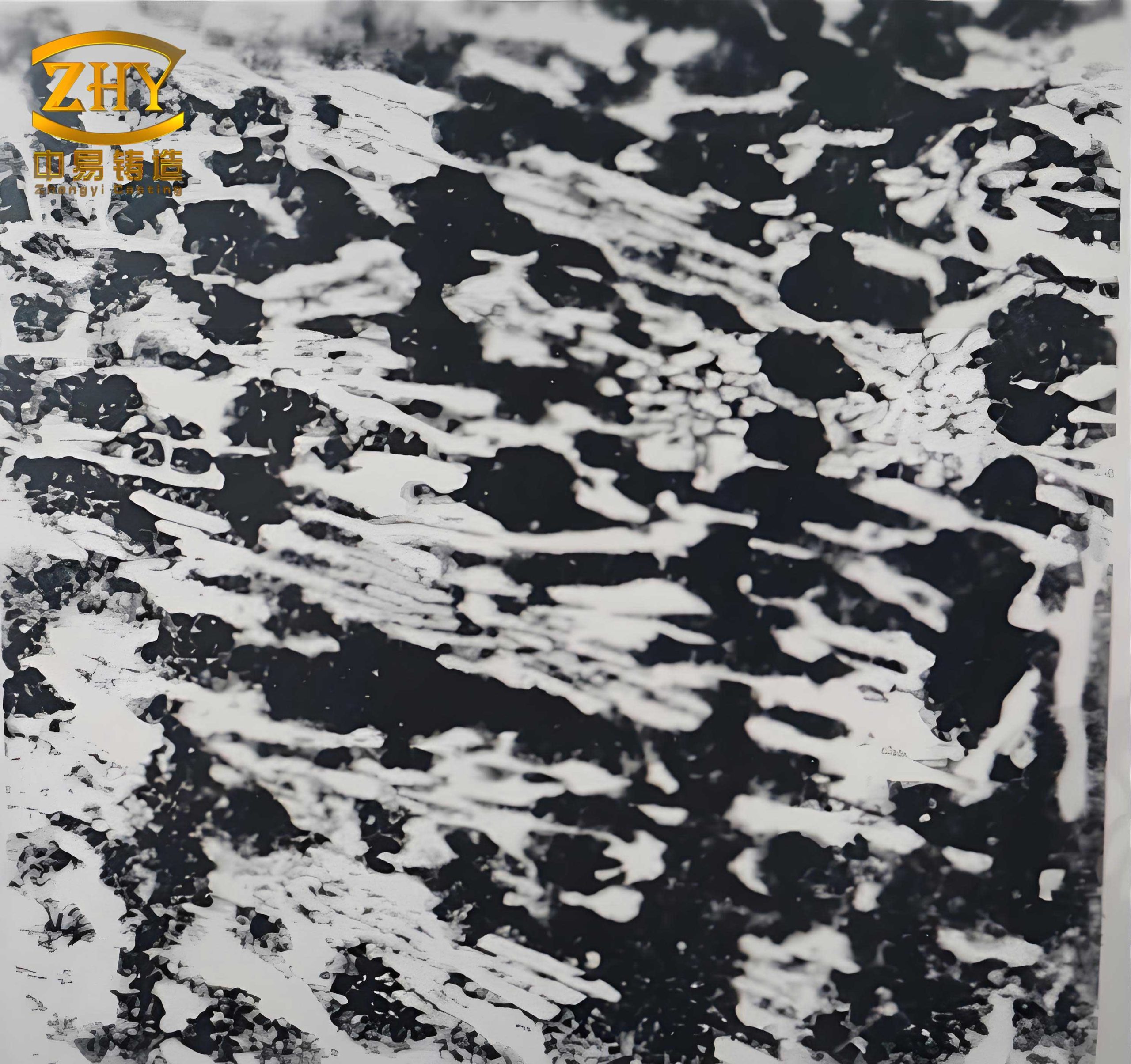
The microstructural evolution was striking. In the as-cast state, the low-chromium white cast iron exhibited the typical continuous network of M3C carbides and ledeburite. After spheroidizing treatment, this network broke down. The carbides fragmented and gradually assumed more rounded, isolated forms—spheroids, blocks, and irregular团聚体. The extent of spheroidization was quantitatively assessed by image analysis, measuring parameters such as carbide aspect ratio and contiguity. The results clearly showed that both higher temperatures and longer holding times promoted more complete spheroidization. At 950°C, some network fragmentation occurred, but many carbides remained interconnected. At 1100°C, the carbides were predominantly discrete and near-spherical. Similarly, at 1050°C, holding for 0.5 h resulted in partial spheroidization, while after 8 h, the carbides were well-spheroidized. This aligns with the theoretical kinetics; the process is thermally activated, and time allows for sufficient diffusion and interfacial rearrangement.
The mechanical property data are consolidated in Table 2. The impact toughness showed a remarkable increase with optimal heat treatment. The as-cast material had very low impact energy, characteristic of brittle white cast iron. After treatment at 1050°C for 2 hours, the impact energy increased by approximately 150%. Further improvements were noted at higher temperatures or longer times, though excessive parameters could lead to some coarsening of carbides, which might slightly reduce toughness. The hardness, interestingly, did not show a dramatic decrease. While some softening occurred due to the partial dissolution of carbides and matrix changes, the hardness remained at a high level suitable for wear applications. This is a crucial finding, as it indicates that spheroidization can enhance toughness without sacrificing the primary attribute of white cast iron—hardness.
| Heat Treatment Condition | Impact Energy (J) | Hardness (HRC) | Carbide Morphology Index (Aspect Ratio) |
|---|---|---|---|
| As-cast | 4.2 ± 0.5 | 58 ± 2 | 5.8 ± 1.2 (Plate-like/Network) |
| 950°C, 2h | 6.8 ± 0.6 | 56 ± 2 | 3.2 ± 0.8 (Fragmented Network) |
| 1000°C, 2h | 8.5 ± 0.7 | 55 ± 1 | 2.1 ± 0.5 (Blocky/部分 Spheroidal) |
| 1050°C, 2h | 10.5 ± 0.8 | 54 ± 1 | 1.5 ± 0.3 (Mostly Spheroidal) |
| 1100°C, 2h | 11.0 ± 0.9 | 53 ± 2 | 1.3 ± 0.2 (Highly Spheroidal) |
| 1050°C, 0.5h | 7.2 ± 0.6 | 55 ± 1 | 2.8 ± 0.6 (部分 Spheroidal) |
| 1050°C, 4h | 11.2 ± 0.8 | 53 ± 1 | 1.4 ± 0.3 (Spheroidal) |
| 1050°C, 8h | 11.5 ± 0.9 | 52 ± 2 | 1.2 ± 0.2 (Very Spheroidal) |
The wear resistance results were equally promising. The wear rate of the as-cast white cast iron was relatively high under high-stress abrasion conditions. After spheroidizing treatment, the wear resistance improved significantly. For instance, after treatment at 1050°C for 2 hours, the wear resistance increased by approximately 30-40% compared to the as-cast state. This improvement can be attributed to the change in carbide morphology. In the as-cast white cast iron, the continuous carbide network is brittle and prone to cracking under abrasive loading. Cracks initiate and propagate along the carbide/matrix interfaces or through the carbides themselves, leading to large-scale material removal via spalling. In the spheroidized white cast iron, the isolated carbides can better accommodate strain. They act as hard, reinforcing particles that resist cutting by abrasives, while the more ductile matrix can undergo plastic deformation without catastrophic crack propagation. The synergy between the hard spheroids and the matrix enhances the material’s ability to dissipate energy during wear. The wear mechanism shifts from brittle fracture to a combination of micro-cutting and plastic deformation, resulting in lower material loss. This can be modeled by considering the wear volume \(V\) removed, which for abrasive wear often follows a relation like:
$$ V = K \frac{N L}{H} $$
where \(K\) is a wear coefficient, \(N\) is the normal load, \(L\) is the sliding distance, and \(H\) is the hardness. However, for materials with composite microstructures like white cast iron, the effective hardness is not simply the macrohardness but also depends on carbide morphology. A parameter such as the contiguity of carbides \(C_c\) influences crack initiation. A lower \(C_c\) (as in spheroidized white cast iron) increases the fracture toughness \(K_{IC}\) of the composite, which in turn reduces the wear coefficient \(K\). Thus, the improved wear resistance of spheroidized white cast iron stems from both maintained high hardness and enhanced toughness.
To further elucidate the kinetics, I analyzed the spheroidization process using diffusion models. The rate of change in carbide surface area can be approximated by a first-order kinetic equation relative to the driving force for spheroidization, which is the reduction in interfacial area. If we denote \(A\) as the total interfacial area per unit volume and \(A_{eq}\) as the equilibrium area (corresponding to perfect spheroids), the rate law might be:
$$ \frac{dA}{dt} = -k (A – A_{eq}) $$
where \(k\) is a rate constant strongly dependent on temperature via an Arrhenius relation:
$$ k = k_0 \exp\left(-\frac{Q}{RT}\right) $$
Here, \(Q\) is the apparent activation energy for the spheroidization process in this low-chromium white cast iron, encompassing diffusion of carbon, chromium, and iron. Integrating the rate law gives:
$$ \ln\left(\frac{A – A_{eq}}{A_0 – A_{eq}}\right) = -k t $$
where \(A_0\) is the initial interfacial area. From my experimental data, by plotting \(\ln(A – A_{eq})\) versus time at different temperatures, I could estimate \(Q\). Preliminary calculations based on image analysis data suggested an activation energy on the order of 200-250 kJ/mol, which is consistent with volume diffusion of substitutional elements in iron. This quantitative analysis reinforces that the spheroidization of carbides in white cast iron is a diffusion-controlled solid-state transformation.
The implications of this research are substantial for industries utilizing white cast iron components. By implementing a relatively simple post-casting heat treatment, the service life of parts subject to impact and abrasion can be extended. For example, liner plates in ball mills, pump casings, and crusher components made from low-chromium white cast iron could benefit from this spheroidizing treatment. The process window is forgiving; temperatures around 1050°C and times of 2-4 hours provide an excellent balance between property improvement and energy cost. It is also worth noting that this treatment does not require rapid quenching, thus minimizing distortion and residual stresses, which is advantageous for complex castings.
In conclusion, my investigation demonstrates that the spheroidization of carbides in low-chromium white cast iron is effectively achievable through controlled heat treatment. Both increasing the heating temperature and prolonging the holding time within appropriate ranges promote the transformation of continuous carbide networks into isolated, fine spheroids. This microstructural modification leads to a significant enhancement in impact toughness—an increase of over 150%—while maintaining high hardness and even improving wear resistance by up to 40%. The underlying mechanisms are rooted in interfacial energy minimization and diffusion kinetics, well-described by existing theories of phase transformations. This work contributes to the broader understanding of microstructure-property relationships in white cast iron and provides a practical pathway to engineer tougher, more durable white cast iron components for demanding applications. Future studies could explore the effects of alloying modifications or combined treatments to further optimize the performance of this versatile class of materials.
Throughout this research, the term “white cast iron” has been central, emphasizing that even within this traditionally brittle material, substantial improvements are possible through microstructure engineering. The successful spheroidization of carbides opens new avenues for expanding the application range of white cast iron, making it a more competitive material for scenarios where toughness is as critical as wear resistance. The principles elucidated here may also be applicable to other cast iron systems or composite materials containing hard phases, underscoring the generality of the approach.