
In our manufacturing operations, we frequently produce sand casting parts with intricate geometries and thin walls, which present significant challenges in achieving high-quality outputs. One notable example is a filter plate component originally designed as a stainless steel part in imported equipment. To address manufacturing difficulties and maintain overall machine weight and strength requirements, we transitioned to aluminum alloy casting. This part features a large轮廓 size with a maximum wall thickness of 3 mm, a minimum wall thickness of 2 mm, and a腹板 thickness of 2 mm, along with 48 solid hemispheres of 8 mm diameter. The complexity of this sand casting part necessitated a meticulous approach to sand casting processes to avoid defects such as cold shuts, misruns, gas holes, shrinkage porosity, and deformation.
The primary difficulties in producing such sand casting parts stem from their rapid cooling due to thin walls, which impedes proper mold filling. Additionally, the sand mold and cores generate substantial gases during pouring, leading to issues like blowholes, gas shrinkage cavities, mold wall movement, and runouts. Furthermore, uneven wall thickness distributions induce significant casting stresses, causing distortion in these delicate sand casting parts. To overcome these hurdles, we developed a comprehensive sand casting工艺 that leverages ordinary green sand molds with dry cores.
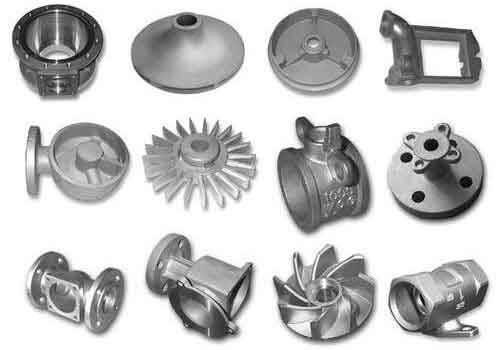
Our工艺 method involves using conventional green sand for the mold, while cores are dried to enhance strength and reduce gas evolution. The molding box assembly is designed with an upper flask that is essentially flat, leaving a cavity to facilitate core and mold ventilation. Cores are suspended within the flask, and we incorporate multiple vent ports—typically 8 to 12—in the mold cavity to ensure efficient gas escape during pouring. For alignment, we employ simple wooden pins for positioning in the lower flask, allowing visual inspection through定位 holes to prevent mismatches. After closing the mold, weights are added to counteract buoyancy forces. To improve surface finish, talcum powder is sprinkled on the mold faces. Pouring parameters are critical: we use ZL101 aluminum alloy with a pouring temperature range of 720°C to 740°C, and the pouring time is controlled between 8 and 10 seconds.
The gating system plays a pivotal role in the quality of sand casting parts. We opted for a bottom-gating system with two sprue channels poured simultaneously, each with a diameter of 18 mm. This design ensures a calm mold filling process, minimizing turbulence and gas entrapment. The pouring time is calculated using empirical formulas that account for fluid dynamics and heat transfer. For instance, the pouring time \( t \) can be estimated as:
$$ t = \frac{W}{\rho \cdot A \cdot \sqrt{2gH}} $$
where \( W \) is the weight of the liquid metal, \( \rho \) is the density of the alloy, \( A \) is the total cross-sectional area of the sprue channels, \( g \) is gravitational acceleration, and \( H \) is the average metallostatic head. For our sand casting part, with a weight of approximately 1.2 kg, density of 2.68 g/cm³ for ZL101, and an average head of 150 mm, the calculated pouring time aligns with our practical range. We often refine this with computational fluid dynamics simulations to optimize gating for different sand casting parts.
| Parameter | Value | Unit |
|---|---|---|
| Maximum Wall Thickness | 3 | mm |
| Minimum Wall Thickness | 2 | mm |
| Number of Hemispheres | 48 | – |
| Hemisphere Diameter | 8 | mm |
| Pouring Temperature | 720-740 | °C |
| Pouring Time | 8-10 | seconds |
| Sprue Diameter | 18 | mm |
| Mold Vent Ports | 8-12 | – |
After pouring, the sand casting parts are allowed to cool for approximately 30 minutes before shakeout. Upon removal, we inspect for deformation, particularly in the腹板 region. If distortion exceeds 0.5 mm over a flat surface, we perform校正 using precision tools. This post-casting correction is essential for maintaining dimensional accuracy in complex sand casting parts.
Defect prevention is a core focus in our sand casting process. The high gas generation from sand molds, combined with low permeability in certain areas, can lead to subsurface porosity. To mitigate this, we ensure adequate venting and use coatings that enhance surface quality. Moreover, the重合 of physical and geometric hot spots, along with mold wall movement, contributes to shrinkage porosity. We address this by designing gating systems that promote directional solidification and by reinforcing molds to resist pressure. For thin-walled high-strength gray iron sand casting parts, we have found that stepped or dispersed gating systems with large flow rates are optimal, as they reduce turbulence and improve temperature gradients.
The economics of producing sand casting parts through this method are substantial. By adopting sand casting instead of pressure die casting or stamping, we saved over 30,000 USD in模具 costs. Furthermore, the implementation of suspended core techniques, as opposed to traditional core placement in the lower flask, significantly boosted yield rates. Initially, the rejection rate for these sand casting parts was as high as 30-40%, but after工艺 refinements, it dropped to below 5%. This reduction in scrap translated into considerable savings in labor and materials, enhancing overall profitability. The table below summarizes the cost benefits observed over a production run of 1,000 units.
| Cost Factor | Traditional Method | Optimized Sand Casting | Savings |
|---|---|---|---|
| Mold/Tooling Cost | $35,000 | $5,000 | $30,000 |
| Rejection Rate | 35% | 5% | 30% reduction |
| Labor Hours per Unit | 2.5 | 1.8 | 0.7 hours |
| Material Waste | 15% | 5% | 10% reduction |
| Total Cost per Unit | $120 | $85 | $35 |
From a technical standpoint, the gating system’s influence on resin sand castings is profound, but our focus here is on conventional sand casting parts. The system regulates the velocity field within the mold, thereby altering solidification patterns. For instance, low-temperature metal filling into high-gas-evolving, low-permeability sections of resin sand molds is a primary cause of皮下气孔, though we adapt similar principles for green sand. The interplay between thermal and geometric hot spots, coupled with mold expansion, often leads to shrinkage defects. We combat this by optimizing pouring parameters and mold design. The governing equation for heat transfer during solidification can be expressed as:
$$ \frac{\partial T}{\partial t} = \alpha \nabla^2 T + \frac{L}{c_p} \frac{\partial f_s}{\partial t} $$
where \( T \) is temperature, \( t \) is time, \( \alpha \) is thermal diffusivity, \( L \) is latent heat, \( c_p \) is specific heat, and \( f_s \) is solid fraction. This helps us predict solidification fronts and adjust工艺 accordingly for sand casting parts.
In practice, we conduct extensive trials to fine-tune variables such as sand composition, binder ratios, and pouring speeds. For aluminum alloy sand casting parts, we use a sand mixture with 85-90% silica sand, 5-8% bentonite clay, and 2-4% water to achieve optimal mold strength and permeability. Cores are made with resin-bonded sand to withstand thermal stresses. The following table outlines typical sand properties for producing high-quality sand casting parts.
| Sand Property | Target Range | Importance |
|---|---|---|
| Green Strength | 15-25 kPa | Prevents mold collapse during handling |
| Permeability | 80-120 | Facilitates gas escape during pouring |
| Moisture Content | 3.5-4.5% | Affects moldability and gas generation |
| Clay Content | 8-12% | Enhances cohesion and durability |
| Compactability | 35-45% | Ensures uniform mold density |
Quality assurance for sand casting parts involves non-destructive testing methods like visual inspection, dimensional checks, and radiographic examination for internal defects. We also perform mechanical testing on samples to validate tensile strength and hardness, which for ZL101 alloy typically range from 150 to 200 MPa and 60 to 80 HB, respectively. The formula for estimating mechanical properties based on cooling rate \( R \) is:
$$ \sigma_y = \sigma_0 + k \cdot R^{1/2} $$
where \( \sigma_y \) is yield strength, \( \sigma_0 \) is a material constant, and \( k \) is a coefficient. This relationship underscores the importance of controlling solidification rates in thin-walled sand casting parts.
Looking forward, we continue to innovate in sand casting technologies for complex parts. Advances in simulation software allow us to predict fluid flow and solidification with greater accuracy, reducing trial-and-error cycles. Additionally, we are exploring the use of additive manufacturing for producing sand molds and cores, which could further streamline the production of intricate sand casting parts. The integration of real-time monitoring during pouring, using sensors to track temperature and pressure, is another area of development aimed at enhancing consistency.
In conclusion, the successful production of complex thin-walled aluminum alloy sand casting parts hinges on a holistic approach encompassing mold design, gating system optimization, and strict process control. By addressing gas-related defects through improved venting and coatings, minimizing shrinkage via directional solidification, and reducing deformation with post-casting corrections, we achieve high yields and cost efficiencies. The economic benefits are clear, with significant savings in tooling and reduced scrap rates. As we refine our methods, sand casting remains a versatile and economical solution for manufacturing intricate sand casting parts, driving innovation in various industrial applications. Our experience underscores that with careful planning and execution, even the most challenging sand casting parts can be produced reliably and profitably.