
In the development of industries such as mechanical manufacturing, metallurgy, construction, and energy, there is an increasing demand for components with stringent technical requirements that cannot be met by a single material. This has led to the adoption of composite casting, a process where two or more metals with different properties are joined into an integral part through casting techniques. Composite casting can be categorized into two main methods: solid-liquid composite casting, where liquid metal is poured onto a solid metal part, and liquid-liquid composite casting, where different metals are sequentially poured into the same mold. This approach offers advantages like local reinforcement, improved wear and corrosion resistance, savings on precious metals, enhanced quality, and better manufacturability. Among various materials, white cast iron stands out due to its high hardness and excellent wear resistance, making it ideal for耐磨件 in mining, metallurgy, crushing, and other fields. However, the inherent brittleness of white cast iron limits its applications. To overcome this, composite casting with high-strength, high-toughness carbon steel is employed, combining the耐磨性 of white cast iron with the韧性 of steel. In this article, I will explore the principles, processes, and experimental findings of composite casting for white cast iron, focusing on key factors that ensure effective bonding.
The core of composite casting lies in the interaction between solid and liquid metals, which can result in mechanical attachment, fusion, or a combination of both. For white cast iron composites, achieving fusion is crucial to prevent cracking or peeling of the brittle white cast iron layer. Fusion involves mutual dissolution and diffusion at the interface, forming a transitional layer with a structure distinct from both materials. This process is driven by thermal conditions and depends on factors like chemical composition, surface conditions, pouring temperature, preheating temperature, and the weight ratio of liquid to solid (liquid-solid ratio). Diffusion theory, as studied by researchers like Budakov, explains how atoms migrate across interfaces, leading to solid solutions or new phases. When a refractory solid metal (e.g., carbon steel) interacts with a fusible liquid metal (e.g., white cast iron), dissolution occurs, and upon cooling, intermediate phases may crystallize based on the alloy system’s phase diagram. For instance, if metals A and B do not form intermetallic compounds, the interface structure might consist of primary crystals and eutectics, as shown in simplified phase diagrams. The formation of diffusion layers is essential for strong bonding, and surface activation agents play a key role in improving wetting and preventing oxide films that hinder diffusion.
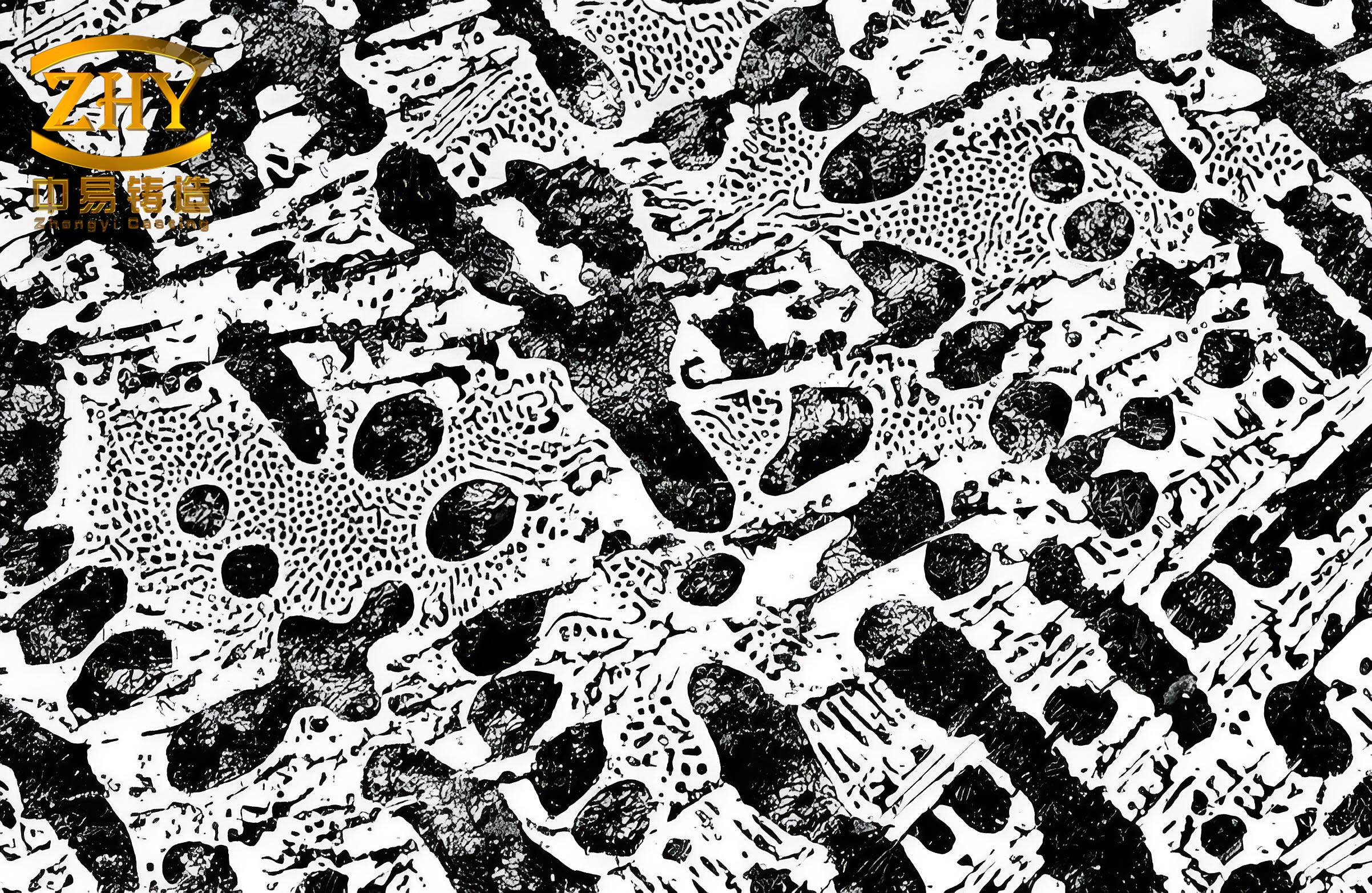
In composite casting of white cast iron, chromium-alloyed white cast iron is often used for the耐磨层 due to its high hardness from carbides like (Cr,Fe)₇C₃ and (Cr,Fe)₂₃C₆. However, high chromium content can lead to Cr₂O₃ films at the interface, impeding fusion. To address this, surface activation is employed. Common agents include copper plating, ZnCl₂, or NH₄Cl, but these can be complex or costly. In our experiments, we investigated borax (Na₂B₄O₇·10H₂O) and zinc as surface activators. Borax, when heated, decomposes to form boric anhydride and sodium metaborate, which react with oxides to form low-melting-point borates, thereby cleansing and activating the surface. Zinc, with its low melting point (419.5°C) and tendency to vaporize at high temperatures, promotes atomic diffusion through zinc vapor formation. The effectiveness of these activators was evaluated through controlled experiments, focusing on surface treatment, pouring temperature, preheating temperature, and liquid-solid ratio.
Our experimental setup involved using carbon steel rods (diameter φ, length 100 mm) as the solid base, with white cast iron poured around them to form composite samples. The white cast iron was a chromium-alloyed type, chosen for its耐磨性. The carbon steel rods underwent surface preparation: degreasing with a NaOH and Na₂SiO₃ solution, derusting with HCl, protection with a borax solution, and finally coating with the surface activator (borax or zinc). Borax coating was applied by反复浸渍 in a saturated borax solution at 200-300°C, while zinc coating involved dipping into molten zinc. Key variables are summarized in the table below, which includes different rod diameters (φ6, φ8, φ10, φ12, φ14 mm) to vary the liquid-solid ratio. The pouring temperature for white cast iron was maintained at approximately 1300-1350°C, and preheating of carbon steel rods was tested at room temperature and 800-900°C.
| Sample Group | Surface Activator | Preheating Temperature of Carbon Steel | Liquid-Solid Ratio (Approx.) | Observed Interface Characteristics |
|---|---|---|---|---|
| Group A (φ6 mm) | Borax | Room Temperature | Low (≈0.5) | Clear interface, no diffusion layer, mechanical attachment only |
| Group B (φ8 mm) | Borax | Room Temperature | Medium (≈0.7) | Thin diffusion layer, partially continuous |
| Group C (φ10 mm) | Borax | Room Temperature | High (≈1.0) | Wide, continuous diffusion layer |
| Group D (φ12 mm) | Borax | 800-900°C | Medium (≈0.8) | Very wide, clear diffusion layer |
| Group E (φ14 mm) | Borax | 800-900°C | High (≈1.2) | Excellent continuity and width in diffusion layer |
| Group F (φ6 mm) | Zinc | Room Temperature | Low (≈0.5) | Clear gap, no diffusion |
| Group G (φ8 mm) | Zinc | Room Temperature | Medium (≈0.7) | No diffusion layer observed |
| Group H (φ10 mm) | Zinc | Room Temperature | High (≈1.0) | Thin diffusion layer, less continuous |
| Group I (φ12 mm) | Zinc | 800-900°C | Medium (≈0.8) | Clear, moderate diffusion layer |
| Group J (φ14 mm) | Zinc | 800-900°C | High (≈1.2) | Wide diffusion layer, good continuity |
The liquid-solid ratio is a critical parameter defined as the weight of liquid white cast iron to the weight of solid carbon steel. It influences the thermal balance at the interface. A higher ratio provides more heat, promoting diffusion. However, excessive ratios can cause remelting or recrystallization of the steel, compromising its strength. The diffusion process can be modeled using Fick’s laws. For one-dimensional diffusion across the interface, the concentration profile of an element (e.g., chromium from white cast iron into steel) can be described by:
$$ C(x,t) = C_0 + (C_s – C_0) \cdot \text{erfc}\left(\frac{x}{2\sqrt{Dt}}\right) $$
where \( C(x,t) \) is the concentration at distance \( x \) and time \( t \), \( C_0 \) is the initial concentration in steel, \( C_s \) is the surface concentration, \( D \) is the diffusion coefficient, and erfc is the complementary error function. For white cast iron composites, the diffusion coefficient depends on temperature according to the Arrhenius equation:
$$ D = D_0 \exp\left(-\frac{Q}{RT}\right) $$
Here, \( D_0 \) is a pre-exponential factor, \( Q \) is the activation energy, \( R \) is the gas constant, and \( T \) is the absolute temperature. Preheating the carbon steel raises \( T \), increasing \( D \) and enhancing diffusion. The formation of intermetallic compounds or solid solutions at the interface follows phase diagram principles. For the Fe-Cr-C system relevant to white cast iron and carbon steel, the interface region may consist of phases like austenite, carbides, or eutectics. The thickness of the diffusion layer \( \delta \) can be estimated from diffusion kinetics:
$$ \delta \propto \sqrt{Dt} $$
In practice, \( t \) is related to the solidification time of white cast iron, which is affected by casting parameters.
Results from metallographic analysis showed that borax as a surface activator yielded thicker and more continuous diffusion layers compared to zinc. For instance, with borax and preheating at 800-900°C, even at moderate liquid-solid ratios, the interface exhibited a well-defined diffusion zone of several hundred micrometers. In contrast, zinc required higher liquid-solid ratios or preheating to achieve similar results. Without preheating, borax could form a diffusion layer at liquid-solid ratios above 0.7, while zinc needed ratios above 1.0. This underscores borax’s superiority in activating the surface for white cast iron composite casting. The diffusion layer typically comprised a mixture of ferrite, carbides, and possibly transitional phases, ensuring strong metallurgical bonding. The hardness gradient across the interface was measured, showing a smooth transition from the hard white cast iron layer (500-700 HV) to the tougher steel core (200-300 HV). This gradient mitigates stress concentrations, reducing the risk of cracking.
To optimize the process, we derived empirical formulas. The effectiveness of surface activation can be quantified by a wetting angle \( \theta \), where lower angles indicate better wetting. For borax-treated surfaces, \( \theta \) decreases significantly due to oxide removal. The bond strength \( \sigma_b \) of the composite can be correlated with diffusion layer thickness \( \delta \) and interface cleanliness:
$$ \sigma_b = k_1 \delta + k_2 (1 – f_{\text{oxide}}) $$
where \( k_1 \) and \( k_2 \) are constants, and \( f_{\text{oxide}} \) is the fraction of oxide coverage. For white cast iron composites, achieving \( \sigma_b > 200 \, \text{MPa} \) is desirable for structural applications. Process windows were established: preheating temperatures of 800-900°C, pouring temperatures of 1300-1350°C for white cast iron, and liquid-solid ratios between 0.8 and 1.2 are recommended. These parameters ensure sufficient diffusion without degrading the steel. Additionally, surface features like grooves or threads on the solid part can enhance mechanical interlocking, but sharp notches should be avoided to prevent stress risers.
The applications of white cast iron composite casting are vast. In mining, components like pump liners or crusher parts benefit from a耐磨 white cast iron surface backed by tough steel. In energy sectors, boiler slag scraper blades can be made via this method. The economic advantages are notable, as it reduces the need for expensive alloys in bulk. Future directions include exploring other activators or automated coating techniques. Moreover, computational models can simulate diffusion dynamics to predict layer formation for different white cast iron compositions.
In conclusion, composite casting of white cast iron with carbon steel is a viable method to combine hardness and toughness. Key factors include surface activation with borax, preheating of the solid part, and controlling the liquid-solid ratio. Diffusion theory underpins the formation of interfacial layers, which are crucial for bond integrity. This process expands the usability of white cast iron in demanding environments, offering a cost-effective solution for耐磨 applications. Further research could focus on optimizing activators for specific white cast iron grades or scaling up for industrial production.