
Our research team, comprising members from several national research institutes and industrial partners, embarked on a project to solve a persistent and costly problem in the construction machinery industry: the premature failure of mixing blades in forced concrete mixers. These components operate under exceptionally severe conditions of abrasive wear, involving constant contact with hard, sharp-edged aggregates like crushed stone and sand, often in the presence of water or other liquid media. This environment leads to a complex wear process combining solid particle abrasion, impact, and liquid-mediated electrochemical corrosion. The interplay of these mechanisms drastically accelerates the destruction of the blades. The materials traditionally used, such as ordinary white cast iron or ductile iron, proved inadequate, offering poor wear resistance and consequently very short service life. This resulted not only in excessive steel consumption and frequent downtime, affecting production efficiency, but also hindered the broader adoption of forced mixing technology. Therefore, the development of a new, superior wear-resistant material for these blades became an urgent technical and economic priority.
Leveraging China’s abundant tungsten resources, our investigation focused on developing tungsten-alloyed white cast iron. We systematically studied the relationships between composition, processing, microstructure, mechanical properties, and ultimately, wear performance. The core objective was to engineer a white cast iron that could withstand the specific wear regime of mixer blades. After years of laboratory research and extensive field testing, we achieved highly satisfactory results. The high-tungsten white cast iron we developed demonstrates a service life 4 to 8 times longer than the previously used materials, exceeding our initial targets and reaching or surpassing the performance level of internationally prevalent high-chromium white cast irons. This material has been formally approved and is now produced on a batch basis to supply original equipment manufacturers, providing a new, effective solution for components subjected to severe abrasive wear.
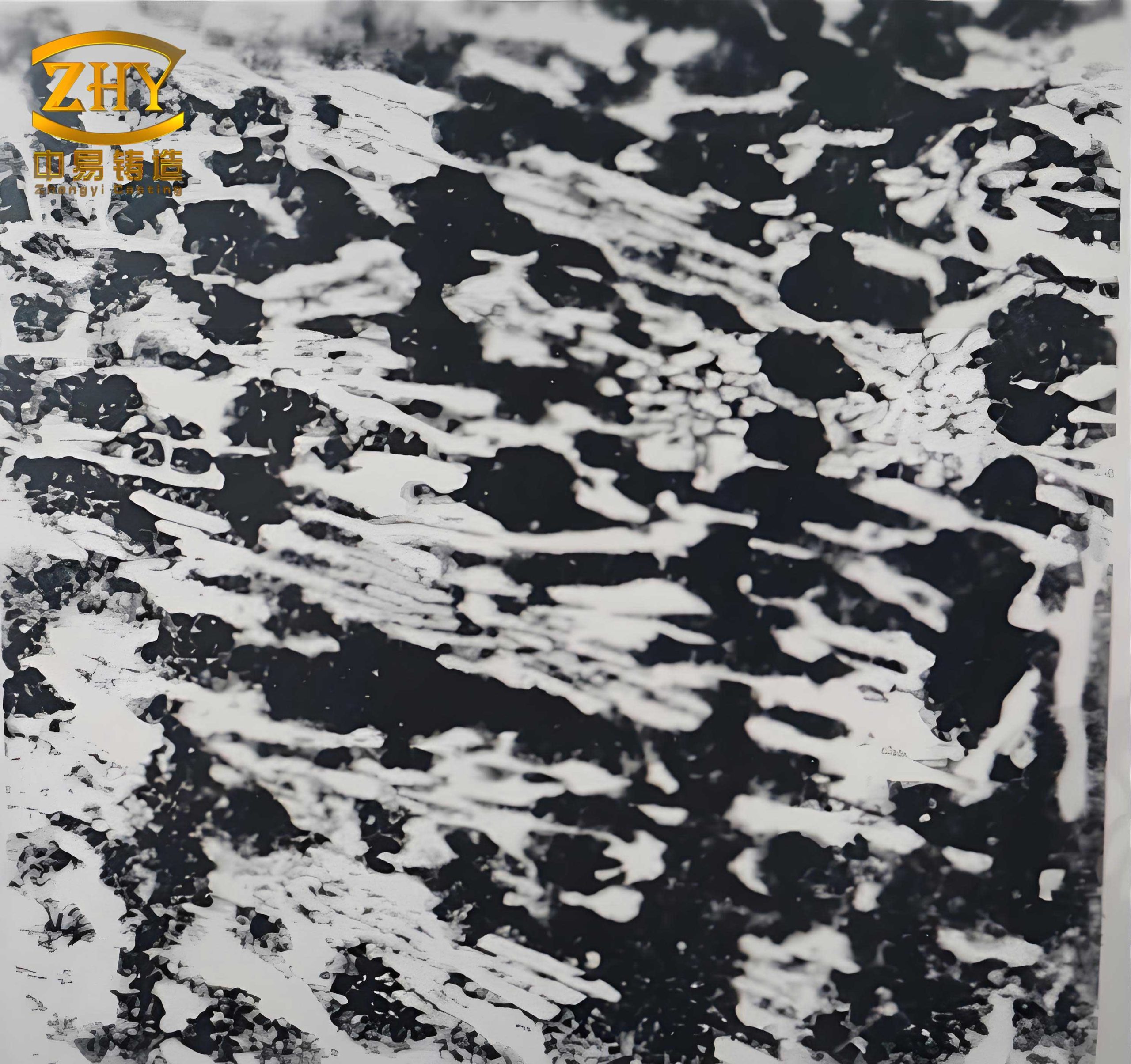
Material Requirements for Mixer Blades Under Abrasive Wear
The failure of mixer blades is classified as a form of erosion wear, dominated by the friction and mechanical abrasion from solid particles, with an additional, complicating factor of corrosion from the liquid medium. To effectively resist this combined attack, the ideal microstructure of the wear-resistant white cast iron must fulfill several criteria. Primarily, the hardness of the material is critical for resisting abrasive penetration and cutting. A general principle for selecting materials for abrasive wear conditions relates the hardness of the abrasive ($H_a$) to the hardness of the metallic material ($H_m$). Optimal wear resistance is often observed when the ratio satisfies:
$$0.8 \leq \frac{H_m}{H_a} \leq 1.2$$
When $H_m/H_a < 0.8$, the material is worn away too easily. When $H_m/H_a > 1.2$, the material typically becomes too brittle for practical application. Our design aimed to control this ratio within the optimal 0.8–1.2 range.
However, hardness alone is insufficient. Excessive focus on hardness without considering toughness can paradoxically reduce service life due to brittle fracture and spalling. Therefore, the microstructure must balance high hardness with adequate fracture resistance. Furthermore, to mitigate corrosion-assisted wear, the electrochemical behavior of the microstructure must be optimized. This involves: (1) transforming the multi-phase as-cast matrix into a single, uniform phase to minimize galvanic cells; (2) increasing the electrode potential of the matrix to reduce the potential gradient with the hard carbides; and (3) purifying grain boundaries.
Consequently, the ideal microstructure for the blade material is one consisting of very hard, uniformly distributed, and isolated alloy carbides embedded in a tough, single-phase martensitic matrix. This structure provides high resistance to micro-cutting and grooving, good support for the hard phases to prevent premature pull-out, and reduced susceptibility to corrosion.
Experimental Methodology and Materials
The research was conducted through a combination of laboratory-scale studies and industrial trials. Melting was performed using medium-frequency induction furnaces (e.g., 50 kW for lab, 150 kW for pilot) and industrial-scale electric arc furnaces (1.5-ton and 5-ton capacity). The base chemical composition range for the tungsten white cast iron under investigation was: Carbon (C): 2.0–3.5%, Silicon (Si): 0.3–1.2%, Manganese (Mn): 0.3–1.5%, Chromium (Cr): 0.5–3.0%, Tungsten (W): 4.0–15.0%, Copper (Cu): 0–1.5%, Titanium (Ti): 0–0.3%, Vanadium (V): 0–0.2%, with Phosphorus (P) and Sulfur (S) kept below 0.1%. Inoculation practices were employed, using vanadium-iron for high-tungsten variants and boron-iron/titanium-iron composite inoculants for others.
A comprehensive suite of characterization techniques was used:
- X-ray diffraction (XRD) for phase structure analysis.
- Scanning electron microscopy (SEM) and electron probe microanalysis (EPMA) to study microstructural features and elemental distribution.
- Dilatometry and differential thermal analysis (DTA) to determine critical transformation temperatures.
- Thermal analysis to study solidification characteristics.
- Specialized foundry testing apparatus to measure casting properties like fluidity, linear contraction, and porosity.
- Orthogonal experimental design and optimization methods to establish optimal composition and heat treatment parameters.
The raw materials used had the following typical compositions:
| Material | C (%) | Si (%) | Mn (%) | P (%) | S (%) | Cr (%) | W (%) |
|---|---|---|---|---|---|---|---|
| Pig Iron | 4.10 | 1.52 | 0.21 | 0.072 | 0.026 | – | – |
| Steel Scrap | 0.20 | 0.25 | 0.50 | 0.030 | 0.030 | – | – |
| Ferrochromium | – | 1.50 | – | – | – | 65.0 | – |
| Ferrotungsten | 0.50 | 1.50 | – | – | – | – | 70.0 |
Composition, Microstructure, and Mechanical Properties
Tungsten is the principal alloying element in this family of white cast irons. Its content, in relation to carbon, fundamentally determines the structure, morphology, distribution, and volume fraction of the carbides, as well as the matrix structure. The ratio $W/C$ is a key parameter.
At lower tungsten levels, the as-cast matrix is a multi-phase mixture of austenite, sorbitte (fine pearlite), and some martensite. As tungsten increases, the sorbitte content decreases while martensite and retained austenite increase, enhancing the toughness and the matrix’s ability to support the hard carbides.
The evolution of the carbide phase with increasing $W/C$ ratio is systematic:
| W/C Ratio | Carbide Morphology | Primary Carbide Type | Microhardness (HV) | Notes |
|---|---|---|---|---|
| Low (< 2.5) | Network | M3C-type (Alloyed Cementite) | ~900 – 1100 | Poor wear resistance due to brittle network. |
| Medium (2.5 – 4.0) | Broken Network | M6C-type / Mixed | ~1300 – 1500 | Transition stage. |
| High (> 4.0) | Isolated Blocks/Rods | M6C-type (Complex Interstitial Compound) | ~1600 – 1800+ | Excellent wear resistance if matrix is tough. |
When the $W/C$ ratio is in the optimal range of approximately 2.5 to 4.0, the as-cast structure features a large volume fraction of isolated, blocky carbides and some eutectic carbides, embedded in a matrix predominantly composed of martensite and austenite with little sorbitte. The isolated nature of the carbides minimizes their crack-initiating effect, while the tough matrix provides good support. Crucially, the carbide phase transitions from the softer M3C type to the much harder M6C type, with a corresponding significant jump in microhardness. This combination yields high wear resistance coupled with acceptable mechanical properties.
To further suppress any remaining detrimental M3C carbides, strengthen the matrix, and improve corrosion resistance, additions of chromium (Cr), copper (Cu), and molybdenum (Mo) are essential. Silicon content must be carefully controlled as it can embrittle the carbides.
Heat Treatment of High-Tungsten White Cast Iron
Relying solely on composition adjustment is often insufficient to achieve both an ideal carbide structure and an ideal matrix in the as-cast state. Cooling rates significantly influence the final matrix, usually resulting in a multi-phase mixture (martensite, retained austenite, sorbitte). This heterogeneity is detrimental: softer phases wear preferentially, creating initiation sites for further wear; phase transformations during service can induce stress; and multi-phase structures are more prone to galvanic corrosion.
Therefore, a specific heat treatment, termed “destabilization-normalizing,” is critical. This process involves austenitizing at a high temperature to allow carbon and alloy elements to diffuse, followed by controlled cooling (typically air cooling) to transform the austenite matrix uniformly into martensite. Studies using dilatometry, SEM/EPMA, and high-temperature microscopy were conducted to determine precise transformation temperatures and elemental partitioning behavior, forming the basis for the treatment schedule.
The effect of cooling rate after austenitization is decisive:
| Cooling Method | Resulting Matrix Structure | Macro Hardness (HRC) |
|---|---|---|
| Oil Quenching | Martensite + Retained Austenite + Carbides | > 65 |
| Air Cooling (Normalizing) | Martensite + Fine Secondary Carbides | 60 – 64 |
| Furnace Cooling | Pearlite/Sorbitte + Carbides | < 50 |
After the optimal destabilization-normalizing treatment, significant improvements are observed: bending strength and macro-hardness increase noticeably compared to the as-cast state; impact toughness slightly decreases; deflection remains similar; and most importantly, the microhardness of the matrix increases substantially due to the formation of martensite and the precipitation of fine secondary carbides, while the primary carbide hardness remains unchanged. The multi-phase matrix is converted into a single, tough martensitic base. This transformation increases the wear resistance of the white cast iron by over 30%.
Abrasive Wear Performance
Field tests comparing blades made from different materials provide the most compelling evidence for the superiority of high-tungsten white cast iron. The following table summarizes the relative service life in a concrete mixing environment:
| Material | Relative Service Life (Indexed to Ordinary White Iron = 1) | Notes |
|---|---|---|
| Ordinary White Cast Iron | 1.0 | Baseline, rapid wear. |
| Ductile Iron | 1.0 – 1.5 | Insufficient hardness. |
| Low/Medium-Tungsten White Cast Iron (As-Cast) | 3.0 – 5.0 | Significant improvement. |
| High-Tungsten White Cast Iron (Heat-Treated) | 6.0 – 8.0+ | Performance matches high-chromium iron. |
| High-Chromium (Cr15Mo3) White Cast Iron | 6.0 – 8.0 | International benchmark. |
The wear process can be modeled as a cyclical sequence for this white cast iron:
- Contact & Plowing: Hard abrasive particles slide under pressure, plowing grooves into the (relatively) softer martensitic matrix: $W \propto \frac{F_N \cdot L}{H_m}$, where $W$ is wear volume, $F_N$ is normal force, $L$ is sliding distance, and $H_m$ is material hardness.
- Matrix Deformation: The matrix deforms plastically, forming ridges adjacent to the grooves.
- Matrix Removal: The deformed ridges are subsequently removed by following abrasives, leaving the hard carbides protruding.
- Carbide Fatigue: The unsupported, protruding carbides undergo micro-cracking, fracture, and eventual spalling: $t_f \propto \frac{K_{IC}}{\sigma \sqrt{\pi a}}$, where $t_f$ is time to fracture, $K_{IC}$ is fracture toughness of the carbide, $\sigma$ is applied stress, and $a$ is flaw size.
The high-tungsten white cast iron excels in this process because its tough martensitic matrix resists deep grooving and provides strong mechanical support (“clamping”) for the isolated, ultra-hard M6C carbides. This support increases the stress required for carbide fracture and spalling ($\sigma$ in the equation above), thereby extending the cycle time and significantly improving overall wear life compared to white cast irons with networked, brittle carbides or a soft matrix.
Casting Properties and Melting Process Characteristics
For industrial adoption, the casting characteristics of the new white cast iron are as important as its wear properties. Tests comparing high-tungsten white cast iron with ordinary white cast iron and high-chromium white cast iron were conducted.
Thermal Analysis Results:
| Material | Liquidus Temp. (°C) | Eutectic Start Temp. (°C) | Solidification Range (°C) |
|---|---|---|---|
| Ordinary White Cast Iron | ~1250 | ~1140 | ~110 |
| High-Tungsten White Cast Iron | ~1280 – 1320 | ~1160 – 1180 | ~100 – 140 |
| High-Chromium White Cast Iron (Cr15Mo3) | ~1350 | ~1230 | ~120 |
Casting Property Test Results:
| Property | Ordinary White Iron | High-Tungsten White Iron | High-Chromium White Iron |
|---|---|---|---|
| Fluidity (Spiral Length, mm) | 480 | 420 | 380 |
| Linear Contraction (%) | 1.8 – 2.0 | 1.6 – 1.9 | 1.9 – 2.1 |
| Shrinkage Porosity Tendency | High | Moderate | High |
The results indicate that high-tungsten white cast iron possesses generally good foundry properties. While its fluidity is slightly lower than that of ordinary white cast iron, it is comparable to or better than high-chromium iron. Its linear contraction and shrinkage tendency are similar to other white cast irons, meaning standard feeding and risering techniques used for steel or high-alloy cast iron are applicable. Electric furnace melting (induction or arc) is preferred for precise composition and temperature control.
Conclusions and Economic Impact
The development of high-tungsten white cast iron represents a significant advancement in wear-resistant materials technology. Its composition—characterized by moderate carbon, high tungsten, and supplemental chromium/copper—successfully balances high wear resistance with adequate toughness. The microstructure, comprising isolated, ultra-hard M6C-type carbides in a tough, heat-treated martensitic matrix, is ideally suited to resist the complex abrasive-corrosive wear experienced by mixer blades.
The transformation of the as-cast multi-phase matrix into a uniform martensite via destabilization-normalizing heat treatment is crucial, enhancing wear and corrosion resistance by over 30%. Field performance confirms its superiority, with service life increased by 6 to 8 times over traditional materials, achieving parity with leading international high-chromium grades.
The economic benefits are substantial. For a fleet of 100 JW-type mixers, switching to high-tungsten white cast iron blades can save over 80 tons of steel annually, reduce blade replacement downtime by 150,000 to 200,000 hours, and potentially increase concrete production by 150,000 to 200,000 cubic meters without additional capital or labor investment. The value of this increased output is significant.
In summary, high-tungsten white cast iron is a technologically advanced and economically rational new wear-resistant material that leverages domestic resource advantages. It has proven effective not only for mixer blades but also in other applications like slurry pump components. While its comprehensive mechanical properties, particularly impact toughness, may still trail some premium high-chromium grades, it offers an excellent performance-to-cost solution for severe abrasive wear conditions, establishing itself as a valuable member of the family of high-performance white cast irons.