
In my research, I investigated the impact of composite modification using niobium (Nb) and silicon (Si) on the microstructure and properties of medium-vanadium white cast iron. White cast iron is widely used in wear-resistant applications due to its high hardness, but its brittleness often limits its use under impact conditions. The goal of this study was to enhance the toughness and overall mechanical performance of white cast iron by adding trace amounts of Nb, thereby reducing the vanadium content while improving carbide morphology. This approach aims to extend the service life of wear parts subjected to impact loads.
White cast iron typically contains hard carbides that provide excellent abrasion resistance, but these carbides often form continuous networks that embrittle the material. Through composite modification, I sought to refine and isolate these carbides, promoting a more ductile matrix. The following sections detail my experimental procedures, results, and theoretical analyses, supported by tables and formulas to summarize key findings.
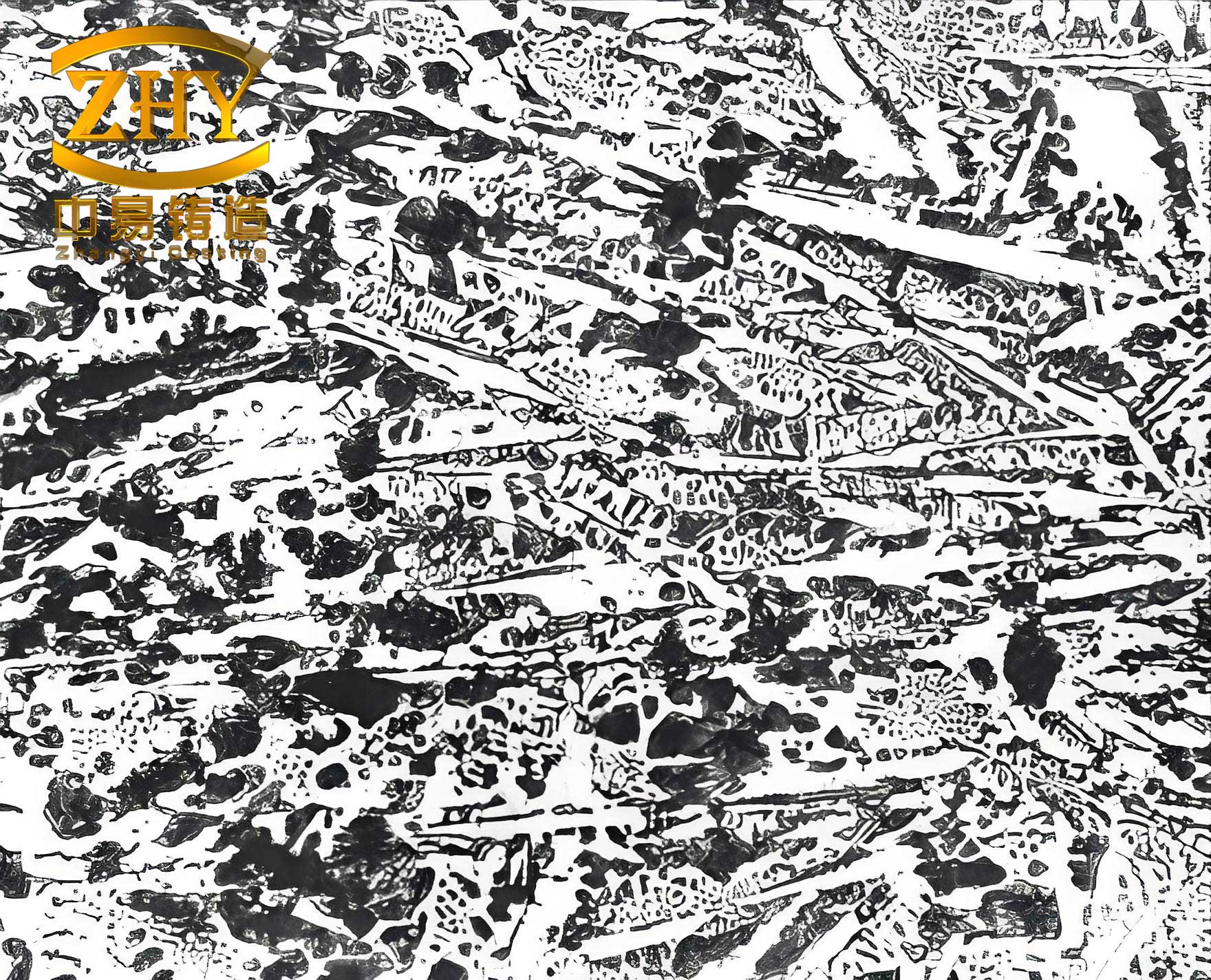
The experimental process began with melting the white cast iron in a medium-frequency induction furnace. I used raw materials including pig iron, scrap steel, and ferrovanadium (containing approximately 50% V) to achieve the desired composition, with added graphite electrodes for carbon adjustment. The molten iron was superheated to around 1500°C, followed by slag removal and aluminum deoxidation. After tapping, the melt was subjected to composite modification by adding Nb-Fe (containing about 60% Nb) and Si-Fe alloy via a ladle inoculation method. This treatment aimed to introduce Nb particles that could act as nucleation sites for carbides.
The chemical compositions and modifier additions for different batches are summarized in Table 1. I designed five heat treatment schedules, including four normalizing processes and one isothermal quenching, to evaluate the effect of thermal processing on the modified white cast iron. The parameters are listed in Table 2.
| Batch | C (%) | Si (%) | Mn (%) | V (%) | Nb (%) | Modifier Addition (wt.%) |
|---|---|---|---|---|---|---|
| 1 | 3.2 | 0.8 | 0.5 | 2.5 | 0 | 0 |
| 2 | 3.1 | 0.9 | 0.6 | 2.3 | 0.05 | 0.5 Si-Fe |
| 3 | 3.3 | 0.7 | 0.4 | 2.4 | 0.10 | 0.5 Si-Fe |
| 4 | 3.2 | 0.8 | 0.5 | 2.2 | 0.15 | 0.5 Si-Fe |
| 5 | 3.1 | 0.9 | 0.6 | 2.3 | 0.20 | 0.5 Si-Fe |
Table 1: Chemical compositions and modifier additions for the white cast iron batches.
| Heat Treatment | Austenitizing Temperature (°C) | Holding Time (min) | Cooling Medium | Medium Temperature (°C) | Additional Parameters |
|---|---|---|---|---|---|
| Normalizing 1 | 900 | 60 | Air | Room Temperature | Air cooling |
| Normalizing 2 | 950 | 60 | Air | Room Temperature | Air cooling |
| Normalizing 3 | 1000 | 60 | Air | Room Temperature | Air cooling |
| Normalizing 4 | 1050 | 60 | Air | Room Temperature | Air cooling |
| Isothermal Quenching | 950 | 60 | Salt bath | 300 | Holding for 120 min, then air cooling |
Table 2: Heat treatment parameters applied to the white cast iron samples.
After processing, I conducted mechanical tests on the white cast iron specimens. Macro-hardness was measured using a Rockwell hardness tester, while micro-hardness was assessed with a micro-hardness indenter. Impact toughness was determined via Charpy impact tests with a span of 40 mm, and bending strength was evaluated on a universal testing machine with a support distance of 100 mm. Wear resistance was tested on a simulated abrasion machine, using quartz sand as the abrasive medium under controlled conditions: flow rate of 200 g/min, load of 50 N, and test duration of 30 minutes. The relative wear resistance coefficient ε was calculated as the weight loss of a standard steel sample divided by that of the white cast iron sample.
The microstructure of the white cast iron was examined using optical and scanning electron microscopy. In the unmodified white cast iron, carbides formed a continuous network, severely embrittling the matrix. However, after composite modification with Nb-Si, the carbide morphology significantly improved. Carbides appeared as isolated blocks, nodules, and short rods, distributed uniformly in the matrix, which enhanced the continuity of the white cast iron structure. This change is attributed to the role of Nb in promoting heterogeneous nucleation of carbides.
To understand this mechanism, I performed thermodynamic and crystallographic analyses. In the white cast iron system, potential carbides include vanadium carbide (VC), niobium carbide (NbC), and complex carbides such as (Nb,V)C. The standard Gibbs free energy of formation ΔG° for these carbides can be expressed as follows:
For VC: $$ \Delta G^\circ_{\text{VC}} = -100,000 + 10T \, \text{J/mol} $$
For NbC: $$ \Delta G^\circ_{\text{NbC}} = -140,000 + 15T \, \text{J/mol} $$
For (Nb,V)C: $$ \Delta G^\circ_{(\text{Nb,V})C} = -120,000 + 12T \, \text{J/mol} $$
At a typical solidification temperature of 1200°C (1473 K), these values become:
$$ \Delta G^\circ_{\text{VC}} = -100,000 + 10 \times 1473 = -85,270 \, \text{J/mol} $$
$$ \Delta G^\circ_{\text{NbC}} = -140,000 + 15 \times 1473 = -117,905 \, \text{J/mol} $$
$$ \Delta G^\circ_{(\text{Nb,V})C} = -120,000 + 12 \times 1473 = -102,324 \, \text{J/mol} $$
Since ΔG° for NbC is the most negative, NbC forms preferentially and remains stable, acting as nucleation sites for other carbides in the white cast iron. Crystallographically, NbC has a face-centered cubic structure that matches well with common carbides like M7C3 or M23C6, allowing for coherent or semi-coherent interfaces that facilitate epitaxial growth. This explains the observed refinement of carbides in the modified white cast iron.
The mechanical properties of the white cast iron are summarized in Table 3. With increasing Nb content, the hardness and bending strength improved, while impact toughness peaked at 0.10% Nb before slightly decreasing. This trend is due to the dual role of Nb: it refines carbides and purifies grain boundaries by forming hard NbC particles that pin dislocations, strengthening the white cast iron matrix. However, excessive Nb may lead to particle clustering, which can slightly reduce toughness.
| Sample ID | Heat Treatment | Hardness (HRC) | Impact Toughness (J/cm²) | Bending Strength (MPa) | Wear Resistance Coefficient ε |
|---|---|---|---|---|---|
| 1 (0% Nb) | As-cast | 58 | 4.5 | 850 | 1.0 |
| 2 (0.05% Nb) | As-cast | 60 | 6.2 | 920 | 1.2 |
| 3 (0.10% Nb) | As-cast | 62 | 7.8 | 980 | 1.5 |
| 4 (0.15% Nb) | As-cast | 63 | 7.0 | 950 | 1.6 |
| 5 (0.20% Nb) | As-cast | 64 | 6.5 | 930 | 1.7 |
| 3 (0.10% Nb) | Normalizing at 1000°C | 55 | 12.5 | 1200 | 1.3 |
| 3 (0.10% Nb) | Isothermal Quenching | 68 | 8.5 | 1100 | 2.0 |
Table 3: Mechanical properties and wear resistance of white cast iron with varying Nb content and heat treatments.
Heat treatment played a crucial role in optimizing the properties of the white cast iron. Normalizing at 1000°C yielded the best combination of impact toughness and bending strength, as it promoted carbide spheroidization and matrix homogenization. The impact toughness increased from 4.5 J/cm² in the unmodified as-cast white cast iron to 12.5 J/cm² after modification and normalizing, representing a nearly threefold improvement. This enhancement is due to the dissolution of secondary carbides and refinement of the pearlitic matrix in the white cast iron. However, higher normalizing temperatures (e.g., 1050°C) led to the precipitation of networked carbides, reducing toughness.
Isothermal quenching resulted in a bainitic matrix, which provided the highest hardness and wear resistance for the white cast iron. The wear mechanism in the modified white cast iron shifted from brittle fracture to micro-cutting, as the isolated carbides and strong matrix resisted abrasive penetration. The wear resistance coefficient ε reached 2.0 for the isothermally quenched sample, indicating double the abrasion resistance compared to the unmodified white cast iron. This makes such white cast iron suitable for high-stress wear applications.
To further analyze the wear behavior, I considered the Archard wear equation, adapted for abrasive conditions:
$$ W = k \frac{P \cdot L}{H} $$
where W is the wear volume, k is a wear coefficient, P is the applied load, L is the sliding distance, and H is the hardness of the white cast iron. The modified white cast iron exhibits higher H and lower k due to refined carbides, leading to reduced wear. The relationship between carbide size and wear resistance can be approximated by:
$$ \varepsilon \propto \frac{H_{matrix} + f \cdot H_{carbide}}{d^{0.5}} $$
where f is the volume fraction of carbides, Hmatrix and Hcarbide are hardness values, and d is the average carbide diameter. In this white cast iron, composite modification reduced d, thereby increasing ε.
In summary, my study demonstrates that composite modification with Nb-Si significantly enhances the microstructure and properties of medium-vanadium white cast iron. The addition of trace Nb (around 0.10%) reduces the need for high vanadium content, improves carbide morphology, and boosts toughness while maintaining high hardness and wear resistance. Heat treatment, particularly normalizing at 1000°C or isothermal quenching, further optimizes these benefits. This approach offers a viable pathway for developing durable white cast iron components for impact-abrasion environments. Future work could explore other modifier combinations or advanced processing techniques to tailor the white cast iron for specific industrial applications.
The success of this research underscores the importance of microstructure control in white cast iron. By leveraging thermodynamic principles and crystallographic matching, we can design white cast iron alloys with superior performance. The tables and formulas provided here encapsulate key data and relationships, serving as a reference for further studies on white cast iron modification. As demand for wear-resistant materials grows, innovations in white cast iron technology will continue to play a critical role in engineering solutions.