
In this study, we explore the heat treatment processes for modifying white cast iron to enhance its properties. White cast iron is known for its high hardness and wear resistance due to the presence of cementite, but it often suffers from brittleness. Our goal is to improve the toughness and overall performance of white cast iron through normalization and austempering, making it more suitable for industrial applications without relying on expensive alloying elements like chromium. The focus is on two types of white cast iron: high-carbon, high-silicon white cast iron and low-carbon, low-silicon white cast iron. We investigate how these materials respond to heat treatment, aiming to optimize their microstructure and mechanical properties.
White cast iron is a ferrous alloy characterized by its white fracture surface, which results from the formation of cementite (Fe3C) during solidification. This cementite network contributes to high wear resistance but also leads to low impact strength. Traditionally, high-chromium white cast iron is used for耐磨 applications, but its cost and complex热处理 limit widespread use. Therefore, we turn to普通 white cast iron, which is more economical and easier to produce. Our research involves detailed analysis of the铸态 properties, followed by normalization and austempering treatments to modify the cementite morphology and base matrix.
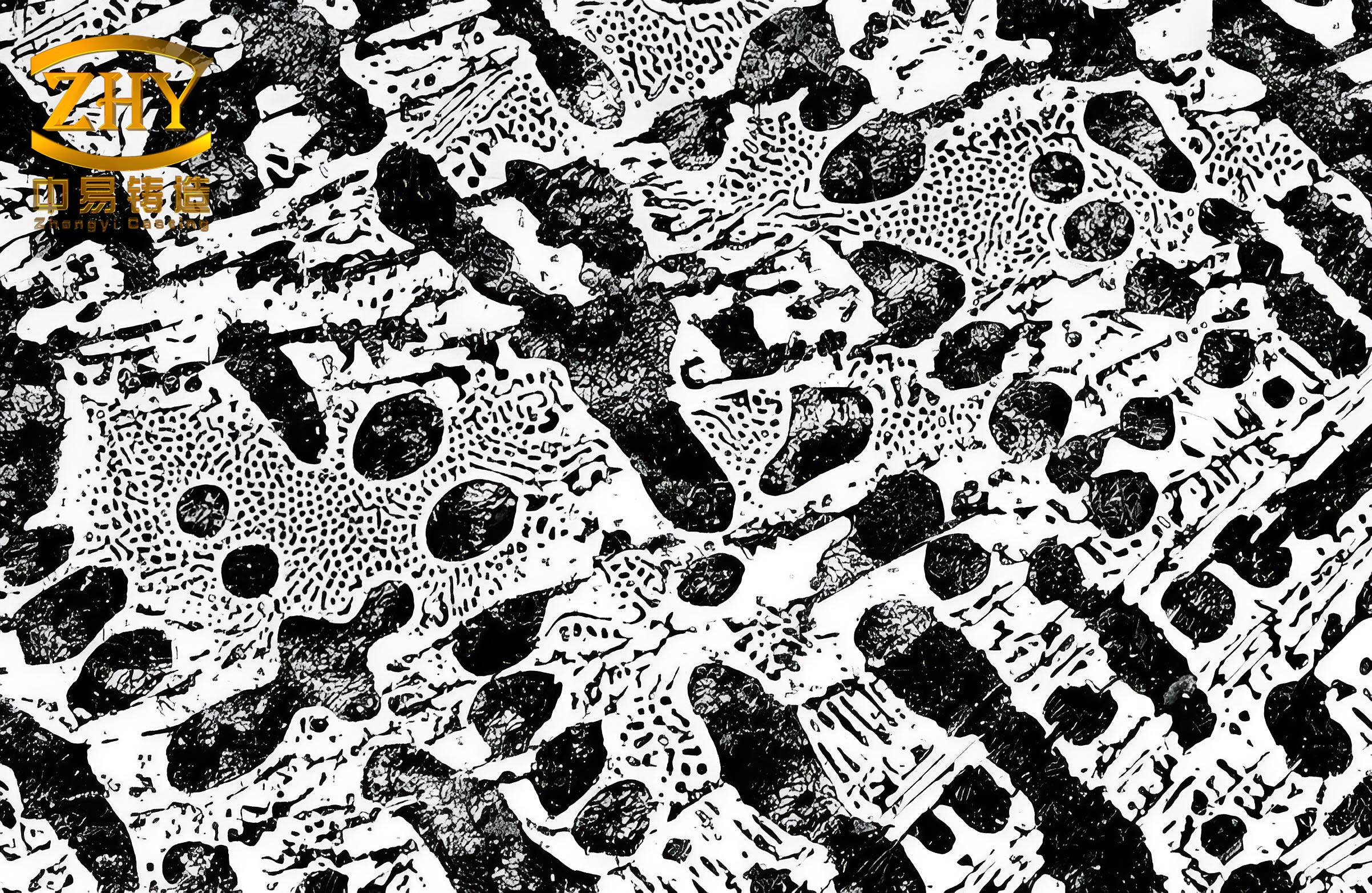
The铸态 white cast iron we studied has a composition as shown in Table 1. The high-carbon, high-silicon white cast iron contains elevated levels of carbon and silicon, which influence the casting behavior and microstructure. In contrast, the low-carbon, low-silicon white cast iron has reduced carbon and silicon, making it suitable for thicker castings. The铸态 microstructure consists of pearlite, ledeburite, and secondary cementite, with the cementite forming a continuous network that embrittles the material.
| Type | C (%) | Si (%) | Mn (%) | P (%) | S (%) | Remarks |
|---|---|---|---|---|---|---|
| High-carbon, high-silicon white cast iron | 3.2-3.6 | 1.8-2.2 | 0.5-0.8 | <0.1 | <0.1 | With minor modifiers |
| Low-carbon, low-silicon white cast iron | 2.4-2.8 | 0.8-1.2 | 0.5-0.8 | <0.1 | <0.1 | Standard grade |
The铸态 properties are summarized in Table 2. Here, $V_c$ represents the volume percentage of free cementite, $V_g$ is the volume percentage of graphite, and $\beta$ is the wear resistance coefficient compared to a reference steel. The high-carbon, high-silicon white cast iron shows higher strength due to a higher $V_c$, which refines the pearlite grains and reduces stress concentration. However, the continuous cementite network leads to low impact values, typically below 5 J/cm². The wear resistance is better for high-carbon, high-silicon white cast iron, with $\beta$ reaching 1.8, attributed to the fine pearlite and supportive cementite structure.
| Type | Tensile Strength (MPa) | Hardness (HRC) | Impact Value (J/cm²) | $V_c$ (%) | $V_g$ (%) | $\beta$ |
|---|---|---|---|---|---|---|
| High-carbon, high-silicon white cast iron | 450-500 | 50-55 | 3-4 | 25-30 | 0-1 | 1.6-1.8 |
| Low-carbon, low-silicon white cast iron | 350-400 | 45-50 | 2-3 | 15-20 | 0-1 | 1.2-1.4 |
To improve these properties, we applied normalization treatment. Normalization involves heating the white cast iron to a temperature above the austenitizing range, holding for a specific time, and then air cooling. This process breaks up the continuous cementite network, transforming it into a discontinuous or破碎网状 morphology. The normalization parameters and resulting cementite形态 are listed in Table 3. For high-carbon, high-silicon white cast iron, we tested different temperatures and holding times to optimize the outcome.
| Process Code | Heating Temperature (°C) | Holding Time (min) | Cooling Method | Cementite Morphology |
|---|---|---|---|---|
| N-1 | 920 | 60 | Air cool | Discontinuous network |
| N-2 | 950 | 90 | Air cool | Broken network |
| N-3 | 980 | 120 | Air cool | Fragmented |
After normalization, the microstructure changes significantly. The cementite network is碎化, reducing $V_c$ and increasing $V_g$ slightly. This leads to enhanced strength and toughness, as shown in Figure 1 (based on data). For instance, the high-carbon, high-silicon white cast iron treated with N-2 (950°C, 90 min) achieves a tensile strength of 550 MPa and an impact value of 6 J/cm², while maintaining a hardness of 52 HRC. The wear resistance coefficient $\beta$ remains around 1.7, indicating that normalization preserves the耐磨性 while improving toughness. We can express the relationship between toughness and cementite morphology using a simple formula: $$T \propto \frac{1}{\sqrt{V_c}}$$ where $T$ is the toughness. As $V_c$ decreases and the cementite becomes more fragmented, toughness increases.
For high-carbon, high-silicon white cast iron, the optimal normalization is at 950°C for 90 minutes, resulting in a破碎网状 cementite with $V_c$ around 20%. This provides a good balance of strength, hardness, and wear resistance. The improvement is due to the reduced stress concentration at grain boundaries and the固溶 strengthening effect of silicon. In terms of耐磨性, the mechanism involves limited micro-cutting of pearlite and reduced脆性剥落. We can model the wear rate $W$ as: $$W = k_1 \cdot V_c^{-0.5} + k_2 \cdot H^{-1}$$ where $k_1$ and $k_2$ are constants, and $H$ is the hardness. For normalized white cast iron, the wear resistance is maintained because $V_c$ is still sufficient to resist abrasion.
Next, we investigate austempering, which involves heating to an austenitizing temperature, holding, and then quenching to a salt bath at an intermediate temperature for isothermal transformation to bainite. This process yields a bainitic matrix with superior综合性能. The austempering parameters for high-carbon, high-silicon white cast iron are given in Table 4. We tested different austenitizing temperatures and holding times to vary the cementite dissolution and distribution.
| Process Code | Austenitizing Temperature (°C) | Holding Time (min) | Isothermal Temperature (°C) | Holding Time (min) | Cementite Morphology |
|---|---|---|---|---|---|
| A-1 | 920 | 60 | 280 | 120 | Discontinuous network |
| A-2 | 950 | 90 | 280 | 120 | Broken network |
| A-3 | 980 | 120 | 280 | 120 | Fragmented |
The resulting microstructure consists of bainite with dispersed cementite. For process A-2, the cementite is破碎网状 with $V_c$ around 18%, leading to excellent properties: tensile strength of 600 MPa, hardness of 55 HRC, impact value of 8 J/cm², and $\beta$ of 1.9. The bainitic matrix provides high strength and hardness, which enhance wear resistance by resisting micro-cutting. However, the脆性 of cementite is more pronounced in bainite due to less容让性, so optimizing $V_c$ is crucial. We find that for bainitic white cast iron, $V_c$ should be between 15% and 20% for best performance. The relationship can be described as: $$\sigma_b = \sigma_0 + k_3 \cdot V_c$$ where $\sigma_b$ is the tensile strength, $\sigma_0$ is the base strength of bainite, and $k_3$ is a constant. Similarly, wear resistance peaks at an optimal $V_c$, as shown by: $$\beta = \beta_0 – k_4 \cdot (V_c – V_{c,opt})^2$$ where $\beta_0$ is the maximum wear resistance, and $V_{c,opt}$ is the optimal cementite volume.
For low-carbon, low-silicon white cast iron, austempering is more challenging due to the lower carbon content, which affects hardenability. We apply a two-step process: normalization followed by low-carbon austenitizing austempering. The parameters are listed in Table 5. This approach first breaks the cementite network via normalization, then uses a low austenitizing temperature to retain部分 cementite for弥散强化.
| Process Code | Normalization Step | Austenitizing Temperature (°C) | Holding Time (min) | Isothermal Temperature (°C) | Holding Time (min) | Cementite Morphology |
|---|---|---|---|---|---|---|
| AL-1 | 920°C, 60 min, air cool | 850 | 30 | 280 | 120 | Broken network + dispersed particles |
| AL-2 | 950°C, 90 min, air cool | 850 | 30 | 280 | 120 | Broken network + dispersed particles |
The properties after this treatment are summarized in Table 6. The low-carbon, low-silicon white cast iron achieves a tensile strength of 500 MPa, hardness of 50 HRC, impact value of 7 J/cm², and $\beta$ of 1.6. The cementite is partially dissolved, with some remaining as a破碎网状 on grain boundaries and some as fine particles in the bainite. This dual distribution improves toughness without sacrificing hardness significantly. The performance is comparable to that of high-carbon, high-silicon white cast iron after austempering, making it suitable for thicker sections where casting defects are a concern.
| Process Code | Tensile Strength (MPa) | Hardness (HRC) | Impact Value (J/cm²) | $V_c$ (%) | $\beta$ |
|---|---|---|---|---|---|
| AL-1 | 480-520 | 48-52 | 6-8 | 12-15 | 1.5-1.7 |
| AL-2 | 500-550 | 50-54 | 7-9 | 10-13 | 1.6-1.8 |
Throughout our study, we emphasize the importance of cementite morphology in white cast iron. The continuous network must be broken to improve toughness, whether through normalization or austempering. For pearlitic white cast iron (from normalization), $V_c$ should be less than 25%, while for bainitic white cast iron (from austempering), $V_c$ around 18% is ideal. The破碎网状 distribution ensures均匀 stress distribution and reduces脆性剥落 during wear. We derive a综合性能 index $P$ to evaluate the treatments: $$P = \frac{\sigma_b \cdot T \cdot \beta}{H \cdot V_c}$$ where higher $P$ indicates better overall performance. For high-carbon, high-silicon white cast iron, normalization at 950°C gives $P \approx 120$, and austempering at 950°C gives $P \approx 150$, showing the superiority of austempering.
In terms of application, white cast iron modified by heat treatment can be used in low-impact, medium-stress abrasive wear conditions, such as in mining equipment, agricultural tools, and industrial machinery. The high-carbon, high-silicon white cast iron is preferable for its good casting properties and simpler热处理, while the low-carbon, low-silicon white cast iron is better for thick-walled components. Both types offer cost advantages over alloyed white cast iron, making them attractive for widespread use.
In conclusion, we have demonstrated that white cast iron can be effectively modified through heat treatment. Normalization improves toughness while maintaining hardness and wear resistance, and austempering provides even better综合性能 with a bainitic matrix. The key is controlling the cementite volume and morphology. Our findings contribute to the development of economical耐磨 materials, and we recommend further research on optimizing工艺 parameters for specific applications. White cast iron, with proper heat treatment, remains a viable alternative to high-alloy grades in many industrial scenarios.