
The production of high-integrity, large-scale grey iron castings presents a significant challenge in foundry engineering. Components like bearing liners, characterized by non-uniform wall thickness and complex geometries, are particularly susceptible to defects such as shrinkage cavities, porosity, cold shuts, and misruns. Traditional trial-and-error methods for process development are not only time-consuming and costly but also lead to high scrap rates and reduced productivity. My research focuses on leveraging advanced numerical simulation technology to analyze, predict, and eliminate these defects before physical prototyping begins. This approach is crucial for optimizing the casting process of grey iron castings, ensuring they meet stringent quality standards while improving manufacturing efficiency.
The inherent properties of grey iron, while offering excellent machinability and damping capacity, also contribute to its solidification characteristics. The formation of graphite during eutectic solidification leads to an expansion phase, which can offset some of the volumetric shrinkage of the austenite. However, in heavy sections or isolated thermal centers, this natural compensation is often insufficient, leading to internal shrinkage defects. The governing heat transfer during solidification can be described by the Fourier equation:
$$
\nabla \cdot (k \nabla T) + \dot{q} = \rho C_p \frac{\partial T}{\partial t}
$$
where $k$ is the thermal conductivity, $T$ is temperature, $\dot{q}$ is the internal heat generation rate (including latent heat release), $\rho$ is density, and $C_p$ is specific heat capacity. For grey iron castings, the term $\dot{q}$ must accurately model the release of latent heat from both the austenite and the graphite eutectic. The challenge is to design a gating and feeding system that promotes directional solidification towards the riser, ensuring that any remaining liquid shrinkage is fed from a controlled source, thereby isolating defects to the riser itself.
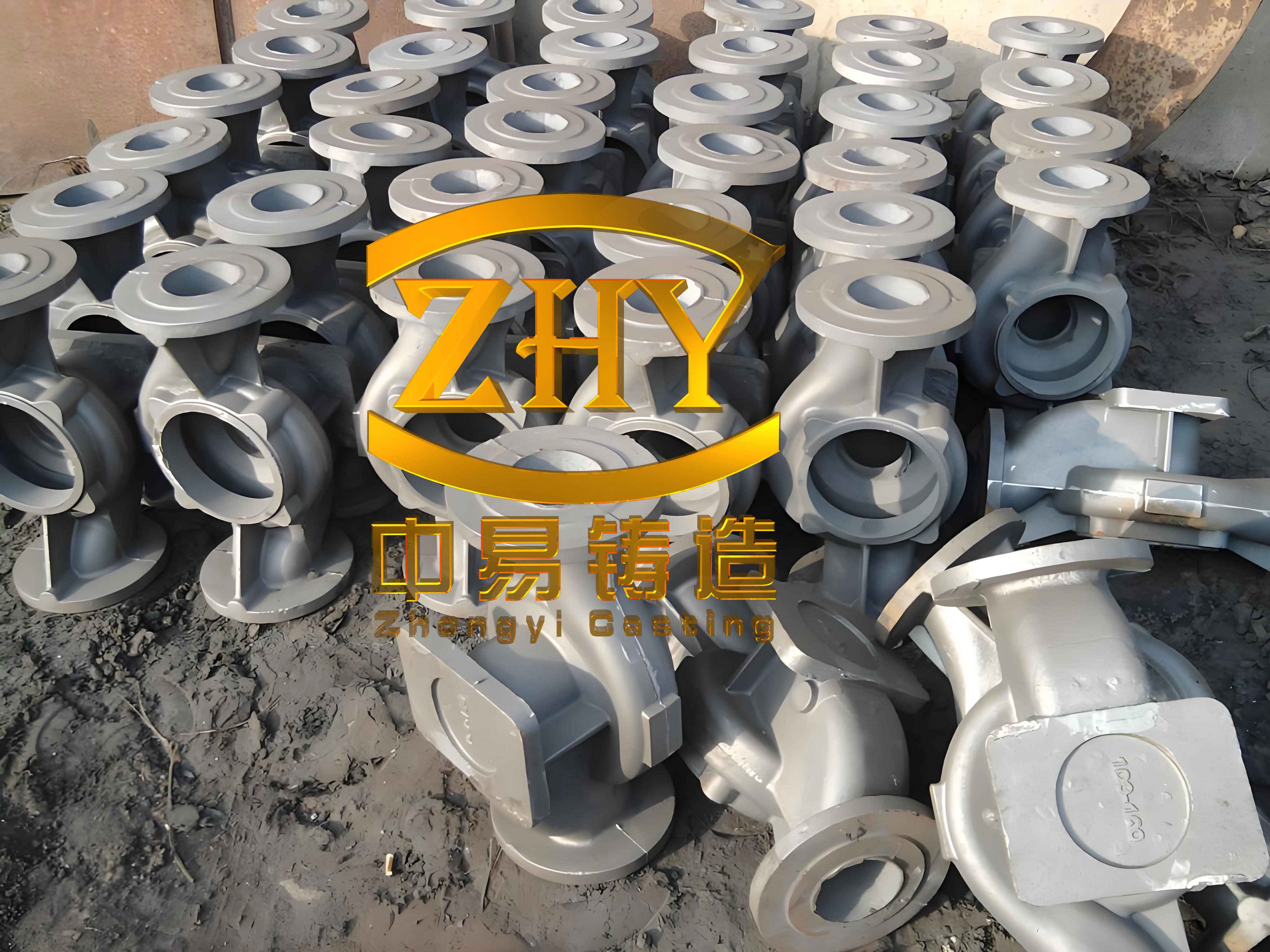
The initial process for the bearing liner, a substantial grey iron casting, employed a bottom-gated closed system with open top risers placed over the thickest sections. This is a common starting point for many grey iron castings. A three-dimensional model of the casting, complete with gating and risering systems, was created, accounting for draft angles and machining allowances. This model was meshed for numerical analysis. The simulation parameters were set based on standard foundry practice for this class of grey iron castings.
| Parameter | Value / Specification |
|---|---|
| Casting Material | HT200 (Grey Iron) |
| Pouring Temperature | 1300 °C |
| Mold Material | Green Sand |
| Initial Mold Temperature | 25 °C |
| Ambient Temperature | 25 °C |
| Average Pouring Velocity | 70 cm/s |
| Feeding System | Bottom-gated, closed system with open top risers |
The filling simulation revealed a relatively smooth fill pattern, which was a positive aspect of the initial design for these grey iron castings. However, the solidification simulation exposed the critical flaw. The progression of the solidus isotherm over time clearly showed that the risers solidified prematurely, before the thermal center in the thick section of the casting beneath them. This created an isolated liquid “hot spot” or “liquid island,” which, upon final solidification, resulted in macro-shrinkage. The Niyama criterion, often adapted for grey iron, can help predict such shrinkage areas. It is based on thermal gradients ($G$) and cooling rates ($\dot{T}$):
$$
N_y = \frac{G}{\sqrt{\dot{T}}}
$$
Areas with a Niyama value below a critical threshold are prone to shrinkage porosity. The simulation’s defect prediction module, which utilizes principles akin to this criterion combined with a mass fraction of liquid tracking, clearly flagged the region under the riser as defective. This finding was consistent with actual foundry scrap, validating the simulation’s accuracy for this type of grey iron casting.
| Simulation Stage | Key Observation | Implied Defect Risk |
|---|---|---|
| Filling | Stable, progressive fill from bottom gates. | Low risk of cold shuts or mistuns. |
| Solidification (Early) | Risers begin solidifying while casting section below remains largely liquid. | Loss of feeding path, risk of shrinkage. |
| Solidification (Final) | Isolated liquid pool forms in the thick section of the casting. | High certainty of macro-shrinkage cavity/porosity. |
| Defect Prediction | High “shrinkage percentage” indicator located directly under the riser neck. | Confirmed defect location matching physical casting scrap. |
The root cause of the failure in the initial design for these grey iron castings was the inability to establish a strong enough thermal gradient to drive directional solidification from the casting extremities towards the riser. The riser, despite its size, could not remain liquid long enough to feed the massive thermal mass of the thick section. This is a classic problem in feeding heavy sections of grey iron castings. The solution required modifying the thermal dynamics of the system. The goal was to accelerate the cooling of the thick section (the “hot spot”) relative to the riser, thereby inverting the solidification sequence. This is achieved by enhancing the heat extraction rate from the problematic area. The rate of heat extraction can be conceptualized as:
$$
Q_{extract} = h_{eff} \cdot A \cdot (T_{casting} – T_{chill})
$$
where $h_{eff}$ is the effective heat transfer coefficient, $A$ is the contact area, and $T$ represents temperature. To significantly increase $Q_{extract}$, we need to increase $h_{eff}$. This is where chills come into play.
For grey iron castings, the use of direct metallic chills can be problematic, as the intense chilling can promote the formation of undesirable chilled iron (cementite) at the surface, leading to hard spots and potential cracking. To mitigate this while still enhancing cooling, a “sand-coated” or “hanging-sand” chill was proposed. This involves placing a high-thermal-conductivity material (like cast iron or graphite) near the mold cavity but separated from the molten metal by a thin, controlled layer of sand. This layer moderates the chilling effect, preventing white iron formation while still substantially increasing the local heat extraction rate compared to sand alone. The thermal resistance of the sand layer is given by:
$$
R_{sand} = \frac{L_{sand}}{k_{sand}}
$$
where $L_{sand}$ is the sand thickness and $k_{sand}$ is its conductivity. By carefully designing this system, we achieve an optimal $h_{eff}$ that is high enough to control solidification but low enough to avoid harmful chilling in these sensitive grey iron castings.
The optimized process integrated a long, contoured sand-coated chill placed directly under the entire length of the thick section of the bearing liner. Its dimensions were designed to match the part’s geometry, ensuring uniform heat extraction. The risers were retained but now worked in concert with the chill. The principle is known as “differential cooling” or “progressive solidification control.” The chill acts as a heat sink, rapidly extracting heat from the bottom of the thick section, thereby initiating solidification there first. This creates a steep thermal gradient pointing upwards towards the riser. The riser, now being the region with the slowest cooling rate (as it is insulated and receives hot metal last), remains liquid longest and can effectively feed the solidifying casting along this established thermal gradient. The modified geometry was remeshed and simulated with identical material properties and boundary conditions to allow for a direct comparison with the initial process for these grey iron castings.
| Thermal Event | Initial Process | Optimized Process (with Chill) |
|---|---|---|
| First Solidification Start | At thin walls and edges of casting. | At interface between thick section and sand-coated chill. |
| Riser Solidification Start | Before the thick section of the casting is fully solidified (~1200s). | Significantly delayed; occurs after chill-adjacent areas are solid (~3300s). |
| Location of Last Liquid | Isolated pool within the thick section of the CASTING. | Controlled pool within the RISER neck and body. |
| Solidification Front Direction | Vague, from multiple points inward, leading to an isolated hot spot. | Clearly directional: from chill upward, then from casting ends inward, all toward the riser. |
The filling simulation for the optimized process confirmed that the addition of the chill did not adversely affect the fill pattern. The metal continued to fill smoothly and progressively from the bottom gates, demonstrating that the modification was solely a thermal management improvement, not a hydrodynamic one. The true test was the solidification simulation. The results were markedly different. The solidification isotherms now progressed uniformly from the chilled surface upward. The thick section of the casting solidified well before the riser. The final area to solidify was neatly confined to the upper portion of the riser itself. The defect prediction plot showed a complete absence of shrinkage indicators in the casting body; all predicted shrinkage was successfully relocated to the riser, which is subsequently removed during machining. This confirmed the technical feasibility of the optimized process for producing sound grey iron castings.
The validated digital process was translated into a physical production protocol. All parameters—sand composition, chill coating thickness and composition, pouring temperature, and riser dimensions—were strictly controlled. The resulting grey iron castings were inspected non-destructively and later sectioned for destructive analysis. The castings were found to be fully dense in the critical bearing liner body, with no evidence of shrinkage cavities or macro-porosity. The microstructure in the previously problematic thick section showed a uniform, Type A graphite distribution in a pearlitic matrix, free from the degenerate graphite or micro-porosity often associated with unsound solidification. The mechanical properties met and exceeded the HT200 specification. This successful outcome underscores the power of simulation-driven design for complex grey iron castings.
| Aspect | Initial (Trial-and-Error) Approach | Simulation-Optimized Approach |
|---|---|---|
| Development Time/Cost | High (multiple physical trials, scrap). | Dramatically reduced (virtual trials, first-shot success). |
| Process Understanding | Empirical, based on post-mortem analysis of defects. | Fundamental, based on visualization of filling, thermal gradients, and solidification sequence. |
| Defect Control | Reactive; defects found after casting. | Proactive; defects predicted and eliminated in process design phase. |
| Material Efficiency | Lower (oversized risers, high yield). | Higher (optimized riser size aided by chills, improved yield). |
| Product Quality & Consistency | Variable, dependent on foundry skill. | High and repeatable, embedded in the engineered process. |
In conclusion, the journey from a defective initial design to a robust, high-yield production process for large grey iron castings like bearing liners vividly demonstrates the transformative role of numerical simulation. By accurately modeling the coupled physics of fluid flow and heat transfer, simulation software acts as a virtual foundry. It allows for the deep analysis of phenomena like isolated liquid pools and premature riser solidification that plague grey iron castings. More importantly, it provides a safe and cost-effective platform for testing and validating solutions, such as the strategic use of sand-coated chills to manipulate thermal gradients. The key achievement was converting an unsound, random solidification pattern into a controlled, directional one, ensuring the final shrinkage was harmlessly contained in the feeder. This methodology moves the production of critical grey iron castings from an art reliant on experience to a science based on predictable engineering principles, ensuring higher quality, reduced waste, and greater overall manufacturing efficiency. The future of producing complex grey iron castings is inextricably linked to the continued advancement and application of these powerful digital tools.