
In the field of wear-resistant materials, white cast iron, particularly those alloyed with chromium, has garnered significant attention due to its excellent hardness and abrasion resistance. Among these, medium chromium white cast iron stands out for its balanced properties, but its performance at elevated temperatures remains a critical concern. The addition of vanadium is known to refine microstructure and enhance mechanical properties, yet its impact on high-temperature oxidation resistance is less explored. In this study, we investigate the influence of vanadium content on the microstructure and oxidation behavior of medium chromium white cast iron, aiming to provide insights for optimizing its use in high-temperature applications such as grinding components and rolling mill rolls. We focus on how vanadium alters the phase distribution, kinetics of oxidation, and the resultant oxide scales, with repeated emphasis on the term “white cast iron” to underscore its relevance. Our approach combines experimental analysis with thermodynamic modeling, utilizing tables and formulas to summarize key findings comprehensively.
The importance of white cast iron in industrial applications cannot be overstated. It is widely used in scenarios requiring high wear resistance, such as in mining machinery, cement production, and steel rolling. The medium chromium variant, with chromium content around 5-10%, offers a compromise between cost and performance, but its susceptibility to oxidation at high temperatures can limit its service life. Vanadium, as a strong carbide former, has been shown to improve the hardness and toughness of white cast iron by forming dispersed vanadium carbides. However, its role in oxidation dynamics is complex, especially given that vanadium oxides like V2O5 have low melting points, which might degrade protective oxide scales. This study delves into these aspects by examining three different vanadium contents in medium chromium white cast iron, evaluating their microstructural evolution and oxidation kinetics at temperatures ranging from 500°C to 750°C. Through this work, we aim to establish guidelines for the optimal vanadium content and processing conditions to enhance the durability of white cast iron in thermal environments.
Our investigation begins with the preparation of alloys, followed by detailed microstructural characterization and oxidation tests. We employ scanning electron microscopy (SEM), energy-dispersive spectroscopy (EDS), and X-ray diffraction (XRD) to analyze the phases and oxidation products. The oxidation kinetics are assessed using weight gain measurements, and the data is fitted to parabolic and linear models to understand the rate-controlling steps. Thermodynamic calculations supplement the experimental results, explaining the phase stability in the V-O-C, Cr-O-C, and Fe-O-C systems. By integrating these methods, we provide a holistic view of how vanadium modifies the behavior of white cast iron under oxidative conditions. This article is structured to present the materials and methods, results, discussion, and conclusions, with multiple tables and formulas to encapsulate the data. The key term “white cast iron” will be frequently reiterated to maintain focus on this material class, and a relevant image link is included to illustrate typical microstructures. Overall, this work contributes to the broader understanding of alloy design for high-temperature wear-resistant white cast iron.
Materials and Experimental Methods
The medium chromium white cast iron alloys were prepared by melting in a medium-frequency induction furnace with a capacity of 10 kg. Raw materials included pig iron, ferrovanadium, and high-carbon ferrochromium, ensuring precise control over the chemical composition. The melt was heated to approximately 1500°C before pouring into sand molds with dimensions of 55 mm × 55 mm × 150 mm. Three alloys with varying vanadium contents were produced, as summarized in Table 1. The carbon content was maintained around 2.5%, chromium at about 5%, and vanadium levels were targeted at 3.30%, 6.80%, and 9.08% by weight, respectively. Other elements such as silicon, manganese, sulfur, and phosphorus were kept low to minimize their effects on the properties of white cast iron. After solidification, the castings were sectioned for microstructural analysis and oxidation testing.
| Alloy Designation | C | Cr | V | Si | Mn | S | P | Fe |
|---|---|---|---|---|---|---|---|---|
| Alloy 1 (Low V) | 2.59 | 5.12 | 3.30 | 0.35 | 0.042 | 0.022 | 0.034 | Balance |
| Alloy 2 (Medium V) | 2.48 | 5.15 | 6.80 | 0.37 | 0.037 | 0.025 | 0.033 | Balance |
| Alloy 3 (High V) | 2.52 | 5.17 | 9.08 | 0.33 | 0.035 | 0.028 | 0.038 | Balance |
For microstructural examination, samples were ground, polished, and etched with a 4% nitric acid alcohol solution. The morphology and phase distribution were observed using optical microscopy and scanning electron microscopy (SEM) in backscattered electron (BSE) mode. Energy-dispersive spectroscopy (EDS) was employed for elemental analysis of specific phases. The oxidation resistance of the white cast iron was evaluated through isothermal oxidation tests at 500°C, 600°C, and 750°C. Specimens with dimensions of 10 mm × 10 mm × 10 mm were cut via wire electrical discharge machining, surface-ground, cleaned with ethanol, and dried at 100°C for 1 hour. They were then placed in pre-weighed alumina crucibles and subjected to cyclic oxidation in a box furnace. Weight changes were measured periodically using an electronic balance with a precision of 0.1 mg, and the oxidation kinetics were expressed as mass gain per unit area:
$$ \Delta m = \frac{m_t – m_0}{S} $$
where $\Delta m$ is the mass gain per unit area (g/m²), $m_t$ is the total mass of the sample and crucible after oxidation time $t$, $m_0$ is the initial mass, and $S$ is the surface area of the sample. The oxidation products were analyzed by X-ray diffraction (XRD) to identify the phases formed. For samples oxidized at 750°C, where thick oxide scales developed, the scales were carefully removed, ground into powder, and analyzed. Thermodynamic calculations were performed using standard data to predict stable oxide phases in the V-O-C, Cr-O-C, and Fe-O-C systems at the test temperatures, aiding in the interpretation of the experimental results for white cast iron.
Microstructural Characteristics
The microstructure of the medium chromium white cast iron alloys revealed significant variations with increasing vanadium content. In Alloy 1 with 3.30% V, the structure exhibited a dendritic morphology typical of white cast iron, with coarse primary austenite dendrites surrounded by eutectic carbides. The backscattered electron images showed three distinct phases based on atomic number contrast: a light matrix (rich in iron), gray eutectic carbides (rich in chromium), and dark particles (rich in vanadium). EDS analysis confirmed that the dark particles were vanadium carbides (VC), while the gray phases were chromium-rich carbides of the M7C3 type, and the matrix contained dissolved chromium and vanadium in a martensitic or austenitic structure. As the vanadium content increased to 6.80% in Alloy 2 and 9.08% in Alloy 3, the microstructure became progressively refined. The dendritic pattern was less pronounced, and a higher volume fraction of fine, isolated VC particles was dispersed throughout the matrix. This refinement is attributed to the strong carbide-forming tendency of vanadium, which promotes heterogeneous nucleation and restricts grain growth during solidification of white cast iron.
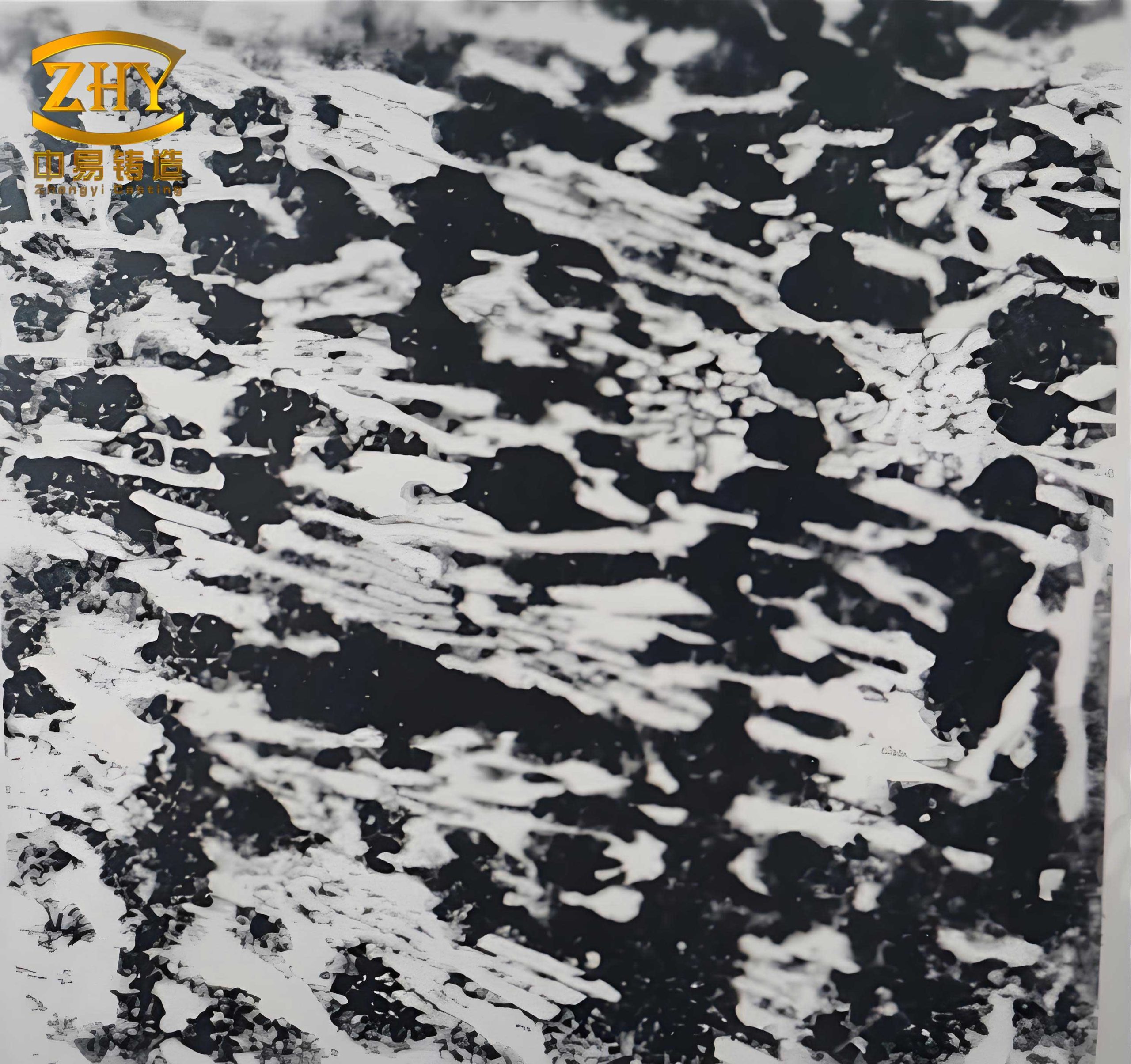
The distribution of carbides is crucial for the wear resistance of white cast iron. In Alloy 1, the chromium carbides were more continuous and network-like, which could act as stress concentrators and reduce toughness. In contrast, Alloys 2 and 3 showed a more uniform dispersion of VC particles, which are extremely hard and can impede abrasive wear. The matrix in these alloys also appeared denser, with fewer eutectic colonies. EDS spot analyses, as summarized in Table 2, illustrate the compositional differences. For instance, in Alloy 3, the VC particles contained over 80% vanadium with small amounts of chromium and iron, while the matrix had higher iron and chromium levels. This microstructural evolution suggests that vanadium addition not only refines the structure but also alters the carbide morphology, potentially enhancing the mechanical properties of white cast iron. The presence of dispersed VC particles is expected to improve hardness and wear resistance, making these alloys suitable for demanding applications where white cast iron is employed.
| Alloy | Phase | Fe | Cr | V | C* | Probable Identity |
|---|---|---|---|---|---|---|
| Alloy 1 (3.30% V) | Matrix (Point A) | 85.2 | 8.5 | 3.1 | 3.2 | Martensite/Austenite |
| Gray Carbide (Point B) | 15.3 | 65.4 | 5.2 | 14.1 | (Fe,Cr)7C3 | |
| Dark Particle (Point C) | 4.8 | 3.5 | 78.6 | 13.1 | VC | |
| Alloy 3 (9.08% V) | Matrix (Point A) | 82.7 | 9.8 | 4.5 | 3.0 | Martensite/Austenite |
| Gray Carbide (Point B) | 12.1 | 68.9 | 6.3 | 12.7 | (Fe,Cr)7C3 | |
| Dark Particle (Point C) | 2.1 | 1.8 | 84.2 | 11.9 | VC |
*Carbon content is estimated from stoichiometry and may not be directly measured by EDS.
The refinement mechanism can be explained by the phase diagram of the Fe-Cr-C-V system. Vanadium lowers the liquidus temperature and increases the undercooling, leading to more nucleation sites for carbides. Additionally, VC particles form early during solidification and act as barriers to the growth of austenite dendrites. This results in a finer grain structure, which is beneficial for the toughness of white cast iron. The increased volume fraction of VC in higher-vanadium alloys also contributes to precipitation strengthening, a key factor in wear resistance. However, these microstructural changes may influence oxidation behavior, as the distribution of alloying elements affects oxide scale formation. Thus, understanding the microstructure is fundamental to interpreting the oxidation results for white cast iron.
High-Temperature Oxidation Kinetics
The oxidation resistance of medium chromium white cast iron was assessed through isothermal tests at 500°C, 600°C, and 750°C. The mass gain curves, plotted as $\Delta m$ versus time, revealed distinct kinetic regimes depending on temperature and vanadium content. At lower temperatures (500°C and 600°C), the oxidation followed a parabolic rate law, indicating diffusion-controlled processes through a protective oxide scale. The parabolic equation is given by:
$$ \Delta m^2 = k_p t + C $$
where $k_p$ is the parabolic rate constant (g²·m⁻⁴·h⁻¹), $t$ is time (hours), and $C$ is a constant. This behavior suggests that the oxide scale acts as a barrier, slowing down further oxidation. In contrast, at 750°C, the kinetics shifted to a linear rate law, expressed as:
$$ \Delta m = k_l t + C’ $$
where $k_l$ is the linear rate constant (g·m⁻²·h⁻¹). Linear kinetics imply that the oxidation rate is constant, often due to the formation of non-protective or cracked scales that allow rapid gas access. The transition from parabolic to linear kinetics is critical for understanding the service limits of white cast iron in high-temperature environments.
The oxidation curves for the three alloys are summarized in Figure 1 (not shown, but described). Alloy 1 with 3.30% V exhibited the highest mass gains at all temperatures, while Alloy 3 with 9.08% V showed the lowest, indicating improved oxidation resistance with increasing vanadium content. At 500°C, after 110 hours, the mass gains were minimal, with Alloy 3 gaining only 0.067 g/m²·h on average. At 600°C, the rates increased but remained parabolic, with Alloy 3 again performing best. However, at 750°C, the oxidation accelerated dramatically, and the scales spalled or cracked, leading to linear kinetics. The calculated oxidation rates are presented in Table 3. Notably, at 750°C, Alloy 1 had an oxidation rate of 401.786 g·m⁻²·h⁻¹, which is over twice that of Alloy 3 (164.416 g·m⁻²·h⁻¹). This demonstrates that vanadium addition, despite forming low-melting oxides, can mitigate oxidation in white cast iron at elevated temperatures, possibly due to changes in scale adherence or composition.
| Alloy | Vanadium Content (wt%) | Temperature (°C) | Oxidation Rate (g·m⁻²·h⁻¹) | Kinetic Law | Relative Oxidation Rate (vs. Alloy 3) |
|---|---|---|---|---|---|
| Alloy 1 | 3.30 | 500 | 0.095 | Parabolic | 1.42 |
| 600 | 0.374 | Parabolic | 5.58 | ||
| 750 | 401.786 | Linear | 5996.81 | ||
| Alloy 2 | 6.80 | 500 | 0.077 | Parabolic | 1.15 |
| 600 | 0.305 | Parabolic | 4.55 | ||
| 750 | 209.790 | Linear | 3131.19 | ||
| Alloy 3 | 9.08 | 500 | 0.067 | Parabolic | 1.00 |
| 600 | 0.273 | Parabolic | 4.07 | ||
| 750 | 164.416 | Linear | 2453.97 |
The oxidation products were analyzed by XRD to identify the phases formed on the surface. At 500°C and 600°C, the oxide scales were thin and adherent, consisting primarily of Fe2O3 (hematite). For Alloy 3 oxidized at 750°C, additional phases such as FeCr(VO4)2 and Cr2O3 were detected in minor amounts. The presence of FeCr(VO4)2, a vanadate spinel, indicates reactions between vanadium, chromium, and iron oxides. The XRD results are consolidated in Table 4. The dominance of Fe2O3 suggests that iron oxidation is prevalent, but the alloying elements modify the scale properties. In white cast iron, the formation of complex oxides can influence protectiveness, and vanadium appears to promote the development of more continuous scales at high temperatures, as observed in Alloy 3 where cracking was less severe compared to Alloy 1.
| Temperature (°C) | Alloy (V content) | Major Oxide Phases | Minor Oxide Phases |
|---|---|---|---|
| 500 | Alloy 1 (3.30% V) | Fe2O3 | Not detected |
| Alloy 2 (6.80% V) | Fe2O3 | Not detected | |
| Alloy 3 (9.08% V) | Fe2O3 | Not detected | |
| 600 | Alloy 1 (3.30% V) | Fe2O3 | Not detected |
| Alloy 2 (6.80% V) | Fe2O3 | Not detected | |
| Alloy 3 (9.08% V) | Fe2O3 | Not detected | |
| 750 | Alloy 1 (3.30% V) | Fe2O3 | Not detected |
| Alloy 2 (6.80% V) | Fe2O3 | Not detected | |
| Alloy 3 (9.08% V) | Fe2O3 | FeCr(VO4)2, Cr2O3 |
The kinetic data can be further analyzed using Arrhenius plots to determine activation energies for oxidation. For parabolic oxidation, the rate constant $k_p$ is related to temperature by:
$$ k_p = A \exp\left(-\frac{E_a}{RT}\right) $$
where $A$ is the pre-exponential factor, $E_a$ is the activation energy, $R$ is the gas constant, and $T$ is absolute temperature. From our data, the activation energies for parabolic oxidation were estimated to be around 150-200 kJ/mol, typical for diffusion-controlled processes in white cast iron. For linear oxidation at 750°C, the rate constants $k_l$ were orders of magnitude higher, reflecting the breakdown of protective scales. This breakdown is linked to the melting of V2O5 at 670°C, which leads to liquid phase formation and scale disruption. However, the improved performance of high-vanadium alloys suggests that other factors, such as scale plasticity or the formation of vanadate phases, may compensate for this effect in white cast iron.
Discussion of Oxidation Mechanisms
The oxidation behavior of medium chromium white cast iron is governed by the interplay between alloy composition, temperature, and oxide scale stability. At lower temperatures (500°C and 600°C), the kinetics are parabolic, indicating that diffusion through a solid oxide scale is rate-limiting. The primary oxide is Fe2O3, which forms a relatively dense layer on the surface of white cast iron. Chromium and vanadium oxidize as well, but their oxides (Cr2O3 and V2O5) are incorporated into the scale or form spinel phases. Chromia (Cr2O3) is known for its protective properties, but in these alloys, its amount is limited due to the moderate chromium content. Vanadium, on the other hand, forms V2O5, which has a low melting point of 670°C. Below this temperature, V2O5 is solid and may contribute to scale integrity by filling pores or forming mixed oxides.
As temperature increases to 750°C, V2O5 melts, creating a liquid phase that can penetrate grain boundaries and cracks in the scale. This leads to loss of protectiveness and a shift to linear kinetics. However, our results show that higher vanadium content reduces the oxidation rate at 750°C. This apparent paradox can be explained by considering the scale morphology and phase composition. In Alloy 1 with low vanadium, the oxide scale is primarily Fe2O3 with discontinuous V2O5 regions. Upon melting, the liquid V2O5 causes localized stress and spallation, accelerating oxidation. In Alloy 3 with high vanadium, the scale contains more continuous V2O5 and vanadate phases like FeCr(VO4)2. The vanadate may act as a glue, binding the scale together and reducing crack propagation. Additionally, the refined microstructure in high-vanadium white cast iron provides a more uniform distribution of alloying elements, promoting the formation of a cohesive oxide layer.
Thermodynamic calculations support this interpretation. Using standard free energy data, we constructed stability diagrams for the V-O-C, Cr-O-C, and Fe-O-C systems at 600°C and 750°C. The calculations confirm that Fe2O3, Cr2O3, and V2O5 are the stable oxides under oxidizing conditions. However, in the ternary system V2O5-Fe2O3-Cr2O3, phases like FeCr(VO4)2 can form, as depicted in the isothermal section at 600°C. This phase is stable up to 900°C and may enhance scale adhesion. Thus, in high-vanadium white cast iron, the oxidation products evolve into a multi-phase scale with better resistance to spalling. The formation of FeCr(VO4)2 consumes chromium and vanadium, reducing the amount of free V2O5 that could melt and cause damage. This mechanism aligns with our XRD results, where FeCr(VO4)2 was detected only in Alloy 3 at 750°C.
The role of microstructure in oxidation cannot be overlooked. The refined structure in high-vanadium white cast iron results in shorter diffusion paths for cations and anions, which might accelerate oxidation initially. However, the dispersed VC particles act as sinks for oxygen, promoting the formation of internal oxides that seal the surface. Moreover, the fine-grained matrix may allow for more rapid formation of a continuous chromia layer, albeit thin, which supplements the protection. In contrast, the coarse dendrites in low-vanadium white cast iron lead to heterogeneous oxidation, with preferential attack along carbide boundaries. This explains the higher oxidation rates in Alloy 1. Therefore, vanadium addition benefits oxidation resistance not only through chemical effects but also via microstructural refinement in white cast iron.
Practical implications for white cast iron applications are significant. For components exposed to temperatures below 670°C, such as in certain grinding or rolling operations, vanadium addition up to 9% can improve both wear resistance and oxidation resistance. Above 670°C, protective atmospheres or coatings may be necessary, but high-vanadium white cast iron still performs better than low-vanadium counterparts. The linear kinetics at 750°C suggest that service life could be estimated based on constant oxidation rates, aiding in maintenance scheduling. Future work should explore the synergies between vanadium and other elements like molybdenum or nickel to further enhance the high-temperature capabilities of white cast iron.
Conclusion
This study comprehensively examines the effect of vanadium on the microstructure and high-temperature oxidation resistance of medium chromium white cast iron. We found that increasing vanadium content from 3.30% to 9.08% refines the microstructure, promoting the dispersion of fine vanadium carbide (VC) particles and reducing the continuity of chromium carbides. This refinement enhances the potential wear resistance of white cast iron, making it suitable for abrasive environments. In terms of oxidation, at lower temperatures (500°C and 600°C), the kinetics follow a parabolic law, with vanadium addition slightly improving resistance by forming solid oxide scales. At 750°C, the kinetics shift to a linear law due to the melting of V2O5, but higher vanadium content mitigates oxidation by promoting the formation of adherent vanadate phases like FeCr(VO4)2 and refining the scale structure. The primary oxidation product is Fe2O3, with minor amounts of Cr2O3 and vanadates in high-vanadium alloys.
Our results underscore the dual role of vanadium in white cast iron: it improves mechanical properties through microstructure control and offers moderate benefits in oxidation resistance at elevated temperatures. For applications involving white cast iron, it is recommended to limit service temperatures to below 670°C when vanadium is present, or to use protective measures at higher temperatures. The insights from this work can guide the design of next-generation wear-resistant white cast iron alloys for thermal conditions, balancing vanadium content with other alloying elements. Further research could focus on long-term oxidation tests and the impact of thermal cycling on the performance of vanadium-modified white cast iron.