
In the field of industrial materials, wear and tear of components and tools lead to significant economic losses, driving the need for advanced abrasion-resistant materials. Among these, high chromium white cast iron stands out due to its exceptional wear resistance, which stems from the formation of hard chromium carbides. The addition of chromium transforms the typical M3C carbide into M7C3 carbide, with a hardness ranging from 1300 to 1800 HV, significantly enhancing the material’s performance. Moreover, the M7C3 carbides exhibit a rod-like, isolated distribution during solidification, improving toughness compared to conventional white cast iron. Through tailored heat treatments, the matrix microstructure can be adjusted to suit various service conditions. This article, from my perspective as a researcher in metallurgy, aims to comprehensively review over a decade of studies, production techniques, and applications of high chromium white cast iron, with a focus on its optimization for diverse wear environments. I will incorporate tables and formulas to summarize key findings, ensuring a detailed understanding of this versatile material.
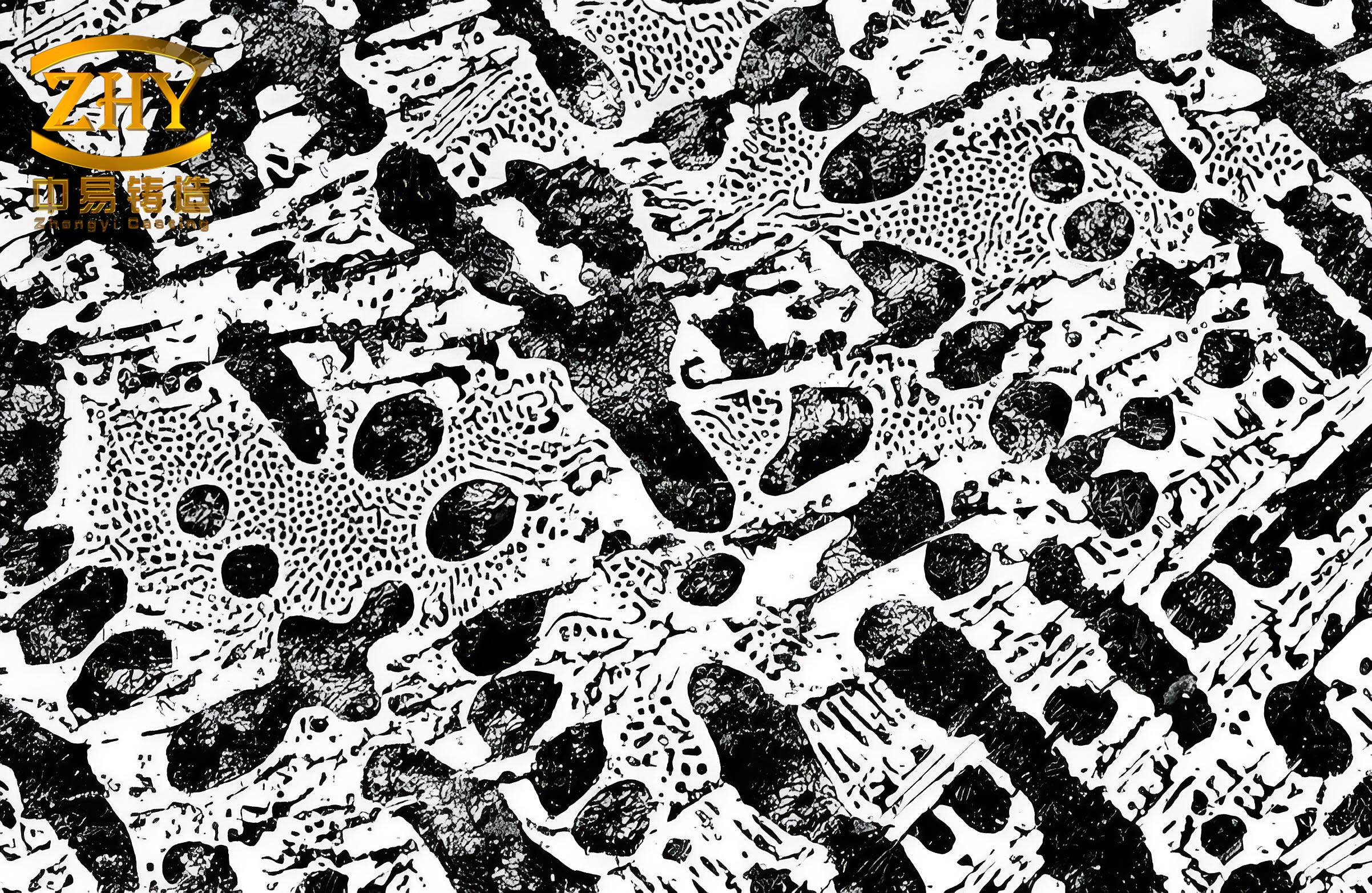
The image above illustrates the typical microstructure of high chromium white cast iron, highlighting the distribution of carbides within the matrix. This visual representation underscores the importance of microstructure control in achieving desired properties for white cast iron applications. In the following sections, I will delve into the research advancements, production methods, and practical uses of this material, emphasizing how its composition and processing influence performance.
1. Research on High Chromium White Cast Iron
Extensive research has been conducted to understand the behavior of high chromium white cast iron under different conditions. Studies focus on abrasion mechanisms, alloying effects, heat treatment responses, and modification techniques to enhance its properties. The goal is to optimize the balance between wear resistance and toughness, making white cast iron suitable for harsh operational environments.
1.1 Abrasion Resistance of White Cast Iron
The abrasion resistance of high chromium white cast iron is highly dependent on the wear conditions, including stress levels, impact, and the hardness of abrasives. Wear is a complex system, and the failure modes vary accordingly. Research using two-body and three-body wear tests simulates different scenarios to evaluate performance. In two-body wear, dominated by cutting actions, the carbides may not protect the matrix if abrasives are harder than the M7C3 carbides. Conversely, with softer abrasives, carbides effectively shield the matrix, and a hard martensitic matrix provides optimal support. Three-body wear involves rolling abrasives that can cause carbide spalling or matrix preferential wear, influencing material selection. Erosion wear, characterized by solid particle impact, shows strong dependence on impact angle; low angles favor cutting, while high angles lead to carbide fracture. The energy distribution between abrasive and material also plays a critical role. For instance, with hard abrasives like silicon carbide, austenitic matrices with good ductility perform better, whereas with soft abrasives like garnet, martensitic matrices excel. The key to superior abrasion resistance in white cast iron is the synergy between carbide protection and matrix support, coupled with adequate toughness to prevent brittle fracture.
To quantify these effects, wear rates can be expressed using empirical formulas. For example, the wear volume loss \( V \) under abrasive conditions might be modeled as:
$$ V = k \cdot H^{-n} \cdot \sigma^{m} $$
where \( k \) is a material constant, \( H \) is the hardness of the white cast iron, \( \sigma \) is the applied stress, and \( n, m \) are exponents dependent on wear mechanism. For high chromium white cast iron, the hardness contribution from carbides can be approximated as:
$$ H_{\text{composite}} = f_{\text{carbide}} \cdot H_{\text{M}_7\text{C}_3} + (1 – f_{\text{carbide}}) \cdot H_{\text{matrix}} $$
with \( f_{\text{carbide}} \) being the volume fraction of M7C3 carbides, typically ranging from 0.2 to 0.4 for common compositions.
| Abrasive Type | Hardness (HV) | Wear Condition | Optimal Matrix | Key Failure Mode | Relative Wear Resistance |
|---|---|---|---|---|---|
| Silicon Carbide | ~2600 | Two-body, cutting-dominated | Austenite (ductile) | Carbide cutting, matrix wear | Moderate, increases slightly with carbide content |
| Garnet | ~1360 | Two-body, low-stress | Martensite (hard) | Matrix protected by carbides | High, significantly improves with carbide content |
| Silicon Carbide | ~2600 | Three-body, rolling | Austenite | Carbide spalling, matrix wear | Low, decreases with carbide content |
| Garnet | ~1360 | Three-body, rolling | Martensite | Carbide protection effective | Very high, improves with carbide content |
| Quartz Sand | ~1120 | Erosion, low angle (20°) | Martensite or austenite | Cutting and minor impact | Slightly better than standard steels |
| Quartz Sand | ~1120 | Erosion, high angle (90°) | Austenite | Carbide fracture, severe impact | Worse than some steels |
| Glass Beads | ~540 | Erosion, various angles | Martensite | Abrasive fragmentation, energy absorption | Excellent, superior to many materials |
This table highlights how the performance of white cast iron varies with abrasive hardness and wear mode, guiding material selection for specific applications.
1.2 Alloying of High Chromium White Cast Iron
Alloying is a common approach to enhance the properties of high chromium white cast iron, either to reduce costs or improve comprehensive performance. Elements like vanadium, boron, and manganese have been studied for their effects on microstructure and wear resistance. Vanadium addition, for instance, promotes the formation of vanadium-containing carbides and refines the microstructure, leading to improved hardness, toughness, and corrosion resistance. Boron increases the volume fraction of hard phases, such as (Fe,Cr)23(C,B)6, enhancing abrasion resistance against soft abrasives but may reduce it against hard ones. Manganese can partially replace molybdenum to lower costs, though with slight decreases in hardness and wear resistance. These alloying strategies allow tailoring white cast iron for targeted environments.
The effect of alloying elements on carbide formation can be described using thermodynamic models. For example, the stability of M7C3 carbides in white cast iron is influenced by chromium equivalent, often calculated as:
$$ \text{Cr}_{\text{eq}} = \%\text{Cr} + 1.5 \cdot \%\text{Si} + 2 \cdot \%\text{Mo} + \ldots $$
Adding vanadium modifies this to include vanadium’s strong carbide-forming tendency, with a contribution factor. The hardness improvement from vanadium can be approximated linearly for small additions:
$$ \Delta H = k_V \cdot \%V $$
where \( k_V \) is a constant around 50-100 HV per weight percent vanadium in white cast iron.
| Alloying Element | Typical Addition Range (wt%) | Microstructural Changes | Hardness Change | Toughness Change | Wear Resistance Impact | Notes |
|---|---|---|---|---|---|---|
| Vanadium (V) | 0.5-4.5 | Forms VC carbides, refines M7C3, may yield as-cast martensite | Increases by 50-200 HV | Improves slightly | Enhances against soft and corrosive abrasives | Cost-effective for certain applications |
| Boron (B) | 0.05-1.5 | Increases hard phase volume, forms borocarbides like (Fe,Cr)23(C,B)6 | Increases significantly at high B | May decrease due to brittleness | Improves 50-100% vs. quartz, but drops vs. SiC | Effective for low-stress abrasion in white cast iron |
| Manganese (Mn) | 1-5 (replacing Mo) | Stabilizes austenite, reduces carbide network | Slight decrease | Improves marginally | Slight reduction, but cost-saving | Partial Mo replacement viable for thin sections |
| Molybdenum (Mo) | 0.5-3 | Enhances hardenability, refines matrix | Increases moderately | May improve with proper heat treatment | Improves overall, especially in thick sections | Traditional alloying element for white cast iron |
This table summarizes how different elements modify white cast iron, aiding in formulation design.
1.3 Heat Treatment of White Cast Iron
Heat treatment is crucial for achieving the desired matrix microstructure in high chromium white cast iron, typically martensitic for maximum wear resistance. The process involves austenitizing, quenching, and tempering, with parameters tailored to composition and section size. Research shows that quenching temperature and cooling rate significantly affect hardness. At lower austenitizing temperatures (920-960°C), slow cooling yields low-carbon martensite with lower hardness, while fast cooling produces high-carbon martensite with higher hardness. At higher temperatures (1040°C), slow cooling reduces retained austensite, increasing hardness, but fast cooling increases retained austensite, lowering hardness. An intermediate temperature around 1000°C often gives peak hardness at an optimal cooling rate. Tempering up to 450°C has minimal effect on hardness due to high tempering resistance. To avoid cracking, controlled heating rates (e.g., 100-200°C/h below 600°C) and slow cooling after austenitizing are recommended. The goal is to fully destabilize the austenite, preferably starting with a pearlitic as-cast structure for complete transformation.
The relationship between quenching temperature \( T_q \) and hardness \( H \) can be modeled for white cast iron using empirical equations. For instance, a polynomial fit might be:
$$ H = a T_q^2 + b T_q + c $$
where \( a, b, c \) are constants dependent on cooling rate and composition. The cooling rate \( \dot{T} \) influence can be expressed as:
$$ H = H_0 + \alpha \cdot \dot{T} + \beta \cdot \dot{T}^2 $$
with \( H_0, \alpha, \beta \) determined experimentally. The volume fraction of retained austensite \( f_{\gamma} \) after quenching affects hardness:
$$ H \propto (1 – f_{\gamma}) \cdot H_{\text{martensite}} + f_{\gamma} \cdot H_{\text{austenite}} $$
where \( H_{\text{martensite}} \approx 800-1000 \, \text{HV} \) and \( H_{\text{austenite}} \approx 500-700 \, \text{HV} \) for typical white cast iron.
| Parameter | Range | Effect on Matrix | Hardness Trend | Toughness Trend | Recommended for |
|---|---|---|---|---|---|
| Austenitizing Temperature | 920-1040°C | Controls carbon solubility in austensite, carbide dissolution | Peak at ~1000°C for moderate cooling | Higher temps may increase retained austensite, improving toughness | Adjust based on Cr/C ratio; higher for higher Cr/C |
| Cooling Rate | Slow (furnace cool) to Fast (air or oil quench) | Influences martensite formation and retained austensite | Varies: slow cooling at high temp gives high hardness; fast cooling at low temp gives high hardness | Faster cooling may reduce toughness due to residual stresses | Optimize for section size; slow cooling reduces cracking |
| Tempering Temperature | 200-450°C | Relieves stresses, may precipitate secondary carbides | Nearly constant in this range | Can improve slightly by stress relief | Optional for stress relief; minimal property change |
| Heating Rate | 100-200°C/h below 600°C | Prevents thermal shock and cracking | No direct effect | Reduces risk of fracture | Essential for large or complex white cast iron castings |
This table provides guidelines for heat treating white cast iron to achieve optimal performance.
1.4 Modification Treatment of White Cast Iron
Modification treatment, involving the addition of trace elements like potassium, sodium, magnesium, or rare earths, refines the microstructure of high chromium white cast iron, particularly the carbide morphology. These elements act as surface-active agents, adsorbing on carbide growth fronts or segregating at interfaces, promoting isolated, blocky carbides instead of continuous networks. This improves toughness and wear resistance. For instance, potassium treatment can increase toughness by 58-112% and reduce wear loss by 28-74%, with slight hardness gains. Combined modifications using rare earths, vanadium, titanium, and boron further enhance properties, yielding toughness improvements of 60-160% and wear loss reductions of 17-47%. The mechanism involves providing nucleation sites and altering growth patterns, leading to more uniform austenitic grains and discrete carbides. Such treatments are cost-effective ways to boost the durability of white cast iron without major composition changes.
The effect of modification on carbide morphology can be quantified using shape factors. For example, the aspect ratio \( AR \) of carbides, defined as length divided by width, decreases with effective modification:
$$ AR = \frac{L}{W} $$
Typically, unmodified white cast iron has \( AR > 5 \) for networked carbides, while modified versions show \( AR < 3 \) for blocky carbides. The toughness improvement \( \Delta K \) correlates with carbide isolation:
$$ \Delta K \propto \frac{1}{\sqrt{\text{carbide connectivity}}} $$
Wear resistance enhancement can be modeled as a function of carbide refinement:
$$ \frac{W_{\text{unmodified}}}{W_{\text{modified}}} = 1 + \gamma \cdot \Delta S $$
where \( \Delta S \) is the change in carbide spacing and \( \gamma \) is a material constant for white cast iron.
| Modifier Element(s) | Addition Method | Carbide Morphology Change | Toughness Increase (%) | Wear Loss Reduction (%) | Hardness Change | Remarks |
|---|---|---|---|---|---|---|
| Potassium (K) | Inoculation during melting | Network broken, rod-like to blocky | 58-112 | 28-74 | Slight increase | Most effective single modifier for white cast iron |
| Sodium (Na) | Inoculation during melting | Similar to K, less pronounced | 40-80 | 20-60 | Minor increase | Good alternative, but handling precautions needed |
| Magnesium (Mg) | Inoculation or addition | Refines carbides, reduces connectivity | 50-90 | 25-65 | Stable or slight increase | Also acts as a desulfurizer in white cast iron |
| Rare Earths (RE) with V, Ti, B | Composite inoculation | Isolated blocky carbides, uniform matrix | 60-160 | 17-47 | Negligible change | Best combined effect on toughness and wear |
This table illustrates how modification treatments can tailor white cast iron for enhanced performance in demanding applications.
2. Production Processes for High Chromium White Cast Iron
The production of high chromium white cast iron involves careful control of melting, casting, and post-processing to achieve the desired properties. Advances in metal mold casting and composite casting have expanded its applicability, offering cost-effective and high-performance solutions.
2.1 Melting and Casting Properties of White Cast Iron
High chromium white cast iron can be melted in various electric furnaces with alkaline, neutral, or acidic linings. Cupola melting is less suitable due to uncontrolled chromium loss and carbon pickup. The molten metal has good fluidity, allowing pouring at relatively low temperatures (1260-1370°C) to promote fine grain structure. Casting can be done in dry or green sand molds, as well as other methods. However, white cast iron has high shrinkage similar to steel, requiring risers for feeding, with a pattern shrinkage allowance of about 2%. Its low thermal conductivity and high elastic modulus make it prone to cracking, necessitating uniform cooling and minimal restraint during solidification. Proper gating and riser design are essential to produce sound castings of white cast iron.
The fluidity \( F \) of white cast iron can be estimated using empirical relations based on composition and temperature:
$$ F = A \cdot e^{-B/(T – T_{\text{liquidus}})} $$
where \( A \) and \( B \) are constants, \( T \) is the pouring temperature, and \( T_{\text{liquidus}} \) is the liquidus temperature, which for high chromium white cast iron is around 1200-1250°C depending on chromium content. The risk of hot tearing relates to thermal stress \( \sigma_{\text{thermal}} \):
$$ \sigma_{\text{thermal}} = E \cdot \alpha \cdot \Delta T $$
with \( E \) as Young’s modulus (~200 GPa for white cast iron), \( \alpha \) as thermal expansion coefficient (~12×10-6 /°C), and \( \Delta T \) as temperature gradient.
2.2 Metal Mold Casting of White Cast Iron
Metal mold casting has gained popularity for producing high chromium white cast iron grinding balls, as it eliminates the need for heat treatment, simplifying production and reducing costs. This process yields specific matrix structures like troostite or austenite directly from casting. For example, troostitic white cast iron balls show good wear resistance and low breakage, while austenitic versions, after low-temperature aging (200-260°C for 4-6 hours), offer excellent performance with wear resistance over 8 times that of forged steel balls. These metal-cast white iron balls often have lower alloy content (e.g., reduced molybdenum and copper), making them economical. They demonstrate low ball consumption (50-90 g per ton of cement) and minimal fracture, showcasing the versatility of white cast iron in as-cast forms.
The cooling rate in metal molds \( \dot{T}_{\text{mold}} \) is higher than in sand molds, affecting microstructure. For white cast iron, the secondary dendrite arm spacing \( \lambda_2 \) relates to cooling rate:
$$ \lambda_2 = k \cdot \dot{T}_{\text{mold}}^{-n} $$
with \( k \approx 50 \, \mu\text{m} \cdot (\text{°C/s})^n \) and \( n \approx 0.3-0.4 \) for typical compositions. The hardness of as-cast metal mold white cast iron \( H_{\text{as-cast}} \) can be predicted from cooling rate and composition:
$$ H_{\text{as-cast}} = C_0 + C_1 \cdot \%\text{Cr} + C_2 \cdot \dot{T}_{\text{mold}} $$
where \( C_0, C_1, C_2 \) are regression coefficients.
| Matrix Type | Typical Composition (wt%) | Processing | Hardness (HRC) | Ball Consumption (g/ton cement) | Relative Wear vs. Steel | Advantages |
|---|---|---|---|---|---|---|
| Troostite | Cr: 15-20, C: 2.5-3.5, low Mo | As-cast from metal mold | 55-62 | 50-90 | ~10 times better | No heat treatment, cost-effective, good toughness |
| Austenite (aged) | Cr: 15-20, C: 2.5-3.5, Mn substituted | Metal cast + low-temp aging | 50-58 | 60-100 | ~8 times better | High impact resistance, suitable for wet grinding |
| Martensite (traditional) | Cr: 15-20, C: 2.5-3.5, Mo: 1-3 | Sand cast + heat treatment | 60-68 | 40-80 | ~12 times better | Maximum wear resistance, but higher cost |
This table highlights how metal mold casting optimizes white cast iron for grinding applications.
2.3 Composite Casting of White Cast Iron
To address the limited toughness of high chromium white cast iron under high-impact conditions, composite casting techniques bond it with tougher steel substrates, creating bimaterials that combine wear resistance and durability. Methods include electroslag casting, impregnation, insert casting, dual-liquid casting, and centrifugal casting. For instance, centrifugal casting produces rolls or sleeves with a white cast iron wear layer on a steel core, ideal for mining and cement equipment. These processes ensure metallurgical bonding, offering synergistic benefits. Composite white cast iron components exhibit prolonged service life in severe abrasion environments, demonstrating the material’s adaptability through innovative manufacturing.
The bonding strength \( \tau_b \) in composite white cast iron depends on interface characteristics and can be modeled as:
$$ \tau_b = \tau_0 + k_i \cdot \Delta T_{\text{bonding}} $$
where \( \tau_0 \) is the base strength and \( k_i \) is a constant related to interdiffusion. The wear performance of the composite \( W_c \) relates to layer thickness \( t_{\text{white iron}} \):
$$ W_c^{-1} = \frac{t_{\text{white iron}}}{L} \cdot W_{\text{white iron}}^{-1} + \left(1 – \frac{t_{\text{white iron}}}{L}\right) \cdot W_{\text{steel}}^{-1} $$
with \( L \) as total thickness and \( W \) as wear rates, showing how white cast iron enhances overall durability.
3. Applications of High Chromium White Cast Iron
High chromium white cast iron is widely used in industries requiring superior abrasion resistance. Its applications span mining, cement production, power generation, and material handling. Common components include liners for coal mills and ore crushers, grinding balls and rods in cement mills, shot blasting machine parts, and slurry pump impellers. The material’s ability to withstand severe wear, coupled with moderate toughness and corrosion resistance, makes it a preferred choice over alternatives like manganese steel or lower-alloy white irons. In mining, white cast iron liners extend equipment life, reducing downtime. In cement plants, grinding media made of white cast iron lower operational costs due to reduced consumption. Additionally, specialized versions with alloying or modifications serve in corrosive environments, such as in chemical processing or dredging. The versatility of white cast iron continues to drive its adoption across sectors, with ongoing research expanding its reach into new areas like additive manufacturing and advanced composites.
| Industry | Component Examples | Key Requirements | White Cast Iron Grade/ Treatment | Performance Benefits |
|---|---|---|---|---|
| Mining and Mineral Processing | Crusher liners, grinding mill liners, hammer heads | High-stress abrasion, impact resistance | Martensitic with high carbide content, often modified | Long service life, reduced replacement frequency |
| Cement Manufacturing | Grinding balls, mill liners, separator blades | Abrasion from clinker and raw materials, moderate impact | Metal-cast troostitic or heat-treated martensitic | Low ball consumption, high grinding efficiency |
| Power Generation | Coal pulverizer rolls, fan blades, ash handling parts | Erosion and abrasion from coal and ash | Austenitic or martensitic with erosion resistance | Improved durability in abrasive flows |
| Shot Blasting and Surface Cleaning | Blast wheels, blades, liners | Severe erosion from metallic shot | High-hardness martensitic, often alloyed with boron | Resists cutting and deformation from high-velocity particles |
| Pumping and Dredging | Slurry pump impellers, volutes, dredger teeth | Abrasion-corrosion in wet environments | Corrosion-resistant grades with chromium and vanadium | Combines wear and corrosion resistance for harsh fluids |
This table underscores the broad utility of white cast iron in solving wear-related challenges.
4. Conclusion
In summary, high chromium white cast iron represents a critical advancement in abrasion-resistant materials, offering a unique combination of hard carbides and tailorable matrix structures. Research has elucidated its behavior under diverse wear conditions, guiding the selection of compositions and heat treatments for optimal performance. Alloying and modification treatments further enhance properties, while production techniques like metal mold and composite casting expand its economic and functional scope. Applications across mining, cement, and other industries demonstrate its value in reducing wear-related costs. However, challenges remain, particularly in improving toughness for high-impact scenarios and exploring non-martensitic matrices. Future work should focus on advanced processing methods, such as additive manufacturing, to produce complex white cast iron components with refined microstructures. By continuing to innovate, white cast iron will maintain its role as a cornerstone material in the fight against wear, driving efficiency and sustainability in industrial operations.
From my perspective, the journey of white cast iron from a brittle material to a versatile performer highlights the importance of interdisciplinary research in materials science. As we push boundaries, integrating computational modeling with experimental validation will unlock new potentials for white cast iron, ensuring it meets the evolving demands of modern engineering. The repeated emphasis on “white cast iron” in this review underscores its centrality in abrasion-resistant applications, and I hope this comprehensive analysis aids engineers and researchers in harnessing its full capabilities.