
The performance and service life of grinding media, particularly grinding balls used in mineral processing and cement industries, are critically dependent on their resistance to impact and abrasion. Low chrome white cast iron is a widely used material for such applications due to its good wear resistance and cost-effectiveness. However, a significant drawback limiting its broader and more reliable application is its inherent brittleness. This brittleness manifests during production and service as cracking, spalling, and catastrophic failure, leading to reduced efficiency and increased operational costs. A comprehensive understanding of the mechanisms driving this brittleness is therefore paramount for developing effective production control strategies to mitigate it and produce more reliable, high-performance grinding balls.
The core of the problem lies in the microstructure of low chrome white cast iron. In its conventional as-cast state, the microstructure can be visualized as a continuous, three-dimensional network of hard and brittle M3C-type carbides (primarily (Fe,Cr)3C) enveloping the metallic matrix. This matrix typically consists of martensite, retained austenite, or pearlite depending on the composition and heat treatment. This carbide network acts like a brittle sponge or skeleton, severely constraining the ductile matrix. The primary mechanism of brittleness is the severe degradation of strength and toughness caused by this hard, brittle phase. The interconnected network acts as a pre-existing path for crack propagation, effectively “cutting” or isolating sections of the tougher matrix, making the material highly susceptible to fracture under impact or thermal stress.
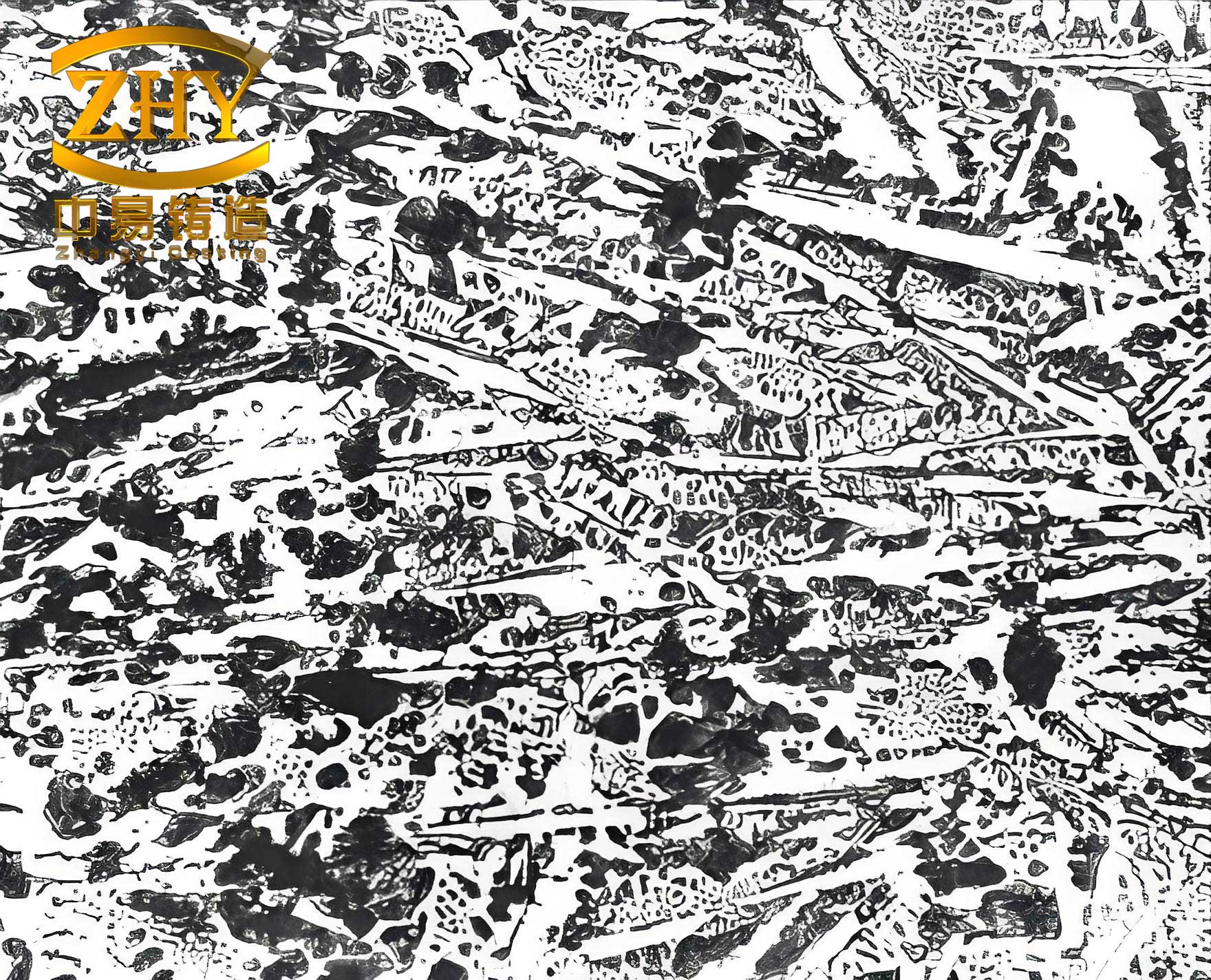
Understanding the formation and characteristics of this detrimental microstructure requires a multi-faceted analysis. The brittleness of low chrome white cast iron grinding balls is not attributable to a single factor but is the result of a complex interplay between solidification behavior, phase transformations, thermal properties, and processing parameters. The following sections detail the key mechanisms contributing to brittleness.
1. Mechanisms of Brittleness Formation
1.1 The Detrimental Role of Carbide Morphology
In hypoeutectic low chrome white cast iron, the primary solidification phase is austenite, followed by the eutectic reaction: Liquid → Austenite + M3C. The M3C carbide is the leading phase in this eutectic reaction, meaning it grows ahead of the austenite, leading to the formation of a continuous network. The morphology, continuity, and distribution of these carbides are the most significant factors controlling brittleness.
- Continuous Network: The interconnected carbide network provides an easy path for crack initiation and propagation. Under mechanical or thermal stress, cracks nucleate at the brittle carbides or at the carbide/matrix interface and propagate rapidly through the network with minimal energy absorption from the matrix.
- Crack Propagation Channel: Studies on the thermal fatigue behavior of alloyed white cast iron under cyclic heating and cooling stresses have shown that carbides serve as the primary channel for crack initiation and propagation. The brittle carbides themselves can fracture under cyclic stress, and once a crack forms, it extends quickly along the carbide network. The crack propagation rate ($\frac{da}{dN}$) in materials with a continuous network is significantly higher than in those with isolated carbides. This relationship can often be described by Paris’ law for fatigue crack growth:
$$ \frac{da}{dN} = C(\Delta K)^m $$
where $a$ is the crack length, $N$ is the number of cycles, $\Delta K$ is the stress intensity factor range, and $C$ and $m$ are material constants. A continuous carbide network results in a higher effective $\Delta K$ and a higher value for the constant $C$, leading to faster failure. - Impeding Hardenability: The continuous carbide network also acts as a barrier to carbon and alloy element diffusion during heat treatment. This can hinder the through-thickness hardenability of the grinding ball, leading to non-uniform microstructure (e.g., a mixture of martensite and pearlite) from surface to core. This inhomogeneity creates internal stresses due to differential transformation volumes.
1.2 Influence of Solidification Characteristics
Grinding balls are typically cast in metal molds (permanent molds). The solidification mode in such a process begins with an exogenous, columnar growth from the mold wall towards the center. The final stages of solidification in the central region occur in a mushy, pasty manner. This results in a distinct macro-structure:
- Columnar Grain Zone: A zone of columnar grains extends from the surface inward.
- Central Segregation and Porosity: At the thermal center of the ball (and particularly below the riser), the last liquid to solidify is enriched in solutes (carbon, chromium, etc.) and prone to forming micro-shrinkage porosity or macro-segregation. These areas are weak, act as stress concentrators, and are preferred sites for crack nucleation, significantly increasing the material’s脆性 propensity.
The temperature gradient ($G$) and growth rate ($R$) during solidification determine the morphology of the eutectic. A high $G/R$ ratio favors more directional, possibly lamellar growth, while a low ratio leads to a more interconnected, coarse network. For metal mold casting of balls, the $G/R$ ratio varies from surface to center, often resulting in an undesirable coarse network at the center.
1.3 Volumetric Changes During Phase Transformation
Heat treatment, typically quenching to form martensite, is essential for achieving high hardness. However, the austenite (γ) to martensite (α’) transformation is accompanied by a significant increase in specific volume. The volumetric strain ($\epsilon_v$) can be approximated by:
$$ \epsilon_v \approx \frac{\Delta V}{V_\gamma} \approx 0.04 – 0.05 $$
This expansion is not uniform, especially in a component with varying section thickness and constrained by a brittle carbide network. The non-uniform expansion generates substantial transformation stresses. If the quenching process also results in a mixed microstructure of martensite and pearlite—due to inadequate hardenability—the differential volume change between these phases ($V_{martensite} > V_{pearlite} > V_{austenite}$) creates additional internal stresses.
1.4 Effect of Thermal Conductivity
The thermal conductivity ($k$) of the constituent phases plays a crucial role during both solidification and heat treatment. Austenite has a lower thermal conductivity than ferrite. More critically, the M3C carbide has an even lower thermal conductivity than the austenitic/martensitic matrix. In a low chrome white cast iron with a continuous carbide network, this network acts as a barrier to heat flow, creating localized “hot spots” during solidification and uneven cooling during quenching. The three-dimensional temperature field ($T(x,y,z,t)$) becomes highly inhomogeneous. This thermal inhomogeneity directly leads to the development of thermal stresses ($\sigma_{thermal}$), which are proportional to the temperature gradient, the coefficient of thermal expansion ($\alpha$), and the elastic modulus ($E$):
$$ \sigma_{thermal} \propto E \cdot \alpha \cdot \nabla T $$
The presence of the low-conductivity carbide network amplifies $\nabla T$, thereby increasing the internal stress, which can promote cracking.
1.5 Impact of Manufacturing Processes
Every step in the manufacturing chain influences the final stress state and microstructure:
| Process Stage | Potential Negative Impact | Consequence for Brittleness |
|---|---|---|
| Melting | Improper superheating temperature, inadequate slag control, poor deoxidation. | Leads to non-metallic inclusions, gas porosity, and undesirable liquid structure affecting nucleation. |
| Mold Design & Coating | Incorrect mold material, thickness, or coating type/thickness. | Creates unfavorable cooling rates ($\dot{T}$), affecting $G/R$ ratio, promoting coarse network and columnar growth. |
| Shakeout & Cooling | Removing the casting from the mold at too high a temperature or cooling it too rapidly in air. | Introduces high thermal stresses and can cause cracking in the brittle temperature range or induce undesirable phase transformations. |
| Heat Treatment | Excessive heating/cooling rates, non-uniform furnace temperature. | Exacerbates transformation stresses and thermal stresses, leading to quench cracks. |
1.6 Influence of Inclusions and Defects
Non-metallic inclusions (oxides, sulfides), gas pores, and shrinkage cavities act as potent stress concentrators. According to fracture mechanics, the stress concentration factor ($K_t$) for a spherical pore or inclusion is around 2. Under an applied or residual stress ($\sigma_0$), the local stress at the defect tip can reach $\sigma_{local} = K_t \cdot \sigma_0$. This localized stress can easily exceed the fracture strength of the brittle carbide or the interface, initiating a micro-crack. These defects also disrupt the uniformity of the microstructure and properties.
In summary, the脆性 of low chrome white cast iron grinding balls stems from a synergistic combination of: 1) A continuous, brittle M3C carbide network that embrittles the structure and provides easy crack paths; 2) Internal stresses generated from solidification shrinkage, thermal gradients, and phase transformations; and 3) Stress concentrators like inclusions and porosity. The driving force for failure is the internal stress, while the brittle carbide network dictates the failure path.
2. Production Control Methods to Reduce Brittleness
The fundamental objective of production control is to modify the carbide morphology from a continuous network to a discrete, blocky, or rod-like form. This “breaking” of the network typically initiates at weak points such as carbide branch junctions or locations of curvature. The following integrated methods target the mechanisms described above.
2.1 Chemical Composition Optimization
A precise balance of elements is crucial. Carbon defines the volume fraction of carbide, while chromium modifies its type and hardness. Other elements influence matrix hardenability and carbide morphology.
| Element | Typical Range (wt.%) | Primary Function & Control Principle |
|---|---|---|
| Carbon (C) | 2.2 – 3.0 | Controls total carbide volume. Lower C reduces network continuity but must be balanced for wear resistance. Aim for hypoeutectic composition to promote primary austenite dendrites that disrupt the eutectic network. |
| Chromium (Cr) | 1.5 – 3.0 | Partitions into M3C, increasing its hardness and slightly modifying morphology. Higher Cr (>~10%) promotes M7C3 which is intrinsically blockier, but here we focus on low-Cr white cast iron. |
| Manganese (Mn) | 0.8 – 2.8 | Powerful austenite stabilizer. Increases hardenability to ensure a fully martensitic matrix upon quenching, avoiding soft pearlite which creates mixed microstructure stresses. Also promotes retained austenite for slight toughness. |
| Silicon (Si) | 0.5 – 1.2 | Ferritizer, promotes graphitization in gray iron but in white cast iron it mainly strengthens the matrix and improves oxidation resistance. Must be controlled to avoid excessive retained austenite. |
| Trace Elements (V, Ti, B, RE) | < 0.5 (total) | Used for modification/inoculation (see below). Form hard, discrete MC-type carbides (e.g., VC, TiC) that act as nucleation sites and refine the overall structure. |
2.2 Modification and Inoculation Treatment
This is the most critical step for achieving carbide fragmentation and spheroidization. The goal is to alter the solidification kinetics by providing potent heterogeneous nucleation sites and influencing the growth morphology of the eutectic carbide.
- Mechanism: Adding elements like Titanium (Ti), Vanadium (V), Niobium (Nb), and Rare Earths (RE) forms high-melting-point, stable carbides or oxides/nitrides (e.g., TiC, V4C3, Al2O3, RE oxides). These particles act as substrates for the nucleation of both primary austenite and eutectic phases, increasing the number of eutectic cells. With more cells growing simultaneously, they impinge on each other earlier, limiting the size and continuity of the carbide network within each cell. The modifier elements may also adsorb on the growing carbide front, poisoning its growth and promoting a more rounded morphology.
- Two-Step/Sequential Treatment: To maximize effectiveness and combat “fade,” a two-step addition process is recommended:
- Furnace Addition: Add a portion of the modifier (e.g., FeTi, FeV) to the molten bath before tapping. This allows for dissolution and homogeneous distribution, forming initial nuclei.
- In-Ladle or In-Stream Addition: Add the remaining modifier (e.g., RE-Si-Fe alloy, Bi) during tapping or just before pouring. This introduces fresh, active nuclei just prior to solidification, ensuring maximum potency.
The efficacy of an inoculant particle can be related to the lattice mismatch with the nucleating phase. A lower mismatch ($\delta$) lowers the energy barrier for nucleation ($\Delta G^*$):
$$ \Delta G^* = \frac{16 \pi \gamma^3}{3 (\Delta G_v)^2} f(\theta) $$
$$ f(\theta) = \frac{(2 + \cos \theta)(1 – \cos \theta)^2}{4} $$
where $\gamma$ is the interfacial energy, $\Delta G_v$ is the volumetric free energy change, and $\theta$ is the contact angle, which is minimized by a low $\delta$.
2.3 Control of Solidification Cooling Rate
Increasing the cooling rate during solidification refines the microstructure, including the eutectic carbide spacing ($\lambda$). A refined network has more frequent weak points and is inherently less continuous. This is achieved by:
- Metal Mold (Chill) Casting: Using high thermal conductivity iron or copper molds.
- Mold Coating: Applying a thin, uniform insulating coating (e.g., zirconia-based) to control initial heat extraction and prevent “chill” (fully white) structures that might be too脆. A thicker coating slows cooling, coarsening the structure.
- Centrifugal Casting: For grinding ball production, centrifugal casting machines offer significant advantages:
- Higher effective cooling rate due to metal mold rotation and design.
- Forces densification under centrifugal pressure, reducing shrinkage porosity and gas defects.
- The induced fluid flow and forced feeding promote a more uniform, fine-grained structure from outer to inner diameter.
The relationship between secondary dendrite arm spacing (SDAS, $d_2$) or eutectic spacing ($\lambda$) and local solidification time ($t_f$) is often expressed as:
$$ d_2 \text{ or } \lambda = B \cdot (t_f)^n $$
where $B$ and $n$ are constants. Faster cooling reduces $t_f$, leading to smaller $d_2$ and $\lambda$.
2.4 Optimized Heat Treatment Process
Proper heat treatment aims to achieve a strong, tough matrix while minimizing residual stress.
| Process Stage | Key Parameters & Goals | Mechanism for Reducing Brittleness |
|---|---|---|
| Stress Relief / Sub-critical Treatment | Heat to 550-650°C, hold for 2-4 hours, furnace cool. Very slow heating rate (≤100°C/hr). | Relaxes casting and transformation stresses without major phase change. Slow heating prevents thermal stress buildup. |
| Austenitization | Temperature: 880-950°C. Time: Sufficient for carbide dissolution (for secondary hardening) and homogenization. | Allows some carbon from carbides to diffuse into austenite, increasing its hardenability. Partial dissolution can also help fragment the carbide network. |
| Quenching | Agitated oil or polymer quenchant. Aim for a cooling rate above the critical rate for pearlite. | Transforms austenite to high-strength martensite. A less severe quenchant reduces thermal stress and distortion compared to water quenching. |
| Tempering | Temperature: 200-450°C. Time: 2-4 hours. | Relieves quench stresses, toughens the martensite, and precipitates fine secondary carbides for additional hardness (secondary hardening peak around 500°C). |
The volume change during martensitic transformation must be managed. The final retained austenite ($\gamma_R$) content can be estimated using the Koistinen-Marburger equation, which is relevant for the quench step:
$$ f_{\gamma_R} = \exp[-\alpha (M_s – T_q)] $$
where $f_{\gamma_R}$ is the fraction of retained austenite, $\alpha$ is a constant (~0.011), $M_s$ is the martensite start temperature, and $T_q$ is the quench temperature. A certain amount of $\gamma_R$ can be beneficial for toughness by absorbing energy via the TRIP (Transformation Induced Plasticity) effect.
2.5 Advanced Melting and Ladle Treatment
Superior melt quality is foundational. This involves:
- Deoxidation: Use composite deoxidizers like Si-Al-Fe (Silicon-aluminum-iron) or Si-Ca to effectively remove oxygen, reducing oxide inclusions.
- Desulfurization: Use CaC2 or CaO-based slags to reduce sulfur content. Low sulfur minimizes the formation of brittle MnS inclusions at grain boundaries.
- Electromagnetic Stirring (in Induction Furnaces): Utilizing the inherent stirring in medium-frequency induction furnaces or applying additional electromagnetic fields ensures excellent thermal and chemical homogeneity, promoting uniform nucleation and growth conditions.
3. Engineering Application and Property Enhancement
The synergistic application of the aforementioned control methods leads to a dramatic improvement in the properties of low chrome white cast iron. The table below contrasts the typical properties of conventionally produced versus controlled-production modified white cast iron grinding balls.
| Property | Conventional Low Chrome White Cast Iron | Modified & Controlled Low Chrome White Cast Iron | Improvement / Notes |
|---|---|---|---|
| Impact Toughness (αK) | 1.0 – 2.0 J/cm² | 2.5 – 4.0 J/cm² | 100-150% increase due to broken carbide network and refined matrix. |
| Macrohardness (HRC) | 45 – 52 | 56 – 62 | Increase due to fully martensitic matrix, finer carbides, and possible secondary hardening. |
| Relative Wear Resistance (β) | 1.0 (Baseline) | 1.6 – 2.0 | Higher hardness and toughness combine to reduce spalling and abrasive wear loss. |
| Carbide Morphology | Continuous, interconnected network | Discontinuous, fragmented, blocky/rod-like | Fundamental microstructural change enabling property improvements. |
| Major Microstructural Features | M3C network + (M+P or M+A’) | Discrete M3C + possible MC + M + A’ (controlled) | A’ is retained austenite. MC are modification carbides (TiC, VC). |
The kinetics of the modification process are governed by factors such as melt temperature and composition. Optimal processing windows have been identified:
- Melting/Superheating Temperature: 1500 – 1550°C to ensure complete dissolution of alloys and inoculants.
- Modification Temperature: 1420 – 1450°C (during tapping/ladle treatment).
- Pouring Temperature: 1350 – 1400°C to balance fluidity with a high cooling rate in the mold.
The success of the composite modification is a result of the integrated optimization of three pillars: 1) Base composition, 2) Modifier/inoculant type and addition sequence, and 3) Solidification and thermal cycle control. When these are aligned with the thermodynamic and kinetic requirements of the system, a superior grade of white cast iron is produced.
4. Conclusion
The脆性 of low chrome white cast iron grinding balls is an intrinsic challenge rooted in its solidification microstructure, specifically the continuous network of M3C-type carbides. This network, combined with internal stresses from processing and service, leads to premature failure through cracking and spalling. Effective mitigation requires a fundamental alteration of the carbide morphology from a continuous network to a discontinuous, blocky form. This is achieved not by a single silver bullet, but through a holistic production control strategy encompassing precise chemical composition design, advanced melt inoculation and modification (using multi-step treatments with elements like RE, Ti, V), controlled rapid solidification (e.g., via centrifugal metal mold casting), and optimized heat treatment cycles focused on stress management and matrix hardening.
The transformation in properties—where impact toughness can be doubled while hardness and wear resistance are significantly increased—validates this approach. The production of high-performance, reliable low chrome white cast iron grinding balls is therefore an exercise in meticulous process control, leveraging metallurgical principles to refine the microstructure of this otherwise脆 material. Future developments may explore more advanced inoculants, computational modeling of solidification under centrifugal forces, and inline process monitoring to further stabilize and enhance the quality of white cast iron grinding media.