
The pursuit of advanced wear-resistant materials for demanding industrial applications in sectors such as mining, cement production, and power generation remains a critical engineering challenge. Among the various candidates, high-chromium white cast iron stands out due to its exceptional abrasion resistance, primarily imparted by a high volume fraction of hard (Cr,Fe)7C3 carbides embedded within a metallic matrix. While successful in applications like grinding balls and liner plates, a persistent focus for researchers is the enhancement of its toughness to expand its service envelope and reliability. The microstructure and, consequently, the mechanical properties of this white cast iron are profoundly influenced by its chemical composition and the subsequent heat treatment it undergoes. Therefore, a fundamental understanding of its phase transformation behavior during cooling, encapsulated in Continuous Cooling Transformation (CCT) diagrams, is paramount for designing optimal thermal processing routes. This article details an investigation into the CCT characteristics of a specific high-chromium white cast iron and systematically explores the effects of heat treatment parameters to establish a process that yields an optimal balance of hardness and toughness.
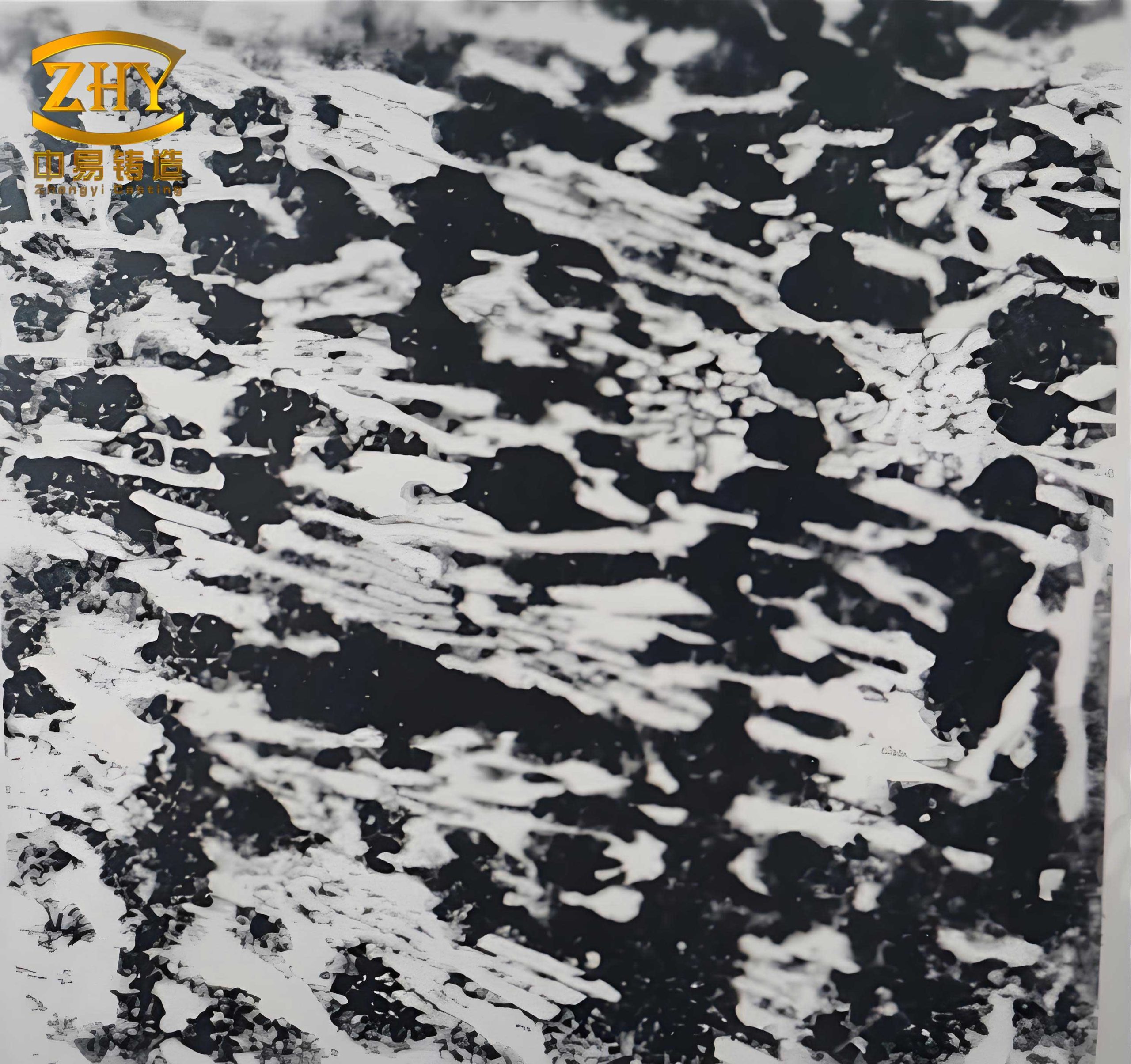
The specific material under investigation is a hypoeutectic white cast iron with a nominal composition designed to form M7C3 carbides. The base chemistry, along with a variant containing a small addition of rare earth (RE) elements, was prepared for this study. The chemical compositions of the two melts are summarized in Table 1. The rare earth addition is intended to explore its potential for microstructural modification, a known but not fully quantified effect in this class of white cast iron.
| Element | Composition A (wt.%) | Composition B (wt.%) |
|---|---|---|
| C | 2.82 | 2.82 |
| Cr | 15.63 | 15.63 |
| Si | 0.78 | 0.78 |
| Mn | 0.81 | 0.81 |
| V | 0.28 | 0.28 |
| Ti | 0.14 | 0.14 |
| RE | – | 0.08 |
| S | 0.06 | 0.06 |
| P | 0.05 | 0.05 |
The material was melted in a medium-frequency induction furnace. After reaching a superheat temperature between 1500-1550°C, the melt was deoxidized with aluminum. The rare earth alloy and other minor additives were introduced using a ladle inoculation method prior to casting at approximately 1400°C. Specimens for CCT diagram determination were cast in resin-coated sand molds to ensure a consistent and sound structure, while standard sand molds were used for specimens dedicated to mechanical property evaluation.
Determination of CCT Diagrams
The core of this study involved experimentally constructing the CCT diagrams for the developed white cast iron. Cylindrical specimens were machined to precise dimensions. A critical preparatory step was implemented: the samples were first austenitized at 980°C for 90 minutes and air-cooled. This pretreatment promotes the precipitation of secondary carbides, ensuring they do not interfere with the phase transformations during the subsequent CCT testing cycle. The phase transformation behavior was then characterized using a Gleeble-1500 thermomechanical simulator. The testing protocol involved heating the specimens to an austenitizing temperature of 980°C at a rate of 5°C/s, holding for 20 minutes to achieve a homogeneous austenitic state saturated with carbon and alloying elements, followed by continuous cooling at various controlled rates. The corresponding dilation and temperature data were recorded to accurately identify the onset and finish temperatures for transformations such as pearlite, bainite, and martensite.
The resulting CCT diagrams for the base white cast iron (Composition A) and the rare-earth-modified white cast iron (Composition B) are shown schematically. A key finding is that the addition of 0.08 wt.% rare earth does not alter the fundamental topology of the CCT diagram but causes a distinct shift. The diagram for Composition B is displaced to the right and slightly downward compared to that of Composition A. This shift indicates an increase in the stability of the undercooled austenite. Quantitatively, the incubation period for the pearlite transformation in the temperature range of 600-650°C is extended from about 10 minutes to approximately 25 minutes due to the rare earth addition.
The underlying mechanism for this stabilization is linked to the segregation behavior of rare earth elements. They are known to be interfacial active elements that preferentially segregate to prior austenite grain boundaries. This segregation significantly reduces the interfacial energy of these boundaries. Since nucleation sites for transformations like pearlite and bainite are often at grain boundaries, a reduction in boundary energy acts as a barrier to the formation of critical nuclei for ferrite and carbide phases. This effectively delays the onset of transformation, shifting the CCT curves to longer times. It is noteworthy that the effect is more pronounced on the pearlite transformation region than on the bainite region, which can be attributed to differences in their nucleation and growth mechanisms. Furthermore, the rare earth addition was observed to lower both the Ac1 temperature (from 746°C to 738°C) and the Martensite Start (Ms) temperature (from 193°C to 186°C). The precise thermodynamic rationale for these depressions warrants further study but is likely related to changes in austenite chemistry and stability.
Influence of Heat Treatment Parameters on Microstructure and Properties
With the phase transformation kinetics mapped, the next phase focused on optimizing the final heat treatment for the rare-earth-modified white cast iron (Composition B). The effects of key parameters—quenching temperature and tempering temperature—on hardness (HRC), impact toughness (αK), and transverse rupture strength (σbb) were systematically investigated.
Effect of Quenching Temperature
Specimens were austenitized at temperatures ranging from 900°C to 1100°C, followed by quenching in oil. The resulting properties are graphically summarized. Both hardness and transverse rupture strength exhibit a peak value as a function of quenching temperature. In contrast, the impact toughness shows a more complex behavior: it remains relatively stable for quenching temperatures below 1000°C but increases significantly at higher temperatures.
This behavior is directly tied to the evolving microstructure. The austenitizing temperature controls the amount of carbon and alloying elements (Cr, V, etc.) that dissolve into the austenite phase. At lower temperatures (e.g., 900°C), the dissolution is incomplete, leading to a quenched matrix consisting of martensite with a lower carbon content and a relatively low amount of retained austenite. As the temperature increases, more carbon and alloys enter solution, enhancing the hardenability and increasing the carbon content of the resulting martensite, which raises hardness. Concurrently, the stability of the austenite increases, leading to a greater volume fraction of retained austenite after quenching. The peak in hardness and strength typically occurs at an intermediate temperature where a high-carbon, heavily alloyed martensite is achieved without an excessive amount of soft retained austenite. The subsequent sharp rise in impact toughness above 1000°C is primarily attributed to the dramatically increased volume of retained austenite, which can absorb energy through transformation-induced plasticity (TRIP) effects or by blunting propagating cracks. This microstructural evolution can be described by the relationship between dissolved carbon content in austenite (Cγ) and quenching temperature (TQ), often approximated by an equation of the form:
$$ C_{\gamma}(T_Q) = C_0 – k \cdot \exp\left(-\frac{Q}{RT_Q}\right) $$
where \( C_0 \) is the nominal carbon content, \( k \) is a constant, \( Q \) is an activation energy, and \( R \) is the gas constant. The volume fraction of retained austenite (Vγ) is then a complex function of \( C_{\gamma} \) and the Ms temperature.
Effect of Tempering Temperature
The as-quenched microstructure is metastable. Tempering is essential to relieve internal stresses, improve toughness, and achieve dimensional stability. Specimens quenched from different temperatures were tempered at various temperatures, and the resulting hardness and toughness were measured. The tempering response of the high-chromium white cast iron martensite is notably stable. For tempering temperatures below 400°C, the hardness remains largely unchanged. This indicates that in this range, the primary processes are the decomposition of the martensite (precipitation of transition carbides like ε-carbide) and possibly the precipitation of fine, secondary alloy carbides from the supersaturated matrix. These hardening precipitates counterbalance the softening from the martensite decomposition, leading to a plateau in the hardness curve.
Above 500°C, a significant drop in hardness occurs due to the coarsening of carbides and the transformation of martensite into ferrite. An interesting phenomenon is observed for specimens quenched from high temperatures (e.g., >1050°C): a secondary hardness peak appears around 500°C during tempering. This is a direct consequence of the decomposition of the substantial amount of retained austenite present in these samples. As the tempered white cast iron is heated through the 450-550°C range, this retained austenite transforms into fresh, untempered martensite upon cooling from the tempering temperature (secondary hardening) or into a mixture of ferrite and carbide (bainitic transformation), both of which can cause a temporary arrest or increase in hardness.
The impact toughness during tempering is governed by two competing factors: the softening and increased ductility of the tempered martensite, which improves toughness, and the decomposition of the beneficial retained austenite, which can reduce toughness. The net effect is the appearance of a peak in toughness at a specific tempering temperature, which varies depending on the initial quenching temperature and hence the initial amounts and stabilities of martensite and retained austenite. The tempering kinetics for a property like hardness retention can be modeled using an equation such as:
$$ \text{Hardness} = H_0 \cdot \exp(-k_T \cdot t^n) $$
where \( H_0 \) is the initial hardness, \( k_T \) is a temperature-dependent rate constant following an Arrhenius relationship, \( t \) is time, and \( n \) is a time exponent.
Microstructurally, tempering leads to the decomposition of the as-quenched martensite and retained austenite into a tempered matrix of ferrite and finely dispersed carbides. Furthermore, the morphology of the eutectic carbides themselves can appear modified after high-temperature tempering, appearing more fragmented or globular due to diffusion processes at the carbide/matrix interface, although their fundamental type remains M7C3.
Optimized Heat Treatment Process and Final Properties
Synthesizing the data from the CCT analysis and the parametric study of quenching and tempering, an optimized heat treatment process for the rare-earth-modified Cr15C3 white cast iron was derived. The objective is to maximize the product of hardness and toughness, i.e., to achieve high wear resistance without compromising structural integrity. The recommended process is as follows:
- Austenitizing/Quenching: Heat to 1030°C. Hold for sufficient time to ensure complete austenitization (typically 1-2 hours depending on section size). Quench in oil. This temperature was selected as it provides a good balance, resulting in a matrix with high-carbon martensite and a beneficial, controlled amount of retained austenite.
- Double Tempering:
- First temper at 550°C for 90-120 minutes. This high-temperature temper is crucial for decomposing the majority of the retained austenite into a stable, tough aggregate of ferrite and secondary carbides. It also significantly tempers the primary martensite.
- After cooling from the first temper, perform a second temper at 400°C for 90-120 minutes. The purpose of this step is to temper any fresh martensite that might have formed from the final traces of retained austenite during cooling from the 550°C temper. This ensures the entire matrix is in a fully tempered, stress-relieved condition.
This two-stage tempering cycle is essential for stabilizing the microstructure and maximizing toughness in this high-alloy white cast iron. The process curve is illustrated schematically as a temperature-time plot. The mechanical properties achievable with this optimized treatment for Composition B white cast iron are summarized in Table 2.
| Property | Symbol | Value Range |
|---|---|---|
| Hardness | HRC | 58 – 62 |
| Impact Toughness | αK (J/cm²) | 9.5 – 13.8 |
| Transverse Rupture Strength | σbb (MPa) | ~960 |
These properties represent an excellent compromise, offering the very high hardness characteristic of white cast iron necessary for abrasion resistance, coupled with significantly improved toughness compared to the as-cast state or sub-optimally heat-treated material. The role of the rare earth addition in refining the solidification structure and enhancing hardenability contributes to this performance profile.
Conclusion
This investigation provides a comprehensive framework for understanding and processing high-chromium white cast iron, specifically a Cr15C3 type. The experimental determination of the CCT diagram established the phase transformation kinetics, revealing that a small addition of rare earth (0.08 wt.%) increases the stability of undercooled austenite, shifting the CCT diagram to longer times and lower temperatures. This foundational knowledge directly informs heat treatment design.
The systematic study of heat treatment parameters elucidated the complex interplay between quenching temperature, retained austenite, martensite characteristics, and final properties. It confirmed that properties like hardness and toughness are non-monotonic functions of processing temperature due to competing microstructural changes. The stability of the martensite in this alloyed white cast iron during low-temperature tempering was also demonstrated.
Ultimately, by integrating the CCT behavior with the parametric optimization, a robust and effective heat treatment process was developed: austenitizing at 1030°C followed by oil quenching, and a double tempering sequence at 550°C and 400°C. This protocol successfully tailors the microstructure to achieve a superior combination of high hardness (58-62 HRC) and appreciable impact toughness (9.5-13.8 J/cm²), thereby enhancing the potential of this high-chromium white cast iron for demanding wear-resistant applications where resistance to fracture is as critical as resistance to abrasion. The methodologies and findings presented serve as a valuable guide for the thermal processing of this important class of engineering materials.