
In the field of materials science and engineering, corrosion and wear resistance are critical challenges that have driven extensive research worldwide. Over the years, significant advancements have been made in developing high-hardness wear-resistant white cast iron, such as the Ni-hard type, which represents the first generation of such materials with hardness reaching HRC 55–60. However, the high cost of nickel prompted the exploration of alternatives, leading to the development of high-chromium white cast iron with chromium content exceeding 13%, considered the second generation. In this study, we focus on designing a new low alloy white cast iron through multi-alloying with elements like manganese, chromium, copper, molybdenum, and vanadium, combined with rare earth composite modification treatment and appropriate heat treatment. Our goal is to achieve a microstructure featuring uniformly dispersed blocky or lamellar carbides embedded in a martensitic matrix with a controlled amount of austenite, thereby enhancing comprehensive mechanical properties and erosion-corrosion resistance. This article details our approach, from microstructure and chemical composition design to experimental methods, results, and analysis, with an emphasis on the role of white cast iron in addressing wear and corrosion issues.
The microstructure of white cast iron is pivotal in determining its performance, particularly in abrasive and corrosive environments. In our design, we aimed for a fine-grained organization where high-microhardness carbides are isolated and evenly distributed within a matrix of martensite and a moderate amount of austenite. Carbides serve as the primary wear-resistant phase, and their macro-hardness depends on factors such as microhardness, quantity, morphology, and distribution. Typically, carbide content is limited to below 30% to balance hardness and toughness, though under low-impact conditions, higher levels may be permissible. The morphology of carbides is crucial; blocky or lamellar forms, due to their larger surface area, embed firmly in the matrix and exist in isolated states, increasing crack propagation resistance and improving toughness. When these carbides are oriented perpendicular to the wear surface, they exhibit superior wear resistance. We employed rare earth composite modification treatment to refine carbide morphology and distribution, a method known for its simplicity and effectiveness.
The matrix composition is equally important for wear resistance. The abrasion resistance of alloy white cast iron increases with the ratio of matrix microhardness (HV) to abrasive microhardness (HA), expressed as HV/HA. A matrix with high cohesive strength to carbides prevents carbide pull-out, which could otherwise generate high-hardness debris and accelerate wear. Martensite meets these requirements ideally, making it our preferred matrix. Additionally, the presence of residual austenite in the matrix can enhance toughness without compromising wear resistance, provided its content is controlled, typically below 15% for low-impact applications. Thus, our target microstructure for the new low alloy white cast iron consists of fine grains with dispersed, high-hardness alloy carbides in a martensitic base with适量 austenite.
To achieve this microstructure, we carefully designed the chemical composition, as summarized in Table 1. Carbon is a key element influencing hardness, wear resistance, and impact toughness. Increasing carbon content raises carbide volume, enhancing hardness but reducing impact value. For low-impact conditions, we selected a carbon range of 3.0%–3.8%. Silicon reduces carbon solubility in austenite and raises the Ms temperature, decreasing residual austenite; thus, we set silicon at 0.3%–1.3%. Manganese stabilizes austenite, lowers the A1 temperature, improves hardenability, and refines grain-boundary carbides to enhance toughness. Our manganese content is 3.0%–4.0%, as levels beyond 3.5% may reduce hardness. Copper, similar to nickel, slows austenite transformation, aiding martensite formation in large sections. It also increases carbon solubility in austenite, reducing carbide content and refining carbides to boost impact toughness. However, excessive copper can lead to segregation, so we limited it to 0.5%–2.8%. Molybdenum dissolves in both matrix and carbides, significantly improving hardenability and preventing pearlite formation, while refining structure for better toughness, strength, and wear resistance. Given its cost, molybdenum is kept at 0.5%–1.5%. Vanadium, a strong carbide-forming element, combines with carbon during solidification, lowering carbon content in austenite and raising Ms to facilitate martensite formation in the as-cast state. It also increases carbide hardness and refines structure, so we included 0.65%–0.85% vanadium.
| Element | Content Range (%) |
|---|---|
| C | 3.3–3.8 |
| Si | 0.3–0.8 |
| Mn | 3.0–4.0 |
| P, S | <0.1 |
| Cr | 3.0–4.0 |
| Cu | 0.5–2.8 |
| Mo | 0.5–1.5 |
| V | 0.65–0.85 |
The melting and processing of white cast iron are critical steps in realizing the designed properties. We conducted melting in a medium-frequency induction furnace, using raw materials such as pig iron, scrap steel, ferrochromium, ferromolybdenum, ferrovanadium, and electrolytic copper plates. After melting, we added ferromanganese at a temperature rise, with a tapping temperature of 1600°C and a pouring temperature of 1550°C, monitored by a platinum-rhodium thermocouple. Specimens were cast using green sand molds with bottom gating, producing impact test blocks of dimensions 20 mm × 20 mm × 120 mm. Molds were shaken out 30 minutes after pouring.
For modification treatment, we applied a rare earth composite treatment via the ladle addition method. In a pit at the ladle bottom, we added 1.5% Baotou No. 1 rare earth (containing 20.53% RE, 40.95% Si, and 3.84% Ca) and 0.15% boron iron (16% B, 0.1% C, 0.01% S) at 1550°C. After stirring and letting the melt stand for 2–3 minutes, we skimmed slag and proceeded with casting. This treatment aims to refine microstructure and improve carbide morphology in white cast iron.
Heat treatment was varied to study its effects: as-cast condition, stress relief treatment (480°C × 5 h, furnace-cooled to 200°C then air-cooled), and quenching (980°C × 3 h) followed by tempering (320°C × 2 h). These processes help optimize the matrix and carbide distribution in white cast iron.
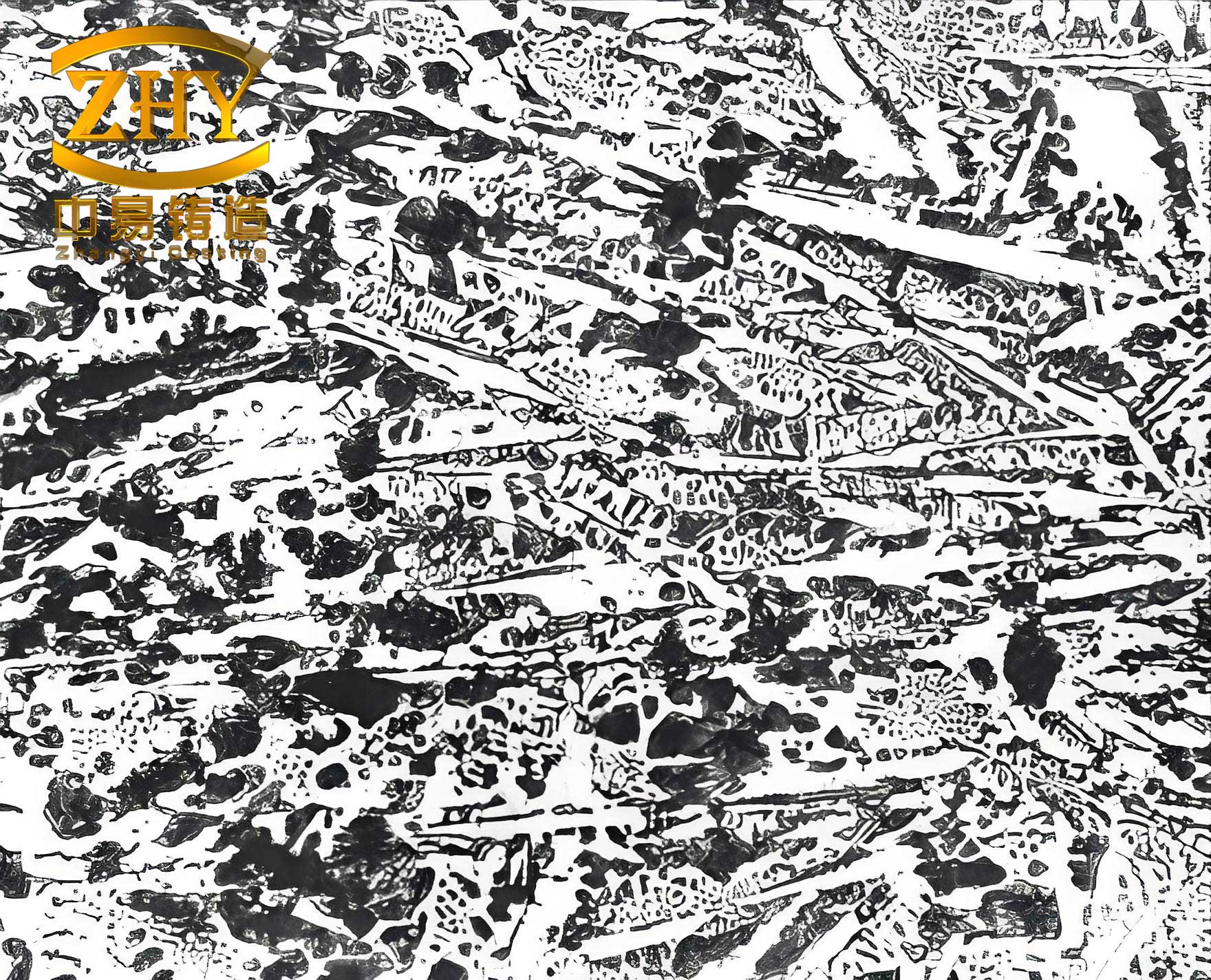
Our experimental methods included metallographic analysis, mechanical property testing, and erosion-corrosion evaluation. For microstructure examination, we used optical microscopy and X-ray diffraction (XRD) for phase identification. Microhardness of carbides and matrix was measured on a Model 71 microhardness tester with a 50 g load, averaging three points. Carbide volume fraction was determined using the grid method, with a 17 × 17 grid lens on an optical microscope. For each sample, 30 random fields were selected, and carbide percentage (fc) was calculated as:
$$f_c = \frac{\sum_{i=1}^{K} P_i}{K n}$$
where K is the number of measurements (i.e., fields), Pi is the number of grid points on carbides, and n is the total grid points (289). Residual austenite content (fr) was derived from XRD patterns using the direct comparison method, based on the α-phase (211) and γ-phase (311) diffraction lines:
$$f_r = \frac{I_r C_\alpha (1 – f_c)}{I_r C_\alpha + I_\alpha C_r} \times 100\%$$
Here, Iα and Ir are diffraction peak intensities, Cα and Cr are correction coefficients, and fc is carbide volume fraction. This approach ensures accurate phase quantification in white cast iron.
Mechanical properties were assessed via impact toughness and macro-hardness tests. Impact tests were performed on a pendulum impact tester with a 70 mm span, using unnotched specimens (20 mm × 20 mm × 120 mm), with results averaged over three samples. Hardness was measured on a Rockwell hardness machine on specimens cut to 20 mm × 10 mm × 3 mm, taking three points near the edge and averaging. These tests highlight the performance of white cast iron under stress.
Erosion-corrosion tests were conducted on a custom-built apparatus. Specimens, sized Ø6 mm × 45 mm, were weighed on an analytical balance (0.1 mg sensitivity). Each material group included three specimens, tested at a linear velocity of 1.4 m/s with 40–70 mesh refined quartz sand as abrasive, a water-to-sand ratio of 1:1, temperature of 25°C, and a weak acidic medium of pH 6 (Clark-Lubs buffer solution). Testing lasted 14 hours, after which mass loss was calculated. Eroded surfaces were examined by scanning electron microscopy (SEM) to study wear mechanisms. This simulates conditions where white cast iron might be used in corrosive environments.
The results of our microstructure analysis are presented in Table 2 and supported by XRD data. For the new low alloy white cast iron (CCLT-1), the as-cast microstructure without treatment consisted of martensite (M), residual austenite (Ar), and M3C carbides. After RE-B composite modification, the as-cast structure showed refined carbides, transformed from continuous networks to isolated blocky or lamellar forms, with phases including M, Ar, M3(C,B), and M23(C,B)6. This change is attributed to boron’s role as a carbide-forming element, enhancing carbide stability. Heat treatment further increased martensite content and reduced residual austenite, without significant carbide alteration. The microhardness of carbides and matrix improved post-treatment, as detailed in Table 2.
| Material Code | Modification Treatment | Heat Treatment | Microstructure Composition (%) | Microhardness (HV) | |||
|---|---|---|---|---|---|---|---|
| Carbides | Residual Austenite | Martensite | Carbides | Matrix | |||
| CCLT-1 | None | As-cast | 30.88 | 25.56 | 43.56 | 1624.2 | 868.5 |
| CCLT-1 | RE-B | As-cast | 31.66 | 20.04 | 48.30 | 1788.4 | 866.4 |
| CCLT-1 | RE-B | Stress Relief | 31.93 | 14.85 | 53.21 | 1799.8 | 886.2 |
| CCLT-1 | RE-B | Quench + Temper | 31.98 | 6.40 | 61.62 | 1886.5 | 938.6 |
| Ni-hard I | None | Stress Relief | 34.07 | 29.61 | 36.32 | 1008.8 | 788.8 |
| Cr15Mn4Cu | None | Quench + Temper | 32.05 | 28.96 | 38.99 | 1249.6 | 805.1 |
These findings demonstrate that RE-B treatment and heat treatment effectively refine the microstructure of white cast iron, leading to higher carbide microhardness and a more martensitic matrix, which are beneficial for wear resistance.
Mechanical property results are summarized in Table 3. The RE-B treated white cast iron in the as-cast state exhibited superior comprehensive properties compared to reference materials like Ni-hard I and Cr15Mn4Cu. Modification and heat treatment increased hardness due to higher martensite content and boron-containing carbides, while impact toughness improved from carbide morphology changes—specifically, the break-up of continuous networks into dispersed blocks. The quenched and tempered white cast iron achieved the best balance, with hardness over HRC 63 and reasonable impact values, meeting or exceeding performance levels of conventional white cast iron types.
| Material Code | Modification Treatment | Heat Treatment | Impact Value (J/cm²) | Hardness (HRC) |
|---|---|---|---|---|
| CCLT-1 | None | As-cast | 4.8 | 56.8 |
| CCLT-1 | RE-B | As-cast | 6.6 | 59.9 |
| CCLT-1 | RE-B | Stress Relief | 5.8 | 60.3 |
| CCLT-1 | RE-B | Quench + Temper | 5.7 | 63.6 |
| Ni-hard I | None | Stress Relief | 5.6 | 56.8 |
| Cr15Mn4Cu | None | Quench + Temper | 6.5 | 59.8 |
Erosion-corrosion performance, shown in Table 4, revealed that treated white cast iron had lower mass loss rates than untreated versions. The RE-B treated and heat-treated white cast iron outperformed both Ni-hard I and Cr15Mn4Cu in resistance to wear in pH 6 medium. This improvement stems from increased hardness, refined carbide distribution, and reduced carbide-matrix mean free path relative to abrasive particle size, allowing carbides to shield the matrix effectively. SEM analysis of eroded surfaces (e.g., for quenched and tempered CCLT-1) indicated mechanisms dominated by solid particle impact at high angles, creating pits and lips on the matrix. However, the martensitic matrix with embedded high-hardness carbides acted as a skeleton, resisting material loss. In contrast, Ni-hard I showed deeper erosion pits due to coarse and uneven carbides. The weak acidic medium also accelerated corrosion, promoting electrochemical interactions between carbides and matrix that could lead to carbide microcracking and detachment, but our designed white cast iron minimized such effects.
| Material Code | Modification Treatment | Heat Treatment | Weight Before (g) | Weight After (g) | Mass Loss Rate (%) |
|---|---|---|---|---|---|
| CCLT-1 | None | As-cast | 8.2153 | 8.0370 | 2.17 |
| CCLT-1 | RE-B | As-cast | 8.2288 | 8.0757 | 1.86 |
| CCLT-1 | RE-B | Stress Relief | 8.1836 | 8.0461 | 1.68 |
| CCLT-1 | RE-B | Quench + Temper | 8.1526 | 8.0344 | 1.45 |
| Ni-hard I | None | Stress Relief | 8.1985 | 8.0245 | 2.12 |
| Cr15Mn4Cu | None | Quench + Temper | 8.2468 | 8.0868 | 1.94 |
To further elucidate the properties of white cast iron, we can consider theoretical models for wear and corrosion. The wear resistance of white cast iron often correlates with hardness ratios, as mentioned earlier. A simplified model for abrasive wear volume loss (V) can be expressed as:
$$V = k \frac{W}{H} t$$
where k is a wear coefficient, W is load, H is material hardness, and t is time. For white cast iron, high carbide hardness (Hc) and matrix hardness (Hm) contribute to overall H, reducing V. In multi-phase materials like white cast iron, the effective hardness can be approximated by rule-of-mixtures:
$$H_{\text{eff}} = f_c H_c + (1 – f_c) H_m$$
where fc is carbide volume fraction. Our design aims to maximize Heff through optimal fc and high Hc values. Additionally, corrosion in acidic media involves electrochemical reactions; for white cast iron, the corrosion rate (CR) might be influenced by phase distribution. A general corrosion rate formula is:
$$CR = \frac{i_c M}{n F \rho}$$
where ic is corrosion current density, M is molar mass, n is number of electrons transferred, F is Faraday’s constant, and ρ is density. In white cast iron, carbides act as cathodic sites, while the matrix is anodic, so refining microstructure can reduce galvanic effects and lower CR. These principles underpin our approach to enhancing white cast iron performance.
In discussion, we emphasize that multi-alloying with Mn, Cr, Cu, Mo, and V enables the attainment of a martensitic matrix with适量 austenite in as-cast white cast iron, reducing reliance on expensive elements like nickel. RE-B composite modification is crucial for transforming carbide morphology from continuous networks to isolated blocks, refining grains, and improving mechanical properties. Heat treatment further optimizes the structure, yielding a combination of eutectic carbides, high-carbon martensite, residual austenite, and dispersed secondary carbides. This microstructure grants excellent comprehensive mechanical properties and high erosion-corrosion resistance, surpassing traditional white cast iron grades. The synergy between alloy design, modification, and heat treatment makes this white cast iron promising for applications in mining, slurry transport, and chemical processing, where wear and corrosion coexist.
Looking forward, there are opportunities to refine this white cast iron further. For instance, varying cooling rates during solidification could affect carbide size and distribution. Computational modeling, such as finite element analysis of stress distributions under impact, could guide microstructure optimization. Additionally, exploring other modification agents or alloy additions (e.g., titanium or niobium) might enhance properties. The role of boron in white cast iron warrants deeper study, as it influences carbide formation and stability. Long-term field tests in real-world environments would validate laboratory findings and ensure the durability of this white cast iron.
In conclusion, our research demonstrates that through multi-alloying and RE-B composite modification, we can develop a new low alloy white cast iron with superior microstructure and properties. The designed chemical composition, centered on elements like carbon, manganese, chromium, copper, molybdenum, and vanadium, facilitates a martensitic matrix with controlled austenite and high-hardness carbides. Treatment processes refine carbide morphology and enhance matrix hardness, leading to improved impact toughness, hardness, and erosion-corrosion resistance. Compared to conventional white cast iron like Ni-hard I and Cr15Mn4Cu, our material shows competitive or better performance, making it a viable candidate for demanding industrial applications. This work underscores the potential of innovative alloy design and processing in advancing white cast iron technology, contributing to more sustainable and cost-effective solutions for wear and corrosion challenges.