
In the field of thermal power generation, grinding balls represent one of the most consumed wear-resistant components. Statistical data indicates that national thermal power plants annually consume over ten thousand tons of wear-resistant parts, with grinding balls accounting for approximately half of this total, around ten thousand tons. Additionally, reports suggest that the building materials industry consumes another ten thousand tons of grinding balls yearly, with significant consumption also in metallurgical and other sectors. This not only depletes substantial steel resources but also escalates production costs. The application of new wear-resistant materials for manufacturing grinding balls can reduce consumption per unit output, thereby conserving fuel and steel while enhancing economic efficiency. Our research focuses on a novel abrasion-resistant white cast iron, where manganese (Mn) is used to replace molybdenum (Mo). This substitution is particularly suitable for producing grinding balls, as manganese iron is cost-effective, priced at only one-fourteenth that of molybdenum iron, leading to lower production costs. Industrial trials at the Taiyuan First Thermal Power Plant demonstrated that the wear resistance of these white cast iron grinding balls is seven times that of ordinary forged steel balls.
The abrasion-resistant white cast iron we developed belongs to the high-chromium white cast iron category. To achieve a martensitic matrix in the quenched state for thick-walled high-chromium cast iron components, traditional high-chromium white cast iron requires the addition of 2.5% to 3.0% Mo to obtain an as-cast austenitic structure that transforms to martensite upon quenching, resulting in high macro-hardness. Higher molybdenum content increases hardenability, with thicker sections demanding more molybdenum. However, molybdenum is expensive and scarce, making large-scale production of high-molybdenum white cast iron impractical. Therefore, we sought to replace molybdenum with other economical elements to achieve an as-cast austenitic and quenched martensitic structure, with wear resistance approaching that of high-molybdenum high-chromium white cast iron. Among elements capable of substituting for molybdenum, manganese is a strong promoter and stabilizer of alloy austenite. In China, manganese is widely available and low-cost, prompting our experimental research into replacing Mo with Mn.
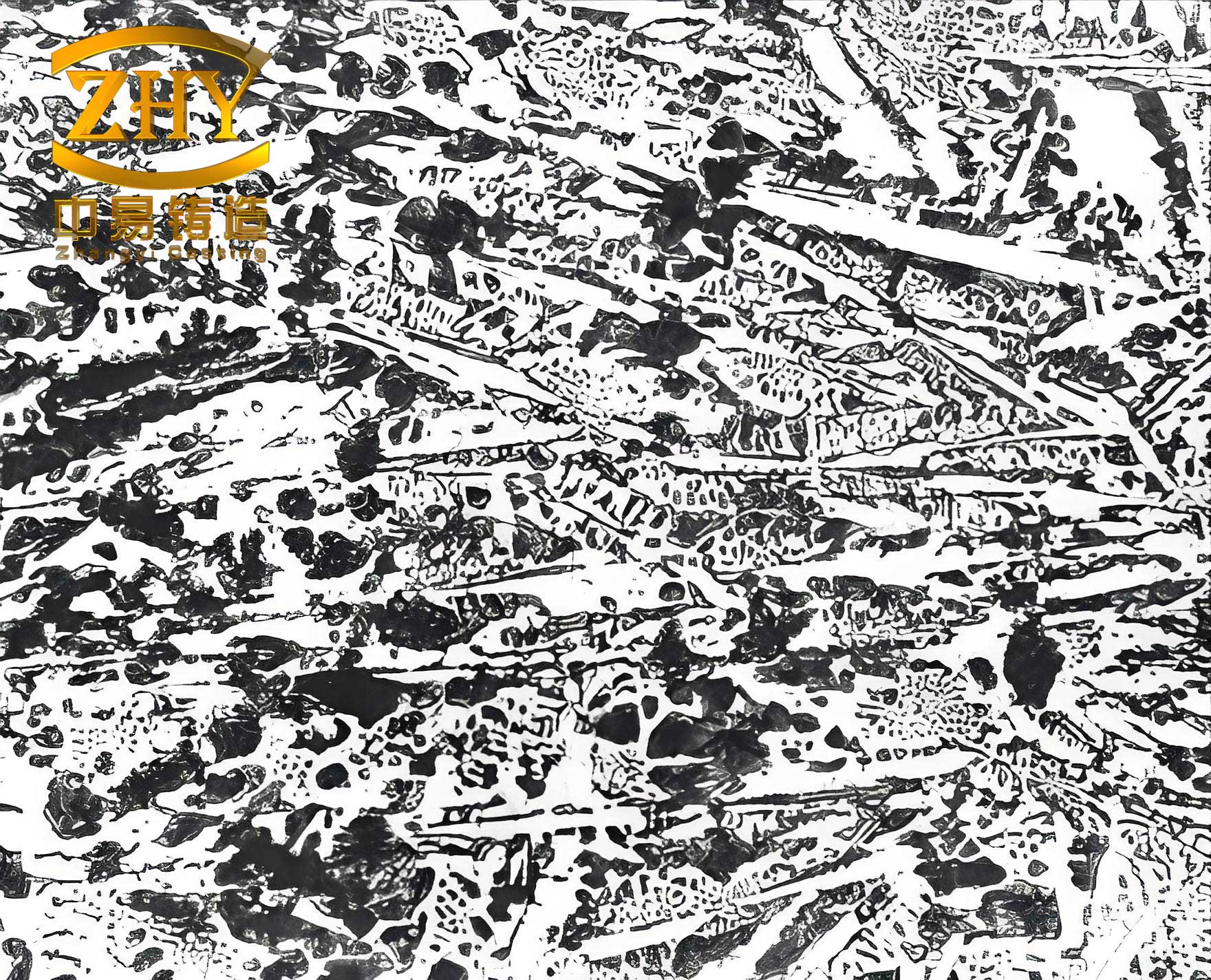
Through systematic experiments, we found that replacing all or most of the molybdenum in high-chromium white cast iron with manganese yields an as-cast austenitic matrix, which transforms to a martensitic matrix with minor retained austenite upon quenching. The carbides remain of the M7C3 type. Our experiments revealed that substituting manganese for molybdenum in white cast iron results in a quenched hardness exceeding 60 HRC, with other mechanical properties also being favorable. In selecting chemical compositions, we conducted systematic tests on five formulations. The specimen dimensions were φ30 mm × 50 mm, melted in a high-frequency electric furnace with a 10 kg quartz crucible and sand-cast. The charge composition included carbon steel, carbon-chromium iron, electrolytic manganese, molybdenum iron, and carburizer, as detailed in Table 1.
| Formulation | C | Cr | Mo | Mn | Si | P | S |
|---|---|---|---|---|---|---|---|
| 1 | 2.0 | 15.0 | 2.5 | 0.5 | 0.5 | <0.05 | <0.05 |
| 2 | 2.5 | 15.0 | 1.5 | 1.5 | 0.5 | <0.05 | <0.05 |
| 3 | 3.0 | 15.0 | 0.5 | 2.5 | 0.5 | <0.05 | <0.05 |
| 4 | 2.8 | 12.0 | 0.0 | 3.0 | 0.5 | <0.05 | <0.05 |
| 5 | 2.8 | 10.0 | 0.0 | 4.0 | 0.5 | <0.05 | <0.05 |
The actual chemical compositions after melting are shown in Table 2. Specimens from all five melts underwent air quenching, with hardness values at different quenching temperatures listed in Table 3. Based on the data, Formulation 5 with 2.8% C, 10% Cr, 4% Mn, and 0.5% Si exhibited the highest hardness. However, considering production realities, such as fluctuations in manganese content when using acid induction furnaces, Formulations 4 and 5 were deemed acceptable as both achieved martensitic matrices after quenching with minimal retained austenite and hardness above 60 HRC. Thus, we set the manganese content at 3.0% to 4.0%. After replacing most molybdenum with manganese, proper control of other elements ensures good mechanical properties and excellent wear resistance in this white cast iron.
| Melt No. | C | Cr | Mo | Mn | Si | P | S |
|---|---|---|---|---|---|---|---|
| 1 | 2.1 | 14.8 | 2.4 | 0.6 | 0.52 | 0.04 | 0.03 |
| 2 | 2.6 | 14.9 | 1.4 | 1.6 | 0.51 | 0.04 | 0.03 |
| 3 | 3.1 | 14.7 | 0.6 | 2.6 | 0.53 | 0.04 | 0.03 |
| 4 | 2.9 | 11.8 | 0.0 | 3.1 | 0.54 | 0.04 | 0.03 |
| 5 | 2.9 | 9.9 | 0.0 | 4.1 | 0.55 | 0.04 | 0.03 |
| Formulation | 900°C | 950°C | 1000°C | 1050°C | 1100°C |
|---|---|---|---|---|---|
| 1 | 58 | 60 | 62 | 61 | 59 |
| 2 | 59 | 61 | 63 | 62 | 60 |
| 3 | 60 | 62 | 64 | 63 | 61 |
| 4 | 61 | 63 | 65 | 64 | 62 |
| 5 | 62 | 64 | 66 | 65 | 63 |
In high-chromium white cast iron, chromium primarily forms carbides such as M7C3 and M23C6, and provides sufficient hardenability. In our Mn-substituted white cast iron, carbides are mainly M7C3, with hardness around 1200-1600 HV. Research indicates that when Cr/C ≥ 5, the carbides are predominantly M7C3, which enhances wear resistance. Our data shows that with 10-15% Cr, hardness is highest, so we set chromium content at 10-15%. The wear resistance of white cast iron is attributed to the presence of hard carbides. Higher carbon content increases carbide volume, improving wear resistance but reducing toughness. The relationship between carbon content and carbide volume fraction in high-chromium white cast iron can be expressed as:
$$ V_c = k \cdot C $$
where \( V_c \) is the carbide volume fraction (%), \( C \) is the carbon content (wt%), and \( k \) is a constant approximately 12-15 for high-chromium white cast iron. From experiments, when carbon exceeds 3.0%, hypereutectic structures appear, so we selected 2.8-3.0% carbon for grinding balls. Silicon serves as a deoxidizer; content below 0.8% is optimal, as higher silicon reduces strength and wear resistance. Phosphorus and sulfur should be minimized, controlled below 0.05% and 0.03%, respectively, to avoid brittleness and sulfide formation at grain boundaries. Thus, the finalized chemical composition for our abrasion-resistant white cast iron is: C: 2.8-3.0%, Cr: 10-15%, Mn: 3.0-4.0%, Si: ≤0.8%, P: ≤0.05%, S: ≤0.03%.
Heat treatment is crucial for achieving the desired martensitic matrix in white cast iron. Manganese promotes austenite formation and stabilization, lowering the martensite start temperature (Ms). Thus, as-cast structures are austenitic regardless of cooling rate. Upon heating to 950-1050°C and air quenching, martensite forms. Experiments show that at 1000°C, after holding and air quenching, a martensitic structure with minimal retained austenite is obtained, yielding hardness up to 66 HRC. The relationship between quenching temperature and hardness can be modeled as:
$$ H = H_0 – \alpha (T – T_0)^2 $$
where \( H \) is hardness (HRC), \( T \) is quenching temperature (°C), \( H_0 \) and \( T_0 \) are constants, and \( \alpha \) is a coefficient. For our white cast iron, optimal quenching temperature is 1000°C. Holding time is also critical; for Mn-substituted white cast iron, longer times are needed for secondary carbide precipitation to raise Ms above room temperature. Minimum holding time is 30 minutes, with hardness increasing with time up to 90 minutes, as shown in Figure 1. The heat treatment process for grinding balls involves heating to 1000°C, holding for 60-90 minutes, and air quenching.
Hardenability is influenced by manganese and molybdenum content. White cast iron with 3.0-4.0% Mn and no Mo achieves sufficient hardenability for sections up to 100 mm. For φ100 mm grinding balls, full hardening is possible. Hardness distribution from surface to core is uniform, as verified by measurements after service. The wear resistance of our white cast iron was evaluated through laboratory and industrial tests. Brinell abrasion tests using a modified lathe with a copper wheel showed that the weight loss of 45# steel was 5-7 times that of our white cast iron. Small-scale industrial trials on shot blasting machine blades demonstrated that 45# steel blades wore out after 500 hours, with weight loss 6 times higher than our white cast iron blades.
Wear behavior varies with working conditions and composition. For high-chromium white cast iron, higher carbon generally improves wear resistance, but under impact loads, hypoeutectic structures with lower carbon perform better due to reduced carbide spalling. Our industrial trial at Taiyuan First Thermal Power Plant used a 250/390 ball mill loaded with 10 tons of balls, including 5 tons of φ100 mm and 5 tons of φ60 mm white cast iron balls. Over four months (3000 hours), 30,000 tons of coal were ground without ball addition. Results indicated wear rates of 0.1 mm/1000h for φ100 mm balls and 0.15 mm/1000h for φ60 mm balls, corresponding to ball consumption of 50 g/ton of coal, seven times lower than forged steel balls. Broken balls accounted for 2% of total, primarily φ60 mm balls with internal shrinkage defects. Post-service examination revealed smooth surfaces with minimal micro-cracking or spalling, confirming excellent wear resistance.
Casting process for this white cast iron involves melting in induction furnaces (acid, basic, or neutral linings). Charge materials include carbon steel, carbon-chromium iron, manganese iron, and molybdenum iron if needed. Manganese addition should be late in melting to minimize oxidation losses in acid furnaces. The linear shrinkage of white cast iron is similar to steel, around 2%, with shrinkage porosity up to 6%. Thus, adequate risers are essential for feeding grinding balls. Gating systems should have large cross-sections, with sprue connected to risers for effective feeding. No special sand requirements exist; typical steel or iron casting sands suffice, but in cold conditions, better insulation and larger mold walls prevent cracking. Pouring temperature is critical: too low leads to shrinkage, too high causes coarse grains and micro-shrinkage. Recommended pouring temperature is 1450-1500°C. Continuous pouring avoids cold shuts.
Economically, our white cast iron reduces material costs by nearly half compared to high-molybdenum high-chromium white cast iron, due to manganese substitution and lower chromium content. Heat treatment at lower temperatures saves energy and reduces oxidation and cracking. Industrial trials show that using one ton of our white cast iron grinding balls saves approximately 10,000 yuan in power plants. With improved casting quality, wear resistance can reach eight times that of forged steel balls, offering significant economic benefits across industries. In summary, the development of Mn-substituted abrasion-resistant white cast iron for grinding balls provides a cost-effective, high-performance solution for wear-intensive applications, leveraging the advantages of white cast iron while minimizing reliance on expensive alloys.