
As a materials engineer specializing in wear-resistant alloys, I have spent years investigating the potential of white cast iron for demanding industrial applications. The pursuit of enhanced performance in abrasive environments has led me to focus on alloy modifications, particularly the introduction of vanadium into high-chromium white cast iron systems. In this comprehensive account, I will detail our systematic study, from laboratory experiments to production-scale validation, on a novel high-vanadium, high-chromium white cast iron. The term “white cast iron” will be central to our discussion, as we explore how its microstructure and properties can be radically transformed.
White cast iron, characterized by its cementite-dominated microstructure, is renowned for exceptional wear resistance but often suffers from brittleness. The development of high-chromium white cast iron, where chromium carbides (M7C3) replace cementite, marked a significant advance, offering better toughness and corrosion resistance. However, the quest for further improvement is relentless. Our research hypothesis was that introducing vanadium to form extremely hard vanadium carbides (VC) within the matrix could elevate the wear performance of white cast iron to unprecedented levels while maintaining or even improving fracture resistance. This report presents my first-person perspective on this journey.
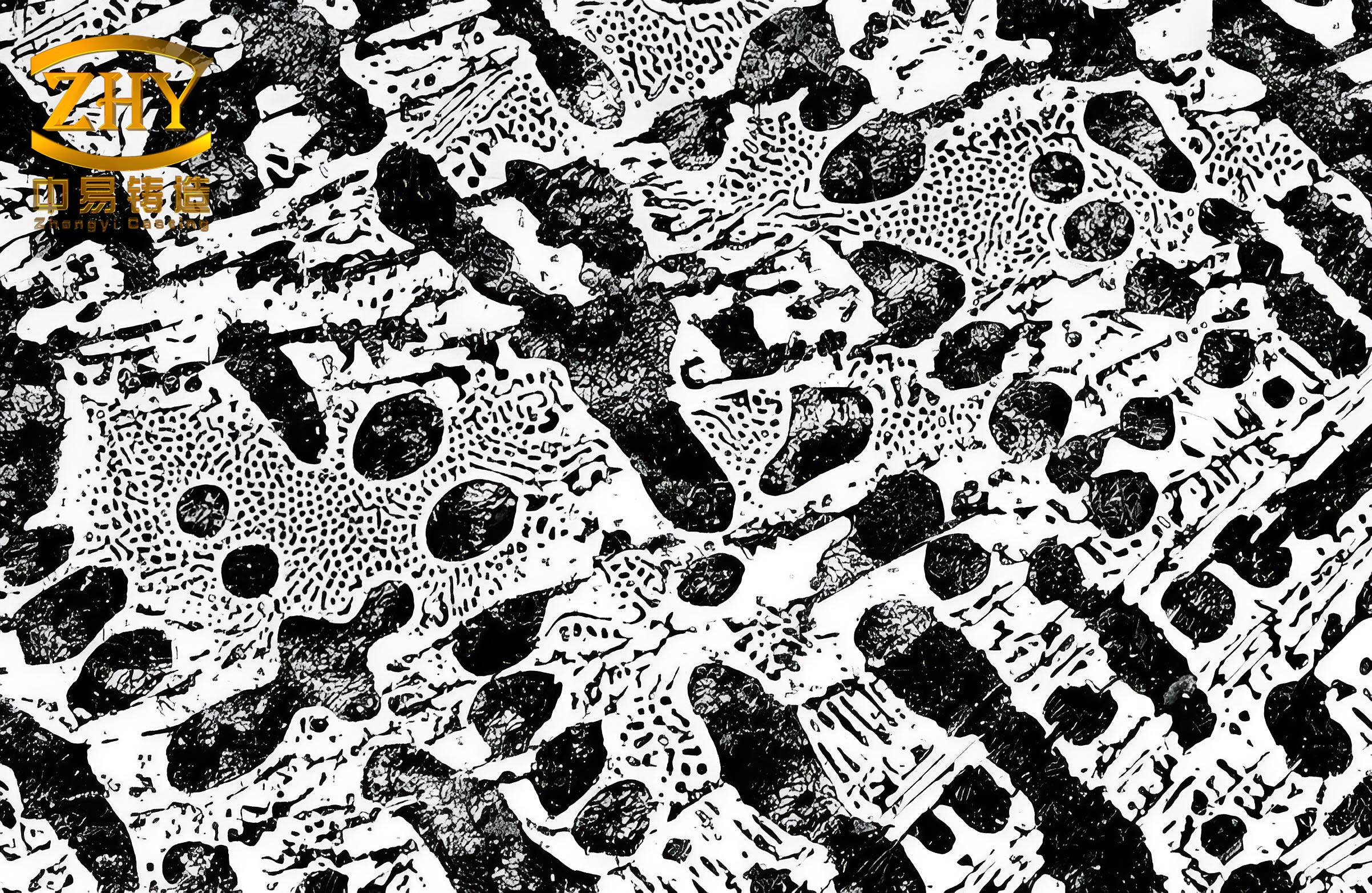
The foundational step was designing the alloy chemistry. We aimed for a white cast iron with high levels of both vanadium and chromium. The base composition was centered around a hypereutectic system to ensure a high volume fraction of hard carbides. A series of experimental melts were prepared in a medium-frequency induction furnace. To minimize vanadium loss during melting, a specific procedure was followed: the charge (excluding V-Fe) was melted and superheated to approximately 1550°C before adding the V-Fe alloy. The melt was then deoxidized with aluminum, and finally, a modifier containing rare earth elements was added to promote the spheroidization and aggregation of carbides. This careful processing is crucial for any advanced white cast iron.
The chemical compositions of four key experimental alloys are summarized in Table 1. Alloy 1 represents a standard high-chromium white cast iron for comparison, while Alloys 2, 3, and 4 feature increasing vanadium content. The balance between carbon, chromium, and vanadium was carefully calculated to control the type and amount of carbides.
| Alloy ID | C (wt.%) | Cr (wt.%) | V (wt.%) | Mo (wt.%) | Si, Mn (wt.%) |
|---|---|---|---|---|---|
| 1 (Reference) | 3.2 | 15 | – | 1.5 | <1.0 |
| 2 | 3.5 | 12 | 5.0 | – | <1.0 |
| 3 | 3.8 | 10 | 8.5 | 1.0 | <1.0 |
| 4 | 4.0 | 8 | 10.5 | 1.5 | <1.0 |
Wedges were cast from each melt, and samples were extracted for heat treatment and testing. A critical challenge with high-vanadium white cast iron is its oxidation tendency at high temperatures due to the low melting point of V2O5 (690°C). Therefore, heat treatments above this temperature, such as conventional austenitizing, require a protective atmosphere. This led us to explore sub-critical heat treatment as a more practical alternative. Our heat treatment regime involved holding samples at various temperatures below the austenitic transformation point (Ac1) for two hours, followed by air cooling. The goal was to transform retained austenite and temper the matrix without causing excessive oxidation.
The microstructure was the first aspect we examined. Using specific etchants (alkaline sodium picrate for general structure, potassium ferricyanide for distinguishing carbides), we observed a dramatic evolution. The reference high-chromium white cast iron (Alloy 1) showed a typical microstructure of martensite/bainite with interconnected network of M7C3 carbides. In contrast, the vanadium-bearing white cast iron exhibited a dispersion of very hard VC carbides. In Alloy 4, with 10.5% V, the primary carbides were large, blocky VC, while the eutectic carbides appeared as aggregated short rods or clusters. The volume fraction of carbides was quantitatively analyzed using image analysis, with results presented in Table 2. The key finding was the replacement of M7C3 by VC as vanadium content increased.
| Alloy ID | Total Carbide Vol.% | VC Vol.% (Estimated) | M7C3 Vol.% (Estimated) | Primary Carbide Morphology |
|---|---|---|---|---|
| 1 | ~32 | 0 | ~32 | Network |
| 2 | ~34 | ~12 | ~22 | Blocky VC + M7C3 network |
| 3 | ~36 | ~25 | ~11 | Blocky/Cluster VC, isolated M7C3 |
| 4 | ~38 | ~30 | ~8 | Large blocky VC, clustered eutectic VC |
The mechanical and tribological properties were thoroughly evaluated. Macro-hardness (HRC) was measured on heat-treated samples. Impact toughness (ak) was determined using unnotched charpy specimens due to the inherent brittleness of white cast iron; this provides a comparative measure of fracture resistance. Wear resistance was assessed using a pin-on-disk test against 150-grit Al2O3 abrasive paper under a 50N load for 30 minutes. The wear volume loss was measured, and the relative wear resistance was calculated with Alloy 1 (heat treated) as the baseline (value = 1). The comprehensive results for different heat treatment states are shown in Table 3.
| Alloy ID & State | Heat Treatment | Hardness (HRC) | Impact Toughness ak (J/cm2) | Wear Loss (mg) | Relative Wear Resistance |
|---|---|---|---|---|---|
| 1 – As-Cast | – | 55 | 4.5 | 45.2 | 1.0 |
| 1 – QT | 980°C Quench + 250°C Tempering | 62 | 6.8 | 38.5 | 1.17 |
| 2 – Sub-Critical | 480°C, 2h, AC | 58 | 7.2 | 22.1 | 2.04 |
| 3 – As-Cast | – | 52 | 8.5 | 18.7 | 2.42 |
| 3 – Sub-Critical | 480°C, 2h, AC | 60 | 9.8 | 12.5 | 3.62 |
| 4 – As-Cast | – | 50 | 9.0 | 15.9 | 2.84 |
| 4 – Sub-Critical | 480°C, 2h, AC | 61 | 10.5 | 9.8 | 4.61 |
The data reveals a transformative effect of vanadium. While the as-cast hardness of the high-V white cast iron (Alloys 3 & 4) was lower than the reference, their wear resistance was already superior. After the simple sub-critical treatment at 480°C, Alloy 4 achieved a hardness over 60 HRC and a wear resistance 4.6 times that of the conventional high-chromium white cast iron. Remarkably, this was accompanied by an impact toughness exceeding 10 J/cm², which is exceptionally high for a white cast iron. This synergy stems from the microstructure: the ultra-hard VC carbides (HV ~2800) provide the abrasion resistance, while their more isolated, clustered morphology (compared to the continuous network of M7C3) and the toughened matrix reduce stress concentration and crack propagation.
The role of heat treatment, particularly the sub-critical process, is profound. We investigated the tempering response in detail. The relationship between sub-critical treatment temperature and hardness for Alloy 3 and Alloy 4 is described by the following empirical equations derived from our data:
For Alloy 3 (8.5% V): $$ HRC(T) = 52 + 0.032 \times (T – 400) – 2.5 \times 10^{-5} \times (T – 400)^2 $$ where T is the tempering temperature in °C (range: 400°C to 560°C).
For Alloy 4 (10.5% V): $$ HRC(T) = 50 + 0.048 \times (T – 400) – 3.8 \times 10^{-5} \times (T – 400)^2 $$
These parabolic trends show an initial increase in hardness due to the transformation of retained austenite and secondary carbide precipitation, followed by a slight decrease at higher temperatures due to overtempering. The optimal temperature for this class of white cast iron was found to be between 480°C and 520°C.
We used X-ray diffraction (XRD) to quantify the amount of retained austenite (γR) after different treatments. The direct comparison method using the (211)α and (220)γ peaks was employed. The volume fraction of retained austenite, Vγ, can be calculated using the formula:
$$ V_{\gamma} = \frac{1}{1 + K \frac{I_{\alpha}}{I_{\gamma}}} $$
where \( I_{\alpha} \) and \( I_{\gamma} \) are the integrated intensities of the α-ferrite (martensite) and austenite peaks, respectively, and K is a material constant determined from standard samples. Our measurements, summarized in Table 4, show that the sub-critical treatment effectively reduces retained austenite to below 5%, contributing to dimensional stability and higher hardness.
| Alloy ID | Condition | Vγ (Vol.%) | Notes |
|---|---|---|---|
| 3 | As-Cast | ~35 | Significant retained austenite |
| 3 | 480°C, 2h, AC | <5 | Mostly transformed |
| 4 | As-Cast | ~30 | Significant retained austenite |
| 4 | 480°C, 2h, AC | <3 | Minimal retained austenite |
The exceptional properties of this vanadium-modified white cast iron demanded a real-world test. We produced a batch of hammer heads for a PC-0808 type crusher, used in cement clinker crushing. Each hammer head weighed approximately 8.5 kg and was cast from Alloy 4 composition. They underwent the established sub-critical heat treatment: 480°C for 2 hours, followed by air cooling. The results were outstanding. In field service at a cement plant, the service life of these high-vanadium high-chromium white cast iron hammers was three times longer than that of conventional high-chromium white cast iron hammers. This performance leap translates directly into reduced downtime and lower operating costs, validating the laboratory findings for this advanced white cast iron.
Beyond hammers, the potential applications for this material are vast. Any component subjected to severe abrasive wear with moderate impact could benefit. This includes slurry pump parts, liner plates for ball mills, rolling guides, and shot blast blades. The economics are also favorable. Although vanadium is an expensive addition, the dramatic increase in service life and the simplicity of the required heat treatment (no high-temperature quenching with protective atmosphere) often result in a lower total cost per operating hour. The development of this white cast iron represents a significant step in the evolution of wear-resistant materials.
In conclusion, our research into high-vanadium, high-chromium white cast iron has demonstrated a powerful method for enhancing performance. By strategically alloying to form vanadium carbides and employing a practical sub-critical heat treatment, we created a white cast iron with an unparalleled combination of wear resistance and toughness. The key was microstructural engineering: replacing the network of chromium carbides with a dispersion of harder, more isolated vanadium carbides within a strengthened matrix. This white cast iron, this particular grade of white cast iron, has proven its mettle in both the lab and the field. The journey of optimizing white cast iron continues, but this work solidly positions vanadium as a critical alloying element for the next generation of ultra-wear-resistant white cast iron components. Further studies could explore the effects of even higher vanadium levels, the synergy with other micro-alloying elements like niobium, and the behavior under different wear modes (e.g., erosion, cavitation). The fundamental principles established here, however, provide a robust framework for the future development of superior white cast iron alloys.