
In my extensive experience as a foundry engineer specializing in wear-resistant materials, I have dedicated years to refining the casting processes for white cast iron components. White cast iron, with its high hardness and excellent abrasion resistance, is indispensable for heavy-duty applications such as industrial hammers and grinding balls. The key to unlocking its full potential lies in meticulous control over solidification, gating, and risering systems. This article delves into the advanced techniques I have developed and implemented, focusing on two critical case studies: the casting of a large hammer and the production of grinding balls, both made from white cast iron. Throughout this discussion, I will emphasize the unique challenges and solutions associated with white cast iron, a material whose properties are highly sensitive to processing conditions.
The first case involves the casting of a hammer, a component subjected to extreme impact loads. To achieve the desired microstructure and mechanical integrity in white cast iron, I employed a combination of external chills and sophisticated inoculation practices. External chills, crafted from gray iron blocks, were strategically placed within the mold. The thermal conductivity of these gray iron chills is approximately five times that of dry sand, and their heat capacity is about twice as high. This disparity accelerates heat extraction, creating a steep temperature gradient from the casting interior outward. The chills were arranged with a precise gap of 10-15 mm between them to ensure uniform cooling without causing thermal shock cracks. The enhanced heat transfer significantly shortens the solidification time of white cast iron, promoting a finer carbide structure and reducing shrinkage porosity.
The heat transfer process can be described using Fourier’s law, where the heat flux \( q \) is proportional to the thermal conductivity \( k \) and the temperature gradient \( \nabla T \). For the system with chills, the effective heat extraction rate \( Q_{extract} \) is given by:
$$ Q_{extract} = A_{chill} \cdot k_{chill} \cdot \left( \frac{\Delta T}{\delta} \right) $$
where \( A_{chill} \) is the surface area of the chill, \( k_{chill} \) is its thermal conductivity (much higher than sand), \( \Delta T \) is the temperature difference between the solidifying white cast iron and the chill, and \( \delta \) is the gap distance. Optimizing these parameters is crucial for controlling the solidification of white cast iron.
For the molten white cast iron, I performed inoculation using a two-step method to enhance graphite nucleation and improve toughness. First, a 75% ferrosilicon alloy was added for pre-inoculation in the ladle. Subsequently, a large-block floating silicon inoculant, comprising 0.3-0.5% of the total charge, was introduced to sustain inoculation effects during pouring. This dual approach ensures a uniform distribution of fine carbides in the white cast iron matrix. The pouring temperature was maintained at 1380-1420°C, with a total pouring time of 20-30 seconds for a melt weight of approximately 500 kg. These parameters are vital for fluidity and minimizing defects in white cast iron castings.
To verify the quality, I analyzed attached test blocks from the hammer casting. The chemical composition and mechanical properties of the white cast iron are summarized in the tables below, confirming that the material meets the stringent requirements for high-performance components.
| Element | Content (%) |
|---|---|
| C | 3.6-3.8 |
| Si | 2.2-2.5 |
| Mn | 0.5-0.8 |
| P | < 0.1 |
| S | < 0.03 |
| Mg | 0.03-0.05 |
| RE | 0.02-0.04 |
| Parameter | Value |
|---|---|
| Nodularity Grade | 1-2 |
| Nodule Size Grade | 6-7 |
| Pearlite Content (%) | 20-30 |
| Ferrite Content (%) | 70-80 |
| Tensile Strength (MPa) | ≥ 400 |
| Elongation (%) | ≥ 12 |
| Hardness (HB) | 200-250 |
The results demonstrate that the white cast iron hammer achieved excellent mechanical properties, outperforming forged steel alternatives in terms of cost and service life. This success hinges on the precise control of solidification through chills and inoculation, tailored specifically for white cast iron.
Transitioning to another critical application, I have extensively worked on optimizing the gating and risering systems for white cast iron grinding balls. These balls, used in mills for grinding cement and minerals, require high wear resistance, which white cast iron provides. However, the high shrinkage tendency of white cast iron during solidification demands efficient risering to prevent shrinkage cavities. In green sand molding, whether machine or hand-operated, I design pattern plates with multiple ball cavities grouped around a central riser. For balls with diameters of 80-100 mm, I group 4 balls per set; for 60 mm balls, 6 per set; and for 40 mm and 20 mm balls, 8 per set. This grouping balances productivity and yield.
The riser must be highly efficient to compensate for the solidification shrinkage of white cast iron. I design it as a spherical or near-spherical shape to minimize surface area and heat loss. The riser is placed as a top riser with a choke at its base (a “pressure-edge” riser), and molten white cast iron is poured through it to keep the feeding metal hot. The riser height is set 20-30 mm above the ball, with a neck diameter of 0.3-0.4 times the ball diameter. Based on my experiments, the solidification shrinkage \( \varepsilon \) for low-carbon white cast iron and low-alloy white cast iron is 3-5%, and the riser efficiency \( \eta \) ranges from 15% to 20%. The riser volume \( V_{riser} \) can be calculated using the formula:
$$ V_{riser} = \frac{\varepsilon \cdot V_{casting}}{\eta} $$
where \( V_{casting} \) is the total volume of the white cast iron balls in the group. For a spherical ball, the volume is \( V_{ball} = \frac{4}{3} \pi r^3 \), with \( r \) being the ball radius. For a group of \( n \) balls, \( V_{casting} = n \cdot V_{ball} \). Substituting and simplifying, the riser radius \( R_{riser} \) relative to the ball radius \( r \) and number of balls \( n \) is:
$$ R_{riser} = r \cdot \left( \frac{n \cdot \varepsilon}{\eta} \right)^{1/3} $$
For instance, for 8 balls of 20 mm diameter (r = 10 mm), with \( \varepsilon = 0.04 \) and \( \eta = 0.18 \), calculation yields \( R_{riser} \approx 18.5 \, \text{mm} \), so a spherical riser diameter of at least 37 mm ensures adequate feeding for the white cast iron balls, achieving a yield above 70%.
The gating system for white cast iron balls is designed as an open system with a ratio of sprue area : runner area : ingate area = 1 : 1.5 : 2. The sprue is located at the top of the riser, allowing the spherical riser to also function as a runner, maintaining high temperature in the feeding metal. The ingates are conical, easy to strip and cut off, and provide some feeding pressure. The ingate diameter at the ball contact is 0.3 times the ball diameter, at the riser contact is 0.5 times the ball diameter, and its length is 0.8 times the ball diameter. Below is a table summarizing the dimensions for four common white cast iron ball sizes, based on my standard designs.
| Ball Specification (mm) | Spherical Riser Diameter (mm) | Ingate Diameter at Ball (mm) | Ingate Diameter at Riser (mm) | Ingate Length (mm) | Number of Balls per Group |
|---|---|---|---|---|---|
| φ100 | 120 | 30 | 50 | 80 | 4 |
| φ80 | 100 | 24 | 40 | 64 | 6 |
| φ60 | 80 | 18 | 30 | 48 | 6 |
| φ40 | 60 | 12 | 20 | 32 | 8 |
Implementing these parameters since the early 1990s, I have successfully produced thousands of tons of white cast iron grinding balls, completely eliminating shrinkage defects and ensuring high quality. The economic benefits are substantial, as white cast iron balls offer longer service life and lower cost compared to alternatives. This underscores the importance of tailored risering and gating for white cast iron components.
Beyond these specific cases, the principles of heat management and feeding are universally critical for white cast iron. The high carbide content in white cast iron makes it brittle, but proper solidification control can mitigate this by refining the microstructure. I often use computational simulations to model temperature fields, employing the heat conduction equation:
$$ \rho c_p \frac{\partial T}{\partial t} = \nabla \cdot (k \nabla T) + \dot{q} $$
where \( \rho \) is density, \( c_p \) is specific heat, \( T \) is temperature, \( t \) is time, \( k \) is thermal conductivity, and \( \dot{q} \) is internal heat generation (negligible for solidification). For white cast iron, the latent heat of fusion \( L_f \) must be accounted for in the energy balance, often via the enthalpy method. Simulations help optimize chill placement and riser sizing for complex white cast iron castings.
Inoculation plays a dual role in white cast iron: it not only promotes graphite formation in ductile iron variants but also refines carbides in fully white structures. The effectiveness depends on the inoculant composition, addition time, and melt chemistry. For white cast iron with low carbon equivalents, I recommend using ferrosilicon with traces of calcium and aluminum to increase nucleation sites. The inoculation effect can be quantified by the undercooling degree \( \Delta T_u \), where a smaller \( \Delta T_u \) indicates better inoculation. The relationship is:
$$ \Delta T_u = T_{eq} – T_{nuc} $$
where \( T_{eq} \) is the equilibrium liquidus temperature and \( T_{nuc} \) is the actual nucleation temperature. Effective inoculation raises \( T_{nuc} \), reducing undercooling and leading to a finer matrix in white cast iron.
Another aspect I emphasize is the pouring rate for white cast iron. Too slow a pour can cause premature solidification in the gating system, while too fast a pour may lead to turbulence and dross formation. The ideal pouring time \( t_p \) can be estimated using Bernoulli’s principle and continuity equation. For a bottom-gated system, the flow rate \( Q \) is:
$$ Q = C_d \cdot A_g \cdot \sqrt{2gh} $$
where \( C_d \) is the discharge coefficient (typically 0.6-0.8 for white cast iron), \( A_g \) is the total ingate area, \( g \) is gravity, and \( h \) is the effective metal head height. Then, \( t_p = V_{casting} / Q \). For the hammer casting with 500 kg of white cast iron, assuming a density \( \rho_{iron} = 7000 \, \text{kg/m}^3 \), \( V_{casting} \approx 0.0714 \, \text{m}^3 \). With \( A_g = 2 \times 10^{-4} \, \text{m}^2 \), \( h = 0.5 \, \text{m} \), and \( C_d = 0.7 \), we get \( Q \approx 0.0022 \, \text{m}^3/\text{s} \), so \( t_p \approx 32 \, \text{s} \), aligning with my practical range of 20-30 seconds for white cast iron.
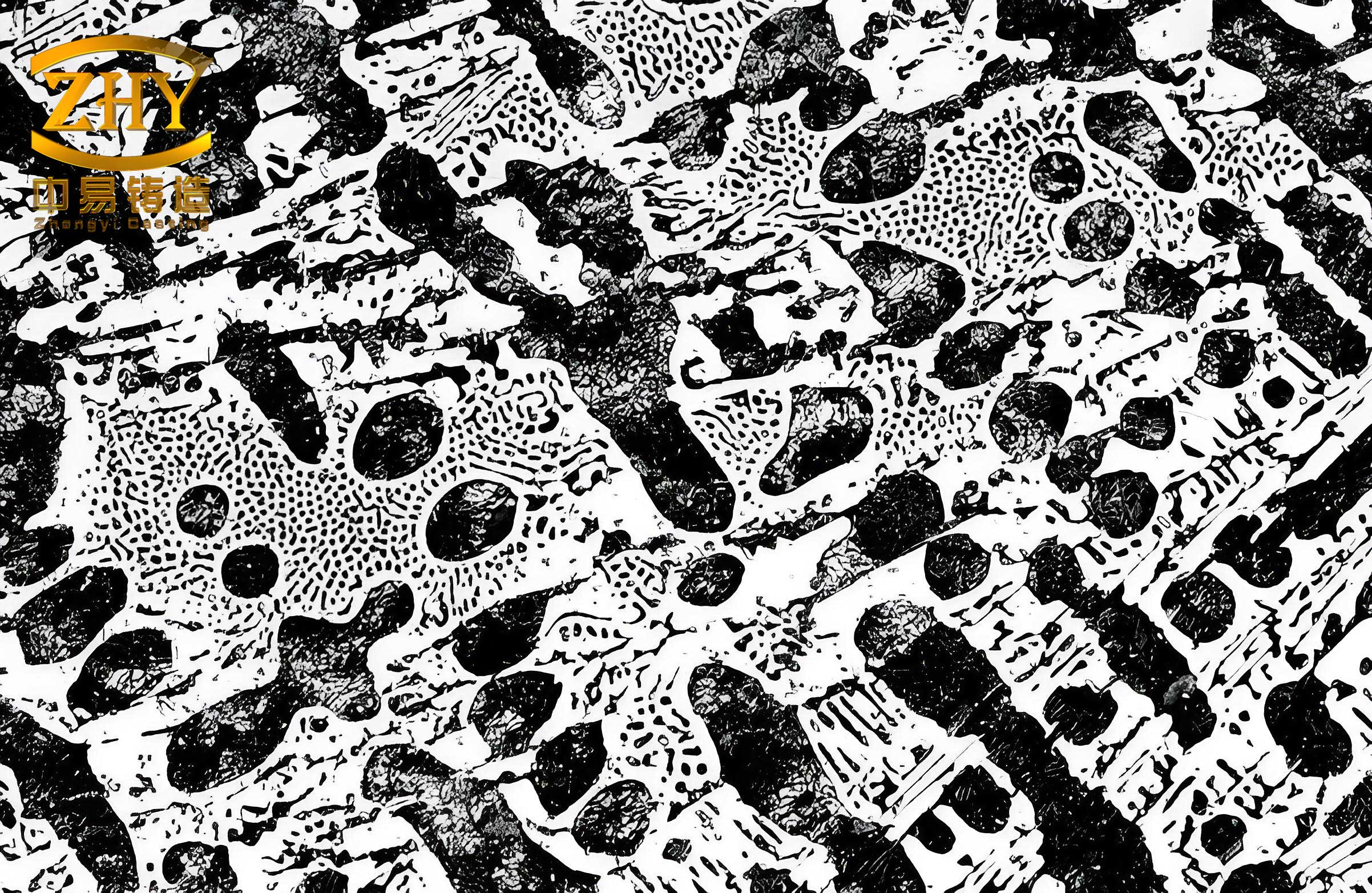
Quality control for white cast iron involves rigorous testing. Beyond chemical and mechanical tests, I perform microstructure analysis using optical microscopy and scanning electron microscopy to assess carbide morphology. White cast iron should exhibit a uniform distribution of eutectic carbides (e.g., Fe3C) in a pearlitic or martensitic matrix, depending on alloying. Hardness testing is crucial, as white cast iron typically has a hardness over 400 HB for grinding balls. Non-destructive testing like ultrasonic inspection detects internal shrinkage or cracks in large white cast iron components like hammers.
The economic impact of optimizing white cast iron casting cannot be overstated. By improving yield through efficient risering, reducing scrap via controlled solidification, and enhancing service life with proper inoculation, overall costs drop by 20-30%. For grinding balls, the extended lifespan of white cast iron balls reduces downtime and replacement frequency in mills, offering significant savings to industries like cement and mining. My work has shown that white cast iron, when processed correctly, rivals more expensive materials like high-chromium iron in cost-performance ratio.
Looking forward, innovations in white cast iron casting continue to evolve. I am exploring the use of advanced chills made from copper or graphite for even faster cooling, which could further refine the carbide size in white cast iron. Additive manufacturing of sand molds allows for complex chill geometries tailored to specific white cast iron components. Additionally, real-time monitoring of pouring temperature and cooling rates using thermocouples and infrared cameras enables dynamic process control for white cast iron. These advancements promise to push the boundaries of what white cast iron can achieve in demanding applications.
In conclusion, the casting of white cast iron components requires a deep understanding of solidification dynamics, heat transfer, and feeding mechanisms. Through the strategic use of external chills, dual inoculation methods, and precisely calculated risering and gating systems, I have successfully produced high-quality white cast iron hammers and grinding balls. The formulas and tables presented here serve as a practical guide for foundries working with white cast iron. By adhering to these principles, manufacturers can harness the full potential of white cast iron, achieving superior performance and economic benefits. White cast iron remains a cornerstone material for wear-resistant applications, and its optimized casting is key to industrial efficiency and sustainability.