
This study investigates the spheroidization and growth behavior of carbides in hypoeutectic white cast iron following high-temperature deformation and subsequent isothermal holding. The underlying mechanisms and kinetics are explored, revealing a coarsening process governed by diffusion and interfacial energy reduction, aligning with classical particle coarsening theories. The findings provide significant insight into microstructural control for enhancing the properties of this important class of wear-resistant materials.
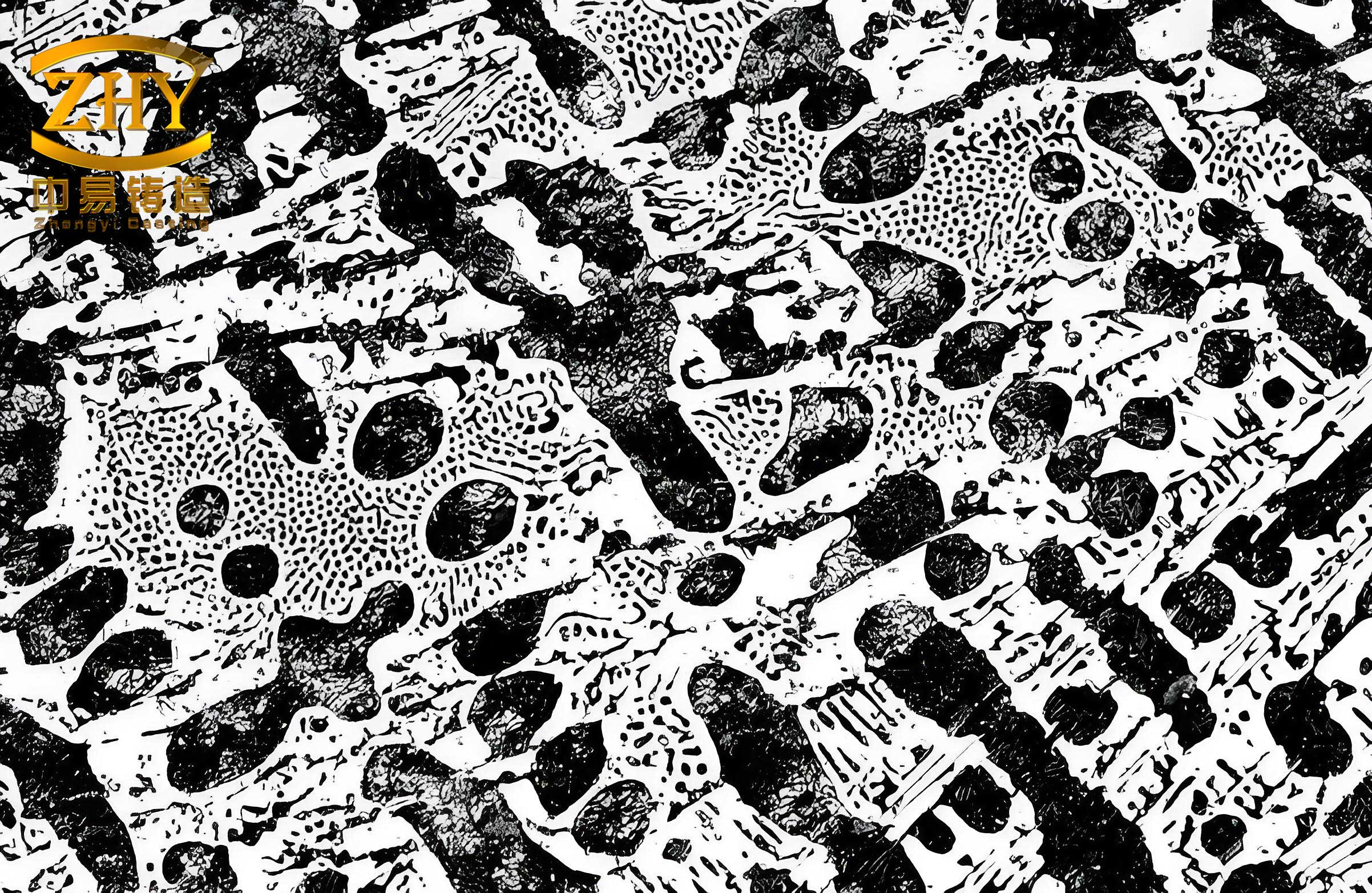
The microstructure of white cast iron is characterized by a hard, brittle network of carbides within a metallic matrix. This structure confers excellent wear resistance but poor toughness. Thermomechanical processing, involving hot deformation followed by controlled heat treatment, offers a pathway to modify this microstructure. Specifically, breaking the continuous carbide network and promoting its spheroidization can dramatically improve toughness while retaining much of the hardness. The isothermal spheroidization stage is critical, as it dictates the final size, morphology, and distribution of the carbide particles. This article delves into the microstructural evolution during this stage, quantifying the changes and modeling the growth kinetics.
1. Experimental Methodology
1.1 Material and Initial Processing
The subject material was a hypoeutectic white cast iron. The chemical composition is summarized in Table 1.
| Element | C | Si | Mn | Cr | Fe |
|---|---|---|---|---|---|
| Content (wt.%) | 2.8 – 3.2 | 0.8 – 1.2 | 0.5 – 0.8 | 1.5 – 2.0 | Bal. |
Cylindrical specimens were subjected to uniaxial compression at 1150°C with a deformation degree of 60%. Following deformation, two cooling paths were employed for subsequent analysis: (A) air cooling to 200°C followed by quenching in a 10% NaOH aqueous solution, and (B) furnace cooling to room temperature followed by isothermal holding at 780°C.
1.2 Isothermal Treatment and Characterization
Samples processed via path (B) underwent isothermal treatment at 780°C for varying durations: 10, 30, 60, 120, 240, and 480 minutes. The microstructural evolution was characterized using optical microscopy (OM), scanning electron microscopy (SEM), and X-ray diffraction (XRD). Key parameters were measured using quantitative metallography techniques, including:
- Average carbide particle diameter, \( \bar{d} \).
- Number of carbide particles per unit area, \( N_A \).
- Area/volume fraction of carbides, \( V_V \).
The growth kinetics were analyzed by plotting these parameters against holding time.
2. Results and Discussion: Mechanisms of Carbide Spheroidization and Growth
2.1 Formation of Initial Carbide Morphology
XRD analysis confirmed the presence of M3C-type carbides. The severe plastic deformation at high temperature introduced a high density of dislocations and other lattice defects into the austenite matrix. These defects act as potent nucleation sites, leading to the precipitation of fine, granular carbides approximately 0.1 µm in size during or immediately after deformation. Upon further cooling, dissolved carbon atoms continue to precipitate, preferentially depositing onto the surfaces of these existing particles. However, due to limited diffusion range at lower temperatures, areas distant from existing carbides may transform via a pearlitic reaction. Consequently, the initial microstructure prior to isothermal holding consists of a mixture of fine granular carbides, short rod-like carbides, and some pearlitic regions.
2.2 Spheroidization of Rod-like Carbides
During the initial stage of isothermal holding, the short rod-like carbides undergo spheroidization primarily through a dissolution-and-precipitation mechanism driven by curvature effects. Rods often contain imperfections such as dislocations or sub-grain boundaries. At these sites, interfacial tension creates a groove or notch on the carbide surface. According to the Gibbs-Thomson equation, the solubility \( C_r \) of a particle in the matrix is related to its radius of curvature \( r \):
$$ C_r = C_\infty \exp\left(\frac{2\gamma V_m}{RT r}\right) \approx C_\infty \left(1 + \frac{2\gamma V_m}{RT r}\right) $$
where \( C_\infty \) is the solubility near a flat surface, \( \gamma \) is the interfacial energy, \( V_m \) is the molar volume, \( R \) is the gas constant, and \( T \) is the absolute temperature.
The grooved region has a small radius of curvature, leading to a locally higher carbon solubility in the adjacent matrix. This causes preferential dissolution of carbide at the groove. As dissolution deepens the groove to maintain local interfacial equilibrium, the process continues until the rod fractures into segments. The newly created segments, having sharp edges and non-uniform curvature, then undergo “apex dissolution and face precipitation.” Carbon atoms dissolve from high-curvature tips and edges and re-precipitate onto flatter surfaces, gradually smoothing the morphology until a spherical shape with a near-uniform radius is achieved.
2.3 Coarsening of Granular Carbides (Ostwald Ripening)
Once a population of roughly spherical carbides is established, further isothermal holding leads to coarsening: larger particles grow at the expense of smaller ones. This is a classic Ostwald ripening process driven by the reduction of total interfacial energy. Consider a system with two spherical carbide particles of radii \( r_1 \) and \( r_2 \) (\( r_2 > r_1 \)) in a matrix. The chemical potential of the solute (carbon) around a particle is curvature-dependent. Carbon diffuses down the concentration gradient from the vicinity of the smaller particle (higher solubility) to the vicinity of the larger particle (lower solubility). The result is the dissolution of the smaller particle and growth of the larger one.
The change in the average particle radius over time is often described by the Lifshitz–Slyozov–Wagner (LSW) theory for volume-diffusion-controlled growth:
$$ \bar{r}^3 – \bar{r}_0^3 = K t $$
$$ K = \frac{8 \gamma C_\infty D V_m}{9 RT} $$
where \( \bar{r}_0 \) is the average radius at time zero, \( \bar{r} \) is the average radius at time \( t \), \( K \) is the rate constant, and \( D \) is the diffusion coefficient of the solute in the matrix.
The experimental data for the thermally deformed white cast iron showed that the cube of the average carbide diameter increased linearly with time, confirming diffusion-controlled growth. An empirical power-law relationship was also found to fit the data well:
$$ \bar{d} = k t^n $$
where \( n \) was determined to be approximately 1/3 for the later stages of coarsening, consistent with the LSW model. The measured parameters are summarized in Table 2.
| Isothermal Time (min) | Avg. Diameter, \( \bar{d} \) (µm) | Particle Density, \( N_A \) (per mm²) | Volume Fraction, \( V_V \) (%) |
|---|---|---|---|
| 10 | 0.52 | 4.2 x 10⁵ | 18.5 |
| 30 | 0.68 | 2.8 x 10⁵ | 18.3 |
| 60 | 0.85 | 1.7 x 10⁵ | 18.7 |
| 120 | 1.12 | 8.5 x 10⁴ | 18.4 |
| 240 | 1.48 | 4.1 x 10⁴ | 18.6 |
| 480 | 1.95 | 1.9 x 10⁴ | 18.5 |
The key observations are: 1) The average particle size increases steadily. 2) The number of particles per unit area decreases significantly. 3) The volume fraction of carbides remains constant within experimental error. This triad of evidence is the definitive signature of Ostwald ripening. The process in this thermally deformed white cast iron is a combination of initial shape accommodation (rod breakup and spheroidization) followed by pure coarsening of the granular phase.
2.4 Energetic Driving Force and Kinetics
The total free energy change \( \Delta G \) for a system of carbide particles is the sum of the bulk chemical free energy and the interfacial energy. For a particle of volume \( V \) and surface area \( A \), its contribution is:
$$ \Delta G = \Delta G_{chem} + \gamma A $$
For a two-particle system where one grows and the other shrinks, the reduction in total interfacial area (and thus \( \gamma A \)) provides the driving force, even if the total volume of carbide (related to \( \Delta G_{chem} \)) is constant. The kinetics are governed by the diffusion flux \( J \), which is proportional to the concentration gradient \( \nabla C \). Fick’s first law gives:
$$ J = -D \nabla C $$
The gradient itself is established by the difference in solubility around particles of different sizes, as defined by the Gibbs-Thomson equation. Therefore, the coarsening rate in this white cast iron system is ultimately controlled by the diffusivity of carbon in the austenitic matrix at the isothermal temperature of 780°C.
3. Implications and Summary
The isothermal spheroidization of carbides in hot-deformed white cast iron is fundamentally a diffusional coarsening process. The sequence involves: (i) dissolution of sharp features and fragmentation of rods via curvature-driven instability, (ii) morphological relaxation of fragments into spheres, and (iii) competitive growth where larger carbides consume smaller ones to reduce the total system interfacial energy.
The kinetics follow the cube-root law characteristic of Ostwald ripening, with the particle size increasing proportionally to \( t^{1/3} \). The number density of particles decreases accordingly, while the overall carbide volume fraction remains unchanged. This understanding is crucial for designing heat treatment schedules for white cast iron components. Controlling the isothermal temperature and time allows for tailoring the final carbide size distribution, enabling a balance between hardness (favored by smaller, more numerous carbides) and toughness (favored by a coarser, more isolated distribution).
Further research could focus on the precise role of alloying elements (like Cr in this white cast iron) on the interfacial energy \( \gamma \) and carbon diffusivity \( D \), which would refine the predictive models for growth rate. The principles elucidated here are also broadly applicable to other multi-phase systems where a dispersed hard phase coarsens during high-temperature exposure.