
The relentless pursuit of higher performance and safety standards in industrial applications, particularly within sectors like railway transportation, has led to increasingly stringent requirements for the surface quality of steel castings. Components such as side frames and bolsters for railway freight cars, manufactured to demanding specifications like the B+ grade, are expected to be free from critical surface discontinuities including cracks, sand inclusions, and excessive shrinkage cavities. Given the inherent complexities of sand casting processes, where the stochastic nature of solidification can introduce such imperfections, weld repair emerges not as an optional step but as an essential and sanctioned procedure within the manufacturing sequence. However, this necessary intervention introduces a zone of heterogeneity—the weld repair area and its associated heat-affected zone (HAZ)—which often coincides with the component’s critical load-bearing sections. The localized thermal cycles from welding can induce significant microstructural transformations, leading to non-uniform hardness distributions and the locking-in of detrimental residual stresses. These factors collectively pose a substantial risk to the in-service structural integrity and fatigue life of the component. Consequently, a fundamental understanding of the hardness profile across weld-repaired regions and the development of robust control methodologies, primarily through post-weld heat treatment (PWHT), is of paramount importance. This study delves into these aspects, systematically evaluating how various weld repair and subsequent thermal processing parameters influence the final mechanical state, with a particular focus on mitigating potential heat treatment defects related to improper hardness.
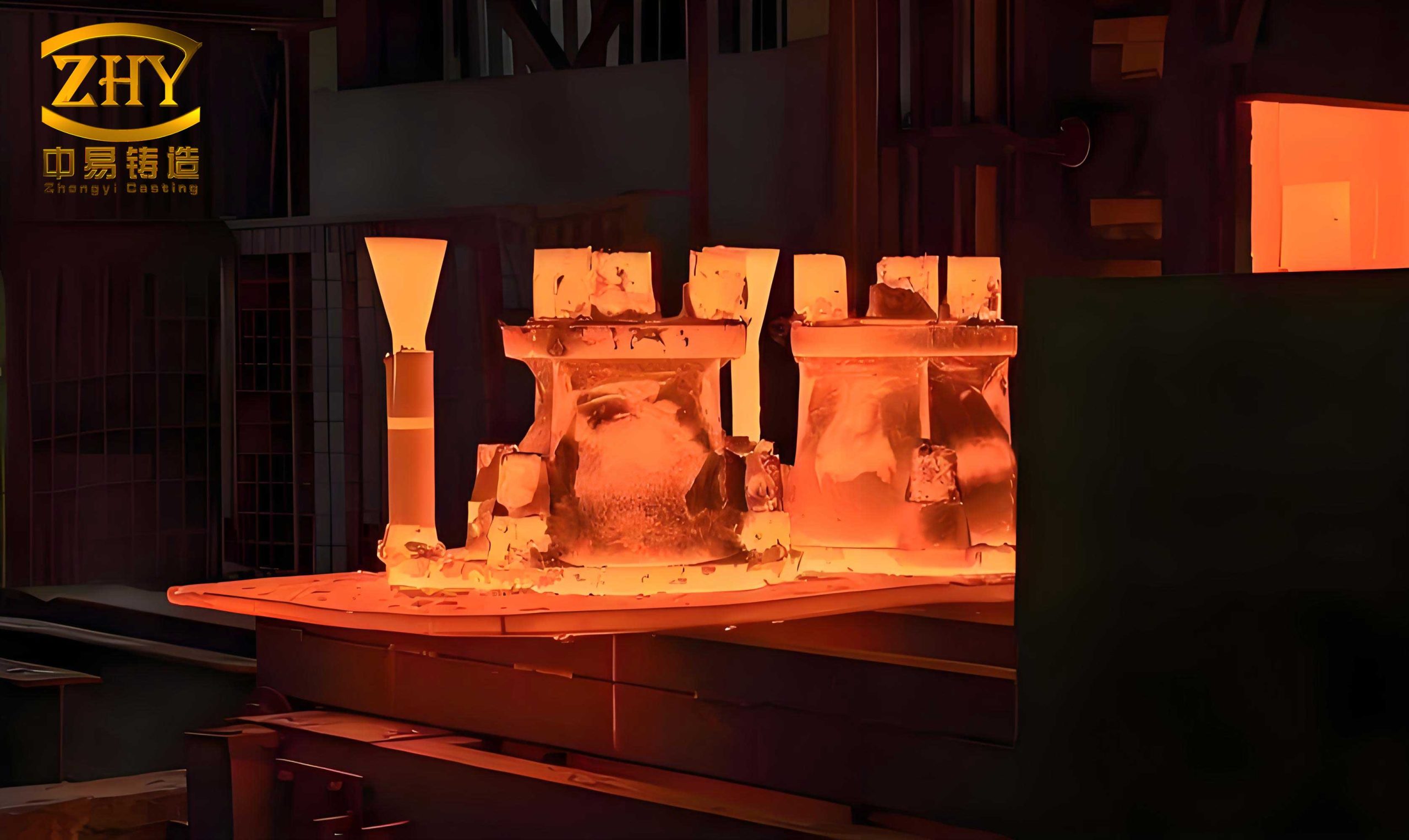
The foundational material for this investigation is B+ grade cast steel, a material engineered for a balanced combination of strength, toughness, and weldability, commonly employed in heavy-section, safety-critical applications. Its standardized chemical composition ensures consistent baseline properties. The initial condition of the cast steel prior to any repair is crucial; for this work, all base material was subjected to a normalizing and tempering treatment. This initial heat treatment is designed to refine the as-cast microstructure, dissolve detrimental segregation patterns, and establish a uniform matrix of ferrite and pearlite (or bainite, depending on cooling rates), thereby providing optimal strength and toughness. The normalizing cycle involves austenitizing in the range of 890–920°C, followed by still-air cooling, which promotes a fine, homogeneous grain structure. Tempering is subsequently performed between 540–580°C to relieve internal stresses from normalizing and to enhance ductility and fracture toughness. The welding consumable selected for repair was a Ø4 mm J557 (AWS E8015-G) electrode. This low-hydrogen, basic-coated electrode is specifically formulated for welding high-strength, low-alloy steels, offering good crack resistance and mechanical properties that can be matched to the base metal. To eliminate moisture—a primary source of hydrogen which can cause cold cracking—the electrodes were rigorously dried at 350°C for two hours prior to use.
The experimental matrix was designed to simulate real-world repair scenarios and isolate the effects of key variables. Test plates of B+ steel, measuring 400 mm × 200 mm × 26 mm and in the normalized-and-tempered condition, served as the base material. Two distinct defect geometries were machined to mimic common casting flaws: punctiform (approximately 15–18 mm diameter after welding) and linear (approximately 60 mm × 15 mm after welding). These geometries represent different thermal sink conditions and restraint levels during welding. The primary variables investigated were: (1) Preheating Temperature (150°C vs. No Preheat), (2) Defect Geometry (Punctiform vs. Linear), and (3) Post-Weld Heat Treatment State (As-Welded vs. Stress Relief Annealed). A standardized welding procedure using shielded metal arc welding (SMAW) with a constant current of 170 A was employed for all repairs. The specific parameter combinations for the eight test conditions are summarized in Table 1.
| Specimen ID | Simulated Defect Type | Preheat Temp. (°C) | Weld Pass Strategy | Post-Weld State |
|---|---|---|---|---|
| PP_AW | Punctiform | 150 | Single Pass | As-Welded |
| PN_AW | Punctiform | None | Single Pass | As-Welded |
| LP_AW | Linear | 150 | Two Passes | As-Welded |
| LN_AW | Linear | None | Two Passes | As-Welded |
| PN_SR | Punctiform | None | Single Pass | Stress Relieved |
| LN_SR | Linear | None | Two Passes | Stress Relieved |
| PP_SR | Punctiform | 150 | Single Pass | Stress Relieved |
| LP_SR | Linear | 150 | Two Passes | Stress Relieved |
The post-weld stress relief heat treatment was conducted according to a precisely controlled thermal cycle, holding the components at 500–540°C for 2.5–3.5 hours followed by furnace cooling. This sub-critical thermal exposure is intended to reduce peak residual stresses without significantly altering the base metal’s tempered microstructure. The core of the evaluation focused on microhardness mapping. Transverse cross-sections of each weld repair were prepared, polished, and etched. Vickers microhardness (HV10) traverses were performed according to relevant standards, with indentation paths spanning from the unaffected base metal (BM), through the heat-affected zone (HAZ), across the weld metal (WM), and into the opposite HAZ and BM. This data provides a quantitative fingerprint of the mechanical heterogeneity induced by the repair process.
Macro-examination of all welded joints confirmed sound fusion without lack-of-penetration or gross defects. The hardness profiles, however, revealed significant variations. For the as-welded condition, the most striking feature was the pronounced hardness peak invariably located within the coarse-grained region of the HAZ. This hardening phenomenon is a direct consequence of the rapid thermal cycle experienced by this region. The base metal, initially in a soft, tempered condition, is heated above the Ac3 transformation temperature into the austenite phase field. The subsequent rapid cooling (quenching) by the surrounding cold metal mass transforms this austenite into hard, metastable constituents like martensite or upper bainite. The peak hardness values for the as-welded specimens are consolidated in Table 2. A clear hierarchy is observed: punctiform defects welded without preheat (PN_AW) exhibited the most severe hardening, reaching a maximum of 510 HV10. In contrast, preheating and a larger weld volume (linear defect) somewhat mitigated the effect, with LP_AW showing a lower peak of 381 HV10. This can be attributed to preheating reducing the overall cooling rate ($t_{8/5}$ time), allowing more time for diffusion-controlled transformations to softer phases, and the larger thermal mass of a linear repair distributing heat more effectively.
| Condition | Specimen ID | Max HAZ Hardness (As-Welded) | Specimen ID | Max HAZ Hardness (Stress Relieved) | Hardness Reduction (%) |
|---|---|---|---|---|---|
| Punctiform, No Preheat | PN_AW | 510 | PN_SR | 375 | 26.5% |
| Punctiform, 150°C Preheat | PP_AW | 478 | PP_SR | 350 | 26.8% |
| Linear, No Preheat | LN_AW | 486 | LN_SR | 369 | 24.1% |
| Linear, 150°C Preheat | LP_AW | 381 | LP_SR | 351 | 7.9% |
The transformative effect of the post-weld stress relief annealing is unequivocally demonstrated in the data. For all conditions, the sub-critical tempering cycle significantly reduced the peak HAZ hardness and, more importantly, homogenized the entire hardness profile across the joint. As seen in Table 2 and the comparative plots, the hardness “spikes” were dramatically flattened. The maximum hardness across all stress-relieved specimens was contained below 380 HV10, whereas 75% of the as-welded specimens exceeded this threshold, with some by a considerable margin. This reduction can be modeled as a tempering response of the hard HAZ microstructure. The holding time at 500-540°C allows for the diffusion of carbon from supersaturated martensite, the precipitation and coarsening of carbides, and the recovery of dislocation structures. The process follows kinetic principles often described by Hollomon-Jaffe tempering parameters or analogous formulations relating hardness decrease to time and temperature:
$$ H = H_0 – k \cdot \log(t) \cdot f(T) $$
where $H$ is the final hardness, $H_0$ is the initial as-welded hardness, $k$ is a material constant, $t$ is time, and $f(T)$ is a function of the absolute temperature. The stress relief treatment had a negligible effect on the hardness of the original base metal (away from the HAZ), confirming that the temperature-time cycle was carefully chosen to avoid over-tempering the component’s core properties—a critical consideration to prevent creating new heat treatment defects in the form of global under-strength material.
The implications of these hardness distributions extend directly to residual stress fields and fatigue performance. The localized expansion and contraction during welding, constrained by the surrounding cooler metal, generate internal stresses. A region of high hardness (high yield strength) adjacent to softer material creates a mechanical incompatibility. Upon external loading, stress concentrations arise at these interfaces, potentially initiating fatigue cracks. The residual stress ($\sigma_{res}$) can be qualitatively related to the hardness gradient and the coefficient of thermal expansion ($\alpha$), Young’s modulus ($E$), and the temperature differential ($\Delta T$):
$$ \sigma_{res} \propto E \cdot \alpha \cdot \Delta T \cdot \left(1 – \frac{H_{HAZ}}{H_{BM}} \right)^{-1} $$
for a simplified model. A large hardness ratio $H_{HAZ}/H_{BM}$ correlates with higher locked-in tensile stresses. The stress relief heat treatment works by lowering the yield strength of the hardened zone (via tempering) and providing sufficient thermal energy for creep and stress relaxation to occur, thereby lowering $\sigma_{res}$ substantially. Failure to apply such a treatment, or applying an incorrect cycle (e.g., insufficient temperature/time), constitutes a major procedural heat treatment defects that leaves the component vulnerable to premature failure.
Delving deeper into the microstructure-property relationships, the HAZ can be subdivided into distinct regions: the coarse-grained HAZ (CGHAZ), the fine-grained HAZ (FGHAZ), the intercritical HAZ (ICHAZ), and the subcritical HAZ (SCHAZ). Each experiences a unique thermal history. The peak hardness invariably resides in the CGHAZ, which suffers from grain coarsening in addition to the formation of hard transformation products. The hardness across the HAZ, $H_{HAZ}(x)$, where $x$ is the distance from the fusion line, is a complex function of the peak temperature $T_p(x)$, the cooling time $t_{8/5}(x)$, and the local composition:
$$ H_{HAZ}(x) = f( T_p(x), t_{8/5}(x), C_{eq} ) $$
where $C_{eq}$ is the carbon equivalent, a measure of the steel’s hardenability. Preheating primarily increases $t_{8/5}$ for all regions, shifting the transformation kinetics on the Continuous Cooling Transformation (CCT) diagram towards softer microstructures. A larger weld deposit (linear vs. punctiform) also increases the effective $t_{8/5}$ due to greater heat accumulation. However, as the data shows, these in-process adjustments alone are insufficient to bring the hardness down to acceptable levels compatible with good fatigue resistance in high-integrity castings. They are beneficial first steps but are not a substitute for a dedicated, final PWHT. Omitting PWHT is a fundamental error and a direct source of heat treatment defects in the broader manufacturing context, as it leaves the component in a metastable, high-stress state.
Beyond hardness, the stress relief treatment also improves the toughness of the HAZ. The as-welded martensitic/bainitic structures, while hard, can possess low ductility and fracture toughness. The tempering action during stress relief recovery and recovers some of this lost ductility, improving the material’s resistance to brittle fracture—a critical property for components subject to dynamic loading and low-temperature service. This underscores that the goal of post-repair heat treatment is not merely hardness reduction but a comprehensive enhancement of the mechanical state of the repair zone to match, as closely as possible, the reliable properties of the original casting. Inadequate heat treatment that focuses only on one parameter (like a simple stress check) while ignoring microstructural homogenization can lead to latent heat treatment defects that manifest as poor impact performance.
In conclusion, the weld repair of high-grade cast steel components is a multi-parametric challenge where process decisions have profound implications for service performance. For normalized-and-tempered B+ grade steel repaired with J557 electrodes, the following key findings provide a roadmap for quality assurance:
- The weld thermal cycle invariably creates a hard heat-affected zone, with hardness significantly exceeding that of both the weld metal and the base material. This is the primary source of mechanical heterogeneity.
- Process parameters such as preheating and weld bead size exert a moderate influence, with preheating and larger weld volumes offering a measurable, yet limited, reduction in peak HAZ hardness in the as-welded state.
- Post-weld stress relief annealing is the single most effective and non-negotiable step for controlling the final state of the repair. It dramatically reduces peak hardness (by 25% or more in severe cases), homogenizes the hardness profile across the joint, and relieves detrimental residual stresses. Its effect is consistently significant across all defect geometries and preheat conditions.
- The stress relief cycle, when properly executed, selectively tempers only the weld-affected regions without altering the properties of the bulk casting material, thus avoiding the introduction of new, widespread heat treatment defects.
Therefore, a robust weld repair procedure for critical B+ steel castings must mandate a properly qualified and controlled stress relief heat treatment following any significant repair. Relying solely on preheating or weld technique adjustments is insufficient to guarantee the long-term structural integrity required for safety-critical applications. The implementation of a verified thermal cycle post-weld is the definitive strategy to transform a potential weak point—the repair zone—into a reliably integrated part of the load-bearing structure, thereby ensuring the component meets its stringent performance and longevity requirements. This holistic approach, integrating controlled welding with definitive thermal processing, is essential to eliminate the risks associated with hardness-related heat treatment defects in weld-repaired heavy-section castings.