
In my extensive experience working with wear-resistant castings, I have come to understand that the service life of these components is not solely determined by the intrinsic properties of the material but is profoundly influenced by the operational conditions under which they are used. Over the past few decades, as equipment has evolved towards greater specialization and diversity, the demands for the technical and economic viability, as well as the applicability, of wear-resistant castings have escalated significantly. The conventional high manganese steel, which was once the standard, has proven inadequate to meet the needs of this diversified development. Consequently, since the 1990s, researchers and practitioners, including myself, have focused on developing a series of high manganese steel products aimed at creating different grades to suit various operational conditions economically and rationally. Initial efforts led to the development of low-manganese and modified series, but practical applications showed that their technical and economic advantages over conventional grades were not substantial, limiting their widespread adoption. Since the 2000s, the emphasis has shifted to the research and development of ultra-high manganese steel products, where considerable progress has been made. The design of chemical compositions and smelting techniques have matured, resulting in various ultra-high manganese steel products whose economic rationality is now recognized within the industry, offering significant potential for promotion. For instance, in cement production, the hammers used in single-stage impact crushers made from traditional high manganese steel exhibited short service lives, with crushing capacities around a certain threshold. Analysis revealed that the primary cause was the low initial hardness of the material, which wore out before achieving sufficient “work hardening” during use. Therefore, developing wear-resistant steel grades with higher initial hardness has become a pressing practical issue in production. Currently, ultra-high manganese steel is in a trial phase in many regions, with different organizations developing products based on varying operational conditions, leading to disparities in composition, smelting, and heat treatment processes, and the absence of unified national standards.
In our work, we have independently designed an ultra-high manganese steel grade specifically for hammer heads in impact crushers, based on their operational conditions. We conducted repeated experimental studies on the heat treatment process, continuously refining it until the process became essentially standardized. The resulting ultra-high manganese steel hammer heads have shown a substantial increase in service life, achieving the desired objectives. This article analyzes the heat treatment process for ultra-high manganese steel castings, sharing insights for industry peers worldwide. A critical aspect of this discussion revolves around avoiding heat treatment defects, which can severely compromise performance. Common heat treatment defects include inadequate dissolution of carbides, grain coarsening, cracking, and excessive decarburization, all of which we have meticulously addressed in our工艺.
The design of ultra-high manganese steel composition is guided by the operational conditions of the castings, aiming to achieve higher initial hardness, appropriate toughness, and a reasonable surface work-hardening effect. The general principle is to increase the manganese content relative to conventional high manganese steel while correspondingly adding elements such as chromium, molybdenum, titanium, and rare earth metals to obtain optimal comprehensive properties. In our production, the steel used for manufacturing hammer heads includes additions like 1.5–2.5% chromium, 0.5–1.0% molybdenum, and trace amounts of titanium and rare earth elements, with strict control over phosphorus content (≤0.04%). The increase in manganese content raises the Mn/C ratio, enhancing the impact toughness of the steel, aiming for a synergistic effect of higher strength and better toughness. The addition of chromium and molybdenum aims to improve wear resistance, while trace titanium refines the grain structure and enhances work-hardening effects. Strictly controlling phosphorus content reduces crack sensitivity. The chemical composition range we employ is summarized in Table 1.
| Element | Content Range | Role in Steel |
|---|---|---|
| C | 1.0–1.4 | Provides hardness and strength |
| Mn | 18.0–22.0 | Enhances toughness and work-hardening |
| Si | 0.3–0.8 | Deoxidizer, improves fluidity |
| Cr | 1.5–2.5 | Increases wear resistance and hardenability |
| Mo | 0.5–1.0 | Improves high-temperature strength and reduces temper brittleness |
| Ti | 0.05–0.15 | Refines grains, enhances carbide dispersion |
| P | ≤0.04 | Minimizes crack sensitivity |
| S | ≤0.03 | Controls sulfide inclusions |
| RE | 0.02–0.08 | Modifies inclusion morphology, improves toughness |
The as-cast microstructure of high manganese steel consists of austenite with a network of carbides. The carbide network precipitated along grain boundaries disrupts the continuity of the austenite matrix, significantly reducing strength, toughness, and wear resistance. Therefore, high manganese steel castings must undergo appropriate heat treatment to eliminate the influence of this carbide network. Generally, high manganese steel is subjected to water toughening treatment, which involves heating the casting to a specific solution temperature, holding for a sufficient time to fully dissolve the carbides, followed by rapid water quenching to prevent carbide precipitation, resulting in a carbon-supersaturated single-phase austenitic structure. The heat treatment of high manganese steel castings is crucial for quality, and improper parameters can lead to various heat treatment defects. Reasonable solution temperature, holding time, heating rate, and cooling rate depend on the steel’s composition and the casting’s dimensions.
For our ultra-high manganese steel, which contains chromium, molybdenum, and titanium, high-melting-point carbides that are difficult to dissolve tend to form. Additionally, since the hammer heads have an effective thickness of over 200 mm, belonging to extra-large castings, higher solution temperatures and longer holding times are necessary to effectively dissolve the initial carbide network. In initial experiments, using conventional high manganese steel heat treatment parameters (solution at 1050°C for 2–3 hours) resulted in carbide ratings of level 3–4, which was unacceptable. This indicated that the solution temperature was too low, and the holding time insufficient, failing to fully dissolve carbides—a classic example of heat treatment defects related to inadequate processing. Subsequent trials with a solution temperature of 1080–1100°C and a holding time of 4–5 hours proved feasible. The microstructure after this treatment showed an austenitic matrix with indistinct grain boundary carbides and a small amount of dispersed carbide particles, grain size level 2–3, and hardness of 220–250 HB, achieving the desired effect. Theoretically, further increasing the solution temperature and reducing holding time could also eliminate the carbide network, but in our facility, which uses coal-fired heat treatment furnaces, the heating rate in the high-temperature zone is slow, and temperature uniformity is poor. Excessively high solution temperatures, if not controlled properly, can cause grain coarsening and severe surface decarburization—another set of heat treatment defects. Therefore, we optimized the parameters to balance carbide dissolution and microstructural integrity.
The heat treatment curve we adopted for large hammer heads is illustrated in Figure 1, with the solution temperature set at 1080–1100°C, holding for 4–5 hours. The mathematical relationship for carbide dissolution can be described using diffusion kinetics, where the time required for complete dissolution depends on temperature and activation energy. The Arrhenius equation is often applied:
$$ t = A \cdot \exp\left(\frac{Q}{RT}\right) $$
where \( t \) is the time, \( A \) is a pre-exponential factor, \( Q \) is the activation energy for carbide dissolution, \( R \) is the gas constant, and \( T \) is the absolute temperature. For ultra-high manganese steel, \( Q \) is higher due to alloying elements, necessitating elevated temperatures or extended times. From our data, we derived an empirical formula for the minimum holding time \( t_{\text{hold}} \) (in hours) as a function of thickness \( d \) (in mm) and temperature \( T \) (in °C):
$$ t_{\text{hold}} = k \cdot \frac{d^2}{D(T)} $$
with \( D(T) = D_0 \exp\left(-\frac{E_a}{RT}\right) \), where \( k \) is a constant, \( D_0 \) is the diffusion coefficient prefactor, and \( E_a \) is the effective activation energy. This helps in predicting parameters to avoid heat treatment defects like retained carbides.
The choice of cooling rate is critical to control carbide precipitation. Using water as the quenching medium can meet the required cooling rate for high manganese steel. However, water temperature must be carefully managed; both too high and too low temperatures adversely affect material properties. As shown in Table 2, based on our experiments, the optimal water temperature after quenching is around 30–40°C. Since our location is in a tropical region, preventing excessive post-quench water temperature is a primary concern to avoid heat treatment defects such as inadequate hardening or quench cracking.
| Post-Quench Water Temperature (°C) | Hardness (HB) | Observed Defects |
|---|---|---|
| 20 | 200–210 | Potential quench cracks due to high thermal stress |
| 30–40 | 220–250 | Minimal defects, optimal structure |
| 50 | 190–210 | Reduced hardness, risk of carbide precipitation |
In practice, we ensure a cooling method where the water volume is at least 5 times the weight of the workpiece, and flowing fresh water is injected during quenching to maintain uniform cooling and keep the water temperature below 40°C. This minimizes thermal gradients and prevents heat treatment defects like distortion or cracking. The cooling rate \( \frac{dT}{dt} \) during quenching can be approximated by Newton’s law of cooling:
$$ \frac{dT}{dt} = -h \cdot (T – T_{\text{water}}) $$
where \( h \) is the heat transfer coefficient, which depends on water agitation and temperature. We aim for \( h \) values above 5000 W/m²K to achieve rapid cooling.
Heating rate is another vital parameter. High manganese steel has poor thermal conductivity—about 1/5 to 1/6 that of carbon steel below 600°C, and about 1/2 at 600°C—with a thermal expansion coefficient twice that of carbon steel. Below 600°C, the steel contains numerous brittle carbides along grain boundaries and within grains, and sometimes pearlite transformations, resulting in low strength and toughness. In ultra-high manganese steel with added chromium, molybdenum, and titanium, carbide dissolution is slower, and the brittle carbide formation region extends to higher temperatures. Therefore, if the loading temperature is too high or the heating rate too fast, significant thermal stress can develop,容易 causing workpiece cracking—a severe heat treatment defect. To mitigate this, we load workpieces into the furnace below 400°C, control the heating rate below 50°C/h up to 600°C, hold for 1–2 hours at 600°C, and then use rapid heating to the solution temperature to avoid grain growth and reduce surface decarburization. This step-wise heating profile is described by:
$$ T(t) =
\begin{cases}
T_0 + \alpha t & \text{for } t \leq t_1 \\
600 + \beta (t – t_1) & \text{for } t > t_1
\end{cases} $$
where \( T_0 \) is the initial temperature (e.g., 400°C), \( \alpha \) is the slow heating rate (50°C/h), \( t_1 \) is the time to reach 600°C, and \( \beta \) is the faster heating rate (100–150°C/h). Production practice confirms that no workpiece cracking occurs, validating this method.
To comprehensively assess the performance, we conducted mechanical tests on the treated ultra-high manganese steel. The results, compared to conventional high manganese steel, are summarized in Table 3. These demonstrate the superiority of our approach in enhancing properties while minimizing heat treatment defects.
| Property | Ultra-High Mn Steel (Our Grade) | Conventional High Mn Steel | Improvement |
|---|---|---|---|
| Hardness (HB) | 220–250 | 180–210 | ~20% increase |
| Impact Toughness (J/cm²) | ≥150 | ≥100 | ≥50% increase |
| Tensile Strength (MPa) | ≥800 | ≥600 | ~33% increase |
| Yield Strength (MPa) | ≥400 | ≥300 | ~33% increase |
| Service Life (relative) | 2–3 times longer | Baseline | Significant enhancement |
The improvement in service life is attributed to the optimized heat treatment that avoids common heat treatment defects. For instance, insufficient solution treatment leads to retained carbides that act as stress concentrators, reducing fatigue resistance. Conversely, excessive temperatures cause grain coarsening, lowering toughness. Our process strikes a balance, ensuring a fine austenitic grain size (ASTM 2–3) with minimal carbide presence.
In discussing heat treatment defects, it is essential to visualize their manifestations. Below is an illustrative example of common defects observed in heat-treated wear-resistant castings, such as cracks, oxidation, and microstructural anomalies. This image serves as a reference for identifying and addressing these issues in practice.
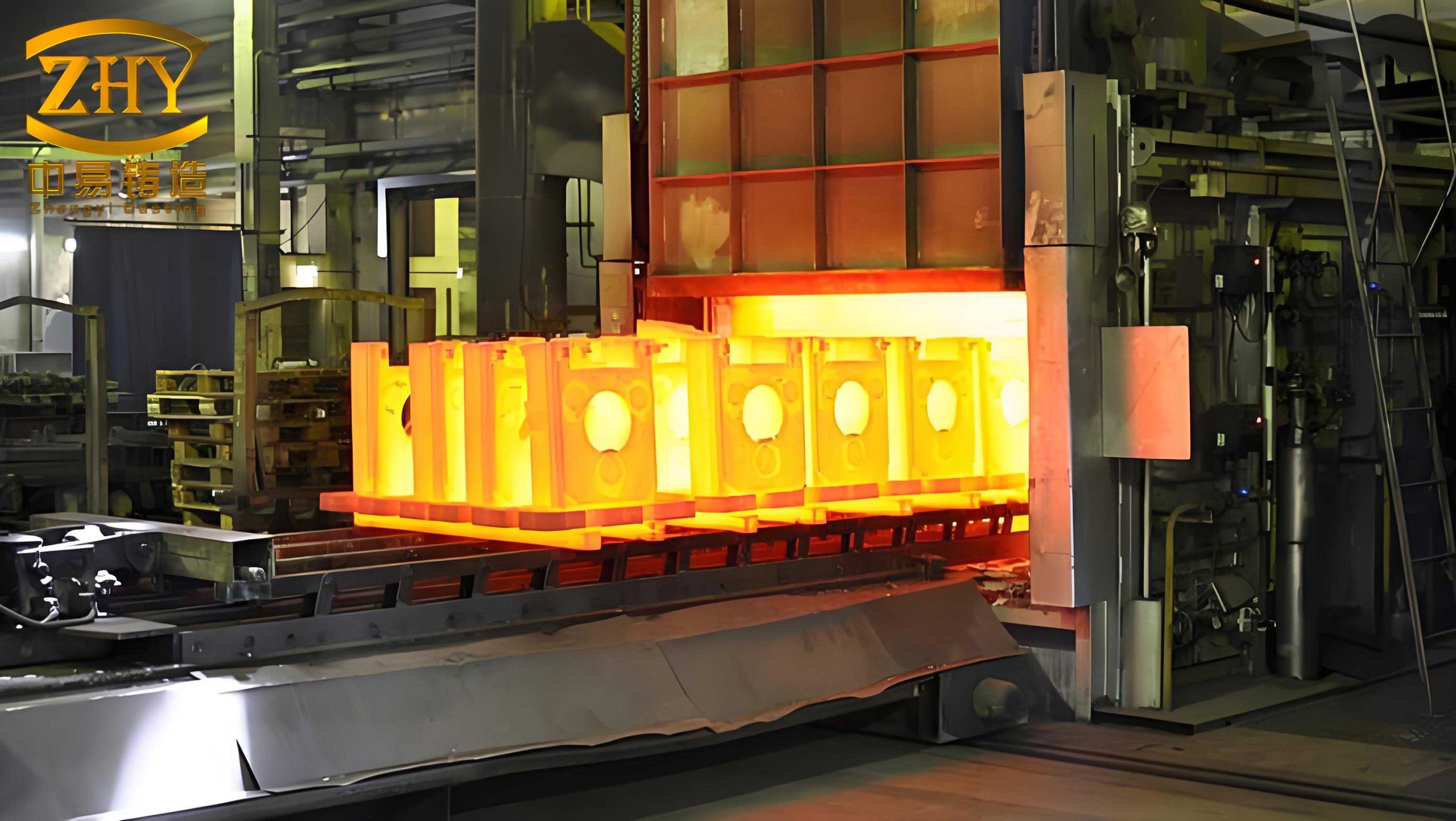
Further analysis of our ultra-high manganese steel under the described heat treatment conditions reveals a metallographic structure with grain size level 2–3, hardness of 220–250 HB, and impact toughness above 150 J/cm². The tensile strength exceeds 800 MPa. Currently, large-scale production has been implemented, with positive feedback from users indicating an average service life 2–3 times higher than that of conventional high manganese steel hammer heads. This confirms the success of the ultra-high manganese steel hammer head product development, as well as the rationality of the composition design and heat treatment parameter formulation. The steel offers advantages that conventional grades cannot match, such as better wear resistance under high-stress conditions without compromising toughness, making it worthy of further promotion.
To generalize our findings, the heat treatment of ultra-high manganese steel involves complex interactions between temperature, time, and cooling rates. We can model the overall effectiveness using a performance index \( P \), which combines hardness \( H \), toughness \( K \), and defect density \( D \):
$$ P = \frac{H \cdot K}{D + \epsilon} $$
where \( \epsilon \) is a small constant to avoid division by zero. Minimizing \( D \), which represents heat treatment defects, is crucial for maximizing \( P \). Our optimized process reduces \( D \) through controlled parameters, as detailed in Table 4, which summarizes key heat treatment steps and their impact on defect mitigation.
| Step | Parameters | Purpose | Potential Defects if Improper | Control Measures |
|---|---|---|---|---|
| Loading | Furnace temperature ≤400°C | Reduce thermal shock | Cracking due to rapid expansion | Slow preheating, uniform loading |
| Heating to 600°C | Rate ≤50°C/h | Avoid brittle phase stress | Microcracks from carbide networks | Controlled ramp, intermediate holds |
| Holding at 600°C | 1–2 hours | Equalize temperature, begin dissolution | Incomplete stress relief | Monitoring furnace uniformity |
| Heating to solution temperature | Rate 100–150°C/h | Minimize time in critical range | Grain growth, decarburization | Atmospheric control, accurate thermocouples |
| Solution treatment | 1080–1100°C for 4–5 h | Dissolve carbides fully | Retained carbides, excessive grain growth | Calibrated temperature, regular audits |
| Quenching | Water at 30–40°C, rapid agitation | Austenite retention, prevent precipitation | Soft spots, cracks, distortion | Adequate water volume, temperature sensors |
| Post-quench handling | Immediate tempering if needed | Relieve residual stresses | Delayed cracking | Timely processing, stress relief cycles |
In conclusion, the development and application of ultra-high manganese steel for wear-resistant castings represent a significant advancement in materials engineering. By meticulously designing the chemical composition and optimizing the heat treatment process, we have achieved a product that offers superior performance in demanding operational conditions. Key to this success is the systematic avoidance of heat treatment defects, which we have addressed through empirical testing and theoretical analysis. The heat treatment parameters—including solution temperature, holding time, heating rate, and cooling rate—are interdependent and must be tailored to the specific steel grade and casting geometry. Our work demonstrates that with proper control, ultra-high manganese steel can provide exceptional hardness, toughness, and service life, making it a viable alternative to traditional materials. Future efforts should focus on standardizing these practices across the industry to ensure consistent quality and further reduce the incidence of heat treatment defects. As we continue to refine these techniques, the potential for innovation in wear-resistant castings remains vast, driven by the ongoing need for efficiency and durability in industrial applications.