
In the field of wear-resistant materials, chromium white cast iron has emerged as a pivotal class of alloys, renowned for its exceptional hardness and abrasion resistance. The evolution of these materials can be traced through several stages, from ordinary white cast iron to high manganese steel, nickel-hard cast iron, and finally, the chromium-based white cast iron systems. Each iteration has brought forth unique advantages and limitations, yet the overarching trend has consistently been toward enhancing the performance-to-cost ratio. Chromium white cast iron, with its origins in the early 20th century, gained widespread adoption post-World War II, propelled by advancements in electric furnace technology. Over the past half-century, extensive research by foundry experts worldwide has refined the properties and simplified the production processes of chromium white cast iron. Today, chromium white cast iron grinding balls have supplanted alternatives like forged steel, medium manganese ductile iron, and low-alloy steel in industries such as mining, construction materials, metallurgy, and thermal power generation, cementing their status as a superior wear-resistant material.
Chromium white cast iron is broadly categorized based on chromium content into three types: high-chromium, low-chromium, and medium-chromium white cast iron. This classification hinges on the chromium-to-carbon ratio, which dictates the carbide morphology and distribution, ultimately influencing mechanical and wear properties.
| Type | Chemical Composition (wt.%) | Mechanical Properties |
|---|---|---|
| High-Chromium White Cast Iron | C: 2.0–3.5, Cr: 12–28, Si: ≤1.0, Mn: 0.5–1.5, Mo: 0–3.0, Cu: 0–2.0, Ni: 0–2.0 | Hardness: 58–65 HRC, Impact Toughness: 5–15 J/cm² |
| Low-Chromium White Cast Iron | C: 2.2–3.5, Cr: 2–5, Si: 0.5–2.0, Mn: 0.5–2.0, Mo: 0–1.0, Cu: 0–1.0 | Hardness: 50–60 HRC, Impact Toughness: 3–8 J/cm² |
| Medium-Chromium White Cast Iron | C: 2.0–3.0, Cr: 6–10, Si: 0.8–2.5, Mn: 0.5–2.0, Mo: 0–2.0, Cu: 0–1.5 | Hardness: 55–62 HRC, Impact Toughness: 6–12 J/cm² |
The carbide types in chromium white cast iron are critically dependent on the chromium-to-carbon ratio (Cr/C). For high-chromium white cast iron, where Cr/C > 5, the eutectic carbide is predominantly (Cr, Fe)7C3, characterized by a hexagonal rod or curved plate morphology with a discontinuous network distribution. This carbide exhibits a microhardness of approximately 1300–1800 HV, contributing to high wear resistance. In contrast, low-chromium white cast iron (Cr/C < 4) forms (Fe, Cr)3C carbides, which appear as a continuous network, leading to brittleness due to matrix embrittlement. Medium-chromium white cast iron (Cr/C ≈ 4–5) features a mixed carbide structure of (Cr, Fe)7C3 and (Fe, Cr)3C, with the proportion of (Cr, Fe)7C3 increasing with higher silicon content and optimized cooling rates.
The relationship between carbide type and composition can be expressed using empirical formulas. For instance, the transition from (Fe, Cr)3C to (Cr, Fe)7C3 occurs when: $$ \frac{Cr}{C} > k $$ where k is a constant typically around 4–5. Additionally, the microhardness of carbides can be approximated as: $$ H_{v} \approx \alpha \cdot \text{Cr\%} + \beta $$ for (Cr, Fe)7C3, with α and β being material-specific coefficients.
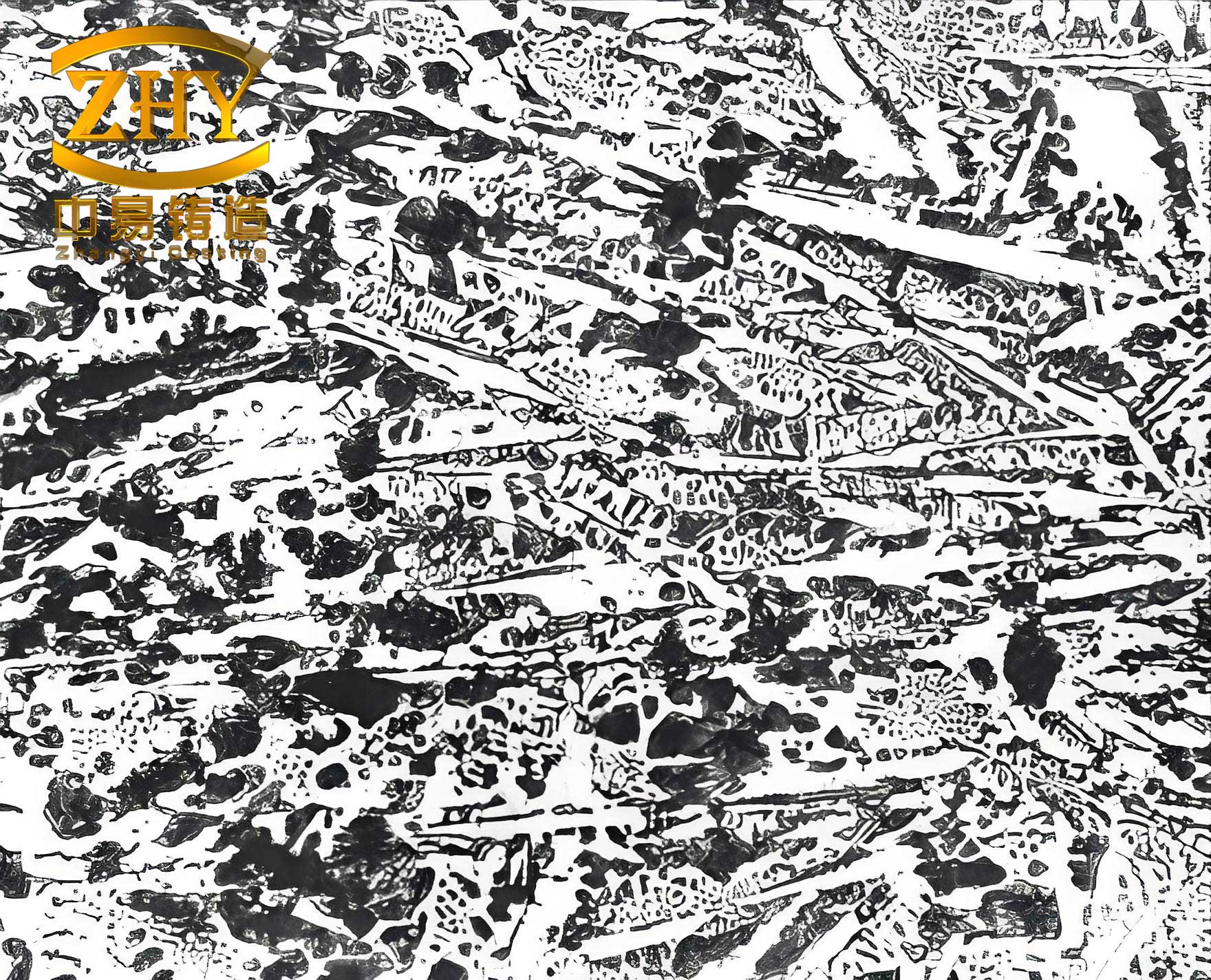
The image above illustrates a typical casting process for white cast iron, highlighting the intricate solidification patterns that influence carbide distribution. In chromium white cast iron, controlling these patterns is crucial for achieving optimal properties.
Research on chromium white cast iron has progressed along multiple fronts, encompassing compositional optimization, heat treatment, inoculation, modification, and novel processing techniques. Domestically, studies have focused on tailoring化学成分 to enhance toughness without compromising hardness. For example, in high-chromium white cast iron, a composition range of C: 2.5–3.2%, Cr: 15–22%, Si: 0.5–1.0%, Mn: 0.8–1.2%, Mo: 1.0–2.0%, and Cu: 0.5–1.0% has been shown to yield a favorable balance, with service life up to twice that of high manganese steel in abrasive environments. The impact of elements on properties can be ranked using regression analysis, where the order of influence on impact toughness is: Cr/C ratio > matrix hardness > carbide hardness > Si content. This guides alloy design toward higher toughness in chromium white cast iron.
Heat treatment is indispensable for unlocking the full potential of chromium white cast iron. For high-chromium white cast iron, austenitizing temperatures range from 950°C to 1050°C, with holding times based on section modulus: $$ t = k \cdot M $$ where t is time in hours, M is modulus in centimeters, and k is a constant (e.g., 0.5–1.0). Quenching rates between 100°C/h and 300°C/h are typical, and in some low-stress applications, air quenching without tempering has proven effective, reducing energy consumption while maintaining wear resistance. Subcritical heat treatment, conducted at 450–550°C, promotes the precipitation of secondary carbides, enhancing hardness through martensite transformation. The hardness peak can be modeled as: $$ H = H_0 + \Delta H \cdot e^{-t/\tau} $$ where H0 is initial hardness, ΔH is hardness increment, t is time, and τ is a time constant dependent on temperature.
Inoculation and modification play vital roles in refining microstructure. For instance, composite inoculation using rare earth silicides and titanium alloys in a two-step process (in-furnace and ladle treatment) enhances nucleation, purifies the melt, and improves carbide morphology. The effectiveness can be quantified by the grain size reduction: $$ d = d_0 \cdot \exp(-k \cdot I) $$ where d is final grain size, d0 is initial size, k is a constant, and I is inoculant addition rate. Similarly, modification with elements like V, Te, or B transforms continuous carbides into discontinuous ones, boosting impact toughness by up to 30% in low-chromium white cast iron.
Internationally, research has delved deeper into microstructural mechanisms and advanced processing. Studies on high-chromium white cast iron reveal that titanium additions (e.g., 0.1–0.3% Ti) form TiC particles, which act as heterogeneous nucleation sites, refining the matrix and increasing microhardness without significantly affecting toughness. The chemical heterogeneity in as-cast structures, where primary austenite contains ~8% Cr and eutectic austenite ~12% Cr, underscores the importance of solidification control. Rapid solidification techniques, such as spray forming, produce ultra-fine, isotropic structures with enhanced oxidation resistance and wear properties. The wear resistance in corrosive environments is influenced by galvanic effects, with the matrix being more anodic than carbides. The corrosion rate can be expressed as: $$ R_c \propto \frac{1}{\text{Cr\%}} $$ highlighting the benefit of higher chromium in white cast iron for combined wear-corrosion applications.
For low-chromium white cast iron, efforts have centered on cost-effective production. Utilizing cupola melting with compositions like C: 2.8–3.2%, Cr: 2.5–3.5%, Si: 1.5–2.0%, Mn: 1.0–1.5%, and Cu: 0.5–1.0% yields grinding balls comparable to bearing steel in performance. As-cast pearlitic or troostitic structures achieved through controlled cooling (e.g., air blowing after casting) eliminate the need for heat treatment, reducing costs. Composite modification with rare earth, titanium, and vanadium further improves toughness by breaking up carbide networks.
Medium-chromium white cast iron bridges the gap between high and low chromium types. Key to its performance is maximizing the (Cr, Fe)7C3 carbide fraction, which is favored by higher silicon content (Si > 1.5%) and optimal Cr/C ratios (4–5). Heat treatment pathways include quenching and low-temperature tempering for martensitic matrices or austempering for bainitic-austenitic mixes. The latter, with isothermal holding at 250–350°C, offers superior impact-abrasion resistance in wet conditions. The transformation kinetics can be described using the Avrami equation: $$ f = 1 – \exp(-k t^n) $$ where f is transformed fraction, k and n are constants, and t is time. Modification with zinc or rare earth silicides enhances carbide spheroidization, boosting wear life by 15–20%.
| Research Area | Key Findings | Impact on White Cast Iron |
|---|---|---|
| Compositional Design | Optimized Cr/C and Si content improve carbide type and matrix stability. | Enhances hardness-toughness balance in chromium white cast iron. |
| Heat Treatment | Subcritical treatments and austempering refine microstructure. | Increases wear resistance and reduces brittleness in white cast iron. |
| Inoculation/Modification | Rare earth and titanium additions refine grains and modify carbides. | Boosts impact toughness and homogeneity in white cast iron. |
| Processing Techniques | Rapid solidification and metal mold casting enhance properties. | Yields finer carbides and isotropic structures in white cast iron. |
| Wear Mechanisms | Carbide-matrix synergy and corrosion effects dictate performance. | Guides application-specific design of chromium white cast iron. |
The future of chromium white cast iron research is poised to build on these foundations. Directions include further alloy microalloying with elements like Nb or W to precipitate hardening phases, development of computational models for predicting microstructure evolution, and integration of additive manufacturing for tailored components. The performance-to-cost ratio remains a driving force, with medium-chromium white cast iron showing particular promise for broad industrial adoption. Additionally, sustainability aspects, such as recycling of scrap white cast iron and energy-efficient heat treatments, are gaining attention.
In summary, chromium white cast iron has evolved into a versatile wear-resistant material through decades of research. The classification into high, low, and medium chromium types provides a framework for application-specific selection. Advances in composition, heat treatment, and processing have consistently pushed the boundaries of performance, making white cast iron a cornerstone in abrasive environments. As studies continue to unravel microstructural complexities and exploit novel techniques, chromium white cast iron is set to cement its role further, offering durable solutions across mining, cement, and energy sectors. The journey of this remarkable material underscores the synergy between traditional foundry wisdom and modern metallurgical innovation, ensuring its relevance for years to come.