
In my experience as a casting engineer, the production of large-scale components like driving wheels for agricultural machinery presents unique challenges, particularly when using spheroidal graphite cast iron. This material, known for its excellent mechanical properties, requires meticulous process design to avoid defects such as shrinkage cavities and blowholes. In this article, I will detail the comprehensive improvements made to the casting process of a driving wheel made from spheroidal graphite cast iron, focusing on simulation-based optimization, gating and riser design, and core handling techniques. The goal is to share insights that can be applied to similar casting projects involving spheroidal graphite cast iron.
The driving wheel is a critical component in heavy-duty tracked agricultural tractors, requiring high strength, durability, and precision. The cast component is manufactured from spheroidal graphite cast iron, specifically grade GGG60 according to DIN 1693, which is equivalent to EN-GJS-600-3. This grade of spheroidal graphite cast iron is chosen for its balanced combination of tensile strength, yield strength, and elongation, making it ideal for high-stress applications. The material’s microstructure, characterized by graphite nodules in a ferritic or pearlitic matrix, contributes to its superior performance. Below, I present the mechanical property requirements for this spheroidal graphite cast iron grade in Table 1.
| Property | Requirement |
|---|---|
| Tensile Strength | ≥ 600 MPa |
| Yield Strength | ≥ 370 MPa |
| Elongation | ≥ 3% |
| Hardness (HBW) | 187–269 |
The driving wheel has an outer diameter of 916 mm, a height of 526 mm, and a mass of 260 kg. Its structure is gear-like, with 19 teeth evenly distributed around the circumference. Each tooth root forms an isolated hot spot, which is prone to shrinkage defects. Additionally, due to functional requirements for engaging with tracks, the teeth must be produced without draft angles, complicating the molding process. Internal quality standards mandate radiographic inspection level 2, with dissection criteria allowing shrinkage porosity less than 12.7 mm in diameter within a 38.1 mm × 38.1 mm area. Surface quality requires that in the same area, blowholes larger than 2 mm in diameter are not permitted, with no more than 5 small blowholes allowed. These stringent requirements necessitate a robust casting process for spheroidal graphite cast iron.
Initially, I designed the molding process with a parting line at the central axis of the wheel, using symmetrical molding. To address the zero-draft requirement on teeth, I adopted a core assembly strategy. Each tooth is formed by combining two sub-cores (Core #1 and Core #2) into a larger core (Core #3). Three of these Core #3 units are then assembled into a positioning core system (Cores #4 and #5) to create Core #6. Finally, six Core #6 assemblies are placed in the drag mold. This approach minimizes flash at the tooth profiles, ensuring dimensional accuracy. The molds are made from resin sand, while the cores (Cores #1, #2, #4, and #5) are produced using hot-box coated sand with a resin binder. This method is common in spheroidal graphite cast iron casting to achieve complex geometries.
After designing the initial process, I used ProCAST simulation software to analyze the solidification and feeding behavior. The simulation revealed significant shrinkage cavities at the centers of the teeth, exceeding the allowable limits. This is a typical issue in spheroidal graphite cast iron due to its solidification characteristics, where graphite expansion can sometimes compensate for shrinkage, but isolated hot spots may still lead to defects. The simulation results indicated that the shrinkage was concentrated in the lower parts of the teeth. Through iterative simulations, I found that adding risers above each tooth could provide effective feeding, reducing the shrinkage size and shifting its location upward. Additionally, placing chills at the tooth bases could accelerate cooling, minimizing the hot spot effect. The simulation guided the optimization of the gating and riser system.
To quantify the riser design, I applied modulus method calculations based on the characteristics of spheroidal graphite cast iron. For a single tooth, the mass \( G_c = 4.44 \, \text{kg} \), volume \( V_c = 6.03 \times 10^{-4} \, \text{m}^3 \), and surface area \( A_c = 5.58 \times 10^{-2} \, \text{m}^2 \). The modulus of the casting is given by:
$$ M_c = \frac{V_c}{A_c} = 1.08 \times 10^{-2} \, \text{m} $$
The mass circumference quotient is calculated as:
$$ Q_m = \frac{G_c}{M_c^3} = 3.52 \times 10^3 \, \text{kg/m}^3 $$
For a controlled pressure riser in spheroidal graphite cast iron, the riser body modulus \( M_R \) is determined by:
$$ M_R = f_1 f_2 f_3 M_c $$
where \( f_1 = 1.19 \), \( f_2 = 0.76 \), and \( f_3 = 1.2 \) are factors based on \( M_c \) and \( Q_m \). Thus, \( M_R = 1.17 \times 10^{-2} \, \text{m} \). The riser neck modulus \( M_N \) is:
$$ M_N = f_p f_4 M_R = 0.68 \times 10^{-2} \, \text{m} $$
with \( f_p = 0.65 \) and \( f_4 = 0.9 \). Given a riser neck diameter of 52 mm, and selecting a cylindrical blind riser with a height-to-diameter ratio \( K = H/D = 1.8 \), I standardized the riser dimensions to 80 mm diameter and 120 mm height. This riser design is optimized for feeding spheroidal graphite cast iron components.
The revised gating system involves a horizontal runner connected to 19 risers, each feeding a tooth through ingates. The pouring temperature is set between 1,355°C and 1,365°C to ensure proper fluidity of the spheroidal graphite cast iron melt. Chills, made of cast iron, are placed at the base of each tooth to enhance directional solidification. The improved layout is summarized in Table 2, which compares key parameters before and after optimization.
| Parameter | Initial Process | Improved Process |
|---|---|---|
| Riser Design | None | 19 blind risers (ϕ80 mm × 120 mm) |
| Chill Usage | None | Cast iron chills at tooth bases |
| Gating System | Central pouring | Horizontal runner with riser connections |
| Pouring Temperature | 1,355–1,365°C | |
| Simulated Shrinkage | Large cavities in teeth | Minor porosity in upper tooth regions |
After implementing these changes, I produced prototype castings and conducted dissection tests. The results showed that shrinkage defects were eliminated in the tooth centers, with only minor microporosity in some upper tooth areas, well within specification limits. This confirms the effectiveness of risers and chills in managing solidification of spheroidal graphite cast iron. However, surface inspection revealed significant blowhole defects, which degraded the surface quality. These blowholes are often associated with core gas evolution in spheroidal graphite cast iron casting, necessitating further process adjustments.
To address the blowhole issue, I analyzed the core system. The extensive use of coated sand cores for the teeth increased the total gas generation during pouring, and the thin wall sections of the teeth hindered venting. For spheroidal graphite cast iron, which is sensitive to gas defects due to its melt chemistry, I implemented several corrective measures. First, I switched to a coarser sand (50/100 mesh) for Cores #1 and #2, reducing the specific surface area and thus the gas evolution. The gas generation rate \( G \) can be approximated by:
$$ G = k \cdot S \cdot \rho $$
where \( k \) is a constant dependent on binder type, \( S \) is the specific surface area of the sand, and \( \rho \) is the core density. Using coarser sand decreases \( S \), lowering \( G \). Second, I introduced a baking process for the assembled Core #6 units. The cores are baked at 180°C for 4 hours in a drying oven, which reduces residual moisture and volatile content. The baking effectiveness can be modeled with an Arrhenius-type equation:
$$ \text{Gas Reduction} = A \exp\left(-\frac{E_a}{RT}\right) $$
where \( A \) is a pre-exponential factor, \( E_a \) is activation energy, \( R \) is the gas constant, and \( T \) is baking temperature. Third, I added explicit venting channels in the core assembly to facilitate gas escape. These channels are designed based on Darcy’s law for gas flow through porous media:
$$ Q = \frac{k_a A \Delta P}{\mu L} $$
where \( Q \) is gas flow rate, \( k_a \) is permeability, \( A \) is cross-sectional area, \( \Delta P \) is pressure difference, \( \mu \) is gas viscosity, and \( L \) is vent length. By optimizing these parameters, venting efficiency is improved.
The impact of these measures on blowhole reduction is quantified in Table 3, which shows data from experimental batches.
| Measure | Blowhole Count per Casting (Average) | Blowhole Size (Max Diameter) | Notes |
|---|---|---|---|
| Original Cores | Unacceptable surface quality | ||
| Coarser Sand (50/100 mesh) | Moderate improvement | ||
| Baking at 180°C for 4 h | Significant reduction | ||
| Added Venting Channels | Within specification limits |
After applying all improvements, I cast over 120 driving wheels in spheroidal graphite cast iron. The results consistently met both internal and surface quality standards, with no blowholes exceeding 2 mm and shrinkage porosity controlled to acceptable levels. This demonstrates the importance of integrated process design for spheroidal graphite cast iron components.
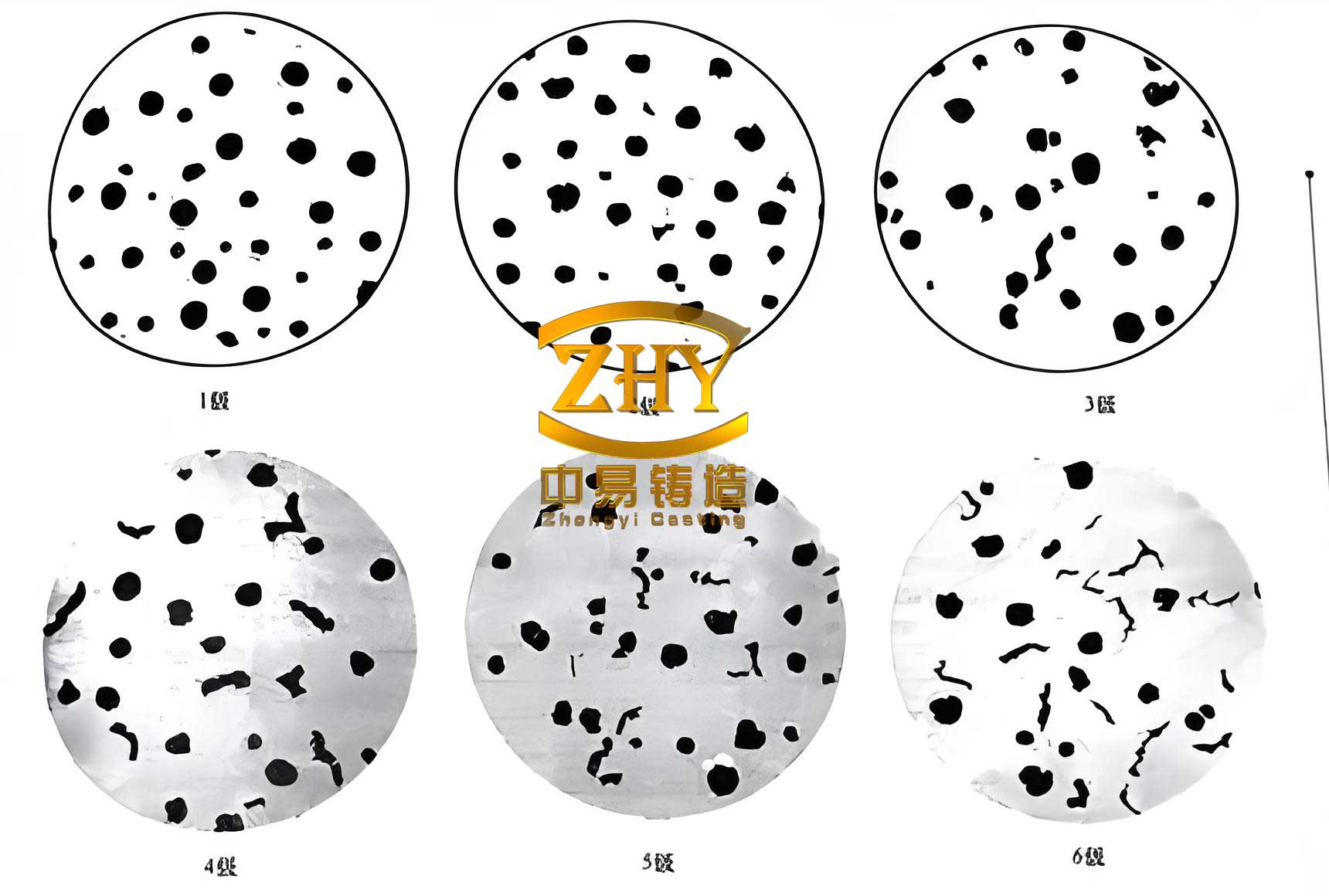
Beyond the specific case, I want to elaborate on the metallurgical aspects of spheroidal graphite cast iron that influence casting quality. Spheroidal graphite cast iron, also known as ductile iron, derives its properties from the spherical graphite nodules formed during solidification. The nodulization process typically involves magnesium or cerium treatment, which alters the graphite morphology from flake to spheroidal. The solidification sequence involves eutectic reaction where graphite nodules grow in an austenitic shell. The volume expansion associated with graphite precipitation can compensate for shrinkage, but this is highly dependent on cooling rates and feeding. The solidification time \( t_s \) for a casting section can be estimated using Chvorinov’s rule:
$$ t_s = B \left( \frac{V}{A} \right)^2 $$
where \( B \) is a constant dependent on mold material and metal properties, \( V \) is volume, and \( A \) is surface area. For spheroidal graphite cast iron, \( B \) values range from 0.5 to 2.0 min/cm² depending on composition and inoculation. Proper riser design ensures that feeding continues until the eutectic expansion phase, reducing shrinkage defects.
Furthermore, the mechanical properties of spheroidal graphite cast iron are governed by matrix structure, which can be ferritic, pearlitic, or ausferritic through heat treatment. The driving wheel requires a pearlitic matrix to achieve the hardness range of 187–269 HBW. The relationship between hardness and tensile strength for spheroidal graphite cast iron can be approximated by:
$$ \text{HB} \approx 0.36 \times \text{TS (MPa)} $$
where TS is tensile strength. For GGG60, with TS ≥ 600 MPa, the calculated HB is around 216, fitting within the specified range. Control of cooling rates and alloying elements like copper or tin is essential to achieve the desired matrix in spheroidal graphite cast iron.
In terms of process economics, the use of risers and chills increases yield and reduces scrap. The yield \( Y \) is defined as:
$$ Y = \frac{\text{Casting Weight}}{\text{Total Poured Weight}} \times 100\% $$
For the initial process without risers, the yield was approximately 85%, but with the added risers, it decreased to 75%. However, this is offset by the higher quality and reduced machining allowance. The cost-benefit analysis for spheroidal graphite cast iron casting often favors such improvements due to the high value of the component.
To summarize, the successful production of the driving wheel in spheroidal graphite cast iron hinged on several key improvements: core assembly to eliminate draft angles, simulation-driven riser and chill design to combat shrinkage, and core baking and venting to mitigate blowholes. Each step leveraged the unique properties of spheroidal graphite cast iron, such as its graphite expansion behavior and sensitivity to gas defects. The process highlights the need for a holistic approach in casting spheroidal graphite cast iron, where design, simulation, and practical adjustments converge to achieve quality outcomes. Future work could explore advanced simulation techniques or alternative core materials to further optimize the process for spheroidal graphite cast iron components.
In conclusion, this case study underscores the adaptability of spheroidal graphite cast iron in demanding applications and the value of iterative process refinement. By sharing these details, I hope to contribute to the broader knowledge base on casting spheroidal graphite cast iron, enabling more efficient and reliable manufacturing across the industry.