
The continuous evolution of the rail transit industry imposes ever-increasing demands for component performance, particularly in the realm of weight reduction. Lightweighting vehicle castings directly contributes to reducing the overall vehicle mass, leading to significant savings in raw material usage and a substantial decrease in the required traction and braking forces. This synergy results in lower energy consumption and operational costs, establishing lightweight, high-performance castings as a critical objective within the foundry sector.
In this context, Austempered Ductile Iron (ADI) has emerged as a superior engineering material. This advanced form of spheroidal graphite cast iron undergoes a specific heat treatment known as austempering, which transforms its microstructure to impart an exceptional combination of high strength, ductility, toughness, and wear resistance, often surpassing the properties of conventional cast steels while offering a lower density. Traditionally, rail transit components have been manufactured from lower-grade ductile irons (e.g., QT400 to QT600). This research and development initiative focused on pushing the boundaries by successfully producing a complex housing casting using high-grade Austempered Spheroidal Graphite Cast Iron, specifically targeting the stringent requirements of grade QT800-10 (Rm > 800 MPa, A > 10%).
The development journey encompassed a holistic approach, integrating advanced simulation-driven casting process design, precise metallurgical composition control, and optimized heat treatment parameters. The core challenge was to achieve the desired high-strength, high-ductility matrix in a casting characterized by significant variation in wall thickness and geometric complexity.
Material Specifications and Composition Design for Spheroidal Graphite Cast Iron
The target material was an austempered spheroidal graphite cast iron meeting the performance benchmarks of EN-GJS-800-10. The key mechanical and microstructural requirements are summarized in the table below.
| Property | Requirement |
|---|---|
| Tensile Strength (Rm) | > 800 MPa |
| Yield Strength (Rp0.2) | > 500 MPa |
| Elongation (A) | > 10 % |
| Brinell Hardness (HBW) | 260 – 320 |
| Matrix Microstructure | Ausferrite (Acicular Ferrite + High-Carbon Austenite) |
Achieving this high-performance austempered structure in a sizable casting necessitates careful chemical composition design. The primary goals are to ensure excellent graphitization (forming spherical graphite nodules), provide sufficient hardenability for the austempering transformation, and minimize elements that promote undesirable microconstituents. The designed composition ranges are presented in the following table.
| Element | Target Range (wt.%) | Rationale |
|---|---|---|
| Carbon (C) | 3.60 – 3.80 | Ensures adequate graphite formation and carbon available for austenite stabilization during austempering. |
| Silicon (Si) | 2.35 – 2.55 | Strong graphitizer, suppresses carbide formation, raises the austempering temperature window. |
| Manganese (Mn) | 0.30 – 0.50 | Enhances hardenability but kept low to avoid segregation and martensite formation in intercellular regions. |
| Copper (Cu) | 0.40 – 0.70 | Improves hardenability and strength without significantly harming ductility; promotes pearlite-free matrix. |
| Phosphorus (P) | ≤ 0.05 | Kept minimal to prevent the formation of brittle phosphide eutectic. |
| Sulfur (S) | 0.006 – 0.018 | Low levels are essential for effective magnesium treatment and graphite spheroidization. |
| Magnesium (Mg) | 0.035 – 0.055 | Essential spheroidizing agent for spheroidal graphite cast iron. |
The Carbon Equivalent (CE) is a crucial parameter for predicting the solidification behavior and graphitization potential of spheroidal graphite cast iron. It is calculated using the formula:
$$ CE = \%C + \frac{\%Si + \%P}{3} $$
For the target composition, the CE typically ranged between 4.43 and 4.60, ensuring a hypereutectic composition favorable for graphite nucleation and growth.
Casting Process Design and Numerical Simulation
The rail transit housing is a structurally complex component with a mass of 36.7 kg, featuring thin sections as narrow as 9 mm and thick hubs up to 58 mm. This non-uniform wall thickness poses significant challenges for achieving soundness, as it promotes differential cooling rates and creates isolated thermal centers prone to shrinkage porosity.
The initial casting process was designed for high-pressure mold line production with two castings per mold. The gating system employed a naturally pressurized, open design with a sprue, runner, and three ingates, incorporating filters to minimize turbulence and slag inclusion. The key to soundness in spheroidal graphite cast iron is feeding. The required riser (feeder) size was determined based on the modulus method. The modulus (M) of a casting section is its volume (V) divided by its cooling surface area (Ac):
$$ M = \frac{V}{A_c} $$
A riser with a modulus approximately 1.2 times that of the region it feeds is generally required to ensure directional solidification toward the riser. Initial risers were placed at the top and side of the casting’s heavy sections based on this calculation.
To validate and optimize this initial design, rigorous simulation analysis was conducted using MAGMAsoft. The model incorporated the exact geometry, material properties of QT800-10, and process parameters such as a pouring temperature of 1400°C. The initial simulation results, however, revealed a critical issue: isolated liquid pools remained within the thick sections of the casting at the end of solidification, indicating a high risk of macro- and micro-shrinkage defects. The thermal analysis confirmed the presence of persistent hot spots within the casting body, demonstrating that the natural feeding distance of the risers was insufficient for this geometry.
The solution involved the strategic use of chills. Chills are massive metal inserts placed within the sand mold that act as heat sinks, dramatically increasing the local cooling rate. By placing chills in contact with the thickest sections of the casting, we could fundamentally alter the solidification sequence. The chill extracts heat rapidly, causing the metal adjacent to it to solidify first. This creates a steep thermal gradient and establishes a controlled direction of solidification from the chilled area toward the riser. The design of the chills followed the principle of achieving sufficient chilling power, calculated by their modulus. The required chill thickness (δ) can be estimated by:
$$ \delta = \frac{G}{\rho \times A} $$
where G is the chill mass, ρ is the density of the chill material (typically iron or steel), and A is the contact area between the chill and the casting. Two types of chills were designed and positioned on the drag side of the thick hubs.
The optimized process, incorporating these chills, was re-simulated. The results confirmed a complete correction of the solidification pattern. The final isolated liquid regions and thermal centers were successfully shifted entirely into the risers and the gating system, guaranteeing a sound casting free from shrinkage porosity. This simulation-driven optimization was critical for the successful production of high-integrity spheroidal graphite cast iron castings.
Austempering Heat Treatment Cycle
The transformation of the as-cast pearlitic/ferritic spheroidal graphite cast iron into high-performance ADI is achieved through the austempering heat treatment. This is a two-stage isothermal process conducted in a batch-type furnace with a salt bath quench. The precise thermal cycle is paramount and was developed as follows:
- Austenitization: The castings are heated to a temperature between 860°C and 920°C and held for 2-3 hours. This stage completely transforms the matrix into a homogeneous, carbon-saturated austenite (γ).
- Rapid Quench: The components are swiftly transferred (to avoid pearlite transformation) into a molten salt bath maintained at the austempering temperature, between 350°C and 400°C.
- Isothermal Hold (Austempering): The castings are held at this constant temperature for 1-2 hours. During this hold, the supersaturated austenite decomposes via a diffusion-controlled reaction into a unique microstructure called “ausferrite.” This consists of fine, acicular ferrite (α) needles intertwined with stable, high-carbon retained austenite (γHC). The stability of this retained austenite is key to the material’s ductility and toughness.
- Final Cooling: After the isothermal transformation is complete, the castings are removed from the salt bath and air-cooled to room temperature.
This treatment is represented by the following simplified kinetic transformation diagram for spheroidal graphite cast iron:
$$ \text{Austenite (γ)} \xrightarrow[\text{Hold @ T_{Austemper}}]{\text{Quench}} \text{Ausferrite (α + γ_{HC})} $$
The selection of the austempering temperature (TAustemper) is a critical compromise: lower temperatures (e.g., ~350°C) yield finer ausferrite and higher strength/hardness but lower ductility; higher temperatures (e.g., ~400°C) produce coarser ausferrite and higher ductility/toughness with lower strength.
Experimental Investigation: Effect of Composition and Inoculation
To refine the composition for optimal performance, three distinct experimental melts (Projects 1, 2, and 3) were conducted. The focus was on adjusting the levels of Mn and Cu (for hardenability) and the addition of a bismuth (Bi)-containing inoculant to enhance graphite nucleation. Test castings were produced using the optimized chill-aided process. Coupons were extracted from critical locations (T1, T2) on the castings for comprehensive analysis. The chemical compositions for the three projects are detailed below.
| Project | Sample | C | Si | Mn | Cu | Bi Inoculant |
|---|---|---|---|---|---|---|
| 1 | T1, T2 | 3.75 | 2.35 | 0.49 | 0.66 | 0 |
| Base composition with Mn+Cu for hardenability. | ||||||
| 2 | T1, T2 | 3.69 | 2.52 | 0.47 | 0.53 | 0.10 |
| Reduced Mn/Cu, increased Si, added Bi inoculant. | ||||||
| 3 | T1, T2 | 3.65 | 2.52 | 0.38 | 0.44 | 0.15 |
| Further reduced Mn/Cu, optimal Bi inoculation. | ||||||
All samples were subjected to the standard austempering heat treatment. Subsequently, they were evaluated for mechanical properties (tensile strength, yield strength, elongation, hardness) and metallographic characteristics (graphite nodularity, nodule count, matrix structure). The results are consolidated in the following table.
| Project | HBW | Rm (MPa) | Rp0.2 (MPa) | A (%) | Nodularity (%) | Nodule Count (mm⁻²) | Matrix |
|---|---|---|---|---|---|---|---|
| 1 | ~320 | 785 | 495 | 6.3 | 80 | 166 | Ausferrite + Carbides? |
| 2 | ~309 | 907 | 577 | 12.0 | 90 | 307 | Ausferrite |
| 3 | ~295 | 978 | 606 | 18.3 | 95 | 345 | Ausferrite |
Analysis of Results:
- Project 1: The base composition with higher Mn and Cu achieved the required hardenability, resulting in a fully austempered matrix. However, the graphite morphology was sub-optimal, with only 80% nodularity and a low nodule count (166/mm²). The presence of some irregular graphite and potential micro-carbides (from Mn segregation) severely compromised ductility (A ~6%), failing the >10% requirement, despite adequate strength.
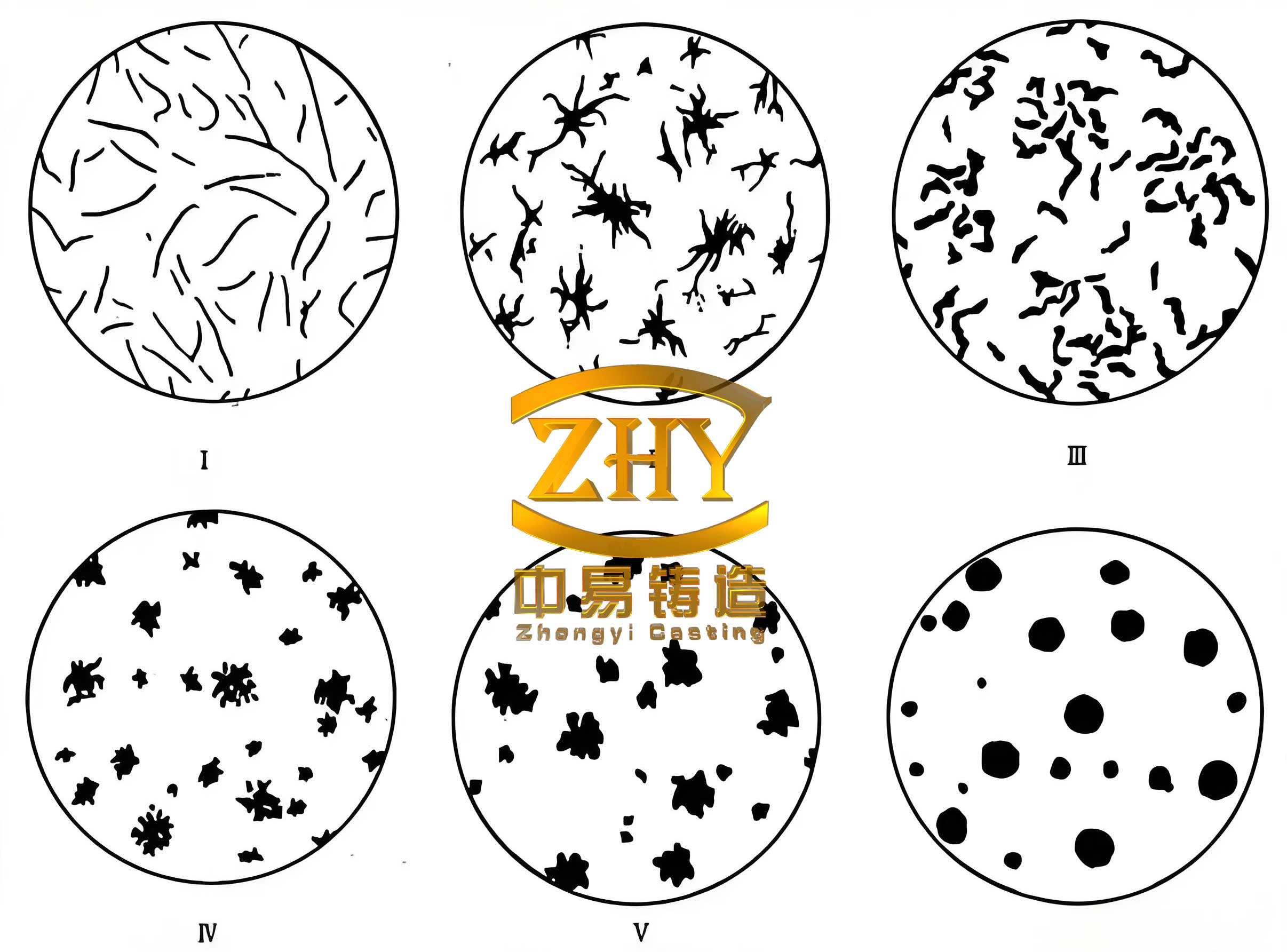
- Project 2: Reducing the Mn and Cu content minimized the risk of segregation and carbide stabilization. The strategic addition of 0.10% Bi-containing inoculant had a profound effect. Bismuth acts as a potent heterogeneous nucleation site for graphite, significantly refining the graphite structure. Nodularity improved to 90%, and the nodule count more than doubled to 307/mm². This refined, more uniform microstructure of spheroidal graphite cast iron led to a dramatic improvement in both strength and, crucially, ductility, comfortably exceeding the QT800-10 specifications.
- Project 3: Further optimizing the composition by lowering Mn and Cu to 0.38% and 0.44% respectively, and increasing the Bi inoculant to 0.15%, yielded the best results. This recipe promoted the highest graphite nodularity (95%) and the highest nodule count (345/mm²). The fine, well-distributed graphite nodules in a fully ausferritic matrix provided an outstanding balance of properties: very high tensile strength (~978 MPa), excellent yield strength (~606 MPa), and remarkable elongation (~18%). The hardness also fell perfectly within the desired range.
The microstructural evolution across the projects underscores a fundamental principle in high-performance spheroidal graphite cast iron: the matrix properties (controlled by heat treatment) are only as good as the underlying graphite structure. The role of effective inoculation in creating a fine, spherical graphite distribution is paramount for unlocking the full potential of the austempering process, particularly for achieving high elongation.
Conclusions and Industrial Implementation
This comprehensive development program successfully demonstrated the feasibility of manufacturing complex, high-integrity rail transit housing castings from Austempered Spheroidal Graphite Cast Iron grade QT800-10. The key findings and implemented solutions are:
- Simulation-Driven Casting Optimization: The use of MAGMA simulation was instrumental in identifying feeding shortcomings in the initial design. The implementation of strategically calculated chills was the critical factor in establishing a sound directional solidification pattern, eliminating internal shrinkage defects in the variable-section casting.
- Optimal Metallurgical Recipe: The experimental study conclusively identified the optimal composition for this application: 3.65% C, 2.52% Si, 0.38% Mn, 0.44% Cu, combined with 0.15% of a bismuth-containing inoculant. This balance provides sufficient hardenability for austempering while promoting an exceptionally fine and spherical graphite structure (95% nodularity, 345 nodules/mm²), which is the foundation for high ductility.
- Performance Achievement: Through the precisely controlled austempering heat treatment (austenitization at 880-900°C followed by isothermal transformation at 360-380°C), the optimized spheroidal graphite cast iron casting achieved a mechanical property profile significantly surpassing the QT800-10 specification: Tensile Strength > 970 MPa, Yield Strength > 600 MPa, and Elongation > 18%, with a hardness of ~295 HBW.
The transition from traditional low-grade ductile irons to high-performance ADI for critical structural components like rail transit housings represents a significant technological advancement. It aligns perfectly with the industry’s goals of lightweighting and performance enhancement. The methodology outlined here—integrating advanced process simulation, targeted alloy design with effective inoculation, and controlled heat treatment—provides a robust framework for the reliable production of other demanding components from Austempered Spheroidal Graphite Cast Iron.