
In the field of advanced casting materials, spheroidal graphite cast iron, particularly high-toughness grades such as QT400-18, has garnered significant attention due to its exceptional mechanical properties, including superior low-temperature toughness and high strength. These characteristics make spheroidal graphite cast iron a preferred choice for applications in transportation, wind power, and machinery industries, where reliability under harsh service conditions is paramount. Traditionally, heat treatment processes like annealing are employed to enhance the performance of spheroidal graphite cast iron components, but these methods often lead to issues such as oxidation, distortion, and energy inefficiency. As a result, there is a growing interest in alternative techniques that can refine the microstructure and improve properties directly during solidification, without the need for post-casting treatments. One such innovative approach involves the application of pulse current during the solidification process, which has been shown to influence the nucleation and growth of graphite nodules, thereby altering the final microstructure and mechanical behavior of spheroidal graphite cast iron.
In this study, we investigate the effects of pulse current treatment on the solidification of as-cast high-toughness spheroidal graphite cast iron QT400-18. The primary objective is to elucidate the underlying mechanisms from an electronic structure perspective, utilizing the Empirical Electron Theory of Solids and Molecules (EET). By analyzing the valence electron structures of key phases involved in the solidification of spheroidal graphite cast iron, we aim to provide a fundamental understanding of how pulse current promotes graphite nucleation and refines the microstructure. This analysis not only enhances our knowledge of spheroidal graphite cast iron behavior under external fields but also opens avenues for optimizing processing parameters to achieve desired properties in cast components.
The experimental setup involved melting spheroidal graphite cast iron QT400-18 in a controlled environment, followed by pulse current treatment during solidification. The pulse current parameters were set as follows: voltage of 2600 V, frequency of 0.88 Hz, capacitance of 200 μF, and a treatment duration of 15 minutes. These parameters were selected based on preliminary trials to ensure effective modification of the solidification process without causing undesirable effects like white iron formation. The melt was then cast into trapezoidal test blocks to evaluate the microstructure and properties. For comparison, identical samples were prepared without pulse current treatment. Thermal analysis was conducted to measure the undercooling during solidification, and metallographic examination was performed to assess the morphology, number, and size of graphite nodules in the spheroidal graphite cast iron matrix.
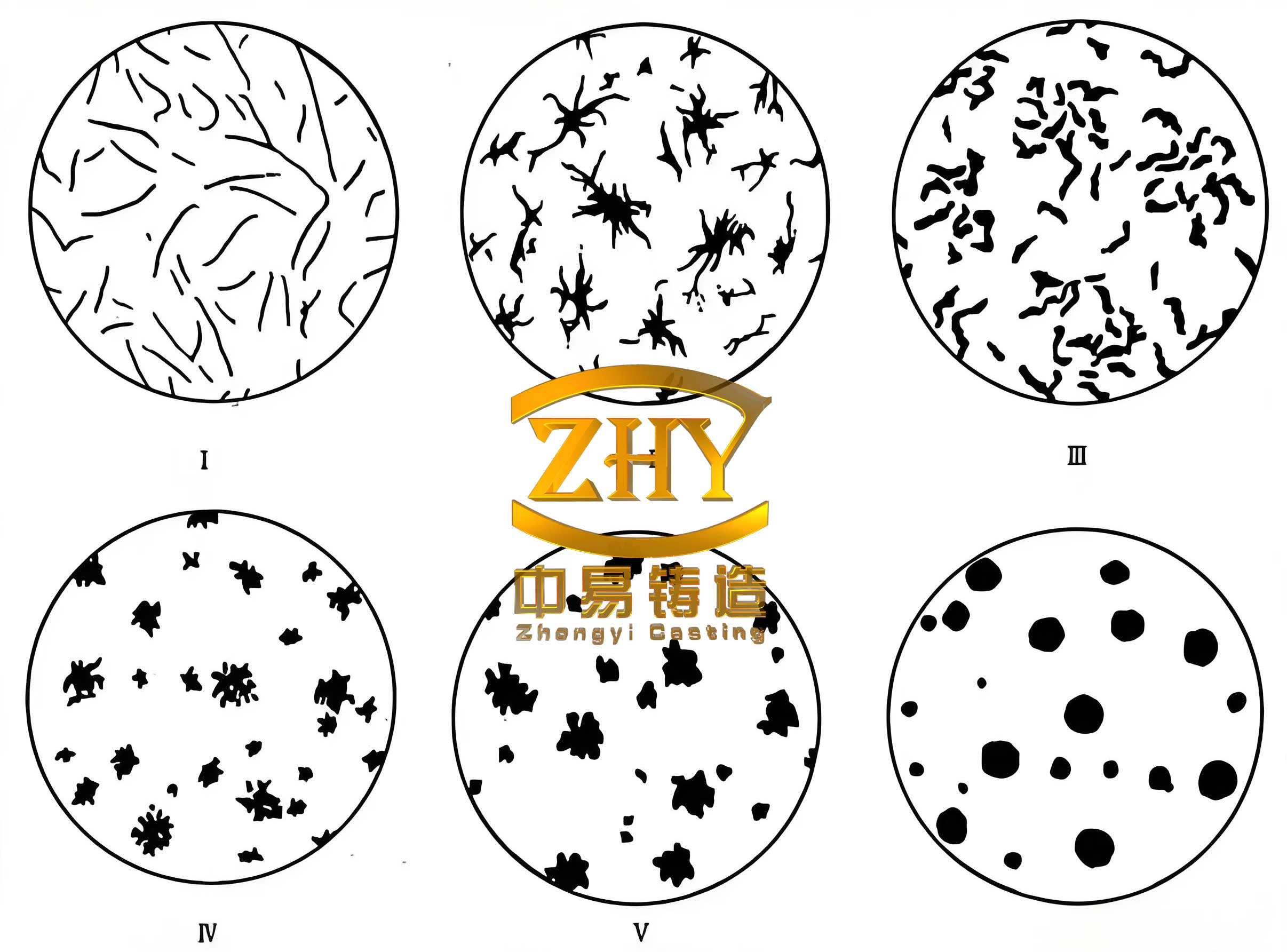
The results demonstrated a notable improvement in the microstructure of spheroidal graphite cast iron after pulse current treatment. Specifically, the graphite nodules exhibited enhanced roundness, with a reduction in distorted graphite shapes. Quantitative analysis revealed that the nodularity increased from an average of 80% in untreated samples to 91% in treated samples. Additionally, the number of graphite nodules per unit area rose from 172 nodules/mm² to 209 nodules/mm², indicating a higher nucleation density. The particle size of the graphite nodules decreased, contributing to a more refined microstructure. Thermal analysis data showed that the undercooling during solidification increased from 81 K in untreated spheroidal graphite cast iron to 93 K in pulse-current-treated spheroidal graphite cast iron. This increase in undercooling suggests that pulse current alters the thermodynamic conditions of solidification, favoring the nucleation of graphite over other phases like cementite. These findings underscore the potential of pulse current as a non-invasive method to enhance the quality of spheroidal graphite cast iron components.
To understand these phenomena at the atomic level, we turn to the Empirical Electron Theory of Solids and Molecules (EET), which provides a framework for analyzing valence electron structures in materials. The EET is based on four fundamental assumptions and employs the Bond Length Difference (BLD) method to calculate key parameters such as the number of shared electron pairs on covalent bonds. In the context of spheroidal graphite cast iron solidification, the valence electron structures of various phase units—including graphite, austenite, cementite, and their alloyed variants—play a critical role in determining nucleation and growth behaviors. The strongest covalent bond in each phase structure, characterized by the shared electron pair number \( n_A \), governs the ease of phase formation or decomposition during non-equilibrium solidification. A higher \( n_A \) value indicates stronger atomic bonding, making the phase more resistant to decomposition and harder to form under given conditions.
For spheroidal graphite cast iron, the melt contains multiple atomic clusters corresponding to different phase units. During solidification, these clusters fluctuate in size and stability, with those reaching a critical radius acting as nuclei for new phases. The pulse current introduces additional energy into the melt, affecting the thermal vibrations of atoms and the dynamics of cluster formation. Specifically, pulse current tends to destabilize clusters with lower \( n_A \) values, breaking them apart and releasing carbon atoms. These carbon atoms then reorganize into clusters with higher \( n_A \) values, such as those resembling graphite or alloy-austenite structures. This process enhances the “drag-like effect,” where clusters with higher \( n_A \) drag down the crystallization temperature of phases with lower \( n_A \), thereby increasing the interval between equilibrium and non-equilibrium eutectic temperatures. As a result, graphite nucleation is promoted at higher undercooling, leading to the observed microstructural refinements in spheroidal graphite cast iron.
The valence electron structures were calculated using the BLD method for relevant phase units in spheroidal graphite cast iron. The key phases considered include graphite (C-C), austenite (γ-Fe), carbon-austenite (γ-Fe-C), alloy-austenite (e.g., γ-Fe-C-Si, γ-Fe-C-Mg), cementite (θ-Fe₃C, ε-Fe₃C), and alloy-cementite (e.g., (Fe,Si)₃C, (Fe,Mg)₃C). The calculations involve determining the covalent bond distances \( D_{u-v}^{n_\alpha} \) and the corresponding shared electron pair numbers \( n_\alpha \) for each bond in the crystal lattice. Here, \( u \) and \( v \) denote atoms, \( \alpha \) represents the bond type (e.g., A, B, C for the shortest bonds), and \( n_\alpha \) can be integer or fractional. The bond distance is derived from crystallographic data, and \( n_\alpha \) is computed based on electron distribution rules in EET. The discrepancy \( \Delta D_{n_\alpha} \) between calculated and theoretical bond distances is kept below 0.005 nm to ensure accuracy.
For graphite, which has a hexagonal lattice structure, the strongest covalent bond lies in the basal plane. The calculation yields:
$$ D_{u-v}^{n_a} = 0.1421 \, \text{nm}, \quad n_a = 1.2051 $$
This high \( n_A \) value signifies strong covalent bonding within the graphite layers, making graphite nucleation energetically demanding. In contrast, austenite (γ-Fe) has a lower \( n_A \) value, as shown in Table 1, which summarizes the \( n_A \) values for various phase units in spheroidal graphite cast iron melts. The table highlights that alloy-austenite and alloy-cementite phases often exhibit higher \( n_A \) values than pure austenite or cementite, due to the incorporation of elements like silicon or magnesium. This influences their stability and interaction during solidification of spheroidal graphite cast iron.
| Phase Unit | \( n_A \) Value | Phase Unit | \( n_A \) Value |
|---|---|---|---|
| C-C (Graphite) | 1.2051 | γ-Fe-C-Mg | 1.3936 |
| γ-Fe (Austenite) | 0.3299 | γ-Fe-C-Mn | 1.2497 |
| γ-Fe-C | 0.9319 | (Fe,Si)₃C | 1.2798 |
| γ-Fe-C-Si | 1.1645 | (Fe,Mg)₃C | 1.7015 |
| γ-Fe-Si | 0.4112 | θ-Fe₃C | 0.9672 |
| γ-Fe-Mn | 0.3960 | ε-Fe₃C | 0.8361 |
The detailed valence electron structure calculations for specific phases are presented below. For γ-Fe austenite, the unit cell contains two significant covalent bonds, with parameters listed in Table 2. The bond length difference \( \Delta D_{n_\alpha} \) is within acceptable limits, validating the EET model for spheroidal graphite cast iron analysis.
| Bond Name | \( I_a \) | \( D_{n_\alpha} \) (nm) | \( \overline{D}_{n_\alpha} \) (nm) | \( n_\alpha \) | \( \Delta D_{n_\alpha} \) |
|---|---|---|---|---|---|
| \( D_{O-A}^{n_A} \) | 12 | 0.2517 | 0.2558 | 0.3299 | 0.0041 |
| \( D_{O-B}^{n_B} \) | 6 | 0.3560 | 0.3600 | 0.0060 | 0.0040 |
| \( D_{O-C}^{n_C} \) | 24 | 0.4360 | 0.4400 | 0.0003 | 0.0040 |
Note: \( I_a \) denotes the bond multiplicity, \( D_{n_\alpha} \) is the calculated bond distance, \( \overline{D}_{n_\alpha} \) is the theoretical bond distance, and \( \Delta D_{n_\alpha} = |D_{n_\alpha} – \overline{D}_{n_\alpha}| \). For γ-Fe-C austenite, which incorporates carbon atoms, the unit cell has six covalent bonds, as detailed in Table 3. The strongest bond is between carbon and iron atoms, with \( n_A = 0.9285 \), indicating enhanced bonding compared to pure austenite in spheroidal graphite cast iron.
| Bond Name | \( I_a \) | \( D_{n_\alpha} \) (nm) | \( \overline{D}_{n_\alpha} \) (nm) | \( n_\alpha \) | \( \Delta D_{n_\alpha} \) |
|---|---|---|---|---|---|
| \( D_{C-Fe_f}^{n_A} \) | 12 | 0.1892 | 0.1901 | 0.9285 | 0.0009 |
| \( D_{Fe_C-Fe_f}^{n_B} \) | 24 | 0.2675 | 0.2684 | 0.2344 | 0.0009 |
| \( D_{Fe_f-Fe_f}^{n_C} \) | 24 | 0.2675 | 0.2684 | 0.2294 | 0.0009 |
| \( D_{C-Fe_C}^{n_D} \) | 16 | 0.3276 | 0.3286 | 0.0106 | 0.0010 |
| \( D_{Fe_C-Fe_C}^{n_E} \) | 6 | 0.3783 | 0.3792 | 0.0071 | 0.0009 |
| \( D_{Fe_C-Fe_C}^{n_F} \) | 12 | 0.3783 | 0.3792 | 0.0066 | 0.0009 |
For alloy-austenite phases, such as γ-Fe-C-Si, the incorporation of silicon alters the valence electron structure significantly. Table 4 presents the calculations for γ-Fe-C-Si, showing ten covalent bonds with the strongest bond between carbon and silicon atoms (\( n_A = 1.1645 \)). This high \( n_A \) value contributes to the drag-like effect in spheroidal graphite cast iron solidification.
| Bond Name | \( I_a \) | \( D_{n_\alpha} \) (nm) | \( \overline{D}_{n_\alpha} \) (nm) | \( n_\alpha \) | \( \Delta D_{n_\alpha} \) |
|---|---|---|---|---|---|
| \( D_{C-Si}^{n_A} \) | 4 | 0.1892 | 0.1886 | 1.1645 | 0.0006 |
| \( D_{C-Fe_f}^{n_B} \) | 8 | 0.1892 | 0.1886 | 0.8844 | 0.0006 |
| \( D_{Fe_C-Si}^{n_C} \) | 8 | 0.2676 | 0.2670 | 0.2995 | 0.0006 |
| \( D_{Fe_f-Si}^{n_D} \) | 16 | 0.2676 | 0.2670 | 0.2607 | 0.0006 |
| \( D_{Fe_f-Fe_C}^{n_E} \) | 16 | 0.2676 | 0.2670 | 0.2275 | 0.0006 |
| \( D_{Fe_f-Fe_f}^{n_F} \) | 8 | 0.2676 | 0.2670 | 0.1980 | 0.0006 |
| \( D_{C-Fe_C}^{n_G} \) | 16 | 0.3277 | 0.3271 | 0.0114 | 0.0006 |
| \( D_{Si-Si}^{n_H} \) | 4 | 0.3784 | 0.3778 | 0.0094 | 0.0006 |
| \( D_{Fe_C-Fe_C}^{n_I} \) | 6 | 0.3784 | 0.3778 | 0.0072 | 0.0006 |
| \( D_{Fe_f-Fe_f}^{n_J} \) | 8 | 0.3784 | 0.3778 | 0.0054 | 0.0006 |
Cementite phases, including θ-Fe₃C and ε-Fe₃C, are also critical in spheroidal graphite cast iron solidification. Their valence electron structures are computed similarly, with results shown in Tables 5 and 6. For θ-Fe₃C, the strongest bond has \( n_A = 0.9672 \), while for ε-Fe₃C, \( n_A = 0.8361 \). Alloy-cementite phases like (Fe,Si)₃C and (Fe,Mg)₃C exhibit higher \( n_A \) values (e.g., 1.2798 and 1.7015, respectively), indicating stronger atomic bonding due to alloying elements in spheroidal graphite cast iron.
| Bond Name | \( I_a \) | \( D_{n_\alpha} \) (nm) | \( \overline{D}_{n_\alpha} \) (nm) | \( n_\alpha \) | \( \Delta D_{n_\alpha} \) |
|---|---|---|---|---|---|
| \( D_{C-Fe1}^{n_1} \) | 2 | 0.1853 | 0.1848 | 0.9672 | 0.0005 |
| \( D_{C-Fe1}^{n_2} \) | 2 | 0.1877 | 0.1872 | 0.8951 | 0.0005 |
| \( D_{C-Fe3}^{n_3} \) | 4 | 0.2056 | 0.2052 | 0.4993 | 0.0004 |
| \( D_{Fe1-Fe2}^{n_4} \) | 4 | 0.2450 | 0.2146 | 0.3684 | 0.0304 |
| \( D_{Fe1-Fe2}^{n_5} \) | 2 | 0.2490 | 0.2486 | 0.3368 | 0.0004 |
| \( D_{Fe1-Fe2}^{n_6} \) | 4 | 0.2515 | 0.2511 | 0.3109 | 0.0004 |
| \( D_{C-Fe2}^{n_7} \) | 4 | 0.2518 | 0.2513 | 0.3081 | 0.0005 |
| \( D_{Fe2-Fe2}^{n_8} \) | 4 | 0.25133 | 0.25400 | 0.28255 | 0.00267 |
| \( D_{Fe2-Fe2}^{n_9} \) | 2 | 0.25483 | 0.25441 | 0.27881 | 0.00042 |
| \( D_{Fe2-Fe2}^{n_{10}} \) | 4 | 0.23092 | 0.23050 | 0.22000 | 0.00042 |
| \( D_{Fe1-Fe2}^{n_{11}} \) | 4 | 0.26476 | 0.26434 | 0.20205 | 0.00042 |
| \( D_{Fe1-Fe2}^{n_{12}} \) | 2 | 0.26476 | 0.26434 | 0.20205 | 0.00042 |
| \( D_{C-Fe2}^{n_{13}} \) | 4 | 0.2666 | 0.26624 | 0.18997 | 0.00036 |
| \( D_{Fe2-Fe2}^{n_{14}} \) | 8 | 0.26781 | 0.26739 | 0.18302 | 0.00042 |
| \( D_{C-Fe1}^{n_{15}} \) | 2 | 0.30175 | 0.30133 | 0.02212 | 0.00042 |
| Bond Name | \( I_a \) | \( D_{n_\alpha} \) (nm) | \( \overline{D}_{n_\alpha} \) (nm) | \( n_\alpha \) | \( \Delta D_{n_\alpha} \) |
|---|---|---|---|---|---|
| \( D_{C-Fe}^{n_A} \) | 24 | 0.19147 | 0.18933 | 0.83613 | 0.00214 |
| \( D_{Fe-Fe}^{n_B} \) | 36 | 0.26814 | 0.26600 | 0.19149 | 0.00214 |
| \( D_{Fe-Fe}^{n_C} \) | 36 | 0.27340 | 0.27126 | 0.16143 | 0.00214 |
| \( D_{C-Fe}^{n_D} \) | 24 | 0.33378 | 0.33164 | 0.00828 | 0.00214 |
| \( D_{Fe-Fe}^{n_E} \) | 36 | 0.38294 | 0.38080 | 0.00463 | 0.00214 |
| \( D_{C-Fe}^{n_F} \) | 24 | 0.36142 | 0.35928 | 0.00338 | 0.00214 |
| \( D_{C-C}^{n_G} \) | 6 | 0.34890 | 0.34676 | 0.00184 | 0.00214 |
| \( D_{Fe-Fe}^{n_H} \) | 12 | 0.43350 | 0.43136 | 0.00090 | 0.00214 |
| \( D_{C-Fe}^{n_I} \) | 12 | 0.43146 | 0.42932 | 0.00035 | 0.00214 |
Based on these calculations, we can analyze the non-equilibrium solidification behavior of spheroidal graphite cast iron under pulse current. The melt consists of various atomic clusters with different \( n_A \) values. Clusters with higher \( n_A \), such as those resembling graphite or alloy-austenite, have stronger atomic bonding and are more likely to persist or grow under thermal fluctuations. In contrast, clusters with lower \( n_A \), like pure austenite or cementite, are more prone to disintegration. When pulse current is applied to the spheroidal graphite cast iron melt, the additional energy input intensifies atomic thermal vibrations, leading to increased collision frequencies among atoms. This promotes the breakdown of weaker clusters (lower \( n_A \)) and the release of carbon atoms, which then aggregate into stronger clusters (higher \( n_A \)). This process is described by the drag-like effect model in valence electron theory, where clusters with high \( n_A \) exert a dragging influence on the crystallization of phases with lower \( n_A \), effectively lowering their formation temperatures.
Mathematically, the drag-like effect can be expressed as an extension of the undercooling required for nucleation. The equilibrium eutectic temperature \( T_e \) for spheroidal graphite cast iron is typically around 1148°C, but under non-equilibrium conditions, the actual crystallization temperature \( T_c \) is lower due to undercooling \( \Delta T \). With pulse current, the increased prevalence of high-\( n_A \) clusters amplifies the drag-like effect, widening the temperature interval between equilibrium and non-equilibrium eutectic points. This can be represented as:
$$ \Delta T_{\text{enhanced}} = \Delta T_{\text{initial}} + \delta T_{\text{pulse}} $$
where \( \Delta T_{\text{initial}} \) is the undercooling without pulse current (e.g., 81 K), and \( \delta T_{\text{pulse}} \) is the additional undercooling induced by pulse current (e.g., 12 K). The enhanced undercooling provides the driving force for graphite nucleation, as graphite has a high \( n_A \) value (1.2051) and requires significant undercooling to form. Consequently, pulse current treatment promotes graphite nucleation in spheroidal graphite cast iron, leading to a higher number of smaller, rounder graphite nodules.
Furthermore, the presence of alloying elements like silicon and magnesium in spheroidal graphite cast iron influences the valence electron structures and solidification dynamics. Silicon, for instance, tends to incorporate into austenite and cementite clusters, increasing their \( n_A \) values. This enhances the drag-like effect and further supports graphite formation. In pulse-current-treated spheroidal graphite cast iron, silicon-rich clusters may segregate at the graphite/austenite interface, facilitating the formation of bull’s-eye ferrite structures, which contribute to improved toughness. The overall solidification sequence under pulse current can be summarized as follows: initial cluster fluctuation, pulse-induced breakdown of low-\( n_A \) clusters, reorganization into high-\( n_A \) clusters, enhanced undercooling, preferential nucleation of graphite, and final microstructure refinement.
The implications of these findings are substantial for the industrial processing of spheroidal graphite cast iron. By applying pulse current during solidification, manufacturers can achieve finer microstructures and better mechanical properties without resorting to energy-intensive heat treatments. This not only reduces production costs but also minimizes environmental impact. Future research could focus on optimizing pulse current parameters (e.g., voltage, frequency, duration) for different grades of spheroidal graphite cast iron, or exploring combined effects with other external fields like magnetic fields. Additionally, advanced simulation models incorporating EET principles could predict microstructure evolution under various processing conditions, aiding in the design of next-generation spheroidal graphite cast iron components.
In conclusion, this study demonstrates that pulse current treatment effectively refines the microstructure of high-toughness spheroidal graphite cast iron QT400-18 by increasing graphite nodule count, improving roundness, and reducing particle size. The underlying mechanism is rooted in the valence electron structures of phase units, as analyzed through the Empirical Electron Theory of Solids and Molecules. Pulse current strengthens the drag-like effect by promoting clusters with high shared electron pair numbers \( n_A \), thereby increasing undercooling and favoring graphite nucleation. This electronic-level understanding provides a solid foundation for manipulating solidification processes in spheroidal graphite cast iron and other cast alloys. As demand for high-performance materials grows, techniques like pulse current treatment offer promising avenues for enhancing material properties in a sustainable manner. Continued exploration of these phenomena will undoubtedly yield further insights into the complex behavior of spheroidal graphite cast iron under external fields.