
Lost foam casting (LFC), also known as evaporative pattern casting, is a near-net-shape forming process that has been recognized as a key technology for the 21st century. The principle involves assembling foam patterns (typically expanded polystyrene) into a cluster, coating them with refractory paint, drying, then embedding the coated pattern cluster in unbonded dry silica sand within a flask. Vibration is applied to compact the sand, followed by pouring molten metal under a controlled vacuum. The foam pattern thermally degrades and vaporizes upon contact with the advancing liquid metal front, leaving a cavity that is exactly filled by the metal. After solidification and cooling, the casting is retrieved. This process eliminates the need for binders and cores, reduces machining allowances, and enables the production of complex geometries that are difficult or impossible to achieve with conventional casting methods. In this article, we discuss the state-of-the-art of lost foam castings, with a special focus on aluminum and magnesium alloys, and outline future research directions.
Lost foam castings offer numerous advantages over traditional sand casting, investment casting, and die casting. Table 1 summarizes a comparison of key attributes.
| Attribute | Lost Foam Casting | Green Sand Casting | Investment Casting | Die Casting |
|---|---|---|---|---|
| Dimensional tolerance (CT grade) | CT5 – CT7 | CT9 – CT11 | CT4 – CT6 | CT5 – CT8 |
| Surface roughness (Ra, μm) | 3 – 12 | 12 – 25 | 1.6 – 6.3 | 3 – 10 |
| Pattern material | Expandable foam (EPS, PMMA) | Wood, metal | Wax | Metal (permanent mold) |
| Core requirement | None | Often required | Often required | None or limited |
| Mold binder | None (dry sand) | Clay + water | Ceramic shell (multiple layers) | None (steel mold) |
| Draft angle | Not needed | 1° – 3° | 0.5° – 1° | 0.5° – 2° |
| Number of parts per mold | Multiple (cluster casting) | Usually one | One or few | Multiple cavities |
| Productivity | High (automation possible) | Medium | Low to medium | Very high |
| Environmental impact | Low (dry sand, easy emission capture) | Moderate (binder dust, emissions) | Moderate (chemicals for shell) | Low (but high energy) |
The historical development of lost foam castings began with the patent by Shroyer in 1956. Initial industrial applications focused on cast iron and steel, but the technology gained momentum in the 1980s with the combination of dry sand molding and vacuum assistance. Since then, innovations in pattern materials, coatings, and process control have expanded lost foam castings to non-ferrous alloys, particularly light metals. The following sections describe the current status, with emphasis on the challenges and specialized variants for aluminum and magnesium alloys.
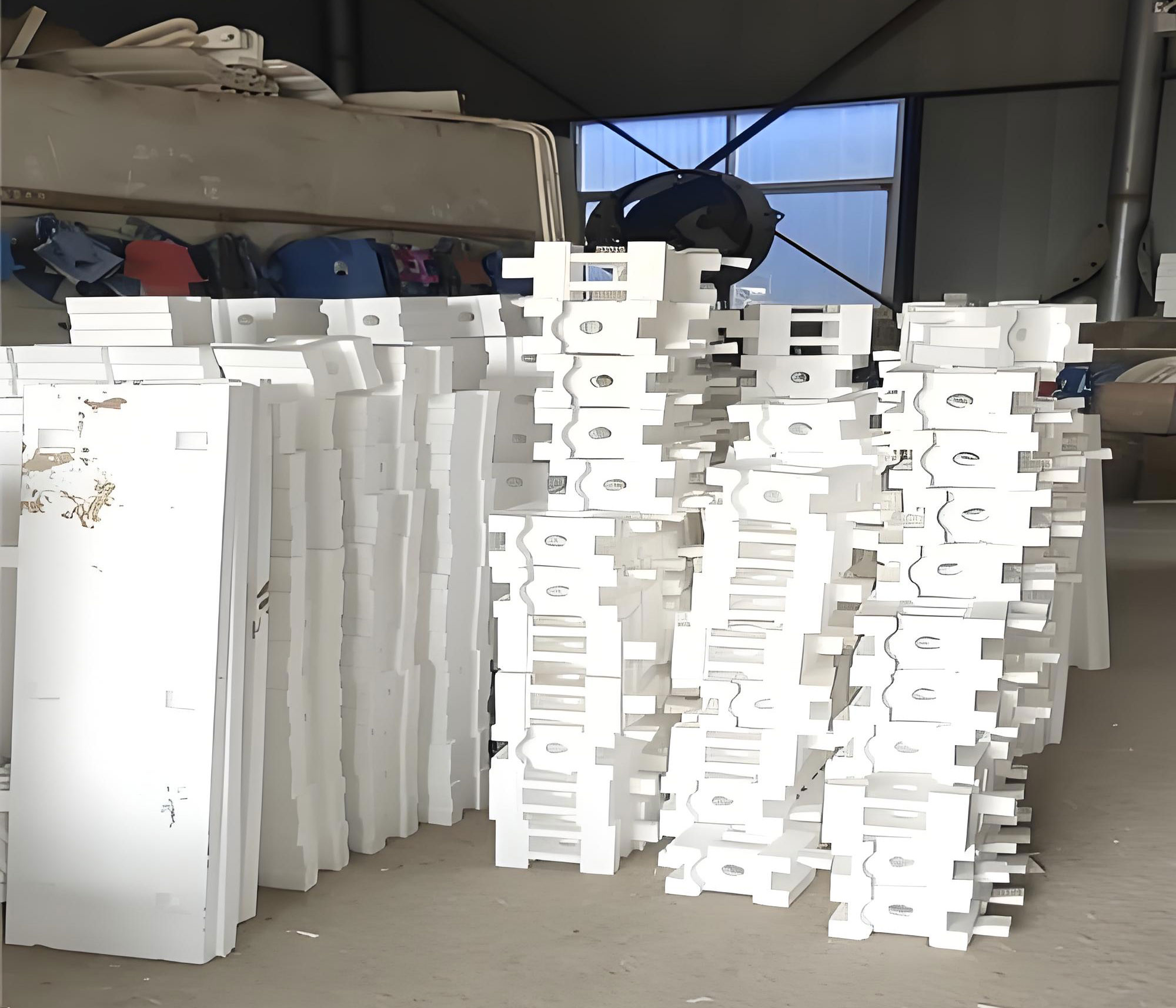
The application of lost foam castings to aluminum and magnesium alloys has encountered several technological barriers. First, the high thermal conductivity of light alloys and the endothermic decomposition of foam patterns cause a significant temperature drop at the metal front, leading to misruns, cold shuts, and porosity. Second, aluminum melts are prone to hydrogen absorption, while magnesium reacts vigorously with oxygen and moisture, resulting in oxide inclusions and burning. Third, the foam degradation products (e.g., carbonaceous residues and gases) can become entrapped in the solidifying metal, forming pinholes and microporosity. To overcome these obstacles, researchers have developed four main specialized lost foam processes, each with distinct mechanisms and operating windows.
2.1 Vacuum Low-Pressure Lost Foam Casting
This technique combines vacuum-assisted lost foam casting with counter-gravity (low-pressure) filling. The mold is placed in a sealed chamber, and the liquid metal is driven upward from a holding furnace into the mold cavity by applying a controlled gas pressure on the melt surface while simultaneously maintaining a vacuum (typically 0.02 – 0.06 MPa) in the sand bed. The pressure differential promotes smooth filling and reduces gas entrapment. The process is governed by the balance between the applied pressure and the vacuum level. The filling velocity can be approximated by:
$$v = \frac{k}{\mu} \cdot \frac{\Delta P}{L}$$
where \( v \) is the metal front velocity, \( k \) is the permeability of the sand bed, \( \mu \) is the dynamic viscosity of the melt, \( \Delta P \) is the net driving pressure (sum of applied gas pressure and vacuum minus hydrostatic head), and \( L \) is the flow path length. The coating permeability and thickness are critical; typical coating thicknesses range from 0.3 to 1.0 mm. Table 2 lists recommended process parameters.
| Parameter | Value |
|---|---|
| Foam pattern density (EPS) | 18 – 22 kg/m³ |
| Coating type | Zircon or mullite based, with organic binder |
| Coating thickness | 0.5 – 0.8 mm |
| Sand mesh size | 30 – 50 AFS |
| Vacuum level | −0.04 to −0.06 MPa |
| Applied pressure (low-pressure system) | 0.02 – 0.05 MPa |
| Pouring temperature | 710 – 740 °C |
| Metal front velocity | 0.02 – 0.06 m/s |
2.2 Vibration-Assisted Lost Foam Casting
In this variant, mechanical vibration is imposed on the flask during and after pouring. The pattern cluster is embedded in dry sand and compacted under vibration (typically 50 – 100 Hz with amplitude 0.5 – 2.0 mm). A vacuum is also applied to stabilize the sand. After the melt is poured, the vacuum valve is closed and a slight positive pressure (0.01 – 0.03 MPa) is introduced for a few minutes, then vibration is maintained for 10 – 15 minutes to promote feeding and degassing. The vibration energy improves the wetting of the decomposing foam by the melt and helps break up oxide films. The vibration intensity is quantified by the dimensionless parameter:
$$\Gamma = \frac{A \omega^2}{g}$$
where \( A \) is the amplitude, \( \omega \) is the angular frequency (\( 2\pi f \)), and \( g \) is gravitational acceleration. Typical values of \( \Gamma \) for LFC range from 3 to 8. Table 3 shows recommended vibration settings for Mg alloy AZ91D.
| Parameter | Value |
|---|---|
| Frequency | 60 – 80 Hz |
| Amplitude | 0.8 – 1.5 mm |
| Vibration duration after pouring | 8 – 12 min |
| Vacuum during filling | −0.05 MPa |
| Post-fill pressure | 0.02 MPa |
| Pouring temperature | 680 – 710 °C |
2.3 Pressurized Lost Foam Casting
In this process, the coated pattern cluster is placed inside a pressure vessel equipped with a sand box. After the foam is completely gasified by the incoming melt, the vessel is sealed and a high pressure (typically 0.3 – 1.0 MPa) is applied using an inert gas such as argon. The external pressure acts on the solidifying shell, forcing liquid metal through the mushy zone and feeding any shrinkage cavities. This technique significantly reduces shrinkage porosity and gas porosity. The pressure required to eliminate porosity can be estimated from the critical pressure for pore collapse:
$$P_{crit} = \frac{2 \sigma_{lg}}{r}$$
where \( \sigma_{lg} \) is the liquid-gas surface tension and \( r \) is the characteristic pore radius. For aluminum alloys, \( \sigma_{lg} \approx 0.9 \, \text{N/m} \), so to collapse pores of 10 μm radius, a pressure of about 0.18 MPa is needed. Industrial practice typically uses 0.4 – 0.7 MPa to ensure reliable densification. Table 4 compares casting density obtained with different applied pressures for Al-Si alloy.
| Applied Pressure (MPa) | Density (g/cm³) | Porosity (%) |
|---|---|---|
| 0.1 | 2.63 | 1.8 |
| 0.3 | 2.67 | 0.6 |
| 0.5 | 2.69 | 0.2 |
| 0.7 | 2.70 | <0.1 |
2.4 Vacuum Low-Pressure Lost Foam Shell Mold Casting
This hybrid process integrates the shell mold technology of investment casting with vacuum low-pressure filling. The foam pattern is first assembled and coated with multiple layers of ceramic slurry (similar to investment casting) to build a shell. The shell is then dewaxed (i.e., the foam is removed by thermal decomposition at 800 – 1000 °C) and fired to obtain a rigid, porous ceramic shell. This shell is placed in a sand box backfilled with dry sand, and the assembly is placed in a vacuum low-pressure casting unit. Because the foam is completely eliminated prior to metal pouring, the issues of foam degradation gases, carbon pickup, and oxide films from pattern decomposition are avoided. The resulting castings achieve near investment casting quality (CT4 – CT6, Ra 2 – 5 μm). The main challenge is to prevent shell cracking during dewaxing and to maintain vacuum integrity. Table 5 outlines key process steps.
| Step | Description | Typical Conditions |
|---|---|---|
| 1. Pattern preparation | Foam pattern (PMMA or EPS) with gating system | Density 20 – 25 kg/m³ |
| 2. Shell building | Dip-coating with colloidal silica + refractory | 5 – 7 layers; thickness 4 – 8 mm |
| 3. Dewaxing (foam removal) | Thermal decomposition in furnace | 800 – 1000 °C, 2 – 4 hours |
| 4. Firing | Sintering of ceramic shell | 1100 – 1200 °C, 1 – 2 hours |
| 5. Assembly | Shell placed in sand box, dry sand backfill | Sand mesh 40 – 60 AFS |
| 6. Casting | Vacuum low-pressure filling | Vacuum −0.06 MPa; gas pressure 0.03 MPa |
| 7. Solidification | Controlled cooling under vacuum | Rate 1 – 3 °C/s |
The future of lost foam castings is closely tied to the growing demand for lightweight components in automotive, aerospace, and electronics industries. Aluminum and magnesium alloys will continue to dominate, but several emerging trends deserve attention.
Digital and simulation-assisted process design: Computational fluid dynamics (CFD) and finite element methods (FEM) are being applied to model the complex multi-phase flow, heat transfer, and foam degradation. The governing equations include the continuity, momentum, and energy equations for the two-phase (metal-gas) system, coupled with a kinetic model for foam pyrolysis. A typical form of the energy balance is:
$$\rho C_p \frac{\partial T}{\partial t} + \rho C_p \mathbf{u} \cdot \nabla T = \nabla \cdot (k \nabla T) + \dot{Q}_{pyro}$$
where \( \rho, C_p, k \) are density, specific heat, and thermal conductivity of the metal, \( \mathbf{u} \) is the velocity field, and \( \dot{Q}_{pyro} \) is the heat absorbed by foam degradation. Accurate simulation can predict filling defects and optimize gating designs, reducing trial-and-error costs.
Advanced pattern and coating materials: New foam materials such as poly(methyl methacrylate) (PMMA) and copolymer blends offer lower decomposition temperatures and reduced carbon residue, which is beneficial for aluminum and magnesium. Coatings with higher permeability and better thermal insulation are being developed using nano-additives like zirconia or alumina nanoparticles. The coating permeability \( K_c \) can be related to pore size \( d_p \) and porosity \( \epsilon \) by the Kozeny-Carman equation:
$$K_c = \frac{\epsilon^3 d_p^2}{180 (1-\epsilon)^2}$$
Tailoring \( K_c \) between 10⁻¹² and 10⁻¹⁰ m² is essential for optimal gas evacuation without metal penetration.
Automation and standardization: Fully automated lost foam casting lines are being implemented for high-volume production of engine blocks, transmission housings, and structural parts. Standardization of pattern processing, coating application, and sand compaction parameters is necessary for consistent quality. Table 6 presents a roadmap for future research priorities.
| Area | Current Challenge | Research Direction |
|---|---|---|
| Pattern materials | Carbon pick-up in Al/Mg | Low-residue polymers (PMMA, POM) |
| Coatings | Balance between permeability and strength | Multi-layer nano-composite coatings |
| Sand compaction | Uniform density distribution | 3D vibration profiles, smart sensors |
| Filling control | Misruns and cold shuts | Adaptive pressure/vacuum control |
| Defect prediction | Gas porosity, shrinkage | Machine learning models integrated with CFD |
| Recycling | Sand reuse and foam residue | Thermal reclamation with emission capture |
Despite the significant progress made by research groups worldwide, a gap remains between laboratory-scale successes and industrial implementation. Developing countries, in particular, need to invest in standardized pattern and coating supply chains, robust equipment, and workforce training. The combination of lost foam casting with additive manufacturing (e.g., 3D printing of foam patterns) is a promising avenue to produce complex, one-of-a-kind castings without expensive tooling. Furthermore, real-time monitoring of the filling front using thermal imaging or acoustic emission is being explored to close the loop on process control.
In conclusion, lost foam castings have evolved from a niche technology to a versatile production method capable of delivering high-precision, lightweight components. The specialized variants for aluminum and magnesium—vacuum low-pressure, vibration-assisted, pressurized, and shell mold—address the specific challenges of these reactive alloys. The incorporation of mathematical models, advanced materials, and digital tools will drive the next generation of lost foam castings, making them even more competitive in the global foundry industry. By focusing on standardization, automation, and sustainable practices, lost foam castings can fulfill their promise as the “green technology” of the 21st century.