
In the manufacturing of water supply valves, the application of spheroidal graphite cast iron has become increasingly prevalent due to its superior mechanical properties and cost-effectiveness. As an engineer specializing in valve production, I have encountered numerous challenges in ensuring the quality of spheroidal graphite cast iron components. This article delves into the comprehensive quality control methods that I have developed and implemented, drawing from extensive testing data and practical experience. The focus is on maintaining the integrity of spheroidal graphite cast iron parts, which are critical for valves operating in low-pressure environments such as water supply, heating, ventilation, and firefighting systems. Through rigorous testing and analysis, we can mitigate issues like reduced mechanical strength, structural instability, and diminished impact resistance, thereby extending the service life of these components to 60–80 years under typical conditions of up to 4.0 MPa pressure and temperatures ranging from -30°C to 350°C.
The unique microstructure of spheroidal graphite cast iron, characterized by spherical graphite nodules embedded in a metallic matrix, confers exceptional properties. In my work, I have observed that the spheroidal graphite structure significantly enhances tensile strength, corrosion resistance, oxidation resistance, ductility, wear resistance, and impact toughness compared to traditional cast iron or steel. For instance, the spheroidal graphite cast iron used in valves often exhibits a tensile strength exceeding that of flake graphite cast iron, with yield strengths that prevent premature failure. The presence of pearlite or ferrite in the matrix further tailors properties: pearlite, when combined with heat treatment, increases hardness and wear resistance, while ferrite improves ductility. Additionally, the spherical graphite morphology disperses stress concentrations, enhancing stability against external impacts. From a production standpoint, the casting efficiency of spheroidal graphite cast iron reduces overall costs, making it an ideal choice for valve components. However, achieving these benefits consistently requires meticulous quality control, as defects in casting processes can compromise performance. In this article, I will share detailed techniques for controlling the quality of spheroidal graphite cast iron, emphasizing mechanical testing, metallographic examination, hardness assessment, chemical analysis, and supplementary methods.
The technical challenges in producing spheroidal graphite cast iron for valves are multifaceted. Based on my experience, low-pressure valves (typically with nominal pressures ≤ 4.0 MPa, often 1.6 MPa or less) and moderate temperature applications (e.g., water介质 below 100°C) demand precise control over the casting process. The primary难点 lies in the inherent variability of spheroidal graphite cast iron properties due to factors like cooling rates, inoculation practices, and composition fluctuations. Without proper techniques, components may suffer from inadequate graphite spheroidization, porosity, or inclusions, leading to failures in service. For example, in a project involving water supply valves, I noted that even minor deviations in spheroidal graphite cast iron quality could result in leakage or fracture under cyclic loading. Therefore, implementing robust quality control is not merely an option but a necessity to ensure reliability and safety. In the following sections, I will outline the specific methods I employ, supported by data and practical insights, to address these challenges and optimize the performance of spheroidal graphite cast iron parts.
Mechanical performance testing is the cornerstone of quality control for spheroidal graphite cast iron components. In my practice, I prioritize evaluating tensile strength, yield strength, and elongation to verify that the material meets specified grades such as QT400-15, QT450-10, or QT500-7. The process begins with sample preparation: I extract attached test bars from castings, ensuring they represent the component’s weight, wall thickness, and geometry. According to standards like GB/T 228.1-2010 (equivalent to ISO 6892-1), I machine these bars into standard specimens. For tensile testing, I use a hydraulic universal testing machine (e.g., WEW-300), where the specimen is clamped and stretched until fracture. The maximum force and elongation are recorded to compute key parameters. The tensile strength (σUTS) is calculated using the formula: $$ \sigma_{UTS} = \frac{F_{\text{max}}}{A_0} $$ where \( F_{\text{max}} \) is the maximum load and \( A_0 \) is the original cross-sectional area. Similarly, yield strength (σy) is determined at 0.2% offset strain, and elongation (A) is derived from the change in gauge length post-fracture. I often summarize results in tables to track consistency. For instance, in a batch of spheroidal graphite cast iron valves, I compiled data showing average tensile strengths of 460 MPa for QT450-10, well above the minimum requirement of 450 MPa. This testing not only validates material grade but also identifies anomalies early in production. Regular mechanical testing has enabled me to correlate process parameters with performance, optimizing casting techniques for spheroidal graphite cast iron.
Metallographic examination is another critical aspect of quality control for spheroidal graphite cast iron. I perform this analysis to assess graphite spheroidization, matrix structure, and potential defects. The procedure involves sectioning samples from castings, mounting them in resin, and grinding/polishing to a mirror finish. After etching with a 2–5% nitric alcohol solution, I examine the microstructure under a metallurgical microscope at 100× magnification. Using software like JX-2000, I evaluate graphite spheroidization grade, spheroidization rate, graphite size, and the proportions of pearlite and ferrite. The spheroidization rate is particularly crucial; from my data, I have observed that grades 2 (90%), 3 (80%), and 4 (75%) exhibit excellent mechanical properties, with minimal variation between levels. However, a drop to 70% spheroidization (still grade 4) can significantly reduce performance due to increased irregular graphite forms like vermicular or clustered flakes, which act as stress concentrators. The relationship between spheroidization rate (S) and tensile strength (σ) can be approximated by: $$ \sigma \propto \log(S) $$ for S > 70%, highlighting the sensitivity of spheroidal graphite cast iron to graphite morphology. In cases where graphite floating (blossom-like graphite) occurs, I reject the batch as it compromises integrity. Below is a table summarizing typical metallographic criteria for spheroidal graphite cast iron in valve applications:
| Property | Acceptable Range | Impact on Performance |
|---|---|---|
| Graphite Spheroidization Grade | 1–4 (≥75% spheroidization) | Higher grades ensure better strength and ductility |
| Graphite Size | 5–7 (ASTM standards) | Smaller graphite improves toughness |
| Pearlite Content | 10–30% for QT450-10 | Balances hardness and ductility |
| Ferrite Content | 70–90% for QT400-15 | Enhances elongation and impact resistance |
Through consistent metallographic analysis, I have refined heat treatment processes to achieve desired matrix structures in spheroidal graphite cast iron, thereby enhancing valve durability.
Hardness testing provides a quick indicator of the material’s resistance to deformation and wear. For spheroidal graphite cast iron, I prefer the Brinell hardness test due to its suitability for coarse-grained materials. I prepare samples with a surface roughness ≤ 1.6 μm, ensuring thickness is at least 8 times the indentation depth per GB/T 231.1-2018. Using an electronic Brinell hardness tester, I apply a load (e.g., 3000 kgf for a 10 mm ball) and measure the indentation diameter with a reading microscope. The Brinell hardness number (HBW) is then referenced from standard tables. In my experience, spheroidal graphite cast iron valves typically exhibit hardness values between 160–230 HBW, depending on the grade. For example, QT500-7 often shows 170–230 HBW, correlating with its mixed ferrite-pearlite matrix. The hardness (H) can be related to tensile strength (σ) through empirical formulas such as: $$ \sigma \approx k \cdot H $$ where k is a material constant (approximately 3.4 for spheroidal graphite cast iron). Regular hardness mapping across castings helps identify uneven cooling or segregation, allowing corrective actions in the foundry. I maintain records of hardness distributions to ensure uniformity, as variations exceeding 20 HBW may indicate processing issues in spheroidal graphite cast iron production.
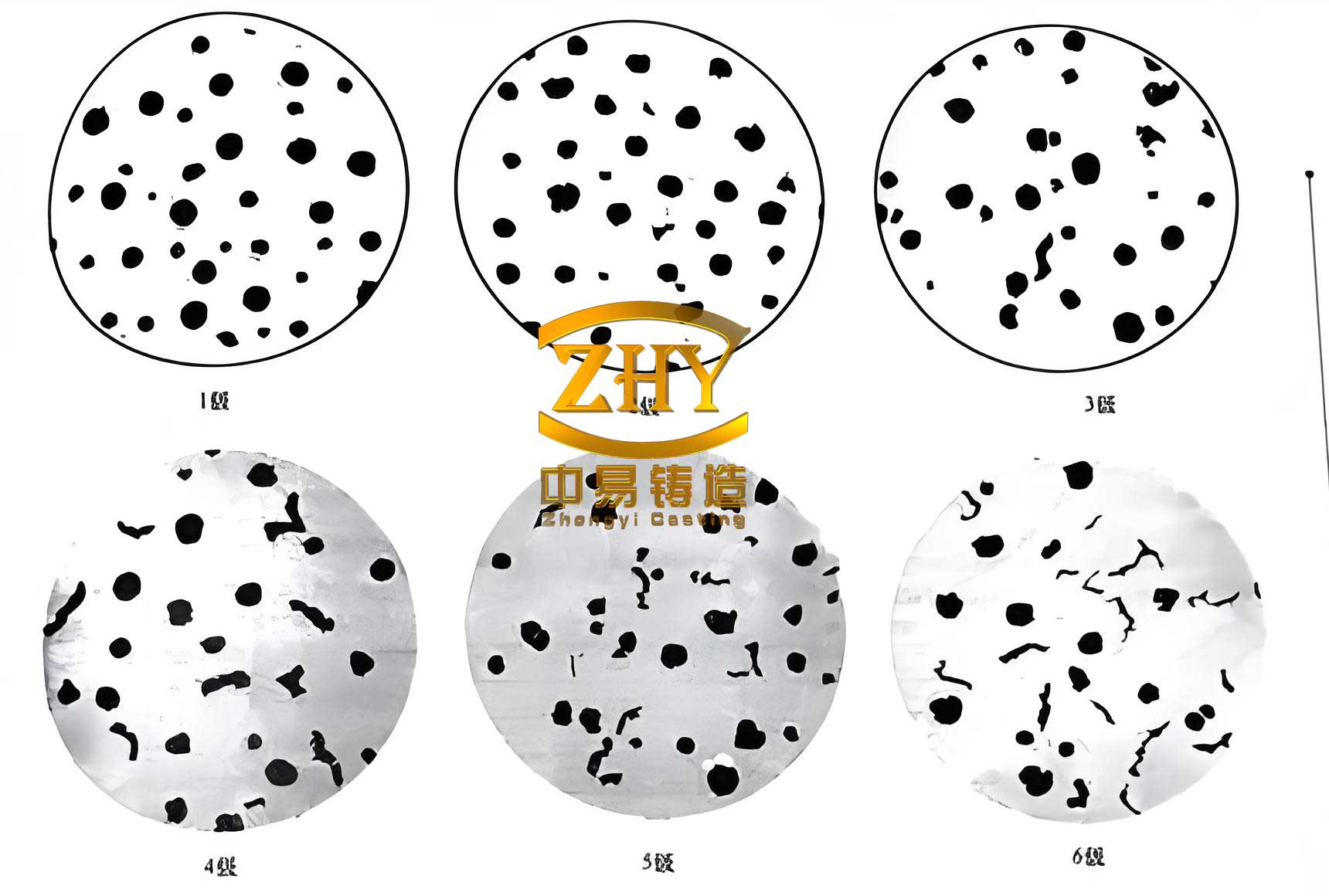
Chemical composition analysis is fundamental to controlling the properties of spheroidal graphite cast iron. I routinely sample from castings and use spectroscopic instruments to determine elemental concentrations, particularly carbon (C), silicon (Si), sulfur (S), phosphorus (P), and manganese (Mn). The composition directly influences graphite formation and matrix characteristics. For instance, high carbon equivalent promotes graphite precipitation, while silicon enhances ferrite formation. Based on my data, I adhere to strict limits to avoid defects like chilling or shrinkage. The following table outlines typical chemical requirements for common spheroidal graphite cast iron grades in valves, derived from standards like GB/T 1348-2019 and EN 1563:
| Grade | C (%) | Si (%) | S (%) | P (%) | Mn (%) | Key Role in Spheroidal Graphite Cast Iron |
|---|---|---|---|---|---|---|
| QT400-15 (EN) | ≥3.0 | ≤2.5 | <0.025 | <0.08 | <0.5 | High ductility via ferrite matrix |
| QT450-10 (GB) | 3.4–3.9 | 2.3–2.7 | <0.025 | <0.08 | <0.5 | Balanced strength and elongation |
| QT500-7 (GB) | 3.6–3.8 | 2.5–2.9 | <0.025 | <0.08 | <0.6 | Enhanced strength with pearlite |
I also monitor trace elements like magnesium (Mg) and cerium (Ce), which are crucial for graphite spheroidization. The effectiveness of spheroidizing agents can be evaluated using the formula: $$ \text{Spheroidization Efficiency} = \frac{[\text{Mg}]_{\text{residual}}}{[\text{Mg}]_{\text{added}}} \times 100\% $$ aiming for values above 80% to ensure consistent spheroidal graphite cast iron quality. By integrating chemical analysis with other tests, I optimize melting and inoculation practices, reducing scrap rates and improving valve performance.
In addition to the core methods, I employ supplementary control techniques for spheroidal graphite cast iron components. Surface quality inspection involves visual and penetrant testing to detect cracks, cold shuts, or sand inclusions. Dimensional checks using coordinate measuring machines (CMM) verify that castings conform to design tolerances, critical for valve assembly and sealing. Non-destructive testing (NDT) methods like ultrasonic or radiographic examination are applied to critical sections to identify internal defects. Furthermore, I conduct pressure tests on finished valves to validate performance under simulated service conditions. These holistic approaches ensure that every spheroidal graphite cast iron part meets stringent quality standards. For example, in a recent project, implementing comprehensive controls reduced rejection rates by 15% and enhanced valve longevity in water supply networks.
To synthesize the quality control process for spheroidal graphite cast iron, I often use integrated formulas that relate multiple parameters. One such model for predicting tensile strength (σ) based on composition and microstructure is: $$ \sigma = \alpha \cdot \text{C}_{\text{eq}} + \beta \cdot S + \gamma \cdot H + \delta $$ where \( \text{C}_{\text{eq}} \) is the carbon equivalent (\( \text{C} + 0.33 \cdot \text{Si} \)), S is the spheroidization rate, H is the hardness, and α, β, γ, δ are empirical constants derived from regression analysis of my test data. This approach allows for proactive adjustments in production, minimizing trial-and-error. Moreover, statistical process control (SPC) charts are maintained to track key variables like hardness and chemistry over time, ensuring stability in spheroidal graphite cast iron manufacturing.
In conclusion, the quality control of spheroidal graphite cast iron for water supply valves is a multifaceted endeavor that demands meticulous attention to detail. Through my experience, I have demonstrated that combining mechanical testing, metallographic examination, hardness assessment, chemical analysis, and ancillary methods can significantly enhance the reliability and performance of these components. The repeated emphasis on spheroidal graphite cast iron throughout this article underscores its centrality in valve technology. By adhering to standardized procedures and leveraging data-driven insights, manufacturers can overcome technical challenges, reduce costs, and produce valves that withstand decades of service in demanding environments. As the industry evolves, continuous improvement in these techniques will further solidify the role of spheroidal graphite cast iron as a material of choice for critical infrastructure applications.