
In this comprehensive study, we delve into the intricate relationships between silicon content and the resultant microstructure, as well as the room-temperature and elevated-temperature mechanical properties, of heat-resistant spheroidal graphite cast iron. Spheroidal graphite cast iron, a material renowned for its exceptional combination of strength, ductility, and castability, has become indispensable in demanding applications such as automotive engine components, power generation equipment, and heavy-duty machinery parts. However, the relentless push for higher operational temperatures and improved performance in these sectors necessitates the development of advanced grades of spheroidal graphite cast iron with superior thermal stability and mechanical integrity under heat. Silicon, as a potent alloying element, plays a multifaceted role in ferrous alloys; it is a strong ferrite stabilizer, enhances oxidation resistance, and provides solid solution strengthening. Yet, its influence on the spheroidization of graphite and the overall balance of properties in spheroidal graphite cast iron is complex and requires meticulous investigation. This work aims to systematically explore this influence, providing quantitative insights that can guide the alloy design of next-generation heat-resistant spheroidal graphite cast iron.
The fundamental appeal of spheroidal graphite cast iron lies in its unique microstructure, where the graphite exists as discrete spheroids embedded within a metallic matrix, which can be ferritic, pearlitic, or a mixture of phases. This morphology drastically reduces the stress-concentrating effect of graphite compared to the flake form in gray iron, granting the spheroidal graphite cast iron remarkable toughness and tensile strength. For high-temperature service, the matrix stability and the resistance of both the matrix and the graphite to oxidation and growth are paramount. Alloying with elements like silicon, molybdenum, chromium, and nickel is a common strategy. Silicon, in particular, is attractive due to its cost-effectiveness and significant impact on elevating the eutectoid transformation temperature, promoting a ferritic matrix, and improving scaling resistance. However, literature and industrial experience indicate that excessive silicon can degrade graphite spheroidization, leading to the formation of degenerate graphite forms like chunky or exploded graphite, and can induce embrittlement. Therefore, optimizing silicon content is a critical challenge in developing heat-resistant grades of spheroidal graphite cast iron.
Our experimental approach involved the preparation of a series of spheroidal graphite cast iron heats with varying silicon contents while maintaining a constant carbon equivalent and fixed levels of other alloying elements such as molybdenum, chromium, nickel, and copper. The carbon equivalent (CE) was kept at 4.3, adjusted by inversely varying the carbon and silicon contents according to the classic formula: $$CE = \%C + \frac{1}{3}(\%Si + \%P)$$. For our alloys, phosphorus was kept low, so the relationship simplified to balancing C and Si. The nominal chemical compositions of the five investigated spheroidal graphite cast iron alloys are summarized in Table 1.
| Alloy Designation | C | Si | Mo | Cr | Ni | Cu | Mg | CE (Approx.) |
|---|---|---|---|---|---|---|---|---|
| A (Low-Si) | 3.4 | 2.8 | 0.6 | 0.6 | 0.8 | 0.4 | <0.04 | 4.3 |
| B | 3.2 | 3.3 | 0.6 | 0.6 | 0.8 | 0.4 | <0.04 | 4.3 |
| C (Mid-Si) | 3.1 | 3.8 | 0.6 | 0.6 | 0.8 | 0.4 | <0.04 | 4.3 |
| D | 2.9 | 4.3 | 0.6 | 0.6 | 0.8 | 0.4 | <0.04 | 4.3 |
| E (High-Si) | 2.7 | 4.8 | 0.6 | 0.6 | 0.8 | 0.4 | <0.04 | 4.3 |
Melting was conducted in a medium-frequency induction furnace, with the tapping temperature carefully controlled between 1500 and 1550 °C. To ensure consistent and high-quality spheroidization—a defining characteristic of spheroidal graphite cast iron—a standard sandwich method was employed for nodularizing treatment using a rare-earth magnesium ferrosilicon alloy. Inoculation was performed in two stages: a primary inoculation with 75% ferrosilicon and silicon carbide in the ladle, and a late stream inoculation with a barium-containing ferrosilicon inoculant to enhance nucleation and combat fade. The melts were poured into Y-block sand molds with a section thickness of 25 mm. After cooling and shakeout, specimens for metallographic examination and mechanical testing were extracted from the keel blocks of the Y-shaped castings.
Microstructural characterization involved standard metallographic preparation followed by etching with 4% nital. Optical microscopy and scanning electron microscopy (SEM) were utilized to assess graphite morphology, spheroidization grade, nodule count, and the matrix structure. Quantitative image analysis software was employed to determine parameters such as nodularity, pearlite fraction, and average graphite size. The mechanical behavior of the spheroidal graphite cast iron was evaluated through uniaxial tensile tests at both room temperature and an elevated temperature of 500 °C. The elevated temperature tests included a 30-minute soaking period at the test temperature to ensure thermal equilibrium. The tensile properties, namely ultimate tensile strength (UTS) and elongation to fracture, were recorded, and the fracture surfaces were examined via SEM to identify the prevailing failure mechanisms.
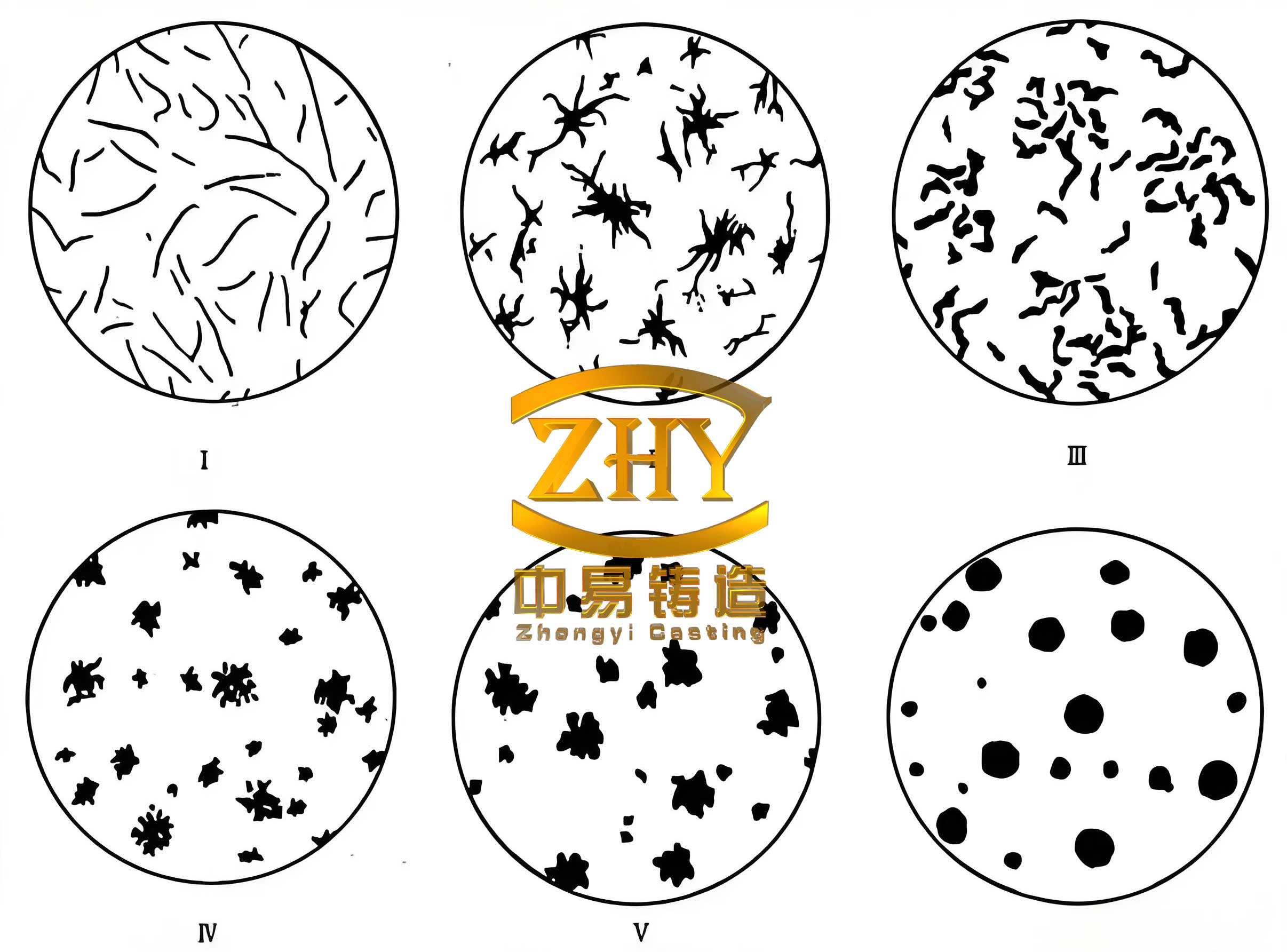
The microstructural evolution of the spheroidal graphite cast iron with increasing silicon content was striking and fundamental to understanding the subsequent property changes. Graphite morphology is the cornerstone of quality in spheroidal graphite cast iron. In alloy A with 2.8% Si, the graphite nodules were predominantly well-formed, densely distributed, and exhibited high spheroidicity. Quantitative analysis yielded a nodularity value exceeding 90%, corresponding to a spheroidization grade of 1 according to relevant standards. As the silicon content increased to 3.3% (Alloy B), a slight deterioration in graphite roundness was observed, with nodularity dropping to approximately 86% (Grade 2). A significant transition occurred at 3.8% Si (Alloy C), where the first signs of degenerate graphite, specifically chunky or fragmented graphite, became evident amidst the spheroids. The nodularity here fell to about 76% (Grade 3). This trend accelerated in alloys D and E with 4.3% and 4.8% Si, respectively. The graphite structure became increasingly irregular, with a high population of compacted/vermicular and chunky forms, leading to nodularity values of roughly 69% and 57%, corresponding to grades 4 and 5. This progressive degradation of graphite shape with higher silicon is attributed to the influence of silicon on the solidification kinetics and the interfacial energy between graphite and the melt. Silicon increases the carbon equivalent and alters the eutectic growth front, potentially favoring the formation of compacted graphite under certain conditions. Furthermore, silicon can affect the activity of surface-active elements like magnesium and cerium, potentially impairing their graphite-modifying efficiency. The average nodule size, however, showed less systematic variation, remaining largely in the size range of 6 to 7 on the standard scale, indicating that silicon’s primary effect is on morphology rather than nucleation density or growth rate in this composition range.
The matrix structure of the as-cast spheroidal graphite cast iron transformed consistently with silicon addition. All alloys exhibited a mixed matrix of ferrite and pearlite. Silicon is a powerful ferritizer; it raises the eutectoid temperature and expands the ferrite phase field, thereby suppressing the formation of pearlite. Our quantitative image analysis confirmed this effect unequivocally. The pearlite volume fraction decreased monotonically from approximately 51.1% in the low-silicon Alloy A (2.8% Si) to a mere 8.7% in the high-silicon Alloy E (4.8% Si). This transition is captured in Table 2. The mechanism is twofold: firstly, silicon reduces the carbon solubility in austenite, shifting the eutectoid point to lower carbon contents; secondly, by raising transformation temperatures, it enhances the diffusion rate of carbon, allowing more carbon to precipitate onto existing graphite during cooling rather than forming cementite lamellae. Consequently, the matrix of the high-silicon spheroidal graphite cast iron alloys was predominantly ferritic, which is generally desirable for high-temperature applications due to ferrite’s better thermal stability and creep resistance compared to pearlite.
| Alloy (Si wt.%) | Graphite Nodularity (%) | Spheroidization Grade | Pearlite Fraction (%) | Room-Temperature UTS (MPa) | Room-Temperature Elongation (%) |
|---|---|---|---|---|---|
| 2.8 (A) | 91.1 | 1 | 51.1 | 692 | 4.2 |
| 3.3 (B) | 86.1 | 2 | 42.4 | 715 | 3.1 |
| 3.8 (C) | 75.8 | 3 | 29.2 | 726 | 1.6 |
| 4.3 (D) | 68.8 | 4 | 17.8 | 701 | 1.2 |
| 4.8 (E) | 57.3 | 5 | 8.7 | 684 | 0.9 |
The room-temperature tensile properties of the spheroidal graphite cast iron displayed a non-monotonic relationship with silicon content, as detailed in Table 2. The ultimate tensile strength initially increased from 692 MPa at 2.8% Si to a peak of 726 MPa at 3.8% Si, before decreasing to 684 MPa at 4.8% Si. The elongation, a key indicator of ductility, decreased steadily and significantly from 4.2% to a low of 0.9% over the same silicon range. This behavior can be interpreted through the competing effects of solid solution strengthening and graphite morphology deterioration. In the lower silicon range (up to ~3.8% Si), the graphite morphology remains reasonably good. The dominant effect is the solid solution strengthening imparted by silicon atoms dissolving in the ferrite lattice. Silicon causes significant lattice strain due to its smaller atomic radius compared to iron. This strain field interacts strongly with dislocations, pinning them and increasing the stress required for plastic flow. The strengthening contribution from solid solution can be described by an equation of the form: $$\Delta \sigma_{ss} = K_{Si} \cdot (C_{Si})^{m}$$ where $\Delta \sigma_{ss}$ is the increase in yield or tensile strength, $K_{Si}$ is a strengthening coefficient for silicon in iron, $C_{Si}$ is the silicon concentration, and $m$ is an exponent typically around 0.5 to 1. This effect led to the observed increase in strength. Simultaneously, the reduction in the brittle pearlite phase fraction might have also contributed to a slight strength increase in this mid-range, as the softer ferrite is being strengthened by silicon. However, beyond 3.8% Si, the detrimental effect of degenerated graphite overwhelms the solid solution benefit. Irregular graphite particles, especially those with sharp edges, act as potent stress concentrators and effective crack initiation sites. Under tensile loading, microcracks readily form at these interfaces, leading to premature fracture. This drastically reduces the ductility and eventually limits the achievable strength, causing the downturn in the UTS curve. The low elongation values, especially below 2% for silicon contents of 3.8% and above, signal a pronounced embrittlement. This embrittlement in high-silicon spheroidal graphite cast iron is often attributed to several factors: the presence of degenerate graphite, solid solution hardening which reduces dislocation mobility, and potential phenomena like reversible temper embrittlement or hydrogen embrittlement facilitated by silicon.
Fractographic analysis of the room-temperature tensile specimens corroborated the mechanical data. The fracture surfaces of alloys with lower silicon (A and B) showed a mixed-mode appearance with some dimples around graphite nodules, indicating microvoid coalescence, but also contained substantial areas of cleavage facets and river patterns, characteristic of brittle fracture. As silicon increased (alloys C, D, E), the brittle features became overwhelmingly dominant. Large, flat cleavage planes covered most of the fracture surface, with clear river markings indicating the propagation of cracks along specific crystallographic planes. The scarcity of dimples aligned with the precipitous drop in measured elongation. The transition to a completely brittle fracture mode in high-silicon spheroidal graphite cast iron underscores the critical importance of maintaining graphite spheroidicity.
The high-temperature (500 °C) tensile behavior of these spheroidal graphite cast iron alloys presented a different trend, as summarized in Table 3. Contrary to the room-temperature results, the ultimate tensile strength at 500 °C increased monotonically with silicon content, from 458 MPa for Alloy A (2.8% Si) to 532 MPa for Alloy E (4.8% Si). The elongation at 500 °C, while significantly higher than its room-temperature counterpart for each alloy due to thermally activated plasticity, decreased monotonically from 11.5% to 6.0% with increasing silicon. The enhancement of high-temperature strength with silicon is a well-known benefit in heat-resistant alloys. Silicon strengthens the ferrite matrix at elevated temperatures by increasing the bonding forces between atoms and by reducing the diffusion rates, which slows down recovery and creep processes. The strengthening effect can be more pronounced at high temperatures where other mechanisms like dislocation forest hardening are less effective. The relationship between high-temperature flow stress and silicon content can often be described by an Arrhenius-type equation incorporating an activation energy term that is influenced by solute atoms: $$\dot{\epsilon} = A \sigma^n \exp\left(-\frac{Q}{RT}\right)$$ where $\dot{\epsilon}$ is the strain rate, $A$ is a constant, $\sigma$ is the stress, $n$ is the stress exponent, $Q$ is the apparent activation energy for deformation, $R$ is the gas constant, and $T$ is the absolute temperature. Silicon is known to increase the activation energy $Q$, making deformation more difficult at a given temperature and strain rate, thereby increasing the measured strength. However, the continued degradation of graphite morphology with higher silicon still exerts a negative influence on ductility, explaining the gradual decrease in elongation at 500 °C. Nevertheless, the overall ductility level is much improved compared to room temperature because at 500 °C, mechanisms like grain boundary sliding and enhanced dislocation climb become active, allowing for more plastic strain before fracture, even in the presence of stress-concentrating graphite particles.
| Alloy (Si wt.%) | High-Temperature UTS (MPa) | High-Temperature Elongation (%) | Fracture Mode at 500 °C |
|---|---|---|---|
| 2.8 (A) | 458 | 11.5 | Ductile-Brittle Mixed |
| 3.3 (B) | 478 | 9.8 | Ductile-Brittle Mixed |
| 3.8 (C) | 499 | 8.2 | Ductile-Brittle Mixed |
| 4.3 (D) | 518 | 7.1 | Ductile-Brittle Mixed |
| 4.8 (E) | 532 | 6.0 | Ductile-Brittle Mixed |
The fracture surfaces of the specimens tested at 500 °C exhibited a markedly different morphology compared to their room-temperature counterparts. They displayed features indicative of a ductile-brittle mixed mode. Well-defined dimples, often surrounding the imprints of graphite nodules that had decohered or fallen out, were prevalent, signifying microvoid nucleation and coalescence—a ductile fracture process. However, these dimples were interspersed with regions of smoother, featureless areas or tear ridges. The presence of dimples correlates with the significantly higher elongations measured at 500 °C. The elevated temperature facilitates plastic deformation of the ferrite matrix, allowing it to blunter crack tips and undergo necking. The matrix can deform around the graphite particles, leading to void formation and growth. The brittle components in the fracture surface likely originate from areas where cracks propagated rapidly along cleavage planes in larger grains or where impurities/secondary phases were present. This mixed-mode fracture is characteristic of many engineering alloys at intermediate temperatures and reflects the balance between thermally assisted plasticity and the inherent microstructural weaknesses.
The implications of these findings for the design of heat-resistant spheroidal graphite cast iron are profound. A clear trade-off exists. Silicon is essential for achieving a stable, predominantly ferritic matrix with good oxidation resistance and high-temperature strength retention. However, its content must be carefully controlled to prevent severe deterioration of graphite morphology, which catastrophically compromises room-temperature ductility and toughness and can also negatively impact high-temperature ductility and fatigue resistance. For applications where room-temperature handling, machining, and resistance to thermal shocks are important, a moderate silicon content around 3.3-3.8% might offer a reasonable balance, providing decent high-temperature strength (near 500 MPa at 500 °C) while maintaining some room-temperature ductility (1.5-3%) and acceptable graphite nodularity (Grade 2-3). For components primarily stressed at high temperature with minimal room-temperature load-bearing requirements, higher silicon contents up to 4.5% could be considered to maximize scaling resistance and creep strength, albeit with the acceptance of very low room-temperature ductility. It is also crucial to consider synergistic effects with other alloying elements. The molybdenum, chromium, and nickel present in our alloys contribute to solid solution strengthening and carbide stability, which support high-temperature performance. Their presence might slightly alter the precise silicon threshold for graphite degeneration. Further optimization could involve advanced melting and treatment practices, such as the use of more powerful inoculants or post-inoculation techniques, to counteract the negative effects of high silicon on graphite shape in spheroidal graphite cast iron.
From a theoretical perspective, the results highlight the complex interplay between composition, solidification, and solid-state transformation in spheroidal graphite cast iron. The effect of silicon on the phase diagram can be modeled using thermodynamic software, but predicting its precise impact on graphite morphology requires considering kinetic factors and interfacial phenomena. The strengthening mechanisms can be analyzed using composite models where the spheroidal graphite cast iron is treated as a metal matrix composite. The tensile strength ($\sigma_c$) might be approximated by considering the matrix strength ($\sigma_m$) and the effect of graphite as voids: $$\sigma_c \approx \sigma_m (1 – f_g)^{n}$$ where $f_g$ is the volume fraction of graphite and $n$ is an exponent. However, this simple model fails to account for graphite shape. A more refined approach would incorporate a stress concentration factor ($K_t$) dependent on nodularity: $$\sigma_c \approx \frac{\sigma_m (1 – f_g)^{n}}{K_t(Nodularity)}$$ where $K_t$ increases as nodularity decreases. Our data suggests that for silicon levels above 3.8%, the increase in $K_t$ outweighs the increase in $\sigma_m$ from solid solution, leading to the observed drop in room-temperature UTS.
In conclusion, this systematic investigation elucidates the pivotal role of silicon in governing the microstructure-property relationships in heat-resistant spheroidal graphite cast iron. We have demonstrated that while silicon is highly effective in promoting a ferritic matrix and enhancing both room-temperature and high-temperature strength through solid solution hardening, its propensity to degrade graphite spheroidization beyond a critical concentration (approximately 3.8% in this specific alloy system) imposes a severe penalty on ductility, particularly at room temperature. The high-temperature tensile strength benefits continuously from higher silicon, but the associated loss in elongation must be factored into component design. Therefore, the alloy development of high-performance spheroidal graphite cast iron for elevated temperature service must involve a meticulous optimization of silicon content, often in conjunction with other alloying elements and advanced foundry techniques, to achieve the best possible compromise between microstructural stability, high-temperature capability, and adequate room-temperature toughness. The journey to perfecting heat-resistant spheroidal graphite cast iron continues, with silicon remaining a key, yet double-edged, sword in the metallurgist’s arsenal.