
The pursuit of automotive safety is inextricably linked to the performance of braking systems. Within these systems, the brake caliper, a critical component of disc brakes, plays a pivotal role. Its material integrity directly dictates the reliability and effectiveness of the braking action. Spheroidal graphite cast iron, often referred to as ductile iron, has emerged as a preferred material for this demanding application. This material ingeniously combines the excellent castability and machinability of grey cast iron with significantly enhanced mechanical properties, courtesy of its characteristic spherical graphite nodules embedded within a metallic matrix. However, as casting technology advances enabling increasingly complex geometries, a significant challenge arises: pronounced variations in section thickness within a single casting. These variations lead to non-uniform cooling rates during solidification, which in turn induce gradients in microstructure and, consequently, mechanical properties. Understanding these gradients is paramount for predicting component performance, optimizing casting processes, and ensuring the consistent quality and safety of automotive brake components. This article delves into a detailed investigation of such microstructure-property relationships in spheroidal graphite cast iron brake calipers, focusing on the often non-linear effects imposed by varying wall thickness.
It is well-established that the solidification kinetics of cast iron are profoundly influenced by cooling rate. For spheroidal graphite cast iron, this affects graphite nucleation, growth, and the subsequent transformation of the austenitic matrix into its final ferritic, pearlitic, or mixed constituents. A higher cooling rate, typically associated with thinner sections, generally promotes a higher nodule count, finer graphite size, and can suppress the formation of pearlite in favor of ferrite. Conversely, slower cooling in thicker sections can lead to fewer, larger graphite nodules and may allow for a greater proportion of pearlite to form, depending on alloy composition. This relationship, however, is not always linear or predictable in complex castings. The thermal history of a specific location is not dictated by its local thickness alone but also by the global heat flow within the entire casting. A thin section connected to a massive thermal mass may cool slower than an isolated, moderately thick section. Furthermore, microsegregation of alloying elements during solidification can locally alter transformation kinetics, overriding the general trends expected from cooling rate alone. Elements like Manganese (Mn) are known to segregate to the last-solidifying regions (positive segregation) and strongly stabilize pearlite, while Silicon (Si) tends to promote ferrite formation. Therefore, the final microstructure at any given point in a casting of spheroidal graphite cast iron is the result of a complex interplay between macroscopic cooling conditions and microscopic chemical heterogeneity.
The present analysis is based on the study of actual production brake calipers manufactured from two common grades of as-cast spheroidal graphite cast iron: QT500-7 and QT550-6. The nominal chemical compositions of these grades are presented in Table 1. QT550-6 generally has a slightly lower carbon equivalent (CE) and higher Mn content compared to QT500-7, aiming for higher strength.
| Material Grade | C (%) | Si (%) | Mn (%) | P (%) | S (%) | CE* |
|---|---|---|---|---|---|---|
| QT500-7 | 3.68 | 2.75 | 0.32 | 0.028 | 0.008 | 4.61 |
| QT550-6 | 3.44 | 2.53 | 0.38 | 0.018 | 0.012 | 4.29 |
* Carbon Equivalent, CE = C% + (Si% + P%)/3
Samples were extracted from three distinct locations (labeled A, B, and C) on calipers from each material grade, creating a total of six specimens. The wall thickness at these locations increased in the order A < B < C, providing a thickness gradient for analysis. The key methodologies employed included numerical simulation of the solidification temperature field, metallographic examination for graphite and matrix analysis, scanning electron microscopy (SEM) for detailed pearlite morphology and interlamellar spacing measurement, energy-dispersive X-ray spectroscopy (EDS) for micro-segregation analysis, and Brinell hardness testing.
Solidification Thermal Analysis: The Foundation of Microstructural Gradients
The initial solidification conditions were elucidated through numerical simulation of the temperature field during casting. The results, captured at various time steps, revealed a critical insight: the thermal history is not a simple function of local wall thickness. While the thickest section (C) consistently showed the highest temperature (slowest cooling), the relative cooling rates of sections A and B were inverted compared to their geometric thickness. Despite being geometrically thinner, section A remained at a higher temperature than section B for a significant portion of the solidification process. This is attributed to its connection to the larger thermal mass of the caliper body, which acts as a heat source, retarding its cooling. The simulated cooling sequence can be conceptually described by a simplified thermal resistance model. The local cooling rate $(\dot{T})$ at a point can be approximated by the heat extraction through a thermal resistance network:
$$\dot{T} \approx – \frac{(T_{local} – T_{mold})}{R_{th}} \cdot \frac{1}{\rho c_p V}$$
where $T_{local}$ is the local temperature, $T_{mold}$ is the mold temperature, $R_{th}$ is the effective thermal resistance to the environment, $\rho$ is density, $c_p$ is specific heat, and $V$ is a characteristic volume. For section A, $R_{th}$ is increased due to the conductive path through the caliper body, reducing $\dot{T}$ despite a smaller $V$. This simulation output is crucial for correctly interpreting all subsequent microstructural observations, as it defines the true driving force for solidification and transformation kinetics, rather than the nominal wall thickness.
Graphite Morphology: A Tale of Cooling Rate and Under cooling
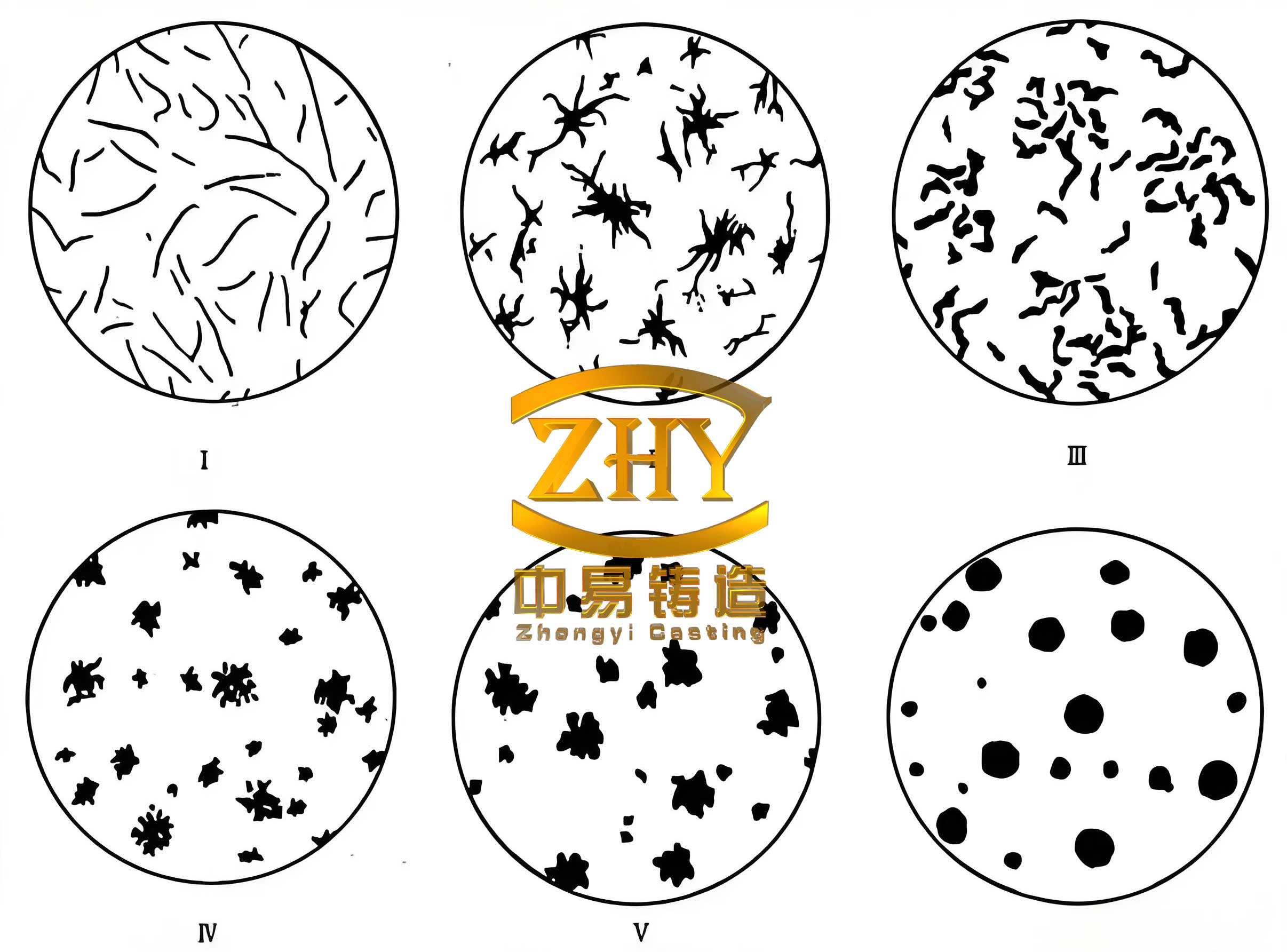
The analysis of graphite morphology provided clear, yet nuanced, evidence of the cooling rate’s influence. The quantitative results for nodule count, average diameter, and nodularity are summarized in Table 2.
| Sample (Grade-Location) | Nodularity (%) | Nodule Count (mm⁻²) | Avg. Diameter (μm) | Graphite Fraction (%) |
|---|---|---|---|---|
| QT500-7 – A | 94 | 299 | 17.4 | 8 |
| QT500-7 – B | 94 | 345 | 16.0 | 8 |
| QT500-7 – C | 91 | 250 | 19.0 | 9 |
| QT550-6 – A | 93 | 308 | 17.2 | 8 |
| QT550-6 – B | 96 | 345 | 15.7 | 7 |
| QT550-6 – C | 92 | 228 | 19.4 | 8 |
The trend from the thickest section C to the thinner ones is consistent with classic theory for spheroidal graphite cast iron: slower cooling in thick section C resulted in the lowest nodule count and the largest average graphite diameter. This can be related to a lower undercooling and fewer active nucleation sites, allowing for greater diffusion-controlled growth of fewer nodules. The relationship between cooling rate $(\dot{T})$ and nodule count $(N_v)$ can be phenomenologically described as:
$$N_v \propto (\dot{T})^n$$
where $n$ is a positive exponent. The significantly higher nodule count in section B compared to section A is a direct consequence of the thermal simulation results. Although section A is thinner, its effective cooling rate was lower (higher temperature), leading to less undercooling and thus fewer nucleation events than in the faster-cooling section B. The final graphite fraction remained relatively constant across all sections, indicating that the total carbon precipitation was largely complete and controlled by the bulk composition and solidification path, not local cooling variations. Nodularity remained high (>90%) in all cases, indicating effective inoculation and spheroidization treatment.
Matrix Structure and the Power of Microsegregation
The matrix microstructure, comprising ferrite and pearlite, showed a more complex behavior that cannot be explained by cooling rate alone. The pearlite content, a primary determinant of hardness and strength, was measured for each sample, as shown in the matrix analysis column of Table 3. The hardness values (HBW) are also included for direct correlation.
| Sample (Grade-Location) | Matrix: Pearlite Content (%) | Matrix: Approx. Ferrite Content (%) | Brinell Hardness (HBW) |
|---|---|---|---|
| QT500-7 – A | 45 | 55 | 183 |
| QT500-7 – B | 25 | 75 | 165 |
| QT500-7 – C | 45 | 55 | 185 |
| QT550-6 – A | 45 | 55 | 205 |
| QT550-6 – B | 35 | 65 | 192 |
| QT550-6 – C | 55 | 45 | 217 |
The data reveals a striking pattern: for both grades of spheroidal graphite cast iron, the pearlite content (and hardness) was lowest in section B, higher in the thinner section A, and highest or equal-highest in the thickest section C. This contradicts a simplistic expectation that slower cooling (thicker sections) should always promote more ferrite. The explanation lies in the potent effect of microsegregation. During the solidification of spheroidal graphite cast iron, alloying elements partition between the solid (austenite) and liquid phases. Elements like Mn, which have a partition coefficient k > 1 (preferentially incorporated into the solid), become depleted in the first-forming solid and enriched in the last-solidifying liquid. This positive segregation leads to a significant local increase in Mn concentration in the inter-nodular regions, which are the last to solidify.
EDS analysis confirmed this phenomenon. Measurements in the pearlitic regions showed that Mn content was highest in sections C and A, and lowest in section B. Conversely, Si, a ferrite promoter, showed an inverse segregation trend. The local Mn concentration $[Mn]_{local}$ can be described by the Scheil-Gulliver equation for non-equilibrium solidification:
$$[Mn]_{local} = k_{Mn} [Mn]_0 (1 – f_s)^{(k_{Mn} – 1)}$$
where $[Mn]_0$ is the nominal concentration, $k_{Mn}$ is the partition coefficient (~1.8 for Mn in Fe-C), and $f_s$ is the solid fraction. This equation predicts substantial enrichment in the final liquid. Since sections C and A experienced the slowest overall solidification times, diffusion in the solid state was less effective at homogenizing this segregation, leaving a stronger local concentration gradient. The enriched Mn in these regions dramatically increases the hardenability of the local austenite, stabilizing pearlite during the subsequent eutectoid transformation, even at relatively slow cooling rates. The transformation kinetics can be modeled by an adapted Johnson-Mehl-Avrami-Kolmogorov (JMAK) equation where the rate constant $k(T)$ is a strong function of local Mn content:
$$X_p(t) = 1 – \exp(-(k(T, [Mn]_{local}) \cdot t)^n)$$
where $X_p$ is the transformed pearlite fraction. A higher $[Mn]_{local}$ increases $k(T)$, shifting the TTT diagram to longer times and allowing more pearlite to form under a given cooling cycle. Thus, the high pearlite content in the slowly-cooled but Mn-enriched sections A and C is a direct result of segregation overpowering the cooling rate effect.
Pearlite Refinement and Micro-Alloying Effects
Further insight was gained from SEM examination of the pearlite colonies. The interlamellar spacing ($\lambda$) of pearlite is a key microstructural parameter influencing strength, following a Hall-Petch type relationship for yield strength $\sigma_y$:
$$\sigma_y \propto \lambda^{-1/2}$$
The measured average interlamellar spacing did not correlate monotonically with wall thickness or cooling rate. Instead, its variation closely followed the local micro-segregation pattern of Si. Si is known to coarsen pearlite by increasing the diffusion rates of carbon. Therefore, in regions where Si was enriched (as indicated by EDS), the pearlite lamellae were found to be coarser, and vice versa. The spacing $\lambda$ is governed by the diffusion-controlled growth and can be approximated for a given undercooling $\Delta T$ below the eutectoid temperature:
$$\lambda \propto \frac{1}{\Delta T}$$
However, the effective undercooling $\Delta T_{eff}$ is chemically modified by local concentrations of Si and Mn. An empirical relationship can be considered:
$$\lambda \approx \frac{K}{(\Delta T + \alpha[Mn]_{local} – \beta[Si]_{local})}$$
where K, $\alpha$, $\beta$ are constants. This explains why the finest pearlite was not necessarily found in the fastest-cooled section B, but rather in sections where the [Mn]/[Si] ratio was most favorable for refinement. This underscores that in alloyed spheroidal graphite cast iron, even nanoscale microstructural features are dictated by the synergy of thermal and chemical history.
Synthesis: The Constitutive Model of Property Gradients
The investigation conclusively demonstrates that wall thickness in a complex spheroidal graphite cast iron casting is not the direct independent variable controlling microstructure. It is a geometric parameter that influences two primary physical phenomena: 1) Local Cooling Rate and 2) Severity of Microsegregation. These two phenomena, often interacting, are the true directors of the microstructural symphony.
The local hardness, a proxy for strength, emerges as a function of these factors. A constitutive model summarizing the findings can be proposed:
$$HBW = f( V_{pearlite}, \lambda^{-1/2}, N_v, d_{graphite}^{-1} )$$
Where:
- $V_{pearlite}$ is the volume fraction of pearlite, governed by: $V_{pearlite} \approx g(\dot{T}, [Mn]_{local}, [Si]_{local})$.
- $\lambda$ is the pearlite interlamellar spacing, governed by: $\lambda \approx h(\dot{T}, [Si]_{local}, [Mn]_{local})$.
- $N_v$ is the graphite nodule count, governed by: $N_v \approx j(\dot{T}_{nucleation})$.
- $d_{graphite}$ is the average graphite diameter.
And critically:
$$\dot{T} = \Phi(Geometry, Thermal Boundary Conditions)$$
$$[Mn]_{local}, [Si]_{local} = \Psi([X]_0, k_X, \dot{T}_{solidification}, Diffusion)$$
In the studied brake caliper:
- Section B, with moderate thickness but the fastest effective cooling, developed the highest nodule count, finest graphite, but the lowest pearlite content due to less time for segregation and a higher driving force for ferrite formation. This resulted in the lowest hardness.
- Section A, thinner but slower-cooling due to thermal mass connection, had a lower nodule count and slightly coarser graphite than B. However, its slow solidification allowed significant Mn segregation, leading to high pearlite content and higher hardness.
- Section C, the thickest and slowest-cooling, exhibited the largest graphite and lowest nodule count. Its very slow solidification maximized Mn segregation, leading to the highest pearlite content and hardness in the QT550-6 grade.
Conclusion
This first-principles analysis elucidates the fundamental mechanisms behind microstructure and property gradients in spheroidal graphite cast iron components with varying wall thickness. The key conclusions are:
- The microstructure and hardness of spheroidal graphite cast iron across different sections are not determined by nominal wall thickness alone, but by the resultant local cooling rate and the extent of microsegregation of key alloying elements like Mn and Si.
- Cooling rate primarily governs graphite morphology (nodule count and size) and provides the baseline condition for matrix transformation. However, microsegregation can decisively override the expected matrix structure, with Mn enrichment in slowly-solidified regions stabilizing pearlite even under slow cooling conditions.
- In complex castings like brake calipers, thermal connections can cause thinner sections to cool slower than isolated thicker ones, inverting simple thickness-property predictions for graphite characteristics.
- Pearlite refinement (interlamellar spacing) is also co-modulated by cooling rate and micro-segregation, particularly of Si, which tends to coarsen the lamellar structure.
- Therefore, accurate prediction and control of properties in critical spheroidal graphite cast iron components require integrated modeling that couples macroscopic solidification thermal analysis with microscopic segregation and transformation kinetics. This holistic understanding is essential for advancing the quality, performance, and reliability of automotive safety-critical components manufactured from spheroidal graphite cast iron.