
The pursuit of quieter and more cost-effective gear systems is a persistent challenge in mechanical engineering, particularly in demanding applications like railway traction. Conventional approaches to reducing gear mesh vibration and noise, such as sophisticated profile modifications, often lead to increased manufacturing complexity and cost. This work explores an alternative pathway: leveraging the inherent material properties of high-strength spheroidal graphite cast iron to achieve noise reduction without extensive tooth form corrections. The core hypothesis is that the superior vibration damping and excellent meshing characteristics of this material can intrinsically suppress gear vibration. However, for practical application, especially in high-load environments, the material must achieve a durability comparable to traditional gear steels. This investigation details how the addition of specific alloying elements combined with controlled gas nitriding enhances the surface durability of high-strength spheroidal graphite cast iron, ultimately presenting a viable, low-noise gear solution. The discussion encompasses the fundamental metallurgy, the resulting fatigue strength, and the empirical noise performance of full-scale nitrided gears.
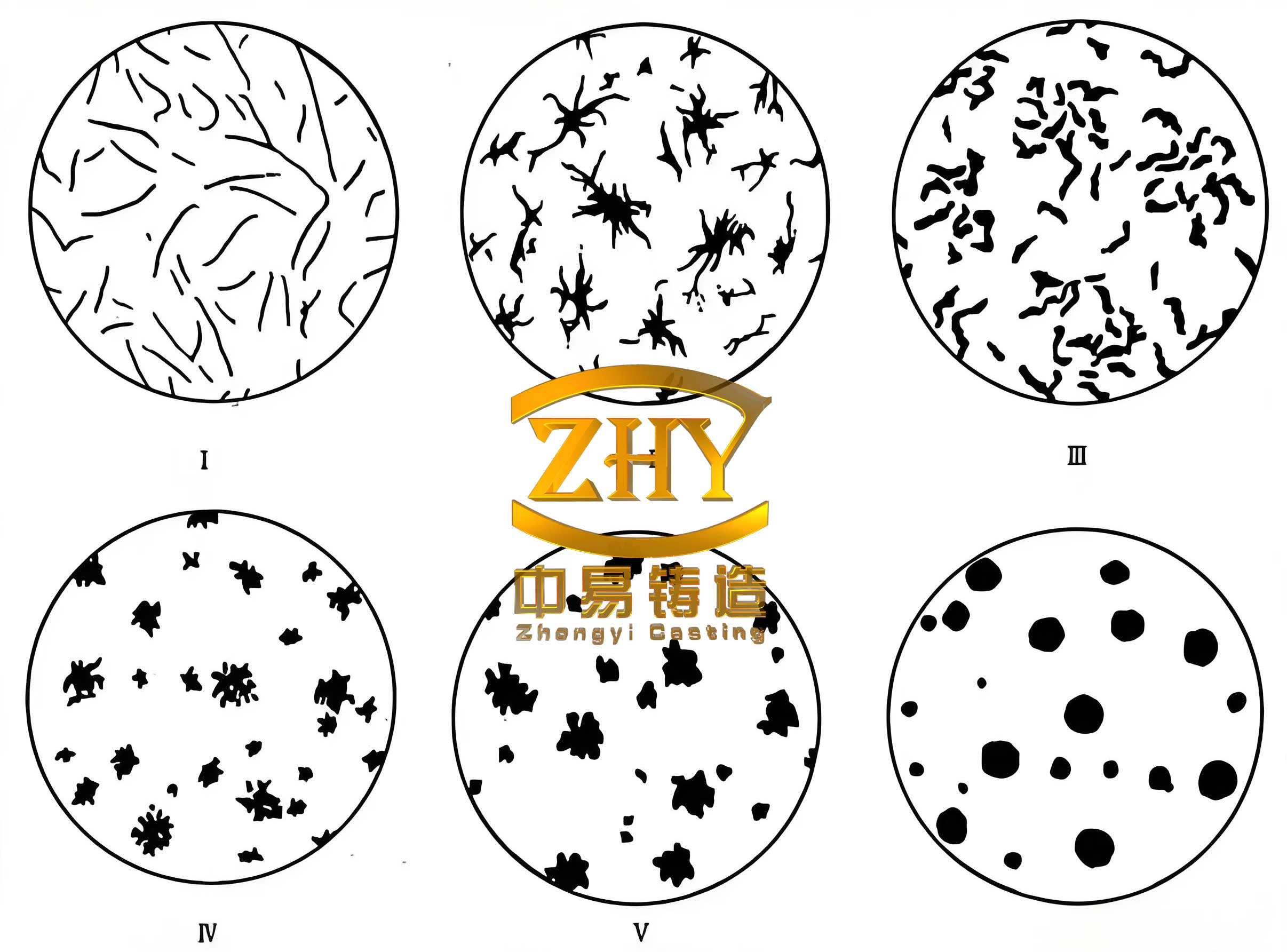
1. Microstructure and Alloying Strategy of High-Strength Spheroidal Graphite Cast Iron
The foundation of this research is a grade of high-strength spheroidal graphite cast iron with a tensile strength of approximately 900 MPa. The efficacy of spheroidal graphite cast iron stems from its unique microstructure, where the graphite exists in a spherical form rather than the flake form found in gray cast iron. This spheroidal morphology drastically reduces the stress-concentration effect of the graphite particles, granting the material much higher strength, ductility, and toughness. The matrix microstructure surrounding these graphite nodules is critical for performance. In the specific alloy studied, the matrix is primarily pearlitic. To enhance the strength of this matrix, particularly in the critical zone around the graphite nodules where fatigue cracks often initiate, copper (Cu) is added at approximately 3 wt.%. Copper is a potent pearlite promoter and solid-solution strengthener. Its strategic concentration in the areas adjacent to the graphite nodules serves to fortify these potentially weak interfaces, thereby raising the overall fatigue resistance of the spheroidal graphite cast iron component.
2. Gas Nitriding: Process and Resulting Surface Layer Architecture
Surface hardening is essential for gears to withstand high contact stresses. Among various thermochemical treatments, nitriding offers distinct advantages for spheroidal graphite cast iron gears. Conducted at temperatures below the eutectoid transformation point (typically 500-580°C), nitriding induces minimal distortion compared to processes like carburizing or induction hardening. This is crucial for maintaining gear accuracy and minimizing runout, which are direct contributors to vibration and noise.
Several nitriding methods exist, including salt bath, plasma (ion), and gas nitriding. This work focuses on gas nitriding using ammonia (NH₃) atmospheres. The process involves the diffusion of nitrogen atoms into the ferritic matrix of the spheroidal graphite cast iron, leading to the formation of a complex surface layer. The architecture of this nitrided case, as revealed by microscopy, consists of two distinct zones:
- Compound Layer (White Layer): The outermost layer, with a thickness of about 10 µm, is composed of iron nitrides. A key finding for nitrided spheroidal graphite cast iron is the predominant formation of the γ’-Fe₄N phase (gamma prime), as opposed to the ε-Fe₂₋₃N phase commonly observed in nitrided steels. The γ’ phase is known for its better stability and combination of hardness and toughness, which is more favorable for improving fatigue strength under rolling-contact conditions.
- Diffusion Zone: Beneath the compound layer, nitrogen atoms diffuse into the α-Fe matrix, forming a solid solution and very fine alloy nitrides (especially with elements like Mo and V). This region, extending up to approximately 200 µm deep, exhibits a significant increase in hardness. The strengthening in this zone is due to solid solution hardening and precipitation hardening from these finely dispersed nitrides.
The hardness profile as a function of depth is a critical performance metric. For spheroidal graphite cast iron, the optimal gas nitriding temperature was identified as 540°C. The resulting surface hardness can reach upwards of 600 HV in the diffusion zone. However, a fundamental characteristic of nitriding is its relatively shallow case depth compared to carburizing. In gear applications, the maximum shear stress ($\tau_{max}$) due to surface contact pressure occurs at a subsurface depth ($z_{max}$), which can be approximated for Hertzian contact by:
$$ z_{max} \approx 0.5b $$
where $b$ is the semi-width of the contact patch. For typical railway gear geometries, $z_{max}$ often lies between 0.3 and 0.5 mm beneath the surface. This depth is frequently beyond the deep case region of a standard nitrided layer. Therefore, to prevent subsurface-originated pitting fatigue, it is imperative not only to achieve a deep and hard nitrided case but also to elevate the core hardness of the spheroidal graphite cast iron itself.
3. Alloying for Enhanced Nitriding Response and Core Strength
To address the challenge of achieving sufficient hardening depth and core strength within economically viable nitriding cycle times, alloying elements are added to the base spheroidal graphite cast iron. Traditional strong nitride formers like aluminum (Al) and chromium (Cr) are generally avoided in castings due to their tendency to promote casting defects such as shrinkage porosity. Instead, molybdenum (Mo) and vanadium (V) were selected as effective alternatives. These elements have a high affinity for nitrogen and promote the formation of fine, stable nitride precipitates during nitriding, significantly enhancing hardness. Furthermore, they contribute to solid solution strengthening of the ferritic/pearlitic matrix.
The effect is quantified in the table below, comparing hardness profiles under different conditions:
| Material Condition | Nitriding Parameters | Surface Hardness (HV) | Effective Case Depth* (mm) | Core Hardness (HV) |
|---|---|---|---|---|
| Base Spheroidal Graphite Cast Iron | 540°C, 50 h | ~650 | ~0.20 | ~280 |
| Mo/V-alloyed Spheroidal Graphite Cast Iron | 540°C, 20 h | >700 | >0.25 | ~320 |
*Depth to 50 HV above core hardness.
The data clearly shows that the addition of just 0.4% Mo and 0.1% V enables a superior hardness profile to be achieved in a 20-hour cycle compared to a 50-hour cycle for the unalloyed material. This translates directly to reduced processing costs and improved productivity. The elevated core hardness provided by these alloying elements is crucial for supporting the hard nitrided case and resisting the subsurface shear stresses that drive pitting fatigue.
4. Fatigue Strength Evaluation: Bending and Contact
The rotating bending fatigue test provides a fundamental measure of a material’s resistance to crack initiation under cyclic stress. Testing was conducted according to standard methods, with results summarized below for common gear materials and the developed spheroidal graphite cast iron.
| Material & Condition | Fatigue Limit at 10⁷ cycles (MPa) | Normalized Strength Ratio |
|---|---|---|
| SNCM420 (Carburized Steel – Pinion Ref.) | 580 | 1.00 |
| S45C (Induction Hardened Steel – Gear Ref.) | 620 | 1.07 |
| Spheroidal Graphite Cast Iron (As-Cast) | 400 | 0.69 |
| Spheroidal Graphite Cast Iron (Gas Nitrided, 540°C/20h) | >650 | >1.12 |
The as-cast spheroidal graphite cast iron falls short of the target 600 MPa required for railway gears. However, after gas nitriding, the fatigue limit surpasses that of the reference gear steels. The enhancement can be attributed to the compressive residual stresses introduced by the volume expansion associated with nitride formation in the case layer, combined with the increased surface hardness. The fatigue life ($N_f$) under alternating stress ($\sigma_a$) can be modeled by a Basquin-type equation for the high-cycle regime:
$$ \sigma_a = \sigma_f’ (2N_f)^b $$
where $\sigma_f’$ is the fatigue strength coefficient and $b$ is the fatigue strength exponent. Nitriding significantly increases the effective $\sigma_f’$ for the spheroidal graphite cast iron by altering the surface condition and stress state.
For contact fatigue (pitting), the key parameter is the permissible contact stress. According to the Hertzian theory, the maximum contact pressure ($p_0$) for two cylinders in contact is:
$$ p_0 = \sqrt{\frac{F E^*}{\pi R^* L}} $$
where $F$ is the normal load, $L$ is the contact length, $E^*$ is the equivalent Young’s modulus, and $R^*$ is the equivalent radius of curvature. The nitrided case on spheroidal graphite cast iron must withstand this repeated pressure without yielding or initiating pits. The hardened case and the supportive alloyed core work in tandem to increase the limiting $p_0$ for pitting failure.
5. Manufacturing and Application in Full-Scale Gears
The practical application involved manufacturing a helical bull gear for an existing railway vehicle using the Mo-alloyed spheroidal graphite cast iron. The gear design retained the low-noise tooth profile of the original component but substituted the material. A critical aspect of using spheroidal graphite cast iron for critical components is managing casting defects. Numerical solidification simulation was employed to predict areas prone to shrinkage porosity, particularly in thick sections like the gear hub. The casting process was meticulously designed based on this analysis, and subsequent non-destructive testing (e.g., liquid penetrant inspection) confirmed the absence of significant defects in the machined stock.
A significant cost-benefit analysis stems from the manufacturing process flow. The inherent machinability of pearlitic spheroidal graphite cast iron in the as-cast state is excellent, leading to extended tool life during gear hobbing compared to harder steels. Furthermore, the minimal distortion from nitriding allows for the omission of the final profile grinding operation that is mandatory after distortion-prone processes like carburizing. The comparative process chain is stark:
| Process Step | Traditional Steel Gear (e.g., S45C) | Nitrided Spheroidal Graphite Cast Iron Gear |
|---|---|---|
| 1. Blank Forging/Machining | Required | Replaced by Casting |
| 2. Rough Machining | Required | Required |
| 3. Gear Hobbing | Required (Moderate tool life) | Required (Superior tool life) |
| 4. Heat Treatment | Induction Hardening | Gas Nitriding | 5. Distortion Correction | Often Required | Minimal, Often Not Required |
| 6. Final Gear Grinding | Mandatory | Omitted |
| Total Cost & Complexity | Higher | Significantly Lower |
This streamlined process offers a compelling route for cost reduction while maintaining performance.
6. Performance Evaluation: Noise and Durability Testing
A definitive test involved running the nitrided spheroidal graphite cast iron bull gear in a back-to-back gear test rig with a standard carburized steel pinion. The lubricant was a standard railway gear oil. The evaluation focused on two key aspects: noise generation and surface durability.
Noise Performance: The run-in behavior of the gears was monitored. Interestingly, the unground tooth flanks of the nitrided spheroidal graphite cast iron gear showed excellent run-in characteristics. The surface roughness ($R_a$) improved from an initial 1.0 µm to approximately 0.6 µm after repeated test cycles, indicating a favorable mating process with the steel pinion. The steady-state noise level during acceleration runs was compared against benchmarks:
- Reference Gear: Low-noise S45C steel gear (induction hardened and profile ground).
- Test Gear 1: Nitrided Spheroidal Graphite Cast Iron gear (unground after nitriding).
- Test Gear 2: As-cast Spheroidal Graphite Cast Iron gear (no nitriding, unground).
The nitrided spheroidal graphite cast iron gear, despite its unground state, produced an average noise level approximately 2 dB lower than the finely ground reference steel gear. This is attributed to the combined effect of the material’s damping capacity and the geometrically stable, hard nitrided surface. Remarkably, the non-nitrided as-cast spheroidal graphite cast iron gear showed an even greater noise reduction (5-6 dB lower), highlighting the profound damping effect of the base material, albeit at the expense of durability. This indicates a future optimization challenge: to preserve as much of the inherent damping of spheroidal graphite cast iron as possible while achieving the necessary surface strength through nitriding.
Durability Performance: Following the noise tests, the nitrided spheroidal graphite cast iron gear was subjected to an extended endurance run under high load (≥90% of rated torque) for about 300 hours. Post-test inspection revealed no signs of pitting, spalling, or other contact fatigue damage on the tooth flanks. The contact pattern was uniform across the full face width and profile, with no evidence of edge loading or abnormal wear. This confirms that the nitrided case, supported by the alloyed core, provided sufficient contact fatigue resistance for the application. The final surface roughness of 0.6 µm, while not as fine as a ground surface (typically ~0.3 µm), was deemed acceptable and stable under load.
7. Conclusions and Future Perspectives
This comprehensive study demonstrates the strong potential of alloyed and gas-nitrided high-strength spheroidal graphite cast iron as a material for durable, low-noise gears. The key conclusions are:
- The vibration damping capacity of spheroidal graphite cast iron provides a material-inherent method for reducing gear mesh noise, potentially reducing reliance on expensive precision grinding for noise control.
- Strategic alloying with elements like Mo and V enhances both the core strength and the nitriding response of spheroidal graphite cast iron, allowing for the development of a deep, hard case with excellent fatigue properties in commercially viable cycle times.
- The nitriding process itself, due to its low distortion, enables significant simplification of the gear manufacturing chain by often eliminating the final grinding step, leading to substantial cost savings.
- Full-scale gear tests confirm that nitrided spheroidal graphite cast iron gears can meet the durability requirements of demanding applications like railway traction while simultaneously achieving lower operational noise levels compared to traditional hardened and ground steel gears.
The path to widespread commercialization involves addressing several key challenges. Further optimization of the nitriding process is needed to minimize any potential embrittlement of the compound layer and to better preserve the base material’s damping characteristics. Precision casting techniques and rigorous quality control are paramount to ensure the consistent absence of defects in critical gear blanks. Finally, advancing the machining technology for spheroidal graphite cast iron, particularly in the pre-nitrided state, can further improve gear accuracy and potentially push noise levels even closer to those achieved by the un-nitrided material. The synergy between the unique properties of spheroidal graphite cast iron and modern thermochemical treatment presents a promising avenue for next-generation, cost-effective, and quiet gear drives.