
In the field of advanced metallic materials, spheroidal graphite cast iron, particularly when subjected to austempering heat treatment to form austempered ductile iron (ADI), has garnered significant attention due to its exceptional combination of high strength, toughness, and wear resistance. As a researcher engaged in the study of ferrous alloys, I have conducted a comprehensive investigation into how varying austempering parameters influence the microstructure, mechanical properties, and tribological behavior of spheroidal graphite cast iron. This article presents my findings in detail, employing numerous tables and mathematical formulations to summarize key data and relationships, with the aim of providing deeper insights into the optimization of this material for demanding applications such as gears, crankshafts, and wear-resistant components.
The fundamental advantage of spheroidal graphite cast iron lies in its unique graphite morphology, which imparts improved ductility and fracture resistance compared to other cast irons. When this material undergoes an austempering process—involving austenitizing followed by rapid quenching to a specific temperature range for isothermal transformation—it develops a matrix consisting of bainitic ferrite and retained austenite. This microstructure, characteristic of ADI, is responsible for its superior performance. My research focuses on the austempering temperature as a critical variable, exploring its effects within the range of 290°C to 380°C while holding other parameters constant. The choice of this range is based on its relevance to industrial practices and the transition from lower to upper bainitic structures in spheroidal graphite cast iron.
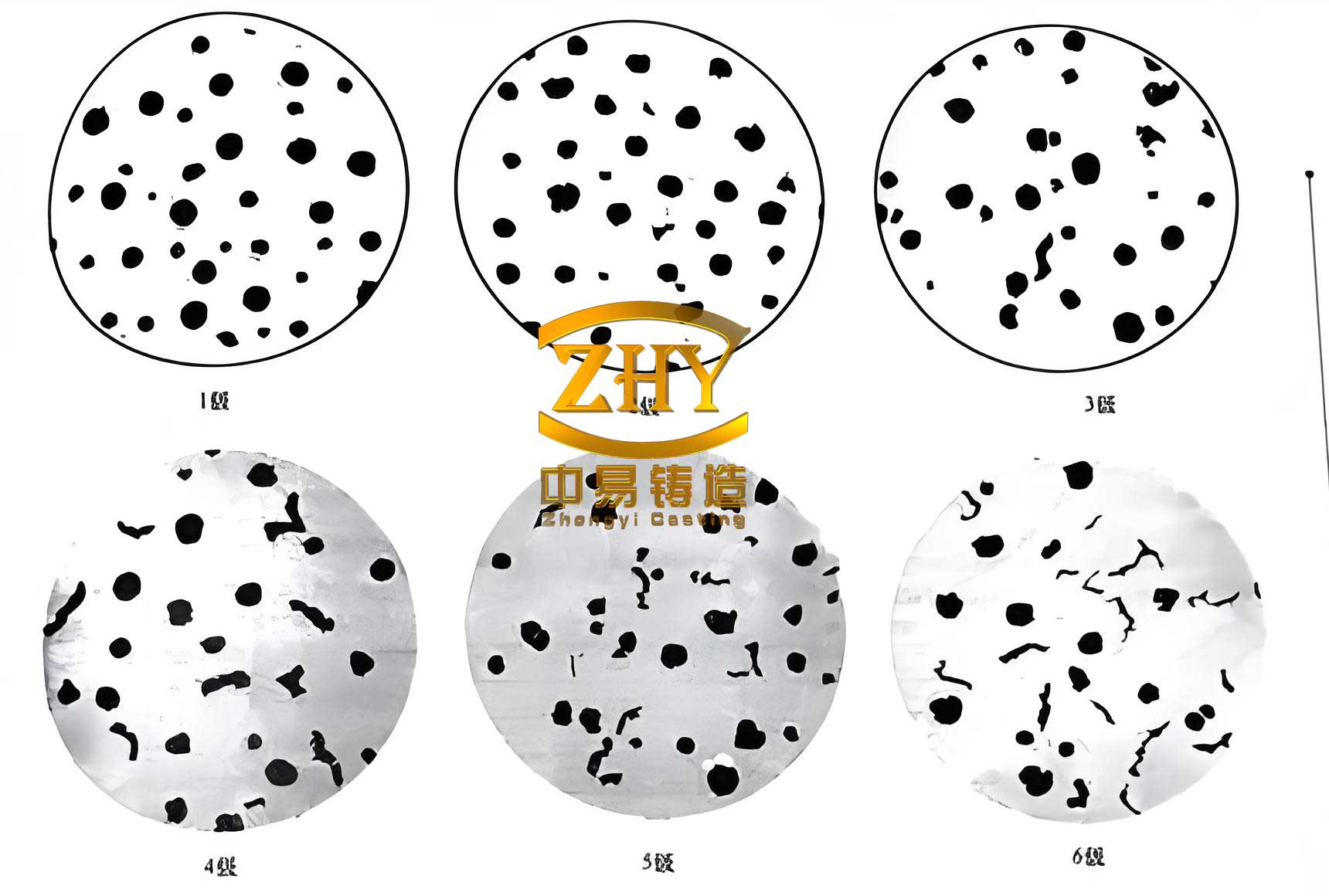
To lay the groundwork, the chemical composition of the spheroidal graphite cast iron used in this study is detailed in Table 1. This composition was carefully formulated to ensure consistent graphite nodularity and matrix response during heat treatment. The presence of elements like silicon and copper enhances the austemperability and strength of the spheroidal graphite cast iron, while molybdenum contributes to hardenability and refinement of the microstructure.
| Element | C | Si | Mn | Cu | S | Mg | P | Mo | Fe |
|---|---|---|---|---|---|---|---|---|---|
| Content | 3.6 | 2.4 | 0.4 | 0.8 | 0.015 | 0.04 | 0.05 | 0.1 | Bal. |
The heat treatment protocol commenced with austenitizing at 900°C for 90 minutes to achieve a homogeneous austenitic structure in the spheroidal graphite cast iron. Subsequently, the specimens were rapidly transferred to a salt bath furnace for isothermal transformation. The austempering temperatures selected were 290°C, 320°C, 350°C, and 380°C, each maintained for 90 minutes before air cooling. This process is schematically represented and can be described by the following kinetic equation for bainitic transformation in spheroidal graphite cast iron:
$$ \frac{dX}{dt} = k(T) \cdot (1 – X)^n $$
where \( X \) is the transformed fraction, \( t \) is time, \( k(T) \) is a temperature-dependent rate constant, and \( n \) is the Avrami exponent. For spheroidal graphite cast iron, the transformation kinetics are influenced by the prior austenite grain size and alloying elements.
Wear testing was performed using a pin-on-disk configuration under a load of 150 N, a rotational speed of 200 rpm, and a duration of 3600 seconds. The wear rate, a critical metric for assessing the durability of spheroidal graphite cast iron, was calculated using the formula:
$$ \nu = \frac{m_2 – m_1}{l} $$
Here, \( \nu \) denotes the wear rate in mg/m, \( m_1 \) and \( m_2 \) are the masses before and after testing in mg, and \( l \) is the total sliding distance in meters. This formula encapsulates the material loss per unit distance, providing a quantitative measure of wear resistance for the spheroidal graphite cast iron.
Microstructural analysis involved optical microscopy and X-ray diffraction (XRD). The volume fraction of retained austenite in the spheroidal graphite cast iron was determined using the direct comparison method from XRD patterns, focusing on the γ(220) and α(200) peaks. The relationship between integrated intensities and phase fractions is given by:
$$ V_\gamma = \frac{\frac{I_\gamma}{R_\gamma}}{\frac{I_\gamma}{R_\gamma} + \frac{I_\alpha}{R_\alpha}} $$
where \( V_\gamma \) is the volume fraction of retained austenite, \( I_\gamma \) and \( I_\alpha \) are the integrated intensities of austenite and ferrite peaks, respectively, and \( R_\gamma \) and \( R_\alpha \) are the corresponding scattering factors. This calculation is essential for correlating microstructure with properties in spheroidal graphite cast iron.
The mechanical properties, particularly hardness, were measured using a Vickers hardness tester under a load of 980 N. The hardness values reflect the composite effect of bainitic ferrite and retained austenite in the spheroidal graphite cast iron. To systematize the data, Table 2 summarizes the key parameters and outcomes for each austempering condition.
| Austempering Temperature (°C) | Microstructure Description | Retained Austenite Content (%) | Hardness (HV100) | Wear Rate (×10-3 mg/m) | Steady-State Friction Coefficient (μ) |
|---|---|---|---|---|---|
| 290 | Fine acicular lower bainite with少量 retained austenite | 26.4 | 435.6 | 2.64 | 0.806 |
| 320 | Coarser bainite with increased retained austenite | 30.1 | 385.2 | 2.89 | 0.711 |
| 350 | Feathery upper bainite with significant retained austenite | 34.8 | 332.7 | 3.12 | 0.698 |
| 380 | Coarse upper bainite with high retained austenite | 38.6 | 288.1 | 3.34 | 0.672 |
As evident from Table 2, increasing the austempering temperature leads to a systematic coarsening of the bainitic structure and a rise in retained austenite content in the spheroidal graphite cast iron. This microstructural evolution directly impacts mechanical and tribological behaviors. The hardness decrease can be modeled by an empirical relationship:
$$ H = H_0 \cdot \exp\left(-\frac{Q}{RT}\right) $$
where \( H \) is hardness, \( H_0 \) is a pre-exponential factor, \( Q \) is an activation energy related to phase softening, \( R \) is the gas constant, and \( T \) is the absolute austempering temperature. For spheroidal graphite cast iron, this reflects the diminishing strength of bainitic ferrite and the increasing proportion of softer retained austenite at higher temperatures.
The wear resistance of spheroidal graphite cast iron, quantified by the wear rate, exhibits an inverse correlation with hardness. This relationship can be expressed through a modified Archard wear equation:
$$ \nu = K \cdot \frac{F_N}{H} $$
Here, \( K \) is a wear coefficient specific to the material pair, \( F_N \) is the normal load, and \( H \) is hardness. For spheroidal graphite cast iron under sliding conditions, \( K \) may vary with microstructure, but the inverse proportionality to hardness generally holds. My data confirms that as hardness declines from 435.6 HV at 290°C to 288.1 HV at 380°C, the wear rate increases from 2.64×10⁻³ mg/m to 3.34×10⁻³ mg/m. This underscores the critical role of matrix hardness in determining the wear performance of spheroidal graphite cast iron.
Furthermore, the friction behavior of spheroidal graphite cast iron during sliding wear tests reveals interesting trends. The steady-state friction coefficient decreases with rising austempering temperature, as shown in Table 2. This phenomenon can be attributed to two factors: first, the reduced hardness of the spheroidal graphite cast iron at higher temperatures facilitates greater plastic deformation, leading to a larger real area of contact and potentially lower shear stress; second, the enhanced graphite exposure and smearing on the wear surface act as a solid lubricant. The friction coefficient \( \mu \) can be related to material properties via:
$$ \mu = \frac{\tau}{p} $$
where \( \tau \) is the shear strength of the interfacial layer and \( p \) is the contact pressure. For spheroidal graphite cast iron, the presence of graphite lowers \( \tau \), thereby reducing \( \mu \). The gradual decrease from 0.806 to 0.672 aligns with increased graphite availability due to more pronounced matrix softening at higher austempering temperatures.
A pivotal aspect of this study is the phase transformation occurring on the wear surface of spheroidal graphite cast iron. XRD analysis before and after wear testing indicates a substantial reduction in retained austenite peaks post-wear, suggesting strain-induced transformation to martensite. This transformation enhances surface hardness through work-hardening, which can be quantified by the increase in hardness measured on worn surfaces. Table 3 compares the hardness values before and after wear for each austempering condition, highlighting the hardening effect.
| Austempering Temperature (°C) | Initial Hardness (HV100) | Hardness After Wear (HV100) | Hardness Increase (ΔHV) |
|---|---|---|---|
| 290 | 435.6 | 458.3 | 22.7 |
| 320 | 385.2 | 415.8 | 30.6 |
| 350 | 332.7 | 378.5 | 45.8 |
| 380 | 288.1 | 349.2 | 61.1 |
The data in Table 3 demonstrates that the hardness increase after wear is more pronounced at higher austempering temperatures. This is because spheroidal graphite cast iron with greater initial retained austenite content undergoes more extensive martensitic transformation under applied stress, following the thermodynamic condition:
$$ \Delta G_{\gamma \to \alpha’} = \Delta G_{\text{chem}} + \Delta G_{\text{mech}} $$
where \( \Delta G_{\gamma \to \alpha’} \) is the total Gibbs free energy change for transformation, \( \Delta G_{\text{chem}} \) is the chemical driving force, and \( \Delta G_{\text{mech}} \) is the mechanical driving force provided by deformation. In spheroidal graphite cast iron, the higher retained austenite levels at elevated austempering temperatures make the material more susceptible to this beneficial transformation, thereby improving near-surface wear resistance despite the lower bulk hardness.
To delve deeper into wear mechanisms, scanning electron microscopy (SEM) examination of wear surfaces was conducted. The observed features vary with austempering temperature, indicating distinct dominant wear modes for spheroidal graphite cast iron. At 290°C and 320°C, the wear surfaces are relatively smooth with shallow grooves and evidence of oxidative layers. Energy-dispersive spectroscopy (EDS) points to elevated oxygen content, confirming oxidative wear. The wear rate at these temperatures can be partially modeled considering oxidation kinetics:
$$ \frac{dh}{dt} = k_p \cdot \exp\left(-\frac{E_a}{RT_s}\right) $$
where \( dh/dt \) is the oxidation-induced thickness loss rate, \( k_p \) is a parabolic rate constant, \( E_a \) is activation energy for oxidation, and \( T_s \) is the flash temperature at the sliding interface. For spheroidal graphite cast iron, the combination of micro-cutting and oxidative wear dominates at lower austempering temperatures.
At 350°C, the wear surface shows deeper ploughing grooves and minor oxidative patches, indicating a shift towards abrasive wear mechanisms. The wear volume \( V \) due to ploughing can be estimated using:
$$ V = \frac{F_N \cdot L}{H} \cdot \tan \theta $$
where \( L \) is sliding distance and \( \theta \) is the effective attack angle of abrasive particles. The increased groove depth in spheroidal graphite cast iron at this temperature correlates with reduced matrix hardness.
At 380°C, the wear surface exhibits severe plastic deformation, fatigue cracks, and material delamination, characteristic of surface fatigue wear. This mechanism involves cyclic loading leading to subsurface crack initiation and propagation, described by fracture mechanics:
$$ \frac{da}{dN} = C (\Delta K)^m $$
Here, \( da/dN \) is crack growth rate per cycle, \( \Delta K \) is the stress intensity factor range, and \( C \) and \( m \) are material constants. The softer matrix of spheroidal graphite cast iron at high austempering temperatures promotes greater plastic strain accumulation, accelerating fatigue wear.
The transition in wear mechanisms with austempering temperature is summarized in Table 4, which links microstructural features to dominant wear modes for spheroidal graphite cast iron.
| Austempering Temperature Range (°C) | Primary Microstructure | Dominant Wear Mechanism(s) | Key Characteristics |
|---|---|---|---|
| 290 – 320 | Fine acicular lower bainite with moderate retained austenite | Micro-cutting and oxidative wear | Smooth surfaces, oxide layers, shallow grooves |
| 350 | Coarser bainite with high retained austenite | Abrasive ploughing with minor oxidation | Deep grooves, limited oxidation, chip formation |
| 380 | Coarse upper bainite with very high retained austenite | Surface fatigue and ploughing | Delamination, cracks, severe plastic deformation |
From an application standpoint, the optimal austempering condition for spheroidal graphite cast iron depends on the specific service requirements. For components subjected to high-stress abrasion, lower austempering temperatures (e.g., 290-320°C) are preferable due to higher hardness and superior wear resistance. In contrast, applications involving impact or requiring some toughness might benefit from higher temperatures, albeit with compromised wear performance. The balance between hardness, retained austenite, and wear mechanism is crucial for designing spheroidal graphite cast iron parts.
In conclusion, my investigation elucidates the profound influence of austempering temperature on the microstructure and wear properties of spheroidal graphite cast iron. Through systematic experimentation and analysis, I have demonstrated that increasing the austempering temperature from 290°C to 380°C leads to coarsening of bainitic structures, elevation of retained austenite content, reduction in hardness, and an increase in wear rate. The friction coefficient decreases correspondingly, aided by graphite lubrication. Moreover, wear mechanisms evolve from micro-cutting and oxidation at lower temperatures to abrasive ploughing and eventually surface fatigue at higher temperatures. The strain-induced martensitic transformation on wear surfaces enhances hardness, particularly in specimens with higher initial retained austenite. These findings underscore the importance of precise heat treatment control in tailoring the performance of spheroidal graphite cast iron for diverse engineering applications. Future work could explore the effects of alloying additions or varying austempering times to further optimize the wear resistance of this versatile material.
To encapsulate the relationships mathematically, the overall wear behavior of spheroidal graphite cast iron can be represented by a composite model incorporating multiple mechanisms:
$$ \nu_{\text{total}} = \nu_{\text{cutting}} + \nu_{\text{oxidation}} + \nu_{\text{abrasion}} + \nu_{\text{fatigue}} $$
where each component depends on microstructure parameters such as bainite morphology, retained austenite fraction \( V_\gamma \), and hardness \( H \). For instance,
$$ \nu_{\text{cutting}} \propto \frac{1}{H^{1.5}}, \quad \nu_{\text{oxidation}} \propto \exp(-\beta H), \quad \nu_{\text{abrasion}} \propto \frac{1}{H}, \quad \nu_{\text{fatigue}} \propto V_\gamma \cdot \sigma^{m’} $$
with \( \beta \) and \( m’ \) as constants, and \( \sigma \) as applied stress. Such models, derived from empirical data on spheroidal graphite cast iron, can guide predictive maintenance and material selection in industrial settings.
In summary, spheroidal graphite cast iron, when properly austempered, offers a remarkable combination of properties. By manipulating the austempering temperature, engineers can fine-tune the microstructure to achieve desired wear resistance and mechanical performance. This study contributes to the broader understanding of spheroidal graphite cast iron and its applications, reinforcing its status as a high-potential material for the 21st century.