
The pursuit of high strength and toughness in as-cast spheroidal graphite cast iron remains a focal point in materials engineering. A critical pathway towards this goal involves the precise control of the pearlitic matrix, specifically by refining its interlamellar spacing. Within the pearlite structure, cementite (Fe3C) serves as the key strengthening phase, and its nucleation and growth mechanisms directly govern the final microstructural characteristics. It has been established that strategies aimed at reducing the interfacial energy of Fe3C can effectively refine the pearlite and enhance mechanical properties. In this context, silicon carbide (SiC) has long been utilized as a pretreatment agent in the foundry practice for spheroidal graphite cast iron, primarily noted for its beneficial effects on graphite morphology. However, the underlying mechanism by which SiC particles influence the pearlitic matrix, particularly their potential role as heterogeneous nucleation sites for Fe3C, has not been thoroughly elucidated, representing a significant gap in the current understanding.
Therefore, this work systematically investigates the regulatory mechanism of SiC pretreatment on the microstructure and properties of spheroidal graphite cast iron through an integrated approach combining first-principles density functional theory (DFT) calculations and experimental validation. The core objective is to reveal the atomic-scale interaction between SiC and Fe3C, establishing the thermodynamic and structural basis for heterogeneous nucleation, and to correlate these findings with the observed macroscopic mechanical performance. By bridging this fundamental knowledge gap, this research aims to provide a robust theoretical foundation and an optimized process guideline for achieving high-performance as-cast spheroidal graphite cast iron.
1. Theoretical Framework and Computational Methodology
Theoretical investigations were conducted using the Vienna Ab initio Simulation Package (VASP) employing the Perdew-Burke-Ernzerhof (PBE) formulation of the generalized gradient approximation (GGA) and the projector augmented-wave (PAW) method. Calculations encompassed bulk, surface, and interfacial properties of both Fe3C and SiC. Stringent convergence criteria were applied: energy change per atom less than $1 \times 10^{-5}$ eV, atomic forces below 0.3 eV/nm, and displacement below $1 \times 10^{-4}$ nm. For bulk structure optimization, a plane-wave energy cutoff ($E_{cut}$) of 360 eV and a k-point mesh of $8 \times 8 \times 8$ were used. Surface and interface calculations employed a $8 \times 8 \times 1$ k-mesh with the same energy cutoff.
1.1. Bulk Properties and Electronic Structure
The optimized crystal structures are shown below. Fe3C crystallizes in an orthorhombic structure (space group Pnma), while SiC has a face-centered cubic (fcc) structure (space group Fm$\bar{3}$m). Their lattice parameters after optimization are summarized in Table 1.
| Phase | Crystal System | Space Group | Optimized Lattice Parameters (nm) |
|---|---|---|---|
| Fe3C | Orthorhombic | Pnma | $a = 0.504$, $b = 0.670$, $c = 0.448$ |
| SiC | Cubic (fcc) | Fm$\bar{3}$m | $a = b = c = 0.437$ |
Analysis of the electronic density of states (DOS) provides insight into the bonding nature. For SiC, the total DOS (TDOS) near the Fermi level ($E_F$) is nearly zero, and a significant band gap is observed, confirming its wide-bandgap semiconductor character. The partial DOS (PDOS) reveals strong hybridization between Si-p and C-p orbitals in the energy range of -7 to 12 eV, indicative of dominant covalent bonding.
$$ \text{DOS}_{SiC}(E_F) \approx 0 $$
In contrast, the band structure and DOS of Fe3C show electronic states crossing $E_F$, confirming its metallic nature. The PDOS analysis indicates covalent coupling between Fe-d/Cr-d and C-p orbitals in the range of -7.5 to -4 eV, and features suggestive of ionic character between Fe-d and Cr-d orbitals from -4 to 0 eV. Therefore, the bonding in Fe3C is a complex mixture of metallic, covalent, and ionic bonds.
1.2. Interfacial Lattice Mismatch and Model Construction
The potential of a substrate to act as an efficient heterogeneous nucleation site for a crystal phase is often assessed using Bramfitt’s two-dimensional lattice mismatch theory. The mismatch ($\delta$) between the nucleating phase and the substrate is calculated as:
$$ \delta_{(hkl)_n}^{(hkl)_s} = \frac{1}{3} \sum_{i=1}^{3} \frac{|d_{[uvw]_s}^i \cos \theta – d_{[uvw]_n}^i|}{d_{[uvw]_n}^i} \times 100\% $$
where $(hkl)_s$ and $(hkl)_n$ are low-index planes of the substrate and nucleating phase, $d_{[uvw]}$ is the atomic spacing along a specific direction, and $\theta$ is the angle between the directions on the two planes. A mismatch $\delta \le 6\%$ is considered indicative of high potency for heterogeneous nucleation.
Applying this theory to the Fe3C/SiC system, several low-index plane combinations were evaluated. The results, presented in Table 2, show that the interface between Fe3C (100) and SiC (110) exhibits the lowest lattice mismatch of 5.77%, satisfying the criterion for an effective nucleation substrate.
| Matching Interface | $[uvw]_{SiC}$ | $[uvw]_{Fe_3C}$ | $\theta$ (°) | $d_{SiC}$ (Å) | $d_{Fe_3C}$ (Å) | $\delta$ (%) |
|---|---|---|---|---|---|---|
| Fe3C (100) // SiC (110) | [1 -1 0] | [0 1 0] | 0 | 6.18 | 6.70 | 5.77 |
| [1 -1 -1] | [1 1 0] | 1.50 | 7.57 | 8.06 | ||
| [0 0 1] | [0 0 1] | 0 | 4.37 | 4.48 |
Based on this result, surface and interface models were constructed for the Fe3C (100) and SiC (110) planes. For SiC(110), two distinct stacking configurations (Case 1 and Case 2) were considered. For Fe3C(100), three possible surface terminations were modeled: Fe-terminated, C-terminated, and Fe-Fe-terminated. Convergence tests for surface energy determined the optimal slab thickness for each model to ensure bulk-like interior properties.
1.3. Interfacial Adhesion Work and Energy
The stability and bonding strength of the constructed Fe3C (100)/SiC (110) interface models were evaluated by calculating the interfacial adhesion work ($W_{ad}$) and the interfacial energy ($\gamma$). The adhesion work, representing the reversible work required to separate the interface into two free surfaces, is defined as:
$$ W_{ad} = \frac{1}{S} (E_{Fe_3C}^{slab} + E_{SiC}^{slab} – E_{Fe_3C/SiC}^{total}) $$
where $E_{Fe_3C}^{slab}$ and $E_{SiC}^{slab}$ are the total energies of the isolated Fe3C and SiC surface slabs, $E_{Fe_3C/SiC}^{total}$ is the total energy of the relaxed interface system, and $S$ is the interface area.
The interfacial energy, which measures the thermodynamic stability of the interface, is given by:
$$ \gamma = \sigma_{Fe_3C} + \sigma_{SiC} – W_{ad} $$
where $\sigma_{Fe_3C}$ and $\sigma_{SiC}$ are the surface energies of the respective free surfaces.
The calculated $W_{ad}$ and $\gamma$ for the six different interface configurations are listed in Tables 3 and 4. The interface labeled “Case 1/Fe” (comprising SiC(110) Case 1 and Fe3C(100) Fe-termination) exhibits the highest adhesion work of 1.842 J/m² and the lowest interfacial energy of 1.304 J/m². This indicates not only the strongest chemical bonding at this specific interface but also the highest thermodynamic stability, making it the most favorable configuration. This computational finding strongly supports the hypothesis that SiC can act as a potent heterogeneous nucleation substrate for Fe3C in spheroidal graphite cast iron.
| Interface Configuration | $W_{ad}$ (J/m²) | $\gamma$ (J/m²) |
|---|---|---|
| Case 1 / Fe-terminated | 1.842 | 1.304 |
| Case 1 / C-terminated | 1.808 | 1.338 |
| Case 1 / Fe-Fe-terminated | 0.510 | 2.632 |
| Case 2 / Fe-terminated | 0.507 | 2.628 |
| Case 2 / C-terminated | 0.513 | 2.629 |
| Case 2 / Fe-Fe-terminated | 0.520 | 2.615 |
2. Experimental Procedures for Validation
To validate the theoretical predictions, a series of spheroidal graphite cast iron samples were prepared with varying additions of nano-sized SiC particles. The base iron composition was targeted at 3.8 wt.% C, 2.2 wt.% Si, and 0.4 wt.% Mn. Melting was conducted in a medium-frequency induction furnace. A FeSiMg6RE1.8 alloy (6% Mg, 1.8% RE) was used as the spheroidizing agent, and FeSi75 was used as the inoculant. The critical experimental variable was the addition of 50 nm SiC particles at levels of 0, 0.05, 0.1, and 0.15 wt.%. The SiC was added to the molten iron just before pouring, followed by brief mechanical stirring to ensure dispersion. The melt temperature was maintained above 1450°C to minimize oxidation or decomposition of the particles. Casting was performed using a sand-lined iron mold to produce Y-block test samples, from which standard tensile specimens were machined according to relevant standards.
The microstructure was characterized using optical microscopy and scanning electron microscopy (SEM). Graphite nodule characteristics (nodularity, count, size distribution) and pearlite interlamellar spacing were quantified using image analysis software. Phase identification was performed using X-ray diffraction (XRD). The tensile properties, including ultimate tensile strength (UTS) and elongation, were measured using a universal testing machine.
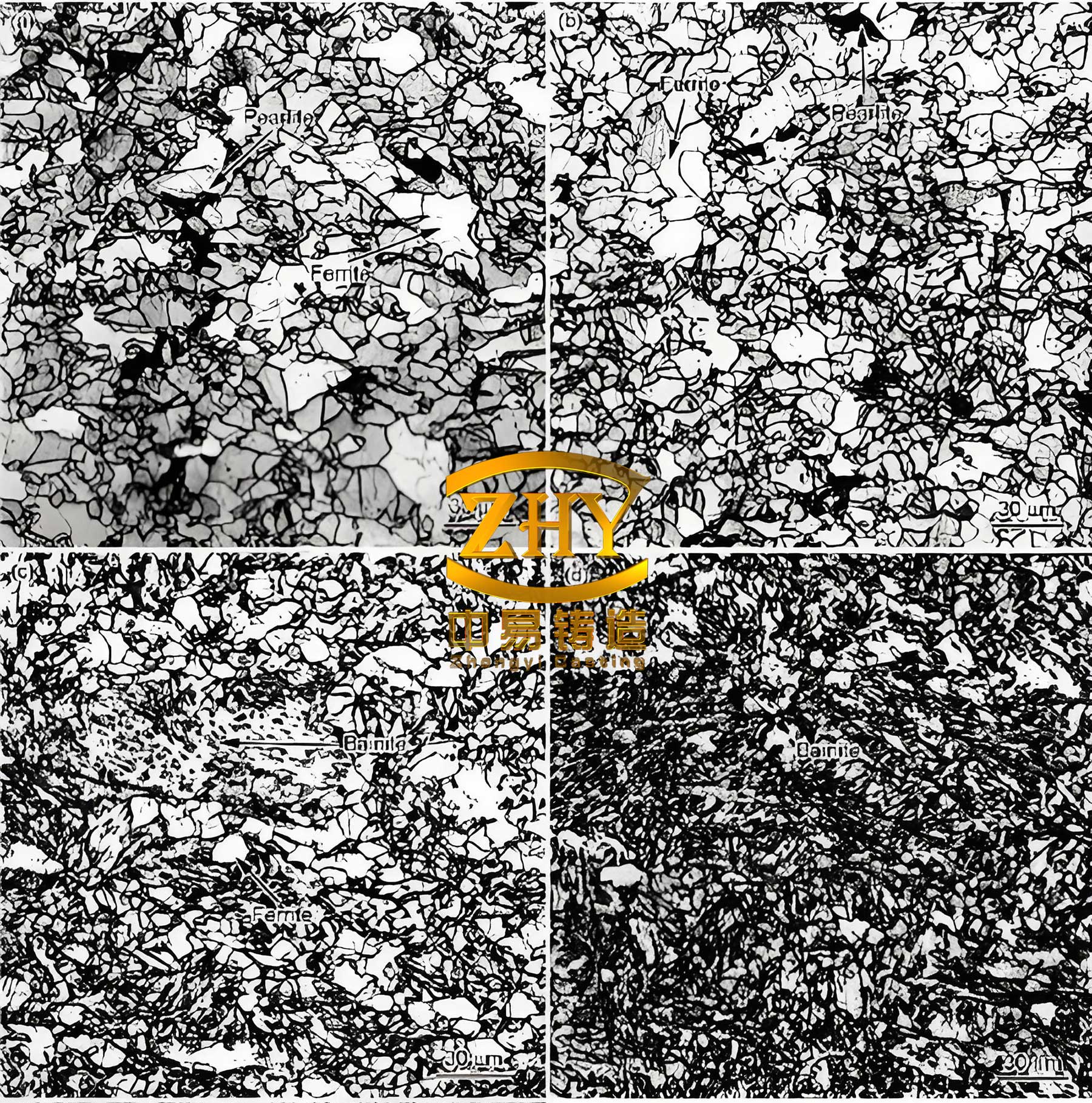
3. Results and Discussion
3.1. Effect of SiC Pretreatment on Microstructure of Spheroidal Graphite Cast Iron
3.1.1. Graphite Morphology
The effect of SiC addition on the graphite morphology is summarized in Table 5. Without SiC addition, the spheroidal graphite cast iron showed a nodularity of 84% and a nodule count of 328 nodules/mm², with some irregular graphite forms present. With the addition of up to 0.1 wt.% SiC, the nodularity improved significantly to 93%, and the nodule count increased to 472 nodules/mm². This improvement is attributed to the dual role of SiC particles during solidification: partial decomposition releases SiO2 and free carbon. The SiO2 can combine with undissolved SiC to form complex substrates that lower the energy barrier for graphite nucleation, increasing nucleation events. Simultaneously, the localized increase in carbon concentration enhances the diffusion gradient, supporting the growth of spherical graphite. However, at 0.15 wt.% SiC, while the nodule count further increased to 512 nodules/mm², the nodularity decreased to 88%, with more graphite particles appearing as exploded or irregular shapes. This suggests an excessive number of nucleation sites possibly leading to carbon diffusion limitations and impingement during growth, deteriorating graphite shape.
| Sample ID | SiC Addition (wt.%) | Nodularity (%) | Nodule Count (nodules/mm²) | Nodule Grade |
|---|---|---|---|---|
| A | 0 | 84 | 328 | III |
| B | 0.05 | 91 | 434 | II |
| C | 0.1 | 93 | 472 | II |
| D | 0.15 | 88 | 512 | III |
3.1.2. Pearlite Matrix Refinement
SEM analysis revealed a pronounced effect of SiC particles on the pearlitic matrix. The interlamellar spacing of pearlite decreased with the addition of SiC, reaching a minimum at the 0.1 wt.% addition level. At 0.15 wt.%, the spacing increased slightly but remained finer than in the untreated sample. This refinement is a direct consequence of the increased nucleation density of Fe3C. XRD analysis of samples with higher SiC additions (0.5 and 1.0 wt.%) confirmed the presence of residual SiC diffraction peaks, proving that not all SiC particles dissolve during processing. These undissolved particles can act as the heterogeneous nucleation sites for Fe3C, as predicted by the first-principles calculations.
Further evidence was obtained from SEM-EDS point analysis on a 0.1 wt.% SiC-treated sample. Points located within or adjacent to Fe3C lamellae showed significantly higher silicon content compared to the ferritic regions. This Si enrichment is strongly indicative of the presence of SiC particles at these locations, co-located with the cementite phase. The synergistic mechanism can be described as follows: The SiC particles, surviving in the melt, provide low-energy interfaces (Fe3C (100)/SiC (110)) for the nucleation of Fe3C during the eutectoid transformation. This increase in nucleation sites forces the alternating growth of Fe3C and ferrite to occur in a more confined space, leading to a reduction in both the pearlite colony size and the interlamellar spacing. The relationship between nucleation density ($N$) and interlamellar spacing ($S$) can be conceptually framed as $S \propto N^{-1/2}$, highlighting how increased nucleation refines the structure.
3.2. Effect of SiC Pretreatment on Mechanical Properties
The tensile properties of the spheroidal graphite cast iron as a function of SiC addition are graphically summarized. Both ultimate tensile strength (UTS) and elongation followed a similar trend, increasing to a maximum at 0.1 wt.% SiC addition and then decreasing at 0.15 wt.%.
The optimal sample (0.1 wt.% SiC) achieved a UTS of 846 MPa and an elongation of 4.7%. This enhancement is the result of multiple reinforcing mechanisms: 1) Solid solution strengthening of ferrite by silicon released from decomposed SiC. 2) Refinement of the pearlite interlamellar spacing, which strengthens the matrix according to a Hall-Petch type relationship for lamellar structures, often expressed as increased yield strength $\sigma_y \propto S^{-1/2}$. 3) Improved graphite nodularity and increased nodule count, which reduce stress concentration sites. The subsequent decline in properties at 0.15 wt.% SiC is directly linked to the degradation of graphite morphology (lower nodularity) and the slight coarsening of pearlite spacing, outweighing the benefits of matrix refinement and solid solution strengthening.
4. Conclusions
This integrated first-principles and experimental study successfully deciphers the mechanism by which SiC pretreatment enhances the microstructure and properties of spheroidal graphite cast iron, with a focus on the pearlitic matrix.
1. Atomic-Scale Nucleation Mechanism: First-principles calculations established that the interface between SiC(110) and Fe3C(100) exhibits a low lattice mismatch of 5.77% and a high interfacial adhesion work of 1.842 J/m². This confirms that SiC particles can serve as highly effective heterogeneous nucleation substrates for Fe3C, lowering the energy barrier for its formation during the eutectoid transformation and providing the fundamental explanation for pearlite refinement.
2. Microstructural Optimization: Experimental results demonstrate that an addition of 0.1 wt.% nano-SiC particles optimally modifies the microstructure of spheroidal graphite cast iron. It maximizes graphite nodularity (up to 93%) and refines the pearlite interlamellar spacing to its minimum. The presence of undissolved SiC particles within the matrix, confirmed by XRD and EDS, corroborates their role as active nucleation sites.
3. Mechanical Property Enhancement: The refined microstructure directly translates to superior mechanical performance. The spheroidal graphite cast iron treated with 0.1 wt.% SiC achieved a peak tensile strength of 846 MPa with an elongation of 4.7%. The strengthening is attributed to a synergy of pearlite refinement (from heterogeneous nucleation), solid solution strengthening by silicon, and improved graphite characteristics.
4. Process Window: Excessive SiC addition (0.15 wt.%) leads to graphite deterioration and property reduction, defining an optimal processing window. This work provides a clear theoretical foundation and a practical guideline for using SiC pretreatment as a powerful tool for producing high-strength, as-cast spheroidal graphite cast iron.