
In the realm of advanced manufacturing, the demand for high-performance materials capable of withstanding extreme低温 conditions has surged, particularly in sectors such as rail transit, wind power, nuclear energy, and polar exploration. Among these materials, low-temperature spheroidal graphite cast iron, specifically grades like QT400-18AL designed for service temperatures as low as -60°C, has emerged as a critical component. This article delves into the comprehensive technological research and production methodologies developed over years of实践, focusing on the intricate control of chemical composition, melting, spheroidization, inoculation, casting, and heat treatment processes. The goal is to achieve superior mechanical properties, including tensile strength ≥425 MPa, impact energy between 12-14 J, and elongation ≥22% at -60°C, thereby meeting the stringent requirements of高端装备制造业. Throughout this discussion, the term ‘spheroidal graphite cast iron’ will be frequently emphasized to underscore its significance in this context.
The foundation of producing high-quality low-temperature spheroidal graphite cast iron lies in the precise design and control of its chemical composition. Each element plays a pivotal role in determining the final microstructure and properties. Carbon, for instance, must be maintained within a range that prevents graphite floating and chill formation while ensuring complete graphitization. The optimal carbon content is typically between 3.50% and 3.80%. Silicon, a strong graphitizer, enhances ferrite formation but adversely affects低温 toughness;每增加0.1% Si, the brittle transition temperature rises by approximately 5.5–6.0°C. Thus, silicon is carefully controlled between 1.90% and 2.25%, and to compensate for potential strength reduction from lower silicon, trace amounts of nickel are added. Manganese is particularly detrimental to impact toughness, with every 0.1% increase elevating the brittle transition temperature by 10–12°C; hence, manganese content must be kept below 0.20%. Phosphorus, when exceeding 0.03%, leads to the formation of phosphide eutectics, severely degrading ductility and塑性. Sulfur, interfering with spheroidization, should be minimized to below 0.015%. Additionally,残余 magnesium from spheroidization is maintained at 0.030–0.050% to ensure proper graphite nodularity. The interplay of these elements can be summarized using the following formula for the brittle transition temperature (\(T_b\)) approximation:
$$ T_b = T_0 + k_{Si} \cdot (\text{Si} – \text{Si}_0) + k_{Mn} \cdot (\text{Mn} – \text{Mn}_0) $$
where \(T_0\) is a base temperature, \(k_{Si}\) and \(k_{Mn}\) are coefficients (e.g., \(k_{Si} \approx 55-60°C/\text{wt\%}\), \(k_{Mn} \approx 100-120°C/\text{wt\%}\)), and \(\text{Si}_0\) and \(\text{Mn}_0\) are reference contents. This highlights the critical need for tight compositional control.
| Element | Control Range (wt%) | Influence on Properties |
|---|---|---|
| Carbon (C) | 3.50–3.80 | Prevents graphite floating/chill, ensures graphitization |
| Silicon (Si) | 1.90–2.25 | Promotes ferrite but raises brittle transition temperature |
| Magnesium (Mg) | 0.030–0.050 | Essential for graphite spheroidization |
| Manganese (Mn) | ≤0.20 | Increases brittle transition temperature significantly |
| Phosphorus (P) | ≤0.03 | Forms harmful eutectics, reduces ductility |
| Sulfur (S) | ≤0.015 | Interferes with spheroidization |
| Nickel (Ni) | Trace (as needed) | Enhances strength without compromising低温 toughness |
The selection of raw materials is paramount in achieving these compositional targets. High-purity pig iron is preferred due to its elevated carbon content and minimal impurities like silicon, manganese, phosphorus, sulfur, and trace elements. This choice directly contributes to the consistency of the spheroidal graphite cast iron. Scrap steel should be low in alloying elements to avoid introducing unwanted components. For carburizing, a low-sulfur增碳剂 with high absorption率 (C ≥90%, S ≤0.25%) is employed to adjust carbon levels without increasing sulfur. The配料 process involves meticulous weighing according to a predefined charge calculation, ensuring that the melt chemistry has room for fine-tuning. During melting, rapid heating is enforced to prevent segregation and棚料, with temperatures monitored closely.炉前 analysis is conducted at two stages: first, for carbon and silicon when the melt exceeds 1420°C, and second, for full光谱 analysis above 1450°C. Adjustments are made based on these results to align with the stringent requirements for low-temperature spheroidal graphite cast iron.
Melting control extends to the出炉 temperature, which is critical for后续 processing. The铁液 is tapped at 1530–1550°C after thorough slag removal. This high temperature ensures adequate fluidity for casting and provides a thermal buffer for the spheroidization reaction. The relationship between tapping temperature (\(T_{\text{tap}}\)) and graphite nodule count (\(N_g\)) can be approximated as:
$$ N_g \propto \exp\left(-\frac{E_a}{k_B T_{\text{tap}}}\right) $$
where \(E_a\) is an activation energy and \(k_B\) is the Boltzmann constant, indicating that higher temperatures promote nucleation sites for spheroidal graphite formation.
Spheroidization is the heart of producing spheroidal graphite cast iron, where graphite morphologies are transformed from flakes to spheres. A low-magnesium, low-rare earth spheroidizing agent is selected, with magnesium oxide content ≤0.7% to minimize oxidation losses. The agent’s particle size ranges from 3 to 20 mm to ensure gradual reaction. The addition amount is precisely controlled at 1.15–1.25% of the melt weight, targeting a残余 magnesium content of 0.036–0.050%. The spheroidization ladle is prepared with a concave bottom pit, optimized for a height-to-diameter ratio greater than 2, which enhances reaction efficiency and magnesium recovery. During the process, the spheroidizer is placed in the pit, compacted, and covered uniformly with inoculant and a thin cast iron plate. Tapping is performed avoiding direct冲击 on the agent, with a fast-initial, slow-later flow rate to control reaction kinetics. The spheroidization time is maintained around 90 seconds, and the entire浇注 must be completed within 15 minutes to prevent衰退. The efficiency of spheroidization (\(\eta_{\text{sph}}\)) can be expressed as:
$$ \eta_{\text{sph}} = \frac{[\text{Mg}]_{\text{residual}}}{[\text{Mg}]_{\text{added}}} \times 100\% $$
where higher values indicate better utilization, crucial for consistent spheroidal graphite cast iron quality.
Inoculation complements spheroidization by enhancing graphite nucleation and preventing undercooling. The inoculant is based on ferrosilicon with additions of calcium, barium, and trace bismuth. Barium is increased slightly to retard fading, while bismuth in the stream inoculant boosts graphite nodule counts. The primary inoculant addition is set at 1.10–1.20%, avoiding excess that could lead to slag inclusions. Instantaneous (stream) inoculation is applied at 0.10–0.20%, providing a final boost just before casting. The combined effect of spheroidization and inoculation on graphite nodule density (\( \rho_g \)) can be modeled as:
$$ \rho_g = A \cdot [\text{Inoculant}]^{0.5} + B \cdot \exp(-t/\tau) $$
where \(A\) and \(B\) are constants, \(t\) is time after inoculation, and \(\tau\) is the fading time constant, emphasizing the need for timely casting. This meticulous approach ensures a uniform microstructure of spheroidal graphite cast iron.
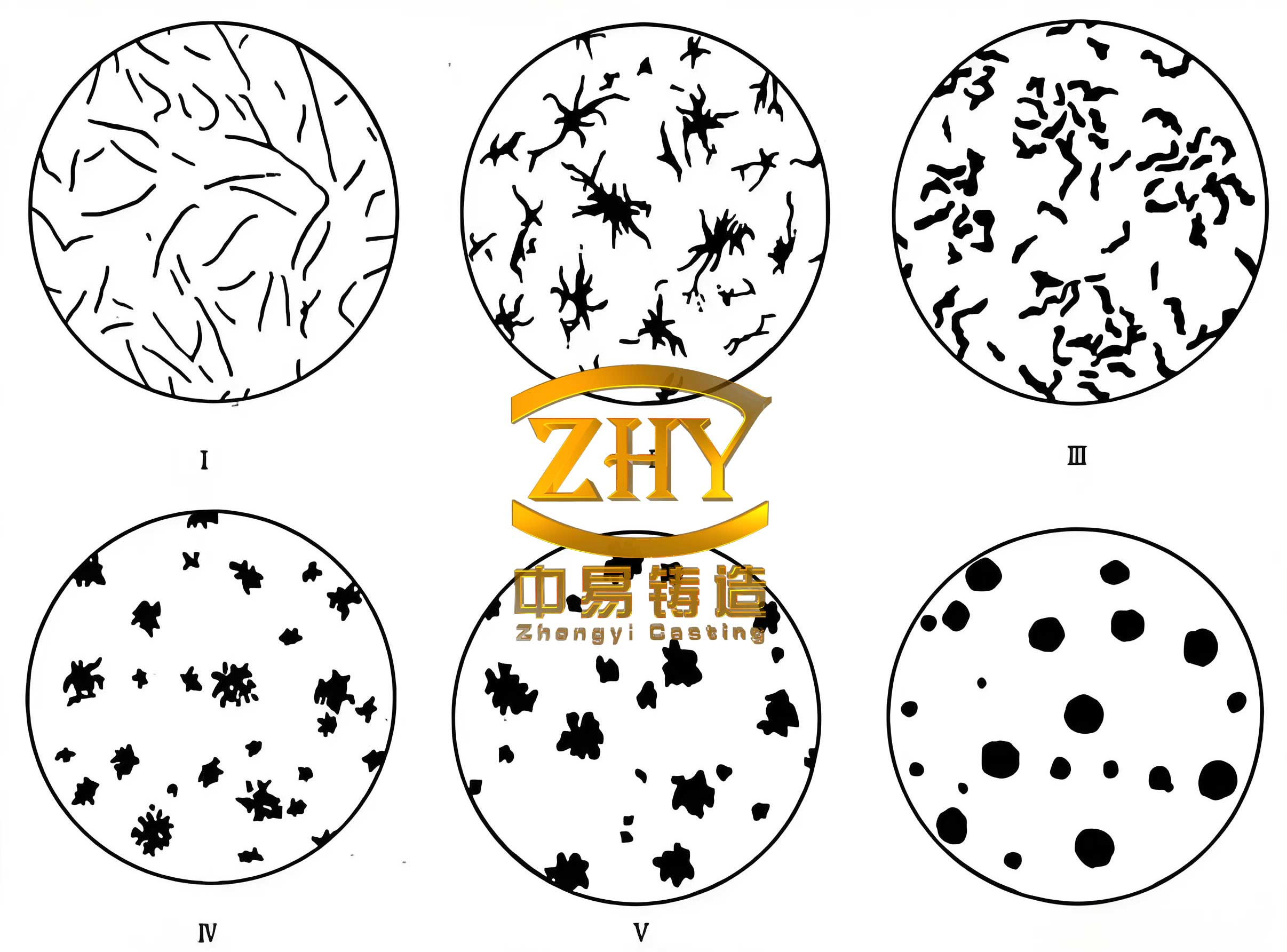
Heat treatment is indispensable for achieving 100% ferrite matrix in QT400-18AL (-60°C) spheroidal graphite cast iron, as-cast microstructures may contain residual pearlite that impairs低温 toughness. Through extensive experimentation, a high-temperature heat treatment at 900–920°C has been established. This process promotes the dissolution of carbides and transformation of pearlite into ferrite, thereby optimizing mechanical properties. The kinetics of ferritization can be described by the Avrami equation:
$$ f = 1 – \exp(-k t^n) $$
where \(f\) is the ferrite fraction, \(k\) is a rate constant dependent on temperature, \(t\) is time, and \(n\) is an exponent. At 900–920°C, the treatment ensures complete转化 within a practical timeframe. After holding at this temperature, controlled cooling is applied to prevent stress accumulation. The resulting spheroidal graphite cast iron exhibits enhanced ductility and impact resistance at low temperatures.
| Stage | Temperature Range (°C) | Time (Hours) | Purpose |
|---|---|---|---|
| Heating | Room to 900–920 | 2–4 | Avoid thermal shock |
| Soaking | 900–920 | 2–3 | Ferritization of matrix |
| Cooling | 900 to Room | Controlled (furnace cool) | Prevent pearlite reformation |
The mechanical properties of the final spheroidal graphite cast iron are rigorously tested. At -60°C, the material consistently achieves tensile strength (\(\sigma_t\)) ≥425 MPa, impact absorption energy (\(E_{\text{impact}}\)) between 12–14 J, and elongation (\(\epsilon\)) ≥22%. These values meet and exceed standards such as GB/T32247-2015 and industry specifications for轨道交通 applications. The correlation between composition, processing, and properties can be summarized by a multivariable equation:
$$ \sigma_t = \alpha_0 + \alpha_1[\text{C}] + \alpha_2[\text{Si}] + \alpha_3[\text{Ni}] + \alpha_4[\text{Mg}] + \alpha_5 T_{\text{HT}} $$
where \(\alpha_i\) are coefficients and \(T_{\text{HT}}\) is the heat treatment temperature. Similarly, impact energy relates to impurity elements:
$$ E_{\text{impact}} = \beta_0 – \beta_1[\text{Mn}] – \beta_2[\text{P}] – \beta_3[\text{S}] + \beta_4 f_{\text{ferrite}} $$
where \(f_{\text{ferrite}}\) is the ferrite volume fraction, underscoring the importance of low manganese and phosphorus in spheroidal graphite cast iron for低温 service.
In production实践, these principles have been applied to various components like gearboxes, motor housings, axle boxes, and bearing caps for high-speed trains and地铁 systems. For instance, gearbox bodies operating at -20°C to -50°C require precise control over spheroidal graphite cast iron properties to withstand dynamic loads. Motor end covers for高寒高铁, such as those used in Harbin-Dalian lines, demand -40°C toughness, achieved through the described methodology. Similarly, traction motor housings for CRH series and复兴号 trains, rated for -50°C, rely on optimized spheroidal graphite cast iron with trace nickel additions. The成功 of these applications hinges on the integrated approach to chemistry, melting, spheroidization, inoculation, and heat treatment.
To further illustrate the process flow, consider the following summary table of key control points:
| Process Step | Key Parameters | Target Values | Monitoring Method |
|---|---|---|---|
| Raw Material Selection | Purity of pig iron, scrap steel,增碳剂 | High-purity, low-alloy inputs | Chemical certification |
| 配料 | Charge calculation accuracy | Within ±0.1% of target composition | Weighing scales, software |
| Melting | Heating rate, temperature control | Rapid melt, 1530–1550°C tap | Thermocouples,光谱 analysis |
| Spheroidization | Agent type, addition量, reaction time | Low-Mg agent, 1.15–1.25%, 90 s | Residual Mg analysis, visual slag |
| Inoculation | Inoculant composition, addition timing | 1.10–1.20% primary, 0.10–0.20% stream | Nodule count microscopy |
| Casting | Pouring time, temperature | Complete within 15 min post-spheroidization | Timers, pyrometers |
| Heat Treatment | Temperature, time, cooling rate | 900–920°C soak for 2–3 h, controlled cool | Furnace controllers, metallography |
| Quality Verification | Mechanical testing at -60°C | \(\sigma_t\) ≥425 MPa, \(E_{\text{impact}}\) 12–14 J, \(\epsilon\) ≥22% | Tensile testers, impact testers |
The economic and operational benefits of this technology are substantial. By mastering the production of low-temperature spheroidal graphite cast iron, manufacturers can supply critical components for global infrastructure projects, including polar exploration vessels and offshore wind turbines. The repeatability of the process ensures batch-to-batch consistency, reducing scrap rates and enhancing sustainability. Moreover, the ability to tailor properties through nickel微合金化 allows for customization based on specific application stresses, making spheroidal graphite cast iron a versatile material choice.
In conclusion, the production of high-performance low-temperature spheroidal graphite cast iron necessitates a holistic and disciplined approach. From the selection of高纯生铁 to the final heat treatment, every step must be meticulously controlled. The chemical composition, centered on low silicon, manganese, phosphorus, and sulfur, with strategic nickel additions, forms the foundation. Melting at precise temperatures, followed by effective spheroidization and inoculation, ensures a fine and uniform distribution of spheroidal graphite. Finally, high-temperature heat treatment guarantees a fully ferritic matrix, unlocking the desired mechanical properties at -60°C. This comprehensive methodology not only meets but often exceeds international standards, positioning spheroidal graphite cast iron as a cornerstone material for advanced engineering applications. Future advancements may focus on further reducing impurity limits or exploring alternative alloying elements, but the core principles outlined here will remain essential for excellence in low-temperature spheroidal graphite cast iron manufacturing.
To deepen the understanding, let’s explore some theoretical aspects. The graphite spheroidization process in spheroidal graphite cast iron involves the adsorption of surface-active elements like magnesium onto graphite生长 fronts, altering the interfacial energy and promoting spherical growth. The critical radius (\(r_c\)) for graphite nodule stability can be expressed as:
$$ r_c = \frac{2 \gamma}{\Delta G_v} $$
where \(\gamma\) is the interfacial energy and \(\Delta G_v\) is the volumetric free energy change. Magnesium降低 \(\gamma\), facilitating spheroid formation. Additionally, the impact of trace elements on graphite morphology can be quantified using a nodularity index (\(I_n\)), defined as:
$$ I_n = \frac{N_{\text{spherical}}}{N_{\text{total}}} \times 100\% $$
where \(N_{\text{spherical}}\) is the number of spherical graphite particles and \(N_{\text{total}}\) is the total graphite count. For premium low-temperature spheroidal graphite cast iron, \(I_n\) should exceed 90%.
Another key factor is the cooling rate during solidification, which influences graphite nodule size and distribution. The relationship between cooling rate (\( \dot{T} \)) and nodule density (\( \rho_g \)) is often modeled as:
$$ \rho_g = C \cdot \dot{T}^m $$
with \(C\) and \(m\) as material constants. Slower cooling in thick sections may require adjustments in inoculation to maintain uniformity. This underscores the importance of process adaptation for different casting geometries in spheroidal graphite cast iron production.
In terms of performance validation, statistical process control (SPC) charts are employed to monitor key variables like residual magnesium and silicon content. For example, a control chart for残余镁 might have upper and lower limits set at 0.050% and 0.030%, respectively, ensuring that the spheroidal graphite cast iron remains within specification. Trend analysis helps predict and prevent deviations, enhancing overall quality assurance.
Furthermore, the role of nickel in low-temperature spheroidal graphite cast iron deserves elaboration. Nickel, being an austenite stabilizer, dissolves in the ferrite matrix, providing solid solution strengthening without significantly affecting the brittle transition temperature. The strengthening contribution (\(\Delta \sigma_{\text{Ni}}\)) can be estimated using:
$$ \Delta \sigma_{\text{Ni}} = k_{\text{Ni}} \cdot [\text{Ni}]^{2/3} $$
where \(k_{\text{Ni}}\) is a constant. This allows for precise tuning of strength while preserving低温 toughness, a hallmark of advanced spheroidal graphite cast iron grades.
Lastly, environmental considerations are integral to modern foundry practices. The use of高纯生铁 reduces the need for extensive slag treatment, while efficient spheroidization minimizes magnesium consumption and emissions. Recycling of returns and scrap within the process loop further enhances the sustainability of spheroidal graphite cast iron production. As industries move towards greener manufacturing, these aspects will become increasingly important.
In summary, the technology for low-temperature spheroidal graphite cast iron represents a synergy of metallurgical science and practical engineering. Through relentless research and refinement, we have established a robust framework that delivers reliable performance under extreme conditions. This achievement not only supports critical infrastructure but also paves the way for future innovations in material science. The continued evolution of spheroidal graphite cast iron will undoubtedly play a vital role in addressing the challenges of tomorrow’s高端装备制造业.