
In my experience as a materials engineer, I have encountered numerous cases where spheroidal graphite cast iron components exhibit unexpected microstructural issues after heat treatment. One such case involved a planetary carrier made of spheroidal graphite cast iron, grade QT700-2, which underwent high-frequency induction hardening. Post-treatment inspection revealed anomalies in the hardened zone, specifically low spheroidization rates of graphite and excessive ferrite content. This article delves into a comprehensive analysis of these anomalies, drawing from experimental data and theoretical principles to elucidate the root causes and propose effective solutions. Spheroidal graphite cast iron, renowned for its excellent mechanical properties, is widely used in automotive, heavy machinery, and wind power applications. However, its performance is highly dependent on microstructure, which can be compromised by casting and heat treatment processes. Here, I will explore how casting defects and thermal processing interplay to affect the final microstructure of spheroidal graphite cast iron.
Spheroidal graphite cast iron, also known as ductile iron, derives its strength and ductility from the spherical shape of graphite nodules embedded in a metallic matrix. The matrix typically consists of ferrite, pearlite, or a combination, with heat treatments like normalizing and hardening used to tailor properties. High-frequency induction hardening is a surface hardening technique that uses electromagnetic induction to rapidly heat and quench specific areas, creating a hard martensitic layer while retaining a tough core. For spheroidal graphite cast iron, this process is advantageous for components subjected to wear and fatigue, such as gears and shafts. However, the success of induction hardening hinges on the initial microstructure; anomalies in graphite morphology or base metal composition can lead to suboptimal results. In this case, the planetary carrier’s hardened zone showed graphite spheroidization below 70% and ferrite content exceeding 30%, both outside technical specifications. Through detailed investigation, I identified casting-related factors as the primary culprits, emphasizing the critical role of foundry practices in ensuring quality for spheroidal graphite cast iron parts.
The planetary carrier was manufactured from spheroidal graphite cast iron with a nominal composition as per GB/T 1348-2009. Key chemical elements are summarized in Table 1. After casting, the component underwent normalizing at 880°C for 2.5 hours, followed by high-frequency induction hardening focused on the inner bore area, which was later machined into splines. The technical requirements for the hardened zone included a graphite spheroidization rate ≥70% and ferrite volume fraction ≤30%. Samples were extracted from both the hardened zone and outer edge regions for metallographic analysis, as illustrated in the schematic. Microstructures were examined using optical microscopy, and image analysis software was employed to quantify graphite spheroidization and ferrite content.
| Element | C | Si | Mn | P | S | Fe |
|---|---|---|---|---|---|---|
| Content | 3.2 | 2.5 | 0.6 | 0.047 | 0.020 | Balance |
Initial observations revealed stark contrasts between regions. The outer edge exhibited graphite spheroidization rates of 90% and ferrite content of 6-8%, meeting specifications. In contrast, the hardened zone showed spheroidization rates of only 25% and ferrite content around 39%. Graphite in the hardened zone appeared largely vermicular or irregular, while the matrix contained substantial ferrite alongside martensite. Since graphite morphology in cast iron is established during solidification and remains unchanged during heat treatment, the anomalous graphite was attributed to casting processes. The hardened zone corresponded to the riser location, where cooling rates are slower and nodulizer efficiency may be reduced due to oxidation or burnout. This aligns with known phenomena in spheroidal graphite cast iron production, where riser areas often suffer from degraded graphite quality.
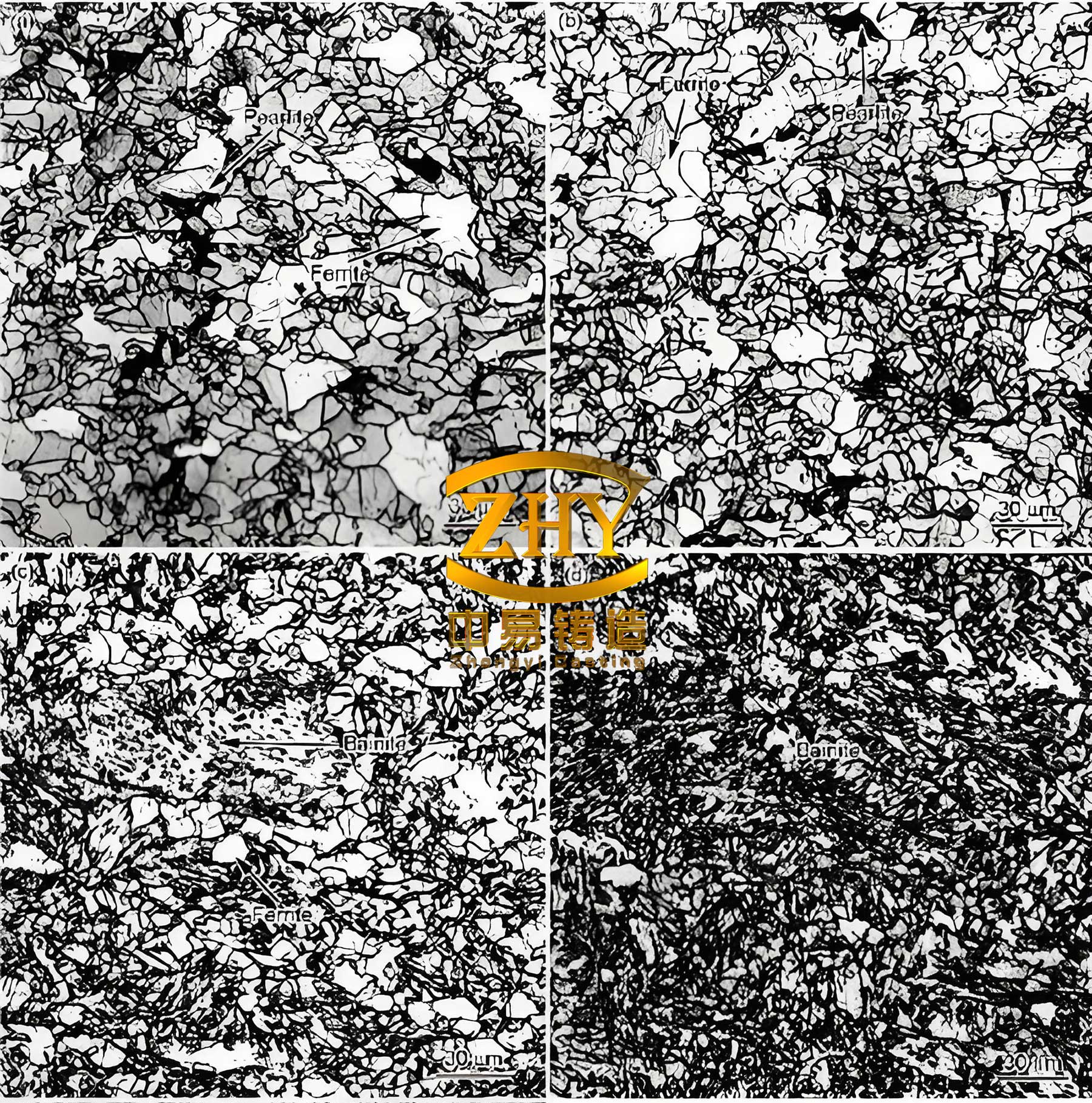
The excessive ferrite in the hardened zone posed a more complex issue. Ferrite, being carbon-poor (maximum solubility of 0.0218 wt% C), requires higher temperatures or longer times for austenitization compared to pearlite. During high-frequency induction hardening, the rapid heating cycle (typically seconds) may not suffice to fully austenitize ferrite-rich areas, especially if carbon diffusion is limited. This results in retained ferrite after quenching, compromising hardness and wear resistance. To understand this, consider the austenitization kinetics in spheroidal graphite cast iron. The transformation from ferrite to austenite involves carbon diffusion from graphite or pearlite into ferrite, governed by Fick’s law: $$ \frac{\partial C}{\partial t} = D \nabla^2 C $$ where \( C \) is carbon concentration, \( t \) is time, and \( D \) is the diffusion coefficient. For a given temperature \( T \), \( D \) follows an Arrhenius relationship: $$ D = D_0 \exp\left(-\frac{Q}{RT}\right) $$ with \( D_0 \) as the pre-exponential factor, \( Q \) the activation energy, and \( R \) the gas constant. In induction hardening, short timescales and localized heating can lead to incomplete austenitization, particularly in regions with coarse ferrite.
To quantify the effect, I analyzed the microstructural evolution. The as-cast microstructure in the riser area likely contained high ferrite due to slow cooling, which promotes ferrite nucleation and growth. Normalizing aims to homogenize the matrix, but if ferrite is excessive, it may persist. I conducted an additional normalizing experiment on samples from the hardened zone, heating to 925°C for 50 minutes and 970°C for 100 minutes, followed by air cooling. This reduced ferrite but did not eliminate it, indicating that the original casting microstructure was inherently ferrite-rich. Table 2 summarizes the microstructural parameters before and after treatments, highlighting the persistence of anomalies in spheroidal graphite cast iron.
| Sample Region | Treatment | Graphite Spheroidization Rate (%) | Ferrite Volume Fraction (%) | Observations |
|---|---|---|---|---|
| Outer Edge | As-cast + Normalized | 90 | 6-8 | Spherical graphite, pearlitic matrix |
| Hardened Zone | As-cast + Normalized | 25 | ~39 | Vermicular graphite, ferrite-rich matrix |
| Hardened Zone | Additional Normalizing | 25 | ~15 | Reduced ferrite, but still present |
The root causes of these anomalies are twofold. First, graphite spheroidization suffers in riser areas due to nodulizer depletion and slow cooling. Nodulizers, such as magnesium or cerium alloys, promote graphite spheroidization, but in risers, exposure to air can lead to oxidation, reducing effectiveness. Cooling rate \( \dot{T} \) influences graphite morphology; slower rates favor vermicular or flake graphite. For spheroidal graphite cast iron, a critical cooling rate is necessary to maintain nodularity, often expressed as: $$ \dot{T}_{critical} = \frac{T_{liquidus} – T_{eutectoid}}{t_{solidification}} $$ where \( T_{liquidus} \) and \( T_{eutectoid} \) are phase transformation temperatures, and \( t_{solidification} \) is solidification time. In risers, \( t_{solidification} \) increases, lowering \( \dot{T} \) and degrading spheroidization.
Second, ferrite retention stems from inadequate austenitization during induction hardening. The process involves heating to temperatures above \( A_c3 \) (the temperature where ferrite fully transforms to austenite), but for spheroidal graphite cast iron with high ferrite, this temperature may not be reached uniformly. The induction heating power density \( P \) and time \( t_h \) determine the temperature profile: $$ T(x,t) = T_0 + \frac{P}{\rho c \sqrt{\pi \alpha t}} \exp\left(-\frac{x^2}{4\alpha t}\right) $$ where \( T_0 \) is initial temperature, \( \rho \) density, \( c \) specific heat, \( \alpha \) thermal diffusivity, and \( x \) depth. Short \( t_h \) can leave ferrite regions below \( A_c3 \). Moreover, carbon diffusion from graphite to ferrite is limited by time. The diffusion distance \( x_{diff} \) can be estimated as: $$ x_{diff} = \sqrt{D t_h} $$ For typical induction hardening times (e.g., 2 seconds) and \( D \approx 10^{-11} \, m^2/s \) at 900°C, \( x_{diff} \) is only about 4.5 µm, insufficient to homogenize carbon in coarse ferrite grains.
To address these issues, I recommended optimizing the casting process for the spheroidal graphite cast iron component. Modifications included redesigning the riser size and location to improve cooling rates and nodulizer efficiency, and refining spheroidization and inoculation practices. After implementing these changes, the planetary carrier was subjected to the same normalizing and induction hardening sequence. Post-treatment analysis showed significant improvement: graphite spheroidization reached 92%, and ferrite content dropped to 9%, within specifications. This underscores the importance of integrated process control in manufacturing spheroidal graphite cast iron parts.
Further theoretical insights can be gleaned from phase transformation diagrams. For spheroidal graphite cast iron, the continuous cooling transformation (CCT) diagram illustrates microstructural outcomes under varying cooling rates. During casting, slow cooling in risers shifts transformation curves, promoting ferrite formation. During induction hardening, the rapid heating alters austenite grain growth kinetics. The austenite grain size \( d \) influences hardenability and is given by: $$ d = k t^n \exp\left(-\frac{Q_g}{RT}\right) $$ where \( k \) and \( n \) are constants, \( t \) is time, and \( Q_g \) is activation energy for grain growth. In ferrite-rich zones, coarse austenite grains may form, affecting martensite transformation. The martensite start temperature \( M_s \) depends on carbon content: $$ M_s = 539 – 423C – 30.4Mn – 17.7Si – 12.1Cr – 7.5Mo $$ where elements are in wt%. Low carbon in ferrite-rich areas raises \( M_s \), potentially leading to softer phases after quenching.
In practice, ensuring quality for spheroidal graphite cast iron requires meticulous attention to both casting and heat treatment. Table 3 outlines key process parameters and their effects on microstructure, derived from this study and broader literature on spheroidal graphite cast iron.
| Process Stage | Parameter | Optimal Range | Effect on Graphite Spheroidization | Effect on Ferrite Content |
|---|---|---|---|---|
| Casting | Cooling Rate | >10°C/s | Promotes spheroidal graphite | Reduces ferrite |
| Casting | Nodulizer Addition | 0.04-0.06 wt% Mg | Enhances spheroidization | Indirect via matrix control |
| Normalizing | Temperature | 880-950°C | No direct effect | Reduces ferrite if sufficient time |
| Induction Hardening | Heating Time | >5 s for ferritic areas | No direct effect | Allows austenitization of ferrite |
| Induction Hardening | Power Density | 1-2 kW/cm² | No direct effect | Affects depth of hardening |
The interplay between graphite and matrix in spheroidal graphite cast iron is complex. Graphite acts as a carbon reservoir, influencing austenitization. During heating, carbon dissolves from graphite into austenite, following a solubility limit: $$ C_{\gamma} = C_0 \exp\left(-\frac{\Delta H}{RT}\right) $$ where \( C_{\gamma} \) is carbon in austenite, \( C_0 \) a constant, and \( \Delta H \) enthalpy of dissolution. In vermicular graphite, surface area is higher, potentially accelerating carbon transfer but also introducing stress concentrations. The mechanical properties of spheroidal graphite cast iron, such as tensile strength \( \sigma_t \), relate to microstructure via empirical models: $$ \sigma_t = \sigma_0 + k_f V_f + k_p V_p + k_g \frac{1}{\sqrt{d_g}} $$ where \( \sigma_0 \) is base strength, \( V_f \) and \( V_p \) are ferrite and pearlite volume fractions, \( k \) constants, and \( d_g \) graphite nodule diameter. Anomalies in graphite or ferrite thus directly degrade performance.
From a quality control perspective, non-destructive testing methods like ultrasonic inspection can detect subsurface defects in spheroidal graphite cast iron, but microstructure assessment often requires metallography. For high-frequency induction hardening, pre-heat treatment normalization is crucial to standardize the matrix. However, as seen here, if casting introduces severe inhomogeneities, normalization alone may not suffice. Statistical process control (SPC) charts can monitor key variables like cooling time and nodulizer concentration, ensuring consistency in spheroidal graphite cast iron production.
In conclusion, the microstructural anomalies in the spheroidal graphite cast iron planetary carrier after high-frequency induction hardening were primarily due to casting deficiencies in the riser area. Low graphite spheroidization resulted from nodulizer loss and slow cooling, while excessive ferrite persisted from the as-cast structure, inadequately corrected by normalization. Induction hardening’s rapid cycle failed to fully austenitize ferrite, leading to retained soft phases. By optimizing riser design and spheroidization practices, the issues were resolved, yielding a component with 92% spheroidization and 9% ferrite. This case highlights the interdependence of casting and heat treatment for spheroidal graphite cast iron. Future work could explore advanced inoculation techniques or tailored induction parameters to mitigate such anomalies, ensuring reliable performance in demanding applications. The lessons learned reinforce that quality in spheroidal graphite cast iron is forged not just in the heat treater’s furnace, but from the very moment molten metal begins to solidify.
To further generalize, the principles discussed apply to various grades of spheroidal graphite cast iron, from QT400 to QT900. Engineers should consider conducting pre-heat treatment microstructural analysis, especially in critical zones like risers, to anticipate issues. Mathematical modeling of heat transfer and phase transformations can aid in process design, reducing trial-and-error. As industries push for lighter and stronger components, mastering the nuances of spheroidal graphite cast iron will remain pivotal, blending metallurgical science with practical craftsmanship to achieve excellence.