
In this article, I will delve into the fascinating world of austempered spheroidal graphite iron, a material that has revolutionized engineering applications due to its exceptional strength, ductility, and wear resistance. As an engineer with years of experience in metallurgy, I have witnessed the evolution of this material from its early research phases to its current industrial prominence. Spheroidal graphite iron, often referred to as ductile iron, forms the base material for austempering, and through controlled heat treatment, it transforms into a superior engineering material known as austempered ductile iron (ADI). The key to its properties lies in the unique microstructure of acicular ferrite and carbon-enriched austenite, which I will explore in detail. Throughout this discussion, I will emphasize the term “spheroidal graphite iron” to underscore its foundational role, and I will incorporate tables and formulas to summarize critical data and principles.
The development of austempered spheroidal graphite iron traces back to the 1930s, when E.C. Bain conducted pioneering research on isothermal transformation in steels. This work laid the groundwork for what would later become the austempering process. In the 1940s, Professor Flinn applied this concept to gray iron, but it wasn’t until the 1950s that significant trials on spheroidal graphite iron were undertaken by companies like International Harvester. These efforts revealed the potential for high strength and toughness, yet widespread adoption was slow. By the late 1960s, successful applications in gear components spurred further research, leading to simultaneous breakthroughs in Finland, the United States, and China in the 1970s. In China, for instance, institutes developed ADI for automotive gears, such as those used in “BJ212” and “BJ130” vehicles, and later in tractors like “东方红-54.” This historical journey highlights how austempered spheroidal graphite iron emerged as a promising alternative to forged and cast steels, often dubbed the “iron代替钢” material due to its cost-effectiveness and performance. From my perspective, understanding this history is crucial for appreciating the material’s current applications and future potential.
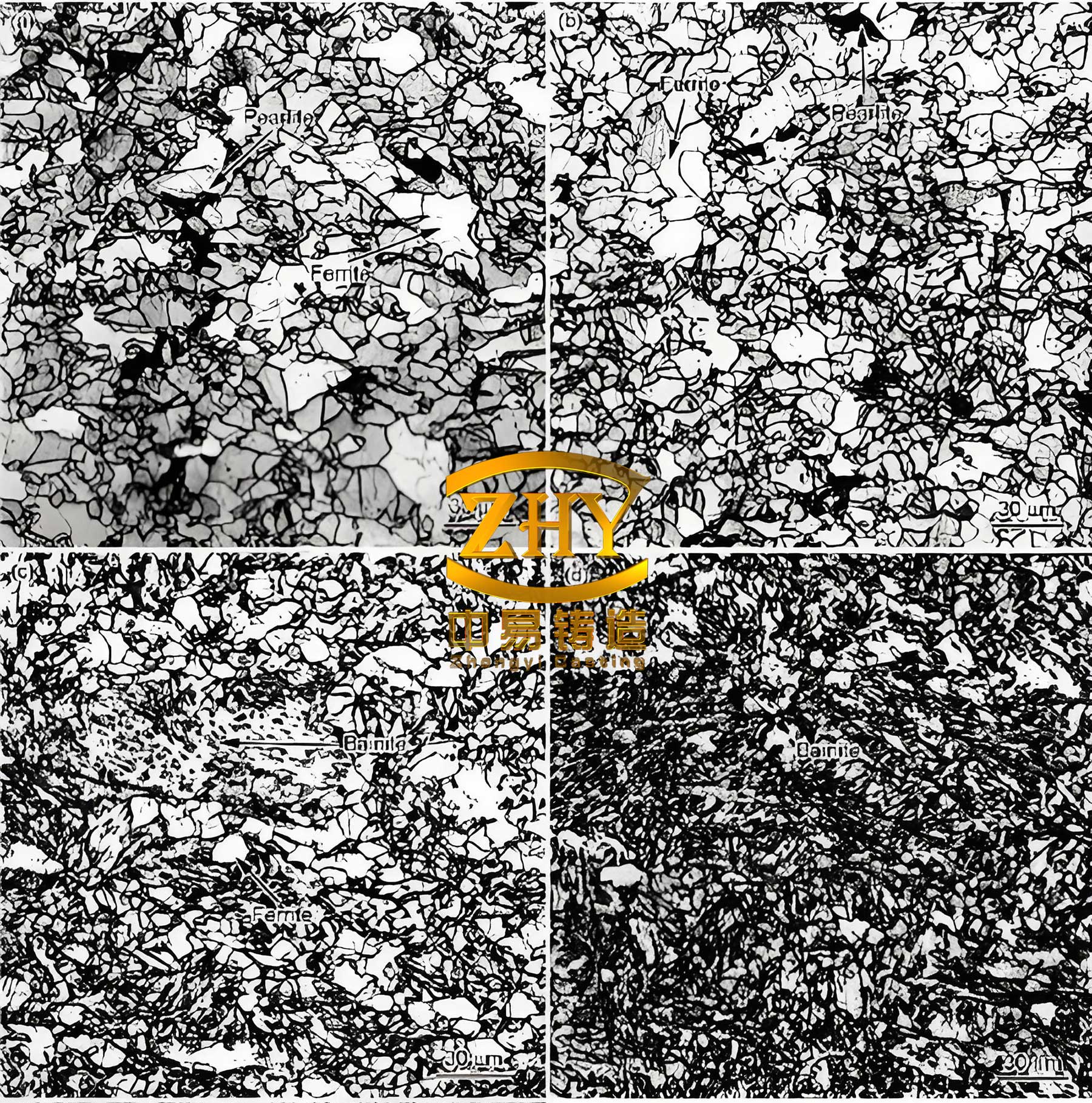
The production landscape for austempered spheroidal graphite iron has evolved significantly over the decades. As of 2017, China’s annual output of ADI, including carbide-austempered ductile iron (CADI), was approximately 150,000 tons, split evenly between engineering structural parts and wear-resistant components. Engineering applications span automotive suspension parts, brackets, control arms, steering knuckles, railway machinery, agricultural equipment, and gears or crankshafts. In recent years, the push toward lightweight and high-performance mechanical parts has fueled interest in austempered spheroidal graphite iron, driving advances in fundamental research, production techniques, and equipment. I have observed that systematic studies have deepened our understanding of how initial spheroidal graphite iron microstructure and heat treatment parameters influence the final ADI properties. For example, research on austenitization kinetics and carbon diffusion has provided insights into optimizing process variables. Additionally, the establishment of specialized ADI heat treatment centers, akin to those in the United States and Europe, has been pivotal. In China, centers in Suzhou, Hebei, Henan, and elsewhere have emerged, facilitating the growth of the ADI industry. These centers often employ advanced quenching lines, such as salt bath or step-quenching systems, which enhance production efficiency and consistency. Moreover, improvements in the quality and stability of spheroidal graphite iron castings have been achieved through better raw materials, like high-purity pig iron, and refined treatment methods, such as covered ladle or wire-feeding techniques for nodulization and inoculation. The use of lanthanum-rich nodularizers and barium-calcium inoculants has enabled precise control over graphite spheroidization, size, and count. Coupled with stringent process controls and non-destructive testing, these advancements ensure that every spheroidal graphite iron casting meets rigorous standards, laying a solid foundation for subsequent austempering.
To quantify the properties of austempered spheroidal graphite iron, I often rely on mathematical models and empirical data. The isothermal transformation during austempering can be described using the Avrami equation, which models phase transformation kinetics. For instance, the fraction of austenite transformed to acicular ferrite, denoted as \( y \), is given by:
$$ y = 1 – \exp(-k t^n) $$
Here, \( t \) is the isothermal holding time, \( k \) is a rate constant dependent on temperature, and \( n \) is an exponent related to the transformation mechanism. This formula helps in predicting the microstructure evolution during the austempering of spheroidal graphite iron. Additionally, the carbon content in austenite, \( C_{\gamma} \), influences stability and can be estimated using diffusion equations. For example, Fick’s second law can be applied to model carbon redistribution:
$$ \frac{\partial C}{\partial t} = D \nabla^2 C $$
where \( D \) is the diffusion coefficient of carbon in austenite, which varies with temperature. These equations underscore the complexity of the process and highlight why precise control is essential for achieving desired properties in austempered spheroidal graphite iron.
| Property | Typical Range for ADI | Influencing Factors |
|---|---|---|
| Tensile Strength (Rm) | 800–1600 MPa | Austempering temperature, alloying elements |
| Yield Strength (Rp0.2) | 500–1100 MPa | Base spheroidal graphite iron composition |
| Elongation (A) | 4–15% | Graphite nodule count and matrix structure |
| Hardness (HBW) | 250–440 | Isothermal time and temperature |
| Impact Toughness | 60–150 J | Residual austenite content and cleanliness |
The table above summarizes key mechanical properties of austempered spheroidal graphite iron, illustrating its versatility. These properties stem from the unique microstructure, which I will elaborate on. During austempering, spheroidal graphite iron undergoes a two-stage reaction: first, austenite decomposes into acicular ferrite and carbon-enriched austenite, and second, if over-held, the austenite may transform into carbides. The optimal structure consists of fine acicular ferrite needles embedded in a stable austenite matrix, providing a balance of strength and ductility. The volume fraction of retained austenite, typically 20–40%, contributes to toughness through transformation-induced plasticity. In my work, I have found that controlling this microstructure requires careful selection of austenitizing temperature, isothermal temperature, and time. For spheroidal graphite iron, common austenitizing ranges are 850–950°C, while isothermal temperatures vary from 250–400°C, depending on whether high strength or high ductility is desired. Lower isothermal temperatures (e.g., 250–300°C) yield higher strength but lower ductility, whereas higher temperatures (e.g., 350–400°C) enhance ductility at the expense of strength. This trade-off is captured in the following empirical relationship for tensile strength \( R_m \) as a function of isothermal temperature \( T \) (in °C):
$$ R_m = A – B \cdot T $$
where \( A \) and \( B \) are material constants derived from regression analysis of spheroidal graphite iron data. Such formulas aid in process design for austempered spheroidal graphite iron components.
Moving to production cases, I have encountered numerous applications of austempered spheroidal graphite iron across industries. For instance, in heavy-duty automotive sectors, components like rear axle spring seats are manufactured using ADI to meet standards equivalent to DIN EN 1564. The spheroidal graphite iron base typically has a chemical composition centered around 3.5% C, 2.5% Si, and low Mn and P, with a ferritic matrix and high nodularity. After austempering, these parts achieve tensile strengths over 1200 MPa and hardness of 340–440 HBW. Another example is protective support brackets for commercial vehicles, where ADI’s wear resistance and strength have led to annual production volumes of around 2000 tons. In agricultural machinery, CADI versions with added Cr, Mo, V, and Ni are used for plow shares, significantly improving abrasion resistance. For automotive leaf spring seats, a push-type isothermal quenching line produces ADI with tensile strength above 1100 MPa and elongation over 10%, demonstrating the material’s reliability. Small-batch parts, such as shift forks, also benefit from austempered spheroidal graphite iron; using salt baths with KNO3 and NaNO3, these components attain a microstructure of ausferrite and retained austenite, with impact energy of 60 J at room temperature. In special off-road trucks, gear housings made of spheroidal graphite iron undergo austempering at 392°C to achieve 885 MPa tensile strength and 15% elongation. Furthermore, continuous-cast spheroidal graphite iron billets, like LZQT500-7, serve as excellent substrates for ADI, often requiring no alloying elements due to their fine grain structure. I have also seen companies using medium-frequency furnaces and wire-feeding methods to produce CADI grinding balls for mining, with diameters from 40–150 mm. However, challenges remain, such as the occasional inferior performance of austempered spheroidal graphite iron compared to as-cast bainitic versions in some applications, indicating areas for further optimization.
| Component Type | Base Spheroidal Graphite Iron Grade | Austempering Parameters | Resulting Properties |
|---|---|---|---|
| Rear Axle Spring Seat | Ferritic, high nodularity | 900°C austenitize, 300–350°C isothermal | Rm >1200 MPa, HBW 340–440 |
| Protective Bracket | Alloyed with Cu, Mo | Customized for wear resistance | High volume production, good toughness |
| Plow Share (CADI) | Alloyed with Cr, Mo, V, Ni | Optimized for abrasion resistance | Enhanced service life in field tests |
| Leaf Spring Seat | Cu-Mo alloyed | Push-line quenching, oil medium | Rm >1100 MPa, A >10%, HBW 310–380 |
| Shift Fork | Ferritic-pearlitic base | 50%KNO3+50%NaNO3 bath, 300–350°C | Rm 1050 MPa, A 7%, impact 60 J |
| Gear Housing | DQT800-10 equivalent | 850°C austenitize, 392°C isothermal | Rm 885 MPa, A 15%, HBW 270 |
| Grinding Ball (CADI) | Alloyed for hardness | Salt bath or oil quenching | Wear-resistant, sizes ø40–150 mm |
The chemical composition of spheroidal graphite iron plays a critical role in determining the final ADI properties. I often recommend tailored compositions based on the intended application. For general engineering parts, a base spheroidal graphite iron with 3.4–3.8% C and 2.2–2.8% Si is common, while alloying elements like Cu, Mo, Ni, and Mn are added to enhance hardenability and matrix stability. The presence of these elements affects the transformation kinetics during austempering. For example, Mo delays the formation of pearlite, allowing thicker sections to be processed effectively. The following formula approximates the ideal carbon equivalent \( CE \) for spheroidal graphite iron intended for austempering:
$$ CE = C + \frac{Si + P}{3} $$
where C, Si, and P are in weight percent. A CE value between 4.2 and 4.6 often yields a good balance of castability and mechanical properties. Additionally, the nodule count in the base spheroidal graphite iron, typically above 150 nodules/mm², ensures uniform transformation and minimizes stress concentrations. In my experience, achieving this requires effective inoculation practices, such as using ferro-silicon alloys with barium or calcium.
Looking ahead, the future of austempered spheroidal graphite iron appears bright, driven by the global trend toward lightweighting in transportation and machinery. ADI’s high specific strength (strength-to-weight ratio) makes it ideal for reducing mass without compromising performance. For instance, in electric vehicles, ADI components can contribute to extended range by lowering overall weight. Research is also expanding into new alloys and hybrid processes, such as combining austempering with surface treatments for enhanced wear resistance. Moreover, digital tools like simulation software are being integrated to predict microstructure and properties, reducing trial-and-error in production. From a sustainability perspective, spheroidal graphite iron is advantageous due to its recyclability and lower energy consumption compared to steel forgings. As industries seek greener solutions, austempered spheroidal graphite iron could see increased adoption in sectors like wind energy, where large gears and bearings benefit from its fatigue resistance. The bending fatigue strength of ADI can reach 420–500 MPa, and contact fatigue strength up to 2100 MPa, as noted in studies. These values are often represented using S-N curves, which follow a power-law relationship:
$$ N_f = C \cdot S^{-m} $$
where \( N_f \) is the cycles to failure, \( S \) is the stress amplitude, and \( C \) and \( m \) are constants derived from testing spheroidal graphite iron samples. Such models aid in design for durability.
In conclusion, austempered spheroidal graphite iron represents a pinnacle in cast iron technology, offering a unique combination of properties that rival traditional steels. Through this article, I have shared insights into its history, production, and applications, emphasizing the importance of the base spheroidal graphite iron material. The integration of heat treatment centers, advanced processes, and quality control measures has propelled ADI into diverse fields, from automotive to agriculture. However, continued innovation is needed to overcome challenges like consistency in thick sections or cost-effective alloying. By leveraging mathematical models and empirical data, engineers can further optimize austempered spheroidal graphite iron for emerging demands. As we move toward a lighter and more efficient industrial landscape, I believe that spheroidal graphite iron, in its austempered form, will play an increasingly vital role. Its ability to be tailored for specific needs—whether high strength, ductility, or wear resistance—makes it a versatile choice for tomorrow’s engineering challenges. I encourage practitioners to explore this material further, experimenting with compositions and processes to unlock its full potential.
To recap, the journey of spheroidal graphite iron from a conventional casting material to a high-performance austempered variant is a testament to metallurgical ingenuity. The tables and formulas provided herein serve as practical guides for those involved in its production and application. Remember, the key to success lies in understanding the interplay between chemistry, microstructure, and heat treatment—all centered on the remarkable spheroidal graphite iron. As research progresses, I anticipate even broader adoption of austempered spheroidal graphite iron, solidifying its place as a cornerstone of modern engineering materials.