
In the ever-evolving landscape of metal casting, the demand for high-quality, efficient production methods has become paramount, especially for components used in industries like plastic injection molding. As an engineer deeply involved in process design, I have witnessed firsthand the limitations of traditional molding techniques for producing small, intricate spheroidal graphite iron castings. These components, such as hinges, brackets, and supports, require precision, excellent surface finish, and consistent mechanical properties. The conventional wood pattern-resin sand molding process, while reliable, often falls short in terms of productivity, dimensional accuracy, and defect control for high-volume orders. This led our team to explore and implement the cold core box assembly molding process, a technique more commonly associated with other metals, but which we have successfully adapted for spheroidal graphite iron. The transition has not only met rising market demands but also delivered superior results across multiple metrics, from casting quality to economic viability.
The cold core box process, utilizing triethylamine-cured resins, represents a significant shift from traditional sand molding. Its core advantages—rapid hardening, high productivity, simplicity in operation, and excellent dimensional stability—make it an attractive alternative. However, its application to spheroidal graphite iron required careful consideration of material selections, process parameters, and system design to ensure the unique metallurgical requirements of this material were met. This article delves into the practical aspects of implementing this process, sharing insights gained from our extensive trials and production runs. Through detailed comparisons, data analysis, and technical discussions, I aim to demonstrate why cold core box assembly molding stands out as a superior method for manufacturing small to medium-sized spheroidal graphite iron castings.
Foundational Principles and Material Selection for Cold Core Box Molding
The success of any casting process begins with the judicious selection of molding materials. For cold core box molding applied to spheroidal graphite iron, this involves a precise balance between sand characteristics, resin systems, and protective coatings. The primary goal is to create a mold assembly that possesses sufficient strength, refractoriness, and surface finish to withstand the thermal and mechanical stresses of iron pouring while facilitating the formation of the desired graphite spheroid microstructure.
Core Sand and Granularity: The base sand forms the skeleton of the mold. For spheroidal graphite iron, which is poured at temperatures typically between 1350°C and 1400°C, high refractoriness is non-negotiable. We selected a high-purity silica sand with a SiO₂ content exceeding 92%. The grain size distribution is a critical factor influencing surface finish, mold density, and gas permeability. A finer grain generally yields a smoother casting surface but can increase resin demand and impede venting. After numerous trials, a grain fineness of 50/100 mesh was identified as optimal. This size provides an excellent compromise, ensuring a dense, rigid mold with good surface detail without excessive resin consumption or venting issues. The relationship between sand grain size, mold permeability (P), and theoretical resin requirement (R) can be conceptualized by an empirical relationship:
$$ P \propto \frac{d^2}{\eta} $$
$$ R \propto \frac{S_A}{d} $$
where \(d\) is the average grain diameter, \(\eta\) is a packing factor, and \(S_A\) is the specific surface area of the sand grains. A 50/100 mesh sand optimizes these competing factors for spheroidal graphite iron castings.
Resin Binder System and Optimization: The binder is the glue that gives the sand mold its strength. The cold box process typically uses a two-part phenolic urethane resin cured by a gaseous amine catalyst. The ratio of resin to sand is paramount. Insufficient resin leads to weak, friable molds prone to erosion or breakage during handling and pouring. Excess resin is economically wasteful, can generate excessive gases during casting, and may lead to burn-on defects. Through systematic strength testing across hundreds of samples, we determined the ideal resin addition level to be 1.8% by weight of sand. This formulation consistently produced molds with a tensile strength exceeding 250 N/cm², providing the necessary rigidity for spheroidal graphite iron. The curing reaction can be summarized as:
$$ \text{Resin Part I} + \text{Resin Part II} \xrightarrow[\text{catalyst}]{\text{triethylamine}} \text{Cross-linked Polymer Network} + \text{Heat} $$
The rapid, room-temperature curing is a key productivity driver.
Mold Wall Thickness Design: Unlike traditional bulk sand molds, cold core box molds are essentially hollow shells. Determining the appropriate wall thickness is a design exercise balancing rigidity against weight and material cost. A wall that is too thin may deform under metallostatic pressure or even fracture, leading to run-outs. An overly thick wall increases the mass of the mold assembly, making handling difficult and escalating sand and resin costs. For our spheroidal graphite iron castings under 50 kg, a wall thickness range of 18–22 mm proved ideal. This provides a safety factor against deformation, which can be modeled by considering the mold as a thin-walled pressure vessel. The hoop stress (\(\sigma_\theta\)) should remain well below the cured sand’s compressive strength:
$$ \sigma_\theta = \frac{p \cdot r}{t} $$
where \(p\) is the metallostatic pressure, \(r\) is a characteristic internal radius of the mold cavity, and \(t\) is the wall thickness. Our chosen thickness range ensures \(\sigma_\theta\) is manageable for typical spheroidal graphite iron pours.
Refractory Coating Application: To further enhance mold refractoriness and prevent metal penetration and burn-in defects—common concerns with spheroidal graphite iron due to its excellent fluidity—a refractory coating is essential. We employ a graphite-based coating applied via full-immersion dipping. This method guarantees a uniform, continuous layer over the entire complex surface of the core assembly. The coating thickness, typically 0.2–0.3 mm, acts as a critical barrier, improving casting surface finish and reducing cleaning time. The effectiveness of the coating can be related to its ability to fill surface porosity of the sand mold, creating a smoother interface for the solidifying iron.
Process Equipment and Gating System Design for Assembly Molding
The hardware and methodology of the cold core box process are fundamentally different from traditional floor or line molding. It centers on precision equipment and a philosophy of mold assembly rather than molding around a pattern.
Core Shooting Machine and Metal Tooling: The heart of the process is a dedicated cold box core shooter. This machine mixes sand with the two-part resin, injects the mixture under pressure into a sealed metal core box (the tooling), and then introduces the amine catalyst gas to cure the resin in seconds. The metal core boxes are typically made from aluminum or cast iron and are machined to high precision. They define the internal and external geometry of the casting cavity. The use of durable metal tooling, as opposed to wood or plastic patterns, is a major factor in achieving consistent dimensional accuracy across thousands of mold cycles for spheroidal graphite iron parts. The maintenance cost of these metal tools over their lifespan is significantly lower than that of consumable patterns used in traditional methods.
Gating, Feeding, and Venting Strategy: Designing the gating system for a cold core box assembly requires a focused approach. The molds are typically stackable, and the gating is integrated into the design of each core segment. A key advantage is the ability to directly cast small-diameter through-holes (down to about 15 mm) due to the excellent collapsibility of the cured cores, which is beneficial for spheroidal graphite iron’s solidification characteristics. We generally employ a traditional gating system design but often find risers unnecessary for many small castings due to the excellent feeding properties of spheroidal graphite iron under controlled conditions. Instead, we rely on a pressurized gating system with a sprue, a well-designed runner (often U-shaped to aid in slag trapping), and multiple ingates to ensure rapid, uniform filling. The absence of filters simplifies the system. Venting is achieved through the natural permeability of the sand and strategically placed vents in the core boxes to allow gases from the binder decomposition and mold atmosphere to escape quickly.
Stacking and Assembly Methodology: This is where the “assembly molding” concept truly shines. The core boxes are designed to produce core segments that are essentially halves of the mold (cope and drag equivalents). A key innovation is designing these segments so that one segment acts as the drag for the casting below and the cope for the casting above. These segments are then stacked vertically, with their parting lines sealed using a proprietary adhesive. This design offers immense production flexibility. The number of castings produced per pour is not fixed by a mold flask size but by the number of segments stacked—commonly between 4 and 10 layers high. This dramatically increases yield per pour cycle and optimizes ladle utilization for spheroidal graphite iron. The clamping force required to hold the stack together against buoyancy forces is minimal due to the adhesive and the weight of the stack itself.
| Parameter | Traditional Resin Sand Molding | Cold Core Box Assembly Molding |
|---|---|---|
| Pattern/Mold Material | Wood, Urethan/Epoxy Pattern | Precision Metal Core Box |
| Mold Making Cycle Time | 30-60 minutes (including curing) | 1-3 minutes (per core segment) |
| Mold Surface Finish | Good, depends on pattern condition | Excellent, consistent from metal tool |
| Dimensional Accuracy | ± 1.0 mm to ± 2.0 mm | ± 0.3 mm to ± 0.5 mm |
| Ability to Cast Small Holes | Limited, often requires machining | Excellent, holes ≥15 mm cast directly |
| Typical Casting Draft Angle | 2° – 3° | 0.5° – 1° |
| Machining Allowance | 3 – 5 mm | 1.5 – 3 mm |
| Mold Handling & Assembly | Labor-intensive, heavy flasks | Lightweight cores, easy stacking |
Melting, Pouring, and Metallurgical Control for Spheroidal Graphite Iron
While the molding process creates the shape, the metallurgical treatment defines the integrity of the spheroidal graphite iron. The cold core box process imposes specific requirements and offers unique opportunities for process control during melting and pouring.
Pouring Temperature Optimization: Controlling the pouring temperature is more critical with thin-walled, precision core assemblies than with massive sand molds. A temperature that is too high increases the thermal shock on the mold, raising the risk of erosion, veining, and excessive gas generation from the resin binder. For spheroidal graphite iron, which has good fluidity, an excessively high temperature is also energetically wasteful and can promote shrinkage porosity. Conversely, a temperature that is too low risks mistruns, cold shuts, and poor graphite nodule formation. We have established an optimal range of 1350–1380°C for our small spheroidal graphite iron castings. This range ensures complete filling of thin sections while maintaining a manageable thermal load on the cold core box molds. The heat transfer dynamics can be approximated by considering the mold as a semi-infinite solid initially at room temperature (T_m) subjected to a constant temperature (T_pour) at the interface:
$$ T(x,t) = T_\text{m} + (T_\text{pour} – T_\text{m}) \cdot \text{erfc}\left(\frac{x}{2\sqrt{\alpha t}}\right) $$
where \(x\) is the distance from the mold surface, \(t\) is time, \(\alpha\) is the thermal diffusivity of the sand, and erfc is the complementary error function. Controlling \(T_\text{pour}\) is key to managing the depth of the heat-affected zone in the mold wall.
Pouring Rate and Time: Fast pouring is generally advocated to maintain metal fluidity, minimize temperature drop in the gating system, and reduce oxide formation. For a stacked core assembly, the total pour time is a function of the number of layers and the designed gating cross-sectional area. We aim for a fill time that achieves a mold cavity fill velocity of 0.5-1.0 m/s to prevent turbulence but ensure rapid filling. The pour time \(t_p\) can be estimated using Bernoulli’s principle and continuity:
$$ t_p \approx \frac{V_\text{total}}{A_g \cdot v_g} $$
where \(V_\text{total}\) is the total volume of metal in the stack, \(A_g\) is the effective choke area of the gating system, and \(v_g\) is the theoretical velocity at the choke, given by \(v_g = \sqrt{2gh}\), with \(h\) being the effective sprue height.
Inoculation Practice for Enhanced Nodularity: Spheroidal graphite iron requires rigorous inoculation to ensure a high nodule count, small graphite size, and prevention of chilling. The fast cooling rates associated with the relatively thin cold core box molds make effective inoculation even more crucial. We employ a three-stage inoculation process: 1) Ladle Inoculation: 0.5% FeSi75 (75% Si) added during tapping to provide baseline nucleation. 2) Late Stream Inoculation: 0.4% SiCaBa added during transfer to the pouring ladle for extended fade resistance. 3) In-Mold Inoculation: 0.10–0.15% sulfur/oxygen-based inoculant added via a flow-through chamber in the gating system during pouring. This multi-stage approach ensures a high nodule count throughout the casting, countering the potential for undercooling. The final nodule count (\(N_v\)) is a critical quality metric for spheroidal graphite iron and can be related to inoculation effectiveness and cooling rate (\(\dot{T}\)):
$$ N_v \propto I_\text{eff} \cdot (\dot{T})^n $$
where \(I_\text{eff}\) is an effectiveness factor of the inoculation practice and \(n\) is a positive exponent. Our practice maximizes \(I_\text{eff}\).
Comprehensive Production Results and Quality Assessment
The transition to cold core box assembly molding has yielded measurable and significant improvements across all facets of production for spheroidal graphite iron castings. The data presented below is derived from statistical process control records over several production batches.
Casting Surface Finish and Dimensional Accuracy: The superior surface finish of the metal tooling directly translates to the castings. Spheroidal graphite iron parts produced via this method exhibit noticeably smoother surfaces with significantly reduced flash and finning at parting lines. This is due to the precision of the core boxes and the rigidity of the cured sand, which minimizes mold wall movement. Dimensional consistency is exceptional, allowing for reduced machining allowances. The standard deviation of critical dimensions has been reduced by over 50% compared to traditional sand castings of the same spheroidal graphite iron grade.
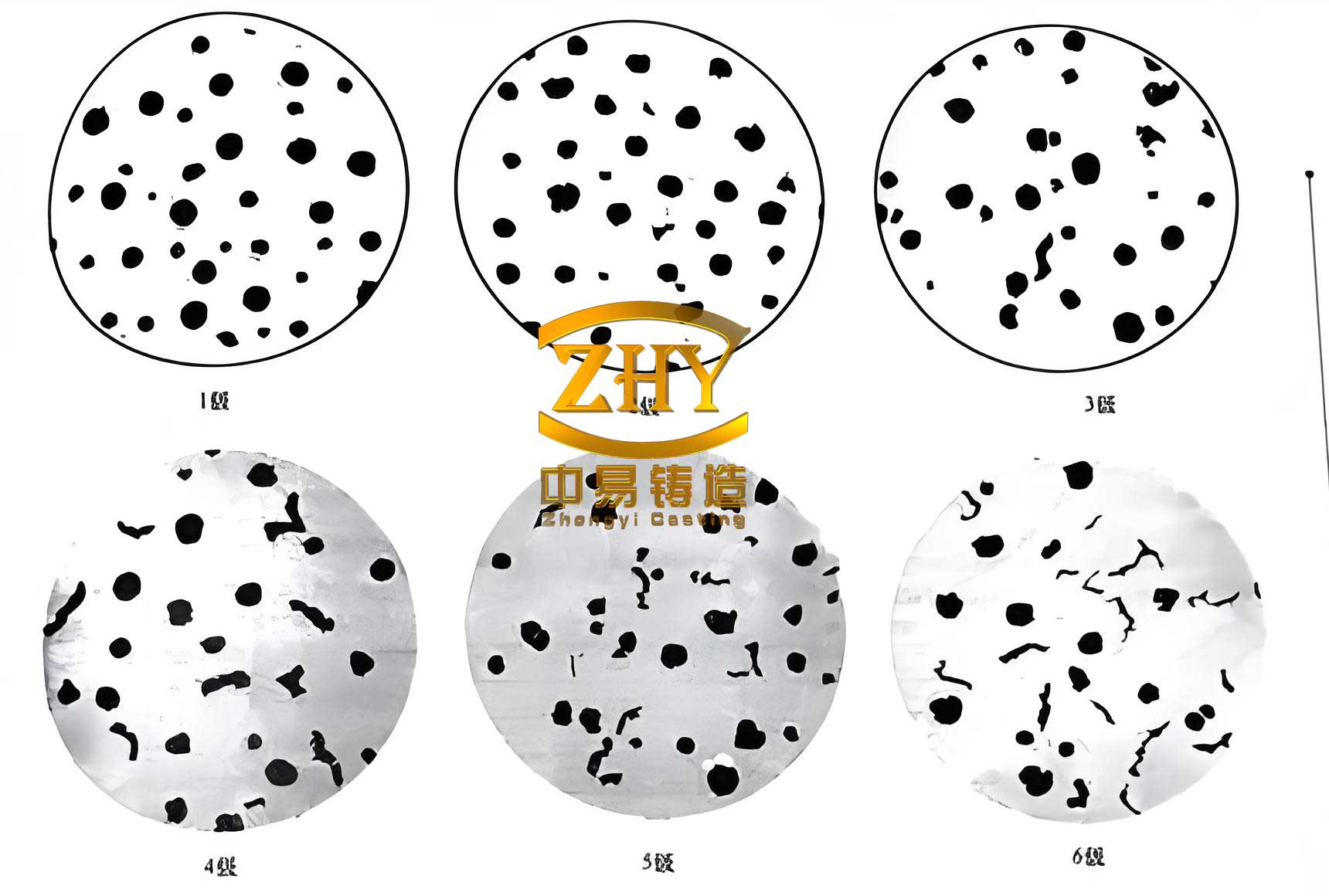
Metallographic Structure and Mechanical Properties: The controlled and rapid cooling inherent to the process can be beneficial for the microstructure of spheroidal graphite iron. Metallographic analysis on sectioned castings reveals a fine, uniform matrix structure. More importantly, the graphite morphology is excellent. Typical results show:
- Graphite Nodularity: >93% (Grade VI-VII according to ISO 945)
- Graphite Size: Mostly 7 (20-30 µm diameter)
- Nodule Count: 230-270 nodules/mm²
- Matrix Structure: Primarily ferritic-pearlitic, ratio adjustable via heat treatment if required.
This consistent, high-quality graphite structure is fundamental to achieving the desired ductility and strength in spheroidal graphite iron. The hardness of the castings in the as-cast condition typically ranges from 165 to 182 HB, well within the specification for most engineered spheroidal graphite iron components.
| Casting Defect Type | Incidence Rate (Traditional Sand) % | Incidence Rate (Cold Core Box) % | Improvement Factor |
|---|---|---|---|
| Sand Inclusion / Burn-on | 3.2 | 0.8 | 4.0x |
| Cold Shut / Misrun | 1.8 | 0.5 | 3.6x |
| Shrinkage Porosity | 2.5 | 1.1 | 2.3x |
| Subsurface Pinholes | 1.5 | 0.3 | 5.0x |
| Dimensional Out-of-Spec | 4.0 | 0.7 | 5.7x |
Productivity and Yield Metrics: The impact on operational efficiency is dramatic. The cycle time for producing a mold assembly (a stack of cores) is a fraction of the time required to produce an equivalent number of molds via traditional methods. For a typical small hinge component in spheroidal graphite iron, daily output jumped from 8-12 pieces using manual sand molding to 60-100 pieces using the semi-automated cold core box system. The yield, defined as the ratio of sound castings to total poured weight, increased by approximately 5-7 percentage points. This is attributed to reduced scrap from defects and the significant decrease in gating and risering weight relative to casting weight. The yield improvement (\(Y\)) can be expressed as:
$$ Y = \frac{W_\text{casting}}{W_\text{total poured}} \times 100\% $$
For cold core box, \(W_\text{total poured}\) is minimized due to efficient gating and the absence of large feeders for these spheroidal graphite iron castings.
Detailed Economic and Environmental Impact Analysis
Beyond technical quality, the economic justification for adopting cold core box assembly molding for spheroidal graphite iron is compelling. The savings manifest in material, labor, energy, and post-casting processing costs.
Direct Cost Savings per Casting: The economic benefits are multi-faceted. First, the ability to cast holes directly eliminates drilling operations for many parts, saving machine time and tool wear. Second, reduced machining allowances (from ~4 mm to ~2 mm) lower the volume of metal to be machined away, saving raw material and machining costs. Third, the higher yield means more saleable castings are produced from the same amount of molten spheroidal graphite iron. The reduction in casting weight for some components, thanks to more precise dimensions and thinner design-allowable sections, further contributes to material savings. The total cost saving (\(\Delta C\)) per casting can be modeled as a sum of contributing factors:
$$ \Delta C = \Delta C_\text{material} + \Delta C_\text{machining} + \Delta C_\text{energy} + \Delta C_\text{labor} – \Delta C_\text{mold mat.} $$
where \(\Delta C_\text{mold mat.}\) represents the potentially higher cost of sand/resin for the core process, which is often offset by the other savings.
Quantified Economic Benefits: The table below illustrates the tangible weight reduction and associated cost savings for a family of spheroidal graphite iron castings for a 120-ton plastic injection molding machine. The metal cost is assumed at 7 monetary units per kg.
| Casting Name | Weight – Traditional (kg) | Weight – Cold Box (kg) | Weight Reduction (kg) | Reduction (%) | Cost Saving per Casting (Monetary Units) |
|---|---|---|---|---|---|
| Long Hinge | 19.5 | 17.90 | 1.60 | 8.2 | 11.20 |
| Small Hinge | 1.8 | 1.55 | 0.25 | 13.9 | 1.75 |
| Hook Hinge Type 1 | 7.7 | 6.60 | 1.10 | 14.3 | 7.70 |
| Hook Hinge Type 2 | 9.3 | 8.20 | 1.10 | 11.8 | 7.70 |
These savings are compounded by the dramatic increase in production rate. The productivity gain (\(G_p\)) can be defined as:
$$ G_p = \frac{\text{Output}_\text{cold box} – \text{Output}_\text{traditional}}{\text{Output}_\text{traditional}} \times 100\% $$
For the small hinge, \(G_p\) exceeds 700%, fundamentally altering capacity planning and customer lead times for spheroidal graphite iron parts.
Environmental and Operational Considerations: The process also offers indirect benefits. The amine catalyst used in curing requires proper ventilation and scrubbing systems, but overall energy consumption is lower as curing occurs at room temperature, eliminating the need for large oven dryers or hot box equipment. The reduction in metal melted due to higher yield and lower weight directly correlates to lower energy consumption in the furnace and reduced CO₂ emissions per good casting. Furthermore, the working environment improves due to less manual handling of heavy sand molds and reduced airborne silica dust during core making compared to some traditional sand preparation methods.
Conclusion and Future Perspectives
The application of cold core box assembly molding to the production of spheroidal graphite iron castings has proven to be a resounding success from both technical and economic standpoints. While the process is well-established for other alloys, its adaptation to spheroidal graphite iron required targeted optimization of materials, process windows, and gating philosophy. The results speak clearly: enhanced surface finish, superior and consistent dimensional accuracy, excellent metallurgical quality with high nodularity and fine graphite structure, a significant reduction in common casting defects, and a staggering improvement in production throughput.
The economic analysis confirms substantial cost savings per casting through material efficiency, reduced machining, and higher yield. This makes the process highly competitive for batch and mass production of small to medium-sized engineering components in spheroidal graphite iron. Challenges remain, such as the initial investment in metal tooling and core shooting machinery, the need for effective gas scrubbing systems, and size limitations for very large castings. However, for the growing market of precision, high-integrity spheroidal graphite iron parts, the cold core box assembly molding process is no longer just an alternative—it is often the optimal choice. As technology advances, further integration with robotics for core handling and stacking, along with developments in more environmentally friendly binder systems, will only solidify the position of this innovative process in the future of spheroidal graphite iron foundry practice.