
The foundry industry, a cornerstone of modern manufacturing, has long grappled with the demanding and hazardous task of finishing cast iron parts. Traditional methods relying on manual labor or semi-mechanized processes are increasingly unsustainable. They present significant challenges: inconsistent product quality, low productivity, high labor intensity, severe environmental pollution from dust and noise, and substantial occupational safety risks. These factors collectively contribute to a growing recruitment crisis within the sector. In this article, I will elaborate on the transformative application of industrial robotics for grinding cast iron parts, detailing the system design, technical advantages, economic benefits, and implementation strategies from a practitioner’s perspective.
The imperative for automation in this domain is clear. Cast iron parts, after the casting process, possess excess material such as gates, risers, parting lines, and flash that must be removed to meet dimensional and surface finish specifications. Manual grinding is not only slow and inconsistent but also exposes operators to harmful airborne particulates and the risk of injury from high-speed abrasive tools. The introduction of robotic grinding cells represents a paradigm shift, addressing these issues head-on while delivering superior operational and financial performance.
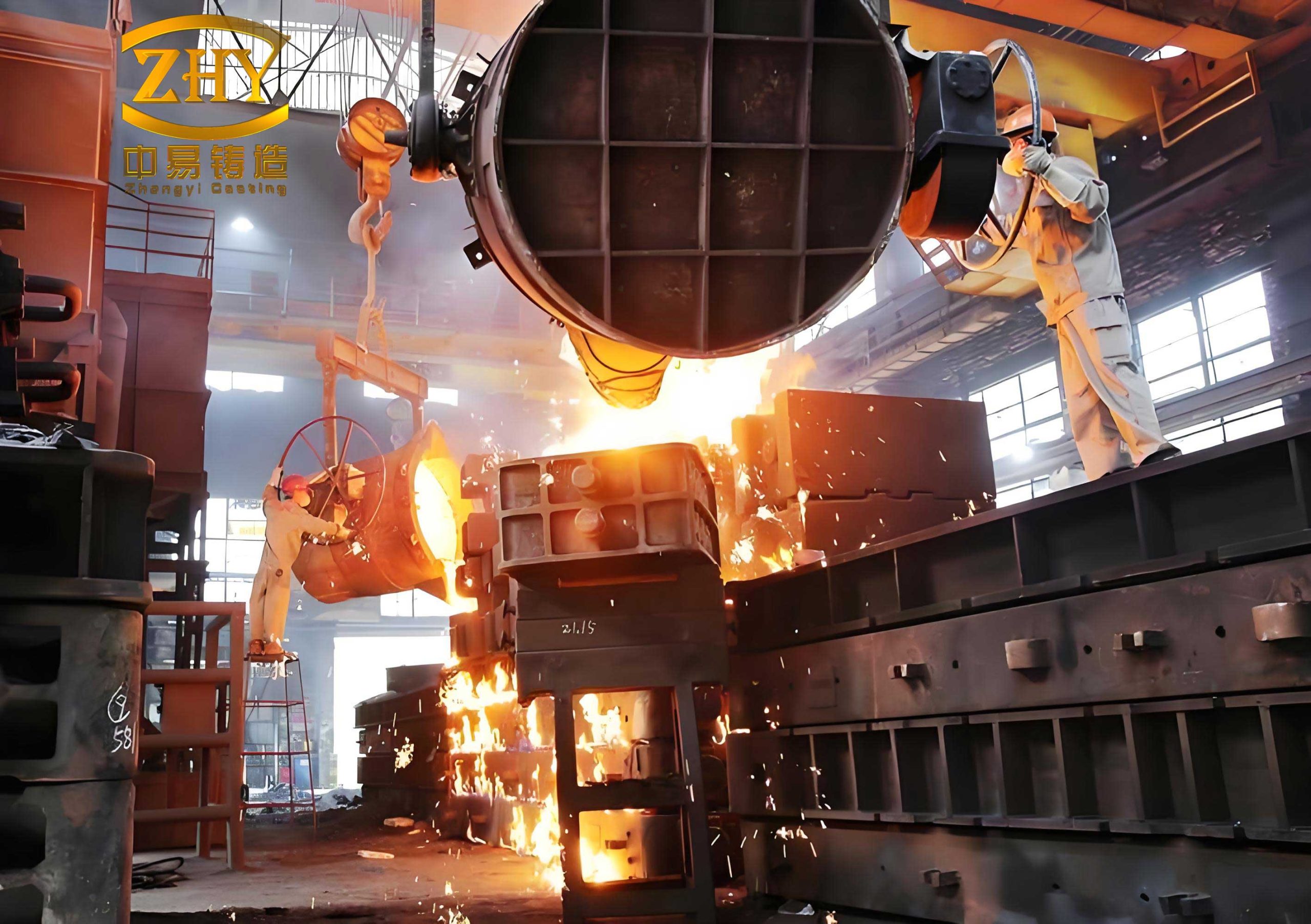
The core advantages of deploying industrial robots for grinding cast iron parts are multifaceted and compelling. Firstly, and most critically, it ensures exceptional and consistent quality. A robot’s end-of-arm tooling (EOAT) follows a programmed path with repeatable accuracy often within $$ \pm 0.05 \, \text{mm} $$, eliminating human variability. This precision translates directly to uniform surface finishes and precise dimensional tolerances across every batch of cast iron parts. Secondly, productivity soars. Robots can operate continuously across multiple shifts, drastically increasing throughput. The use of advanced, long-life tooling like diamond impregnated grinding wheels further reduces downtime associated with frequent tool changes. A single wheel might process over 2,000 cast iron parts before requiring replacement, a stark contrast to the rapid wear of conventional abrasive discs.
Thirdly, the operational environment is revolutionized. By encapsulating the grinding process within a sealed or partially enclosed cell equipped with integrated dust extraction, exposure to particulate matter (PM) and noise is virtually eliminated for human workers. This not only meets stringent environmental and safety regulations but also makes the workplace significantly more attractive. Fourthly, from a financial standpoint, the total cost of ownership becomes favorable. While the initial capital expenditure (CapEx) for a robotic cell is higher than for manual stations, the long-term operational expenditure (OpEx) is drastically lower. Savings are realized through reduced labor costs, lower consumption of abrasive media, minimized scrap and rework, and decreased costs associated with worker health and safety management. The following table summarizes the key comparative advantages:
| Aspect | Manual/Semi-Mechanized Grinding | Robotic Grinding |
|---|---|---|
| Quality Consistency | Low (Operator dependent) | High (Program controlled, repeatable) |
| Production Rate | Low, variable | High, stable (e.g., 20-50% increase) |
| Labor Requirement | High (Skilled labor intensive) | Low (Supervision and maintenance) |
| Operating Environment | Poor (High dust, noise, hazard) | Excellent (Contained, extracted) |
| Tooling Cost per Part | High (Frequent disc changes) | Low (Long-life diamond tools) |
| Flexibility | High (for simple tasks) | Very High (Reprogrammable for new parts) |
Designing an effective robotic grinding solution for cast iron parts requires a holistic systems approach. Two primary configurations are prevalent: Robot-Held-Tool (RHT) and Robot-Held-Part (RHP). In the RHT configuration, which is more common for medium to large cast iron parts, the robot manipulates the grinding spindle or tool against a stationary, fixture-held workpiece. This setup is ideal for complex geometries where the tool path needs significant dexterity. In the RHP configuration, the robot gripper holds the workpiece and presents it to a stationary grinding tool, such as a belt grinder or pedestal wheel. This is often suitable for smaller cast iron parts where the tooling is simpler and the part can be easily manipulated.
The system layout is critical for flow efficiency. A common design involves a dual-station or rotary table system. While the robot grinds a cast iron part in one station, an operator can safely unload a finished part and load a new raw casting in another station, maximizing robot utilization. For high-mix production, an automatic tool changer (ATC) and a tool magazine are integrated, allowing the robot to switch between different grinding wheels, brushes, or deburring tools for a single cast iron part as required by the process.
The heart of process consistency lies in the fixture design. A robust, repeatable fixture is non-negotiable. It must locate and clamp the often-irregular cast iron parts with high precision and rigidity to withstand grinding forces, which can be substantial. The clamping force $$ F_c $$ must be sufficient to prevent part movement, calculated based on the grinding force $$ F_g $$ and a safety factor $$ k_s $$ (typically 2-3):
$$
F_c \ge k_s \cdot F_g
$$
The grinding force itself is a function of material removal rate, wheel characteristics, and feed rate, often modeled empirically for specific cast iron parts.
Tool path generation and process optimization are where significant engineering value is added. Simple teach programming is insufficient for complex contours. Offline programming (OLP) software is used to generate efficient paths from the CAD model of the cast iron part. Furthermore, to achieve optimal surface finish and tool life, parameters like spindle speed $$ N $$, feed rate $$ v_f $$, and depth of cut $$ a_p $$ must be optimized. A common relationship for material removal rate (MRR) is:
$$
\text{MRR} \approx v_f \cdot a_p \cdot w
$$
where $$ w $$ is the width of cut. However, for finish grinding, a focus on specific energy and surface integrity is paramount. Adaptive force control is a game-changer. By integrating a force/torque sensor at the robot’s wrist, the system can maintain a constant contact force $$ F_{desired} $$ between the tool and the cast iron part, compensating for part-to-part variation and tool wear. The control law can be a simple proportional-integral (PI) adjustment to the robot’s path:
$$
\Delta z = K_p \cdot (F_{desired} – F_{measured}) + K_i \cdot \int (F_{desired} – F_{measured}) \, dt
$$
where $$ \Delta z $$ is the corrective offset in the normal direction.
The dust extraction system is not an auxiliary component but a core subsystem. Grinding cast iron parts generates vast amounts of fine, abrasive dust. A high-volume, low-pressure (HVLP) system with strategically placed hoods at the point of operation is essential. The required air volume $$ Q $$ can be estimated based on the hood opening area $$ A $$ and the required capture velocity $$ V_c $$ (typically 0.5-1.0 m/s for grinding):
$$
Q = A \cdot V_c \cdot 3600 \quad (\text{in m}^3/\text{h})
$$
Efficient filtration, often using cartridge filters or baghouses, ensures clean air is exhausted and valuable cast iron particulate can be collected for recycling.
The economic justification for robotic grinding of cast iron parts is robust. A detailed Total Cost of Ownership (TCO) analysis comparing a manual station to a robotic cell over a 5-year period typically reveals a compelling return on investment (ROI). The major cost drivers are illustrated below:
| Cost Category | Manual Cell (Annual) | Robotic Cell (Annual) | Notes |
|---|---|---|---|
| Labor | High (2-3 operators/shift) | Low (0.5 supervisor/shift) | Biggest saving driver |
| Abrasive Consumables | $$ C_m $$ | $$ \approx 0.3 \cdot C_m $$ | Diamond wheels last longer |
| Energy | $$ E_m $$ | $$ \approx 1.2 \cdot E_m $$ | Robot and spindle power |
| Maintenance | Low | Medium (Scheduled robot service) | Predictable cost |
| Scrap/Rework | $$ S_m $$ (3-5%) | $$ \approx 0.5 \cdot S_m $$ (1-2%) | Quality consistency reduces waste |
The payback period $$ T $$ can be approximated as:
$$
T = \frac{\text{Initial Investment}}{\text{Annual Savings}} = \frac{I_{\text{robot}} + I_{\text{fixture}} + I_{\text{peripheral}}}{(\text{Labor Savings} + \text{Consumable Savings} + \text{Quality Savings})_{\text{annual}}}
$$
For many foundries, this period falls between 1.5 to 3 years, after which the robotic cell generates pure cost savings.
Looking forward, the integration of advanced sensing and artificial intelligence will further enhance the capabilities of robotic grinding for cast iron parts. 3D vision systems can be used for automated bin picking of unordered cast iron parts or for scanning each part to generate a tailored grinding path, accommodating the natural variation in casting dimensions. Machine learning algorithms can analyze data from force sensors, spindle power, and acoustic emissions to predict tool wear in real-time, schedule preventive changes, and even identify subtle defects in the cast iron parts during processing.
In conclusion, the adoption of industrial robotics for grinding cast iron parts is no longer a luxury but a strategic necessity for competitive and sustainable foundry operations. It successfully addresses the critical trifecta of quality, productivity, and workplace safety. The technology is mature, the economic case is clear, and the systems are flexible enough to handle the high-mix production common in modern foundries. By implementing a well-designed robotic grinding cell—encompassing precise tool path planning, adaptive force control, robust fixturing, and integrated environmental management—manufacturers can transform a problematic, costly finishing process into a reliable, efficient, and clean value-adding stage in the production of high-quality cast iron parts.