
In my extensive experience in foundry engineering, I have consistently observed that the quality of cast iron parts is profoundly influenced by the additives used during melting, particularly carburizers. These materials are not merely carbon sources; they are pivotal modifiers that dictate the microstructure and mechanical properties of the final casting. The interplay of carbon, sulfur, and nitrogen introduced via the carburizer can make or break the integrity of cast iron parts. This article delves deep into my perspective on how these elements govern the behavior of iron melts and the subsequent performance of cast iron parts, supported by empirical data, theoretical models, and practical insights. I will emphasize the critical need to control these variables to produce reliable, high-performance cast iron parts for diverse industrial applications.
The foundation of modern cast iron production lies in the precise adjustment of melt chemistry. Carburizers are indispensable in this process, especially when using steel scrap or low-carbon charge materials. I categorize commercially available carburizers into three primary types: graphitized petroleum coke, calcined petroleum coke, and coal-based carburizers. Their effectiveness and impact on cast iron parts vary significantly due to differences in fixed carbon, sulfur, and nitrogen content. The table below summarizes a typical range based on my industry assessments:
| Type | Fixed Carbon Content (%) | Sulfur Content (%) | Nitrogen Content (%) |
|---|---|---|---|
| Graphitized Petroleum Coke | 96 – 99.5 | 0.05 – 0.3 | 0.01 – 0.1 |
| Calcined Petroleum Coke | 90 – 98.5 | 0.3 – 1 | 0.3 – 1 |
| Coal-based Carburizer | 85 – 93 | 1 – 3 | 1 – 1.5 |
From my perspective, graphitized petroleum coke is often the premium choice for high-quality cast iron parts due to its high carbon purity, low sulfur, and minimal nitrogen, leading to superior absorption rates and fewer defects. However, economic constraints sometimes necessitate the use of alternatives, demanding careful compensatory controls in the process.
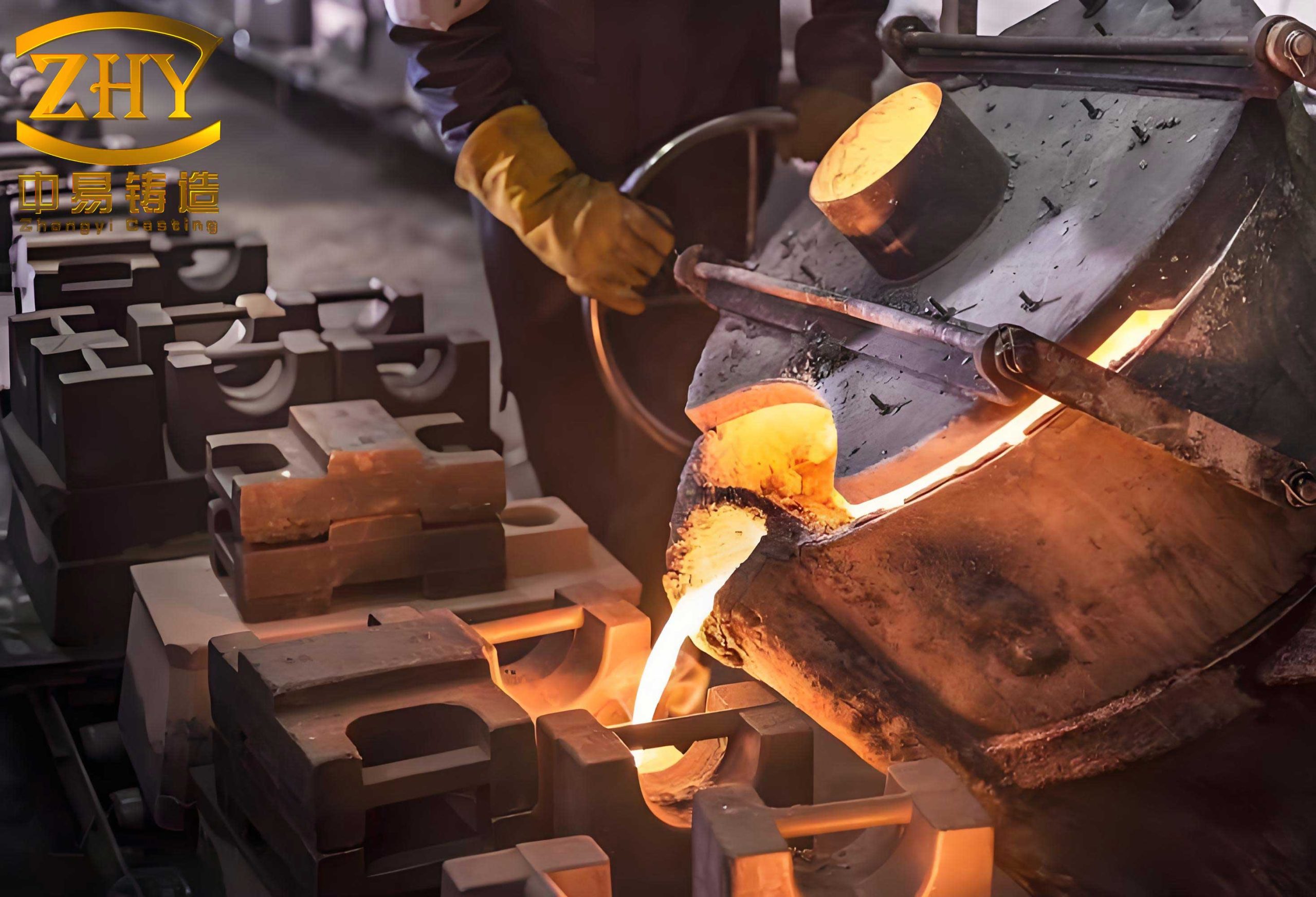
The visual above underscores the complexity and precision required in producing sound cast iron parts. Achieving such quality hinges on mastering the effects of each element introduced by the carburizer.
The Dominant Role of Carbon in Shaping Cast Iron Parts
Carbon is the backbone of all cast iron parts. In my work, I treat carbon not just as an element but as the architect of the microstructure. It exists in two primary forms: as free graphite or as combined carbon in cementite (Fe3C). The balance between these forms determines whether the cast iron parts exhibit ductility or hardness. Carbon strongly promotes graphitization. The fundamental relationship can be expressed in terms of its effect on the eutectic composition. For many practical calculations, I use the Carbon Equivalent (CE) formula to predict the microstructure tendency:
$$ CE = C + \frac{1}{3}(Si + P) $$
where C, Si, and P are the weight percentages of carbon, silicon, and phosphorus, respectively. A CE value close to 4.3 indicates a near-eutectic composition, favoring excellent castability for cast iron parts.
In gray iron cast iron parts, which constitute a large portion of industrial components, carbon content is typically controlled between 2.7% and 3.8%. My observations align with the theory that carbon directly influences graphite morphology. Higher carbon within this range increases the amount of graphite but promotes the formation of coarse, type A graphite flakes. This results in a ferritic matrix with lower mechanical strength and hardness but improved damping capacity and thermal conductivity. Conversely, lower carbon leads to finer graphite flakes within a pearlitic matrix, enhancing tensile strength and wear resistance at the expense of ductility. The effect on fluidity, crucial for filling intricate molds in cast iron parts, is also carbon-dependent. For hypoeutectic gray iron (CE < 4.3), increasing carbon improves fluidity. For hypereutectic iron (CE > 4.3), reducing carbon is necessary to avoid primary graphite precipitation that impedes flow. I often summarize these effects in a performance table for gray iron cast iron parts:
| Carbon Content Range | Primary Microstructure | Graphite Morphology | Key Mechanical Properties | Typical Application for Cast Iron Parts |
|---|---|---|---|---|
| High (≈3.6-3.8%) | Predominantly Ferrite | Coarse, Long Flakes | Low UTS, High Damping, Good Machinability | Engine Blocks, Manifolds |
| Medium (≈3.2-3.5%) | Pearlite + Ferrite | Medium Flakes | Balanced Strength and Damping | General Machinery Parts |
| Low (≈2.7-3.1%) | Predominantly Pearlite | Fine, Interdendritic Flakes | High UTS, High Hardness, Lower Ductility | High-Stress Components like Brake Discs |
For ductile iron cast iron parts, the paradigm shifts. Carbon content is usually higher, between 3.5% and 3.9%. After spheroidization treatment, a loss of 0.1-0.3% carbon is common. Here, carbon exists as spheroidal graphite, and its direct effect on mechanical properties is less pronounced than in gray iron because the spherical shape drastically reduces the stress-raising effect of graphite. However, carbon plays a vital role in foundry soundness. A higher carbon content promotes graphitic expansion during solidification, which compensates for shrinkage porosity—a critical concern for thick-section cast iron parts. This can be conceptually modeled by considering the volume change during the eutectic reaction:
$$ V_{graphite} > V_{austenite} $$
This expansion counteracts the shrinkage of the surrounding austenite, enhancing the dimensional accuracy and internal soundness of cast iron parts. If carbon is too low (<3.5%), the risk of forming undesirable free carbides increases, leading to brittleness and shrinkage defects. If carbon is too high (>4.0%), graphite flotation can occur, segregating graphite nodules at the top of the casting and degrading the properties of the cast iron parts.
In the case of compacted graphite iron (CGI) cast iron parts, carbon content is similar to ductile iron, around 3.5-3.9%. The carbon exists in a worm-like graphite form. The mechanical properties show a sensitive dependence on carbon content relative to the matrix. Higher carbon favors a ferritic matrix, offering better impact toughness and elongation but lower strength. Lower carbon promotes a pearlitic matrix, improving tensile strength and hardness but reducing ductility. For engineers designing cast iron parts, selecting the optimal carbon content is a trade-off based on the required service performance.
Sulfur: The Double-Edged Sword in Cast Iron Parts Production
Sulfur, introduced primarily through lower-grade carburizers like coal-based products, is generally considered a detrimental element in most cast iron parts. In my practice, I treat sulfur control as a non-negotiable aspect of melt preparation. Sulfur stabilizes cementite, inhibiting graphitization. It forms low-melting-point eutectics like FeS, which segregate at grain boundaries and cause hot tearing, reduced fluidity, and impaired mechanical strength in cast iron parts. The solubility of sulfur in liquid iron can be described by interaction coefficients with other elements. For instance, the presence of manganese is crucial as it forms stable, high-melting-point MnS inclusions, which are less harmful than FeS. The required manganese content to neutralize sulfur is often given by:
$$ Mn_{req} (\%) = 1.7 \times S (\%) + 0.3 $$
This formula is a rule of thumb I frequently use to prevent the formation of deleterious iron sulfides in cast iron parts.
For gray iron cast iron parts, sulfur is typically kept below 0.15%. Consequently, the carburizer used should have a sulfur content preferably below 0.5%. In ductile and compacted graphite iron cast iron parts, sulfur is an enemy of the treatment process. It actively consumes spheroidizing or vermiculizing agents (like Mg or Ce), forming stable sulfides and reducing the treatment efficiency. Therefore, for producing high-integrity ductile iron cast iron parts, I insist on using low-sulfur base iron and carburizers with sulfur content below 0.05%. The post-treatment sulfur level is often pushed below 0.02% to ensure a high nodule count and avoid impaired graphite morphology. The economic impact is significant: every 0.01% increase in initial sulfur can increase the required treatment alloy addition by 5-10%, directly affecting the cost of the cast iron parts.
| Type of Cast Iron Parts | Max. Recommended S in Melt (%) | Max. Recommended S in Carburizer (%) | Primary Concern |
|---|---|---|---|
| Gray Iron | 0.15 | 0.5 | Fluidity, Hot Tearing, Strength |
| Ductile Iron | 0.02 (post-treatment) | 0.05 | Treatment Efficiency, Graphite Sphericity |
| Compacted Graphite Iron | 0.02 (post-treatment) | 0.05 | Treatment Efficiency, Graphite Morphology |
Nitrogen: The Hidden Variable Affecting Soundness of Cast Iron Parts
Nitrogen’s role in cast iron parts is subtle yet critical. It is often overlooked until gas porosity defects appear. In my experience, nitrogen-related problems are among the most frustrating to diagnose in cast iron parts. Nitrogen dissolves interstitially in liquid iron. Its solubility decreases sharply upon solidification, leading to gas rejection. If the nitrogen content exceeds the solubility limit at the solidification front, and the evolved gas cannot escape, it forms porosity—typically sub-surface pinholes or fissure-like defects in interdendritic regions. The solubility of nitrogen in liquid iron is influenced by composition and temperature. An approximate relationship, valid for certain ranges, is:
$$ \log [N] = -\frac{188}{T} – 1.25 + \log(P_{N_2}^{1/2}) + \sum e_N^j [j] $$
where [N] is the dissolved nitrogen in ppm, T is temperature in Kelvin, \( P_{N_2} \) is the partial pressure of nitrogen, and \( e_N^j \) is the interaction coefficient of element j on nitrogen. Elements like Ti and Al have strong affinities for nitrogen and can tie it up as nitrides.
Paradoxically, a controlled amount of nitrogen (typically 60-120 ppm) can be beneficial for gray iron cast iron parts. It refines the graphite structure, shortens the flakes, increases their curvature, and promotes a pearlitic matrix. This leads to an increase in tensile strength and hardness. However, the window is narrow. When nitrogen content from carburizers and other charge materials exceeds a critical threshold—often around 150 ppm depending on cooling rate and other elements—nitrogen porosity becomes a severe risk. This is especially true for cast iron parts with large thermal modules or thick sections. Therefore, I strictly specify carburizers with nitrogen content below 0.02% (200 ppm) for critical applications. Coal-based carburizers, with nitrogen often above 1%, are virtually prohibited for producing high-quality, pressure-tight cast iron parts like those used in hydraulic systems.
The defect manifestation is distinct. Nitrogen pores are often accompanied by a textured or “crazed” surface appearance, as suggested in the literature. Preventing this requires a holistic approach: using low-nitrogen carburizers, controlling charge materials, and avoiding excessive superheat temperatures that increase gas absorption.
Integrated Control: A Systematic Approach for Optimal Cast Iron Parts
Producing superior cast iron parts is not about controlling elements in isolation. It’s about managing the synergistic and antagonistic interactions between carbon, sulfur, and nitrogen. From my standpoint, the melt treatment process should be viewed as a multi-variable optimization problem. The goal is to achieve the target microstructure and mechanical properties while minimizing defects and cost.
First, the choice of carburizer sets the baseline. For high-performance ductile iron cast iron parts, I recommend graphitized petroleum coke despite its higher cost, as its low sulfur and nitrogen provide a clean foundation, reduce treatment alloy consumption, and lower the defect rate. The absorption efficiency of carbon from the carburizer is also crucial and depends on addition practice, temperature, and bath agitation. A general formula for the theoretical carbon pickup is:
$$ C_{pickup} (\%) = \frac{W_{carb} \times FC \times \eta}{W_{melt}} \times 100 $$
where \( W_{carb} \) is the weight of carburizer added, \( FC \) is its fixed carbon fraction, \( \eta \) is the absorption efficiency (typically 75-95% for graphitized coke), and \( W_{melt} \) is the melt weight. Inefficient addition leads to carbon loss and inconsistent chemistry in cast iron parts.
Second, the sequential influence of these elements must be considered. For example, high sulfur requires high manganese, which can affect pearlite stability. High nitrogen might be tolerable if sufficient titanium is present to form innocuous TiN particles, but titanium can also affect graphite morphology. I often use interactive charts or software to predict the final microstructure based on the adjusted composition.
Third, process parameters like pouring temperature, cooling rate, and inoculation interact with the elemental composition. A higher cooling rate can suppress graphite growth and counter some effects of high carbon, but it may also increase the risk of chilling in thin sections of cast iron parts. Inoculation with FeSi alloys is used to control graphite nucleation independently of base carbon content.
Advanced Considerations and Future Directions for Cast Iron Parts
The pursuit of ever-stronger, lighter, and more durable cast iron parts drives continuous research. Emerging areas include the use of advanced carburizers doped with nucleation agents, real-time spectral analysis for melt control, and thermodynamic modeling to predict phase formation. The concept of “engineered carburizers” is gaining traction, where the carburizer is tailored not just for carbon content but also for specific trace elements that promote desired characteristics in cast iron parts.
Furthermore, environmental regulations are pushing for greater use of recycled steel scrap, which varies widely in residual elements. This makes the role of high-purity carburizers even more critical to dilute harmful residuals and achieve consistent properties in cast iron parts. The development of low-nitrogen, bio-based carburizers from renewable sources is an exciting frontier that could reduce the carbon footprint of producing cast iron parts.
In my view, the future of producing premium cast iron parts lies in digital integration. Combining real-time sensor data from the melting furnace with machine learning algorithms can predict optimal carburizer addition amounts and timing, minimizing human error and maximizing consistency across batches of cast iron parts.
Conclusion
Through my hands-on involvement in countless foundry campaigns, I have come to regard the carburizer not as a mere commodity but as a precision tool for metallurgical control. The carbon, sulfur, and nitrogen it carries are the levers we pull to engineer the performance of cast iron parts. Carbon defines the fundamental matrix and graphite structure, sulfur demands vigilant neutralization to avoid processing and property pitfalls, and nitrogen requires careful containment to ensure casting soundness. Mastering their individual and combined effects is what separates adequate cast iron parts from exceptional ones. By selecting the appropriate carburizer grade, employing scientific addition methods, and integrating this control within a holistic process management system, foundries can reliably produce cast iron parts that meet the most demanding specifications for strength, durability, and dimensional precision. The journey to perfect cast iron parts is continuous, but it always begins with a deep understanding of what we put into the melt.