
The rapid advancement of China’s equipment manufacturing industry has accelerated the development of high-end CNC machine tools. Market dynamics often demand highly sophisticated, large-scale machine tool castings in very low volumes and with extremely short delivery lead times. In such scenarios, the Lost Foam Casting (LFC) process emerges as the optimal choice to reduce costs and shorten production cycles for cast iron parts. While widely adopted for automotive and smaller castings, the application of LFC for large-scale cast iron parts, particularly those weighing between 500 kg to 2000 kg, has been limited, primarily due to challenges associated with coating quality. To address this gap, a dedicated research and development project was undertaken, focusing on the formulation and application of specialized coatings for cast iron parts. Over six months of production trials, more than 40 tons of large machine tool castings were successfully produced, demonstrating excellent results.
The LFC process utilizes foam patterns coated with a refractory slurry. These coated patterns are then embedded in unbonded sand. Upon pouring, molten metal replaces the vaporizing foam, forming the casting. This method offers advantages like high dimensional accuracy, low cost, and short lead times. However, precise control over every technical parameter is crucial; otherwise, defects such as burn-on, veining, and gas porosity can occur. The coating is one of the most critical technologies in the LFC process, playing a vital role in its successful application. The primary functions of an LFC coating are:
- Reinforcement: To enhance the strength and rigidity of the foam pattern, ensuring dimensional stability during handling.
- Protection: To protect the pattern from damage or deformation during transportation, sand filling, and compaction, thereby preserving the surface quality of the final cast iron parts.
- Barrier: To act as a primary barrier between the molten metal and the sand mold during pouring. It must prevent metal penetration into the sand while maintaining mold stability.
- Permeation: To allow the rapid evacuation of gaseous and liquid decomposition products from the vaporizing foam into the molding sand, preventing defects like gas holes. Therefore, a dedicated LFC coating must possess excellent working and technological properties.
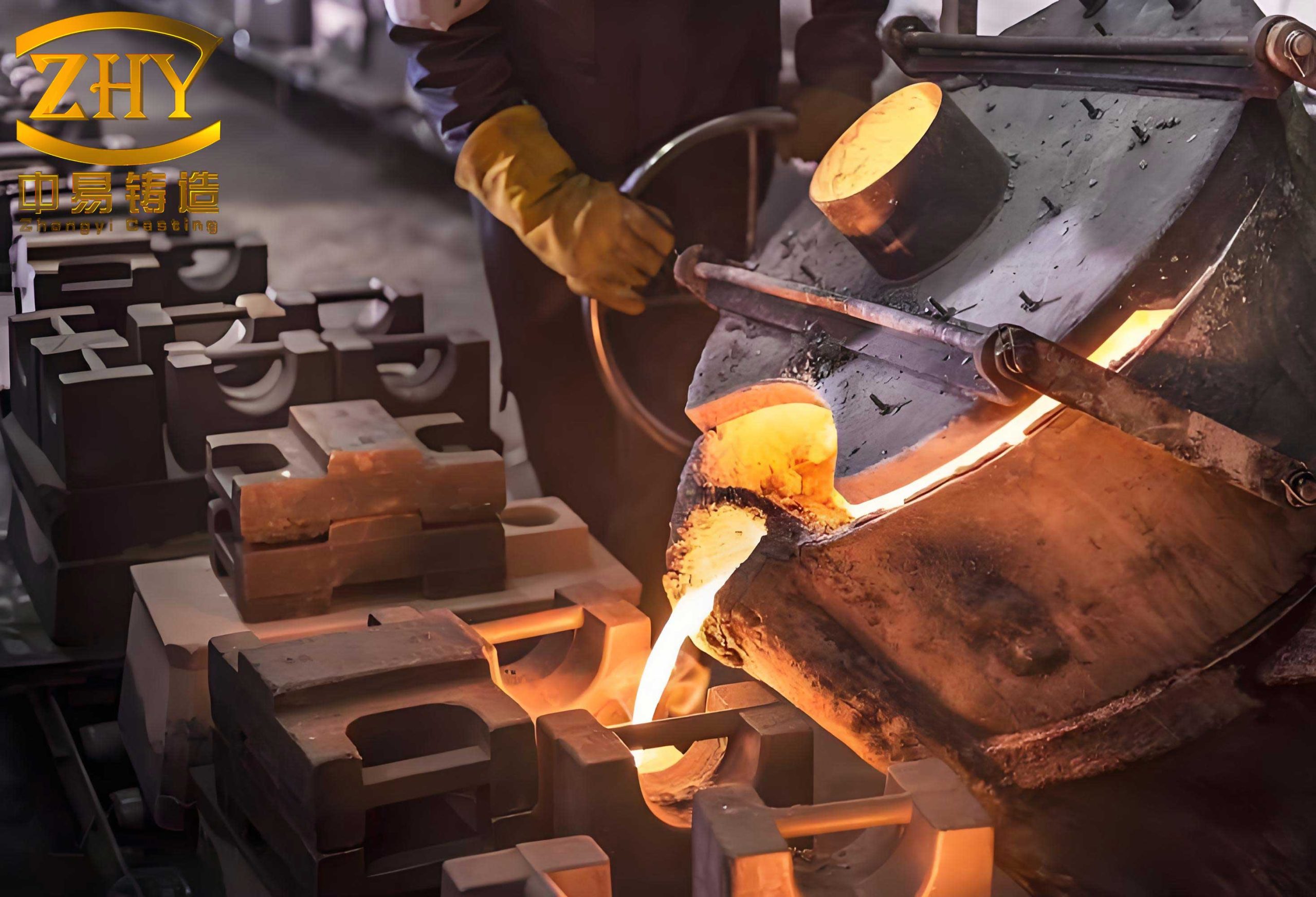
The development of a robust coating for cast iron parts requires a systematic approach to selecting and balancing its fundamental components: refractory aggregates, binders, carriers, surfactants, suspension agents, and other additives.
1. Refractory Aggregate Selection
The refractory aggregate is the primary constituent, dictating the coating’s refractoriness, chemical stability, insulating properties, and collapsibility. It also significantly impacts permeability and suspension. Scientific selection is paramount for a high-quality coating suitable for cast iron parts.
| Aggregate | Chemical Formula | Key Properties | Typical Application for Cast Iron Parts |
|---|---|---|---|
| Quartz Sand | SiO2 | Acidic; reacts with FeO at high temp. Prone to chemical burn-on. | Small to medium castings. Often blended with other aggregates for large sections. |
| Zircon Flour | ZrSiO4 | Chemically inert, low thermal expansion, high thermal conductivity. | High-quality castings. Effective but can be costly for very large cast iron parts. |
| Calcined Bauxite | Al2O3 (50-85%) | Good chemical inertness and sintering properties. Cost-effective. | Excellent for large cast iron parts, can replace zircon. Often blended with other aggregates. |
| Graphite Flake | C | Non-wetting with iron, good chemical stability, produces reducing atmosphere. | Primary aggregate for cast iron parts. Provides smooth surface finish. Blends of flake and amorphous graphite are common for large castings to prevent cracking. |
| Chromite Flour | FeCr2O4 | Excellent thermal stability, chilling power, non-reactive, sinters well. | Superior for very large steel castings; can be considered for heavy-section ductile iron parts. |
The performance of an aggregate can be quantified by its physical properties. The thermal stress resistance is a key factor, often related to thermal expansion (α) and thermal conductivity (k). A simplified metric for relative resistance to thermal shock can be considered as proportional to the ratio of thermal conductivity to the coefficient of thermal expansion and Young’s Modulus (E):
$$ R \propto \frac{k}{\alpha \cdot E} $$
Where aggregates with higher k and lower α generally perform better under the thermal shock of molten iron. The density (ρ) and particle size distribution significantly affect suspension stability and coating permeability. The optimal particle size distribution for LFC coatings often follows a modified Andreasen equation to achieve high packing density and controlled permeability:
$$ CPFT = 100\left(\frac{d}{d_{max}}\right)^q $$
Where CPFT is the Cumulative Percent Finer Than, d is the particle diameter, d_max is the maximum particle size, and q is the distribution modulus, typically aimed between 0.3 to 0.5 for coatings.
2. Binder Systems
A balanced binder system, combining inorganic and organic binders, is essential to achieve both high green/dry strength and sufficient high-temperature permeability after the organic burn-out.
2.1 Inorganic Binders: Sodium Bentonite is the most common. Its plate-like montmorillonite structure ($(Na, Ca)_{0.33}(Al, Mg)_2(Si_4O_{10})(OH)_2·nH_2O$) provides excellent suspension and bonding via ionic forces and water films. Other inorganic binders include sodium silicate (water glass) and silica sol (colloidal SiO2), which provide good high-temperature strength.
2.2 Organic Binders: These burn out during pouring, creating channels for gas escape. Common types include:
- Polyvinyl Alcohol (PVA): A water-soluble polymer forming strong films (e.g., PVA-1799).
- Latex Emulsions (e.g., SBR): Provide excellent flexibility and toughness to the dried coating.
- Cellulose Derivatives (CMC): Act as both suspending agent and supplementary binder.
- Starches & Dextrins: Natural binders offering good strength; pre-gelatinized starch (α-starch) dissolves easily in cold water.
The total binder content (Btotal) is a critical parameter, balancing strength and gas evolution. It can be expressed as a volume fraction of the coating solids:
$$ B_{total} = V_{inorg} + V_{org} $$
Where excessive organic binder ($V_{org}$) can lead to casting defects in thick-section cast iron parts due to excessive gas generation.
3. Additives: Surfactants, Suspension & Thixotropic Agents
3.1 Surfactants: Essential for water-based coatings to wet the hydrophobic foam pattern. Surfactant molecules have a hydrophilic head and a hydrophobic tail, aligning at the water-foam interface. Common non-ionic surfactants like OP-10 (Polyoxyethylene alkylphenyl ether) reduce surface tension (γ), improving coatability. The effectiveness relates to the reduction in contact angle (θ):
$$ \cos \theta = \frac{\gamma_{SG} – \gamma_{SL}}{\gamma_{LG}} $$
A lower γLG (liquid-gas surface tension) promoted by the surfactant leads to better spreading (lower θ).
3.2 Suspension & Thixotropic Agents: Sodium Bentonite and Carboxymethyl Cellulose (CMC) are dual-purpose agents. They form a weakly bonded network structure via hydrogen bonds and ionic bridges, described by a yield stress (τy) model. The coating behaves as a Bingham plastic:
$$ \tau = \tau_y + \eta \cdot \dot{\gamma} \quad \text{for } \tau > \tau_y $$
Where τ is shear stress, τy is yield stress (provided by the agent network), η is plastic viscosity, and $\dot{\gamma}$ is shear rate. This thixotropy allows the coating to flow when brushed (sheared) but prevents flow and sag once applied to the pattern for cast iron parts.
4. Coating Preparation and Applied Formulations
Proper preparation is key. The standard process involves pre-wetting all dry materials for over 24 hours, followed by thorough milling or rolling for 4-8 hours to break down agglomerates and develop binder chemistry. The final slurry density is adjusted with water to a specific Baume gravity or weight-per-gallon suitable for dipping or spraying.
Based on the principles above, several effective coating formulations for cast iron parts were developed and validated in production. The compositions are presented as weight percentages of the total solid components (excluding water).
| Component | Formula A (wt.%) | Formula B (wt.%) | Formula C (wt.%) | Function |
|---|---|---|---|---|
| Refractory Aggregate | Base Material | |||
| • Calcined Bauxite | 80-90% | – | 40-50% | Primary refractory for cast iron parts |
| • Quartz Flour | 10-20% | 66% (of aggregate) | – | Filler, adjusts permeability |
| • Flake Graphite | – | – | 30-40% | Non-wetting, smooth finish for cast iron parts |
| • Other (e.g., Alumina) | – | 33% (of aggregate) | – | Enhances refractoriness |
| Inorganic Binder | Green/Dry/High-Temp Strength | |||
| • Calcium Bentonite | 4% | – | – | Suspension & bonding |
| • Lithium Bentonite | – | 1% | – | Suspension & bonding |
| • Sodium Bentonite | – | – | 1% | Suspension & bonding |
| • Silica Sol | – | ~2.5% | 5% | High-temperature bonding |
| Organic Binder | Strength, Burns out for permeability | |||
| • PVA/Latex Emulsion | 4% | – | 5% | Film-forming strength |
| • Phenolic Resin | 4% | – | – | Thermosetting strength |
| • JD-1 Resin | – | 2% | – | Specialty LFC binder |
| Additives | Process Control | |||
| • CMC | – | ~0.7% | 3% | Suspension & thixotropy |
| • Surfactant (e.g., OP-10, JFC) | 0.1% (Laundry Powder) | 0.3% | 0.2% (FS-3) | Wetting agent for foam |
| • Defoamer (e.g., Isopropanol) | 0.1% | – | – | Prevents foam in slurry |
| • Dispersant / Water Reducer | – | 0.5% | 0.5% (SX-1) | Improves slurry fluidity |
| • Preservative | – | – | 0.5% (Benzoate) | Prevents spoilage |
Formula A utilizes a high bauxite content with quartz filler, bonded by a combination of organic resins and bentonite. It is robust and cost-effective for general large cast iron parts.
Formula B employs a controlled blend of quartz and alumina aggregates with silica sol and a specialized resin, focusing on controlled permeability and strength for complex cast iron parts.
Formula C is a graphite-based coating, ideal for producing excellent surface finish on cast iron parts. The blend of graphite and bauxite, along with a balanced binder system including silica sol and CMC, provides both refractoriness and easy strip.
The application of these coatings has enabled the successful production of major machine tool components like tables, beds, and headstocks, with individual cast iron parts weighing up to 2000 kg. The castings met all dimensional, mechanical, and machinability specifications, proving the efficacy of the tailored coating systems. This development marks a significant step in extending the benefits of Lost Foam Casting to the realm of heavy, high-value cast iron parts.