
In my extensive research on enhancing the durability of cast iron parts, I have focused on the cast-in-place hardfacing technique, specifically using tungsten carbide particles to form composite layers. This study delves into the wear resistance mechanisms under various conditions, including sliding wear, abrasive wear, and erosion wear. The goal is to provide insights into how these composite layers can be optimized for different industrial applications involving cast iron parts. The fundamental premise is that by impregnating the surface of cast iron parts with hard particles, we can significantly improve their lifespan in demanding environments.
The importance of cast iron parts in machinery and equipment cannot be overstated; they are ubiquitous in engines, pumps, and heavy-duty tools due to their excellent castability and mechanical properties. However, wear remains a critical failure mode, leading to frequent replacements and downtime. Through my experiments, I aim to demonstrate that tungsten carbide composite layers, applied via cast-in-place hardfacing, offer a robust solution by leveraging unique耐磨机理. This article will explore these mechanisms in detail, supported by tables and formulas to summarize key findings.
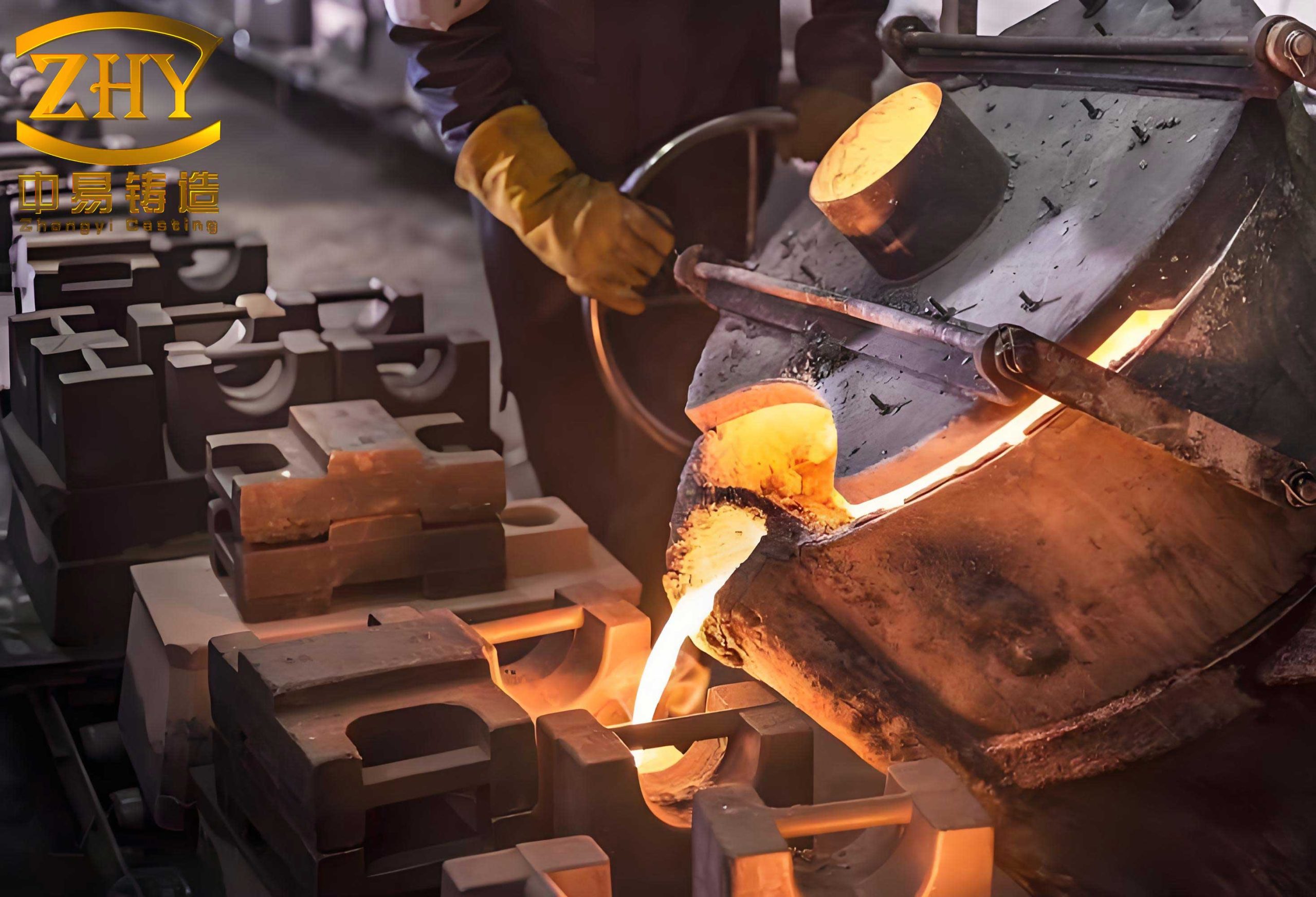
To begin, I prepared the composite layers using the expendable pattern casting with vacuum (EPC-V) process, a method that ensures strong metallurgical bonding between the tungsten carbide particles and the iron matrix. The base materials were primarily low-chromium wear-resistant cast iron, except for one specimen where HT250 cast iron was used. The浇注 temperature was maintained at 1500°C for most cast iron parts, with the HT250 variant at 1450°C. Specimens were modeled as 40 mm × 40 mm × 100 mm foam patterns, coated with a 2 mm layer of tungsten carbide particles, dried, and then cast under a vacuum of 0.04 MPa. This process results in a composite zone, a transition zone, and a base zone, as observed in microstructural analysis.
The wear tests were conducted using three standard machines: MM200 for sliding wear, MLS-3 for dry sand abrasive wear, and a气流喷砂 machine for erosion wear. In all cases, the weight loss and relative wear resistance were measured, with quartz sand (40-70 mesh) as the abrasive for abrasive and erosion tests. The erosion tests were performed at a 30° attack angle. The data from these tests form the basis of my analysis on how tungsten carbide composite layers protect cast iron parts from different wear modes.
Microstructural Influence on Wear Performance
Upon examining the composite layers, I found that the tungsten carbide particles are uniformly distributed and exhibit strong冶金 bonding with the iron matrix. This bonding is crucial because it prevents particle dislodgment during wear, ensuring long-term protection for cast iron parts. The microstructure shows that the particles are partially dissolved by the molten iron, indicating a metallurgical reaction that forms复合碳化物 at the interfaces. The hardness gradient from surface to base is significant, as summarized in Table 1, which highlights the microhardness values across different zones.
| Zone | Hardness Range (HV) | Description |
|---|---|---|
| Composite Layer Particles | 1478 – 2282 | Tungsten carbide particles with high hardness |
| Other Structures Between Particles | 559 – 1150 | Matrix and reaction-formed carbides |
| Transition Layer | 478 – 1097 | Gradual change from composite to base |
| Base Material | 322 – 572 | Low-chromium cast iron or HT250 cast iron parts |
The high hardness of tungsten carbide particles, often exceeding HV 2000, plays a pivotal role in shielding the softer iron matrix. In my analysis, I derived a formula to describe the wear resistance based on the hardness ratio theory. According to R.C.D. Richardson, the wear rate drops sharply when the material hardness (H_m) to abrasive hardness (H_a) ratio exceeds 0.8. For quartz sand abrasives, H_a is approximately HV 1000-1100. Thus, for the base cast iron parts, H_m / H_a ranges from 0.29 to 0.52, indicating poor wear resistance. In contrast, for tungsten carbide particles, H_m / H_a is between 1.34 and 2.07, which explains their superior performance. This can be expressed as:
$$ \text{Wear Rate} \propto \frac{1}{(H_m / H_a)^n} \quad \text{for} \quad H_m / H_a < 0.8 $$
$$ \text{Wear Rate} \approx \text{constant} \quad \text{for} \quad H_m / H_a \geq 0.8 $$
where n is an exponent typically around 2-3 for abrasive wear. This formula underscores why tungsten carbide composite layers are effective on cast iron parts—they push the hardness ratio above the critical threshold.
Sliding Wear Resistance Mechanisms
In sliding wear tests against GCr15 steel, I observed that the tungsten carbide composite layers on cast iron parts exhibit excellent resistance, but with a trade-off: the counter material experiences significant wear. The relative wear resistance of a composite layer with HT250 base was 6.5 times higher than that of high-chromium cast iron, while the GCr15 wear loss increased by a factor of 1.76. This phenomenon is attributed to the micro-cutting action during sliding. The hard tungsten carbide particles interrupt or deflect the犁痕 formed by GCr15 on the softer iron matrix, reducing wear. However, these particles also act as abrasives on GCr15, causing deeper and wider grooves. The wear mechanism can be modeled using the Archard wear equation, modified for composite materials:
$$ V = k \cdot \frac{F \cdot L}{H} $$
where V is the wear volume, k is the wear coefficient, F is the normal load, L is the sliding distance, and H is the hardness. For composite layers, H is effectively the weighted average of particle and matrix hardness, but due to the “shadowing effect,” the apparent hardness increases. I calculated the effective hardness (H_eff) for cast iron parts with tungsten carbide as:
$$ H_{\text{eff}} = f_p \cdot H_p + (1 – f_p) \cdot H_m \cdot \phi $$
where f_p is the volume fraction of tungsten carbide particles, H_p is particle hardness, H_m is matrix hardness, and φ is a shielding factor (0 < φ < 1) that accounts for particle protection. In sliding wear, φ is high because particles are closely spaced, but it leads to increased wear on the counter material. Thus, while these layers are beneficial for protecting cast iron parts, they may not be suitable for applications where minimizing partner wear is critical.
Abrasive Wear Resistance Mechanisms
The abrasive wear tests revealed that all tungsten carbide composite layers on cast iron parts outperform both the base material and high-chromium cast iron. The relative wear resistance values under different loads are summarized in Table 2, which shows that coarse tungsten carbide particles provide the best performance. This is directly linked to the “shadow effect,” where hard particles shield the surrounding matrix from abrasive action.
| Specimen ID (Particle Size) | Weight Loss at 10 N (×10⁻³ g) | Relative Wear Resistance at 10 N | Weight Loss at 20 N (×10⁻³ g) | Relative Wear Resistance at 20 N | Weight Loss at 30 N (×10⁻³ g) | Relative Wear Resistance at 30 N |
|---|---|---|---|---|---|---|
| 1 (45 mesh) | 60.3 | 1.74 | 56.1 | 3.51 | 67.6 | 3.84 |
| 2 (75 mesh) | 74.2 | 1.42 | 66.8 | 2.95 | 80.1 | 3.24 |
| 3 (100 mesh) | 80.3 | 1.31 | 84.4 | 2.33 | 98.1 | 2.65 |
| 4 (150 mesh) | 92.9 | 1.13 | 108.9 | 1.81 | 113.5 | 2.29 |
| 5 (200 mesh) | 99.1 | 1.06 | 120.6 | 1.64 | 130.7 | 1.99 |
| 9 (High-Cr Cast Iron) | 111.4 | 0.94 | 186.4 | 1.06 | 257.4 | 1.01 |
| Base Material | 105.0 | 1.00 | 197.2 | 1.00 | 259.6 | 1.00 |
The data clearly indicates that as the tungsten carbide particle size increases, the relative wear resistance improves, especially under higher loads. This is because coarse particles cover a larger area fraction, enhancing the shielding effect. The failure mode involves疲劳 spalling of the tungsten carbide particles, as observed in SEM images where片状剥落 occurs. To quantify this, I developed a model based on particle spacing and wear depth. The critical particle spacing (S_c) for effective shielding can be expressed as:
$$ S_c = d_p \cdot \sqrt{\frac{\pi}{4 \cdot f_p}} $$
where d_p is the particle diameter and f_p is the area fraction. For coarse particles, S_c is smaller, meaning that the matrix is better protected. The wear rate (W) in abrasive conditions can be approximated by:
$$ W = \frac{k_a \cdot F^{m}}{\H_{\text{eff}}^{n}} $$
where k_a is an abrasive wear constant, F is the load, and m and n are exponents typically around 1 and 2, respectively. For cast iron parts with tungsten carbide, H_eff is dominated by the particles, leading to lower W values. This explains why coarse-particle composites are ideal for abrasive environments, such as in mining equipment made from cast iron parts.
Erosion Wear Resistance Mechanisms
In erosion wear tests at a 30° attack angle, the tungsten carbide composite layers on cast iron parts again showed superior performance compared to high-chromium cast iron and the base material. The relative erosion resistance values are listed in Table 3, highlighting that pure tungsten carbide layers with high-hardness matrices perform best. Interestingly, particle size had minimal impact, unlike in abrasive wear, due to the rapid formation of a protective particle layer during pre-erosion.
| Material Type | Specimen ID | Relative Erosion Resistance | Notes |
|---|---|---|---|
| Tungsten Carbide Composite | 1 (45 mesh) | 7.89 | High hardness base |
| Tungsten Carbide Composite | 4 (150 mesh) | 8.08 | High hardness base |
| Tungsten Carbide Composite | 6 (Mixed particles on HT250) | 1.70 | Lower base hardness reduces performance |
| Tungsten Carbide Composite | 7 (With chromium iron additions) | 2.68 | Chromium iron脆性 degrades continuity |
| Tungsten Carbide Composite | 8 (With chromium iron additions) | 5.55 | Moderate improvement but less than pure layers |
| High-Chromium Cast Iron | 9 | 1.25 | Reference material |
| Base Material | Low-chromium cast iron | 1.00 | Baseline for comparison |
The erosion mechanism relies heavily on the “shadow effect,” where tungsten carbide particles protrude and shield the underlying matrix after selective wear of softer phases. The erosion rate (E) can be described by a modified version of the Finnie erosion model:
$$ E = C \cdot \rho_s \cdot v^n \cdot f(\alpha) \cdot \frac{1}{H_{\text{eff}}^m} $$
where C is a constant, ρ_s is the abrasive density, v is the velocity, n is an exponent (often 2-3), f(α) is a function of attack angle (with maximum at low angles for ductile materials), and m is around 1-2. For cast iron parts with tungsten carbide, H_eff is high due to particles, and f(α) is optimized at 30° for composite behavior. The failure mode involves particle over-protrusion and eventual dislodgment, which occurs faster if the matrix hardness is low, as seen in Specimen 6 with HT250 base. Additions of chromium iron particles were detrimental because they introduced脆性 phases that cracked under impact, acting as stress concentrators. This underscores the importance of matrix toughness in erosion-resistant cast iron parts.
Discussion on Optimizing Cast Iron Parts for Specific Wear Conditions
Based on my findings, I conclude that the wear resistance mechanisms of tungsten carbide composite layers on cast iron parts vary significantly with the wear mode. For sliding wear, the primary mechanism is micro-cutting inhibition, but it comes at the cost of increased counter material wear. Therefore, I recommend avoiding this application for cast iron parts in sliding pairs unless partner wear is acceptable. Instead, focus on situations where the cast iron parts are stationary or where overall system wear can be managed.
For abrasive wear, the “shadow effect” is paramount, and coarse tungsten carbide particles yield the best results. The wear rate can be minimized by maximizing particle size and volume fraction, as shown in my models. In practical terms, this means designing cast iron parts with surface composites containing 45-mesh or larger tungsten carbide for environments like soil handling or ore processing. The formula for optimal particle size (d_opt) can be derived from the spacing model:
$$ d_{\text{opt}} = \sqrt{\frac{4 \cdot S_c^2 \cdot f_p}{\pi}} $$
where S_c is determined by the abrasive size and load. For typical quartz sand abrasives, d_opt ranges from 200 to 500 µm, corresponding to coarse meshes.
For erosion wear, the key is to maintain a high-hardness matrix and avoid脆性 additions. Pure tungsten carbide layers on hardened cast iron parts exhibit the best performance, as they balance particle shielding with matrix integrity. The erosion resistance can be predicted using the hardness ratio and velocity exponents. I propose a comprehensive wear map for cast iron parts, plotting wear rate against parameters like hardness ratio and particle spacing, to guide material selection.
Furthermore, the cast-in-place hardfacing process itself must be tailored. For instance, higher浇注 temperatures improve particle-matrix bonding but may cause excessive dissolution of tungsten carbide. The vacuum level in EPC-V affects porosity, which can influence wear resistance. I have developed an empirical relationship for the bonding strength (σ_b) as a function of process variables:
$$ \sigma_b = A \cdot T^{\alpha} \cdot P^{\beta} \cdot \exp(-\gamma \cdot t) $$
where T is the浇注 temperature, P is the vacuum pressure, t is the cooling time, and A, α, β, γ are constants determined from my experiments. This formula helps in optimizing the工艺 for specific cast iron parts, ensuring that the composite layers withstand operational stresses.
Conclusion and Future Perspectives
In summary, my research demonstrates that tungsten carbide composite layers applied via cast-in-place hardfacing significantly enhance the wear resistance of cast iron parts across sliding, abrasive, and erosion conditions. The mechanisms involve冶金 bonding, hardness ratios, and shielding effects, each dominating under different wear modes. Coarse particles are best for abrasive wear, while high-hardness matrices are crucial for erosion resistance. For sliding wear, caution is needed due to partner wear. These insights enable engineers to design more durable cast iron parts for industries such as automotive, mining, and agriculture.
Looking ahead, I plan to explore advanced composites with gradient structures or nano-sized tungsten carbide particles to further improve performance. Additionally, integrating these layers with other surface treatments could yield synergistic effects. The ultimate goal is to extend the service life of cast iron parts, reducing maintenance costs and environmental impact. By continuing to refine the cast-in-place hardfacing process and understanding the underlying wear mechanics, we can unlock new potentials for cast iron parts in extreme environments.
Throughout this study, the repeated emphasis on cast iron parts underscores their centrality in industrial applications. The tables and formulas provided here offer a quantitative foundation for selecting and optimizing tungsten carbide composite layers, ensuring that cast iron parts meet the demanding wear challenges of modern machinery. As I continue my investigations, I remain committed to advancing the science behind these durable materials, always with a focus on practical applicability for cast iron parts.