
In our foundry, we have implemented a riserless casting process for large-section cast iron parts, including gray iron and ductile iron, since the early 2010s. Over more than a decade of application, this method has yielded ideal results, achieving a metal yield rate of over 95% and producing cast iron parts with dense internal structures. The success of this technique hinges on leveraging the inherent volume changes during solidification, eliminating the need for traditional risers. This article details the principles, scope, process requirements, and practical applications of riserless casting for cast iron parts, providing a comprehensive reference for foundries seeking to enhance efficiency and quality. Throughout this discussion, we will emphasize the benefits and methodologies specific to cast iron parts, as they form the core of our production line.
The fundamental principle of riserless casting for cast iron parts revolves around understanding the volume changes that occur during solidification. When molten iron fills the mold cavity and cools, its volume does not simply contract linearly; instead, it undergoes a complex interplay of shrinkage and expansion due to phase transformations, particularly graphite precipitation. The general pattern of volume change can be represented graphically, but for clarity, we describe it mathematically. The total volume change (ΔV) during solidification is a function of three key components: liquid contraction (α), expansion during solidification (β), and secondary contraction (γ). This relationship can be expressed as:
$$ \Delta V = \alpha + \beta + \gamma $$
In this context, α represents the volume decrease as the molten iron cools from pouring temperature to the liquidus point, β denotes the volume increase due to graphite formation and other metallurgical phenomena during solidification, and γ accounts for the contraction that occurs after solidification is complete. For cast iron parts, especially those with large sections, the expansion β can exceed the sum of α and γ under specific conditions. Specifically, when the molten iron temperature falls below a critical point—typically around 1150°C for ductile iron cast iron parts—the expansion β becomes greater than the contraction (α + γ). This net expansion allows the cast iron part to compensate for its own shrinkage, obviating the need for external feeding via risers. Thus, the riserless casting of cast iron parts exploits this self-compensating mechanism, which is inherently tied to the material properties of cast iron.
To quantify this, we can model the volume changes with empirical formulas. For instance, the liquid contraction α can be approximated as:
$$ \alpha = k_1 \cdot (T_p – T_l) $$
where \( k_1 \) is a material-dependent constant (e.g., for gray iron, \( k_1 \approx 0.0005 \, \text{cm}^3/\text{°C} \)), \( T_p \) is the pouring temperature, and \( T_l \) is the liquidus temperature. The expansion β is primarily influenced by graphite content and cooling rate, often expressed as:
$$ \beta = k_2 \cdot C_g \cdot f(G) $$
where \( k_2 \) is another constant, \( C_g \) is the carbon equivalent, and \( f(G) \) is a function of graphite morphology. For ductile iron cast iron parts, β can be significant, reaching up to 2–3% volume increase. The secondary contraction γ is relatively small, typically around 1% for cast iron parts. When designing riserless casting processes for cast iron parts, we ensure that the casting conditions favor β > α + γ, which is achieved by controlling pouring temperature and section thickness. The following table summarizes the typical volume change parameters for common cast iron parts:
| Type of Cast Iron Part | Liquid Contraction α (%) | Expansion β (%) | Secondary Contraction γ (%) | Net Volume Change (%) |
|---|---|---|---|---|
| Gray Iron (HT200) | 1.5–2.0 | 1.0–1.5 | 0.8–1.2 | -0.3 to +0.2 |
| Ductile Iron (QT500-7) | 1.8–2.2 | 2.0–3.0 | 1.0–1.5 | +0.5 to +1.5 |
As shown, ductile iron cast iron parts often exhibit a positive net volume change, making them ideal for riserless casting. However, this process is not universally applicable to all cast iron parts; it requires careful consideration of material grades and geometric factors.
The applicability of riserless casting for cast iron parts is limited to specific conditions to ensure reliability. In our foundry, we restrict its use to ductile iron and gray iron with grades equal to or below HT200. Additionally, the equivalent thickness of the cast iron part must exceed 5 cm to provide sufficient thermal mass for the expansion effect to dominate. Equivalent thickness (T_eq) is calculated as the volume-to-surface area ratio, which for simple shapes can be derived as:
$$ T_{\text{eq}} = \frac{V}{A_s} $$
where \( V \) is the volume of the cast iron part and \( A_s \) is its surface area. For complex cast iron parts, we use numerical simulations to estimate T_eq. The table below outlines the scope of application:
| Parameter | Requirement for Riserless Casting | Rationale |
|---|---|---|
| Material Type | Ductile iron or gray iron ≤ HT200 | Higher graphite content favors expansion |
| Equivalent Thickness | > 5 cm | Ensures slow cooling for expansion dominance |
| Casting Weight | Up to 30 tons (based on our experience) | Scalability proven for large cast iron parts |
By adhering to these guidelines, we minimize defects such as shrinkage porosity in cast iron parts. The process demands stringent control over several aspects to harness the self-feeding capability effectively.
Process requirements for riserless casting of cast iron parts are meticulous, focusing on mold rigidity, gating design, and temperature management. First, we utilize dry sand molds to ensure high strength and minimize mold wall movement. The sand must be compacted tightly, with a mold hardness no less than 85 on the B-scale for green sand molds. Flask bolts are tightened securely to prevent any loosening during the expansion phase of cast iron parts solidification, which could lead to dimensional inaccuracies. Second, the gating system is designed based on simultaneous solidification principles. We use thin, flat ingates placed at thinner sections of the cast iron part to promote uniform cooling. The ingates freeze quickly after pouring, preventing backflow of molten iron and isolating the casting from the gating system. The total cross-sectional area of ingates (ΣA_in) is calculated using the following formula:
$$ \Sigma A_{\text{in}} = \frac{G}{0.31 \mu \sqrt{H}} \sqrt{t} $$
where \( G \) is the total weight of molten iron in the mold (including the gating system) in kilograms, \( \mu \) is a velocity coefficient (typically taken as 0.5 for cast iron parts), \( H \) is the average pressure head in centimeters, and \( t \) is the pouring time in seconds. The gating ratio is maintained as ΣA_in : ΣA_run : ΣA_cho = 1 : 1.2 : 1.4, where ΣA_run is the total cross-sectional area of runners and ΣA_cho is that of the choke. This ratio ensures balanced flow and rapid filling for cast iron parts. Third, venting is crucial; the total vent area should be equal to or greater than ΣA_in to allow gases to escape, preventing blowholes in cast iron parts. Lastly, we control the pouring temperature strictly at or below 1320°C to favor the expansion regime. The table below summarizes key process parameters:
| Process Aspect | Specification | Impact on Cast Iron Parts |
|---|---|---|
| Mold Type | Dry sand, hardness ≥ 85 | Prevents mold deformation during expansion |
| Ingate Design | Thin and flat, at thin sections | Promotes early freezing and isolation |
| Gating Ratio | 1 : 1.2 : 1.4 (in : run : cho) | Ensures proper feeding and minimal turbulence |
| Venting Area | ≥ ΣA_in | Reduces gas defects in cast iron parts |
| Pouring Temperature | ≤ 1320°C | Enhances expansion effect for self-feeding |
Implementing these requirements has enabled us to produce sound cast iron parts consistently. To illustrate, let’s delve into practical applications from our foundry.
We have applied riserless casting to various cast iron parts, ranging from test blocks to heavy machinery components. One notable example is a test block with dimensions 600 mm × 400 mm × 300 mm, made of HT200 gray iron, with a gross weight of 500 kg. We used a gating ratio of 1 : 1.2 : 1.4 and dry sand molds, pouring at 1300°C ± 10°C. The resulting cast iron part exhibited a smooth surface without sink marks. Upon sectioning, the internal structure was dense, free from shrinkage cavities or porosity. Another case is an ingot mold equivalent to HT150, weighing 4,000 kg, with a minimum wall thickness of 80 mm. By employing riserless casting, we achieved a flawless surface and met all performance specifications. For a base frame cast iron part made of ductile iron (similar to QT600-3), with a weight of 12,000 kg and wall thicknesses mostly over 50 mm, we used chills at thermal junctions and maintained a pouring temperature of 1280°C. After machining, no casting defects were detected, underscoring the efficacy of this method for large cast iron parts. The following table compares these applications:
| Cast Iron Part | Material | Weight (kg) | Key Thickness (mm) | Pouring Temperature (°C) | Outcome |
|---|---|---|---|---|---|
| Test Block | HT200 Gray Iron | 500 | 30–50 | 1300 ± 10 | Dense, no defects |
| Ingot Mold | HT150 Gray Iron | 4,000 | 80–120 | 1290 | Sound surface and interior |
| Base Frame | Ductile Iron (~QT600-3) | 12,000 | 50–100 | 1280 | No shrinkage after machining |
Over four years, we have produced hundreds of tons of cast iron parts via riserless casting, including gray iron parts up to 8 tons with 80 mm walls and ductile iron parts up to 5 tons with sections of 150–200 mm. All have met quality standards, demonstrating the robustness of this approach for cast iron parts.
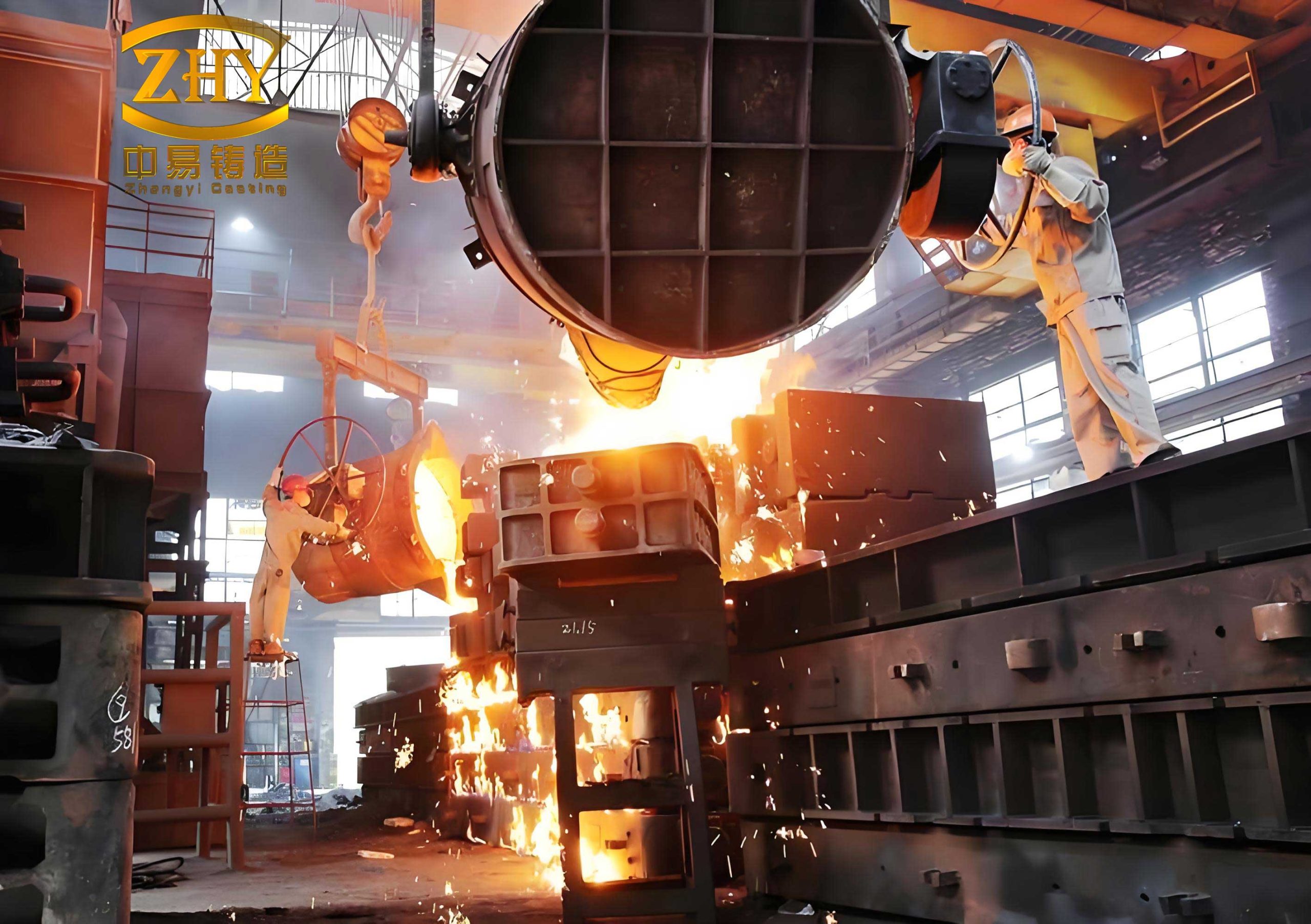
The image above exemplifies the high-quality surface finish and integrity achievable in cast iron parts through riserless casting. This visual reinforces the practical benefits discussed, highlighting how meticulous process control yields superior cast iron parts.
Beyond the core process, we have explored optimizations to enhance riserless casting for cast iron parts. For instance, we integrate computational simulations to predict solidification patterns and optimize chill placement. The use of chills is critical for thick sections in cast iron parts; they accelerate cooling at thermal centers, ensuring uniform solidification and maximizing expansion benefits. We model heat transfer using Fourier’s law:
$$ q = -k \nabla T $$
where \( q \) is the heat flux, \( k \) is the thermal conductivity of the mold material, and \( \nabla T \) is the temperature gradient. For cast iron parts, we often use iron chills with high thermal diffusivity to extract heat efficiently. Additionally, we monitor metallurgical factors such as carbon equivalent (CE), which influences expansion. CE is calculated as:
$$ \text{CE} = \%C + \frac{\%Si + \%P}{3} $$
For riserless casting of cast iron parts, we aim for a CE between 3.8 and 4.3 to balance fluidity and expansion. We also conduct rigorous quality checks, including ultrasonic testing, to verify the integrity of cast iron parts. The table below lists key quality metrics we track:
| Quality Metric | Target for Cast Iron Parts | Measurement Method |
|---|---|---|
| Density | > 7.1 g/cm³ for gray iron | Archimedes’ principle |
| Hardness | 180–220 HB for HT200 | Brinell hardness test |
| Defect Size | ≤ 1 mm in critical zones | X-ray inspection |
These measures ensure that our riserless cast iron parts meet stringent industrial requirements. Moreover, we compare riserless casting with conventional risered methods to highlight advantages. For cast iron parts, riserless casting reduces material waste by 10–15%, lowers energy consumption due to smaller gating systems, and shortens production cycles by eliminating riser removal. The economic benefit can be quantified as:
$$ \text{Cost Savings} = (W_r \cdot C_m) + (E_r \cdot C_e) $$
where \( W_r \) is the weight reduction in risers (typically 10–20% of casting weight for cast iron parts), \( C_m \) is the material cost per kg, \( E_r \) is the energy saved, and \( C_e \) is the energy cost. For a typical 5-ton ductile iron part, this translates to savings of over $500 per casting, making riserless casting highly viable for high-volume production of cast iron parts.
We also address challenges in riserless casting of cast iron parts, such as controlling cooling rates in complex geometries. For asymmetrical cast iron parts, we employ differential cooling techniques, using insulating materials in thin sections and chills in thick ones. This is guided by the Chvorinov’s rule for solidification time:
$$ t_s = B \left( \frac{V}{A_s} \right)^2 $$
where \( t_s \) is the solidification time, \( B \) is a mold constant, and \( V/A_s \) is the modulus. By adjusting \( B \) through mold materials, we tailor solidification for each zone of the cast iron part. Additionally, we optimize pouring practices to minimize turbulence, which can cause inclusions in cast iron parts. The Reynolds number (Re) is kept below 2000 to ensure laminar flow:
$$ \text{Re} = \frac{\rho v D}{\eta} $$
where \( \rho \) is density, \( v \) is velocity, \( D \) is hydraulic diameter, and \( \eta \) is viscosity. For molten iron in cast iron parts casting, we achieve this by designing large, tapered runners.
Looking forward, we are expanding riserless casting to newer grades of cast iron parts, such as compacted graphite iron, which offers intermediate properties between gray and ductile iron. Preliminary trials show promise, with expansion coefficients (β) around 1.5–2.0%. We also integrate Industry 4.0 technologies, using sensors to monitor real-time temperatures and pressures during casting of cast iron parts. Data analytics help refine process windows, further improving yield and quality. The future of riserless casting for cast iron parts lies in digital twins and AI-driven optimization, enabling predictive control over the entire production chain.
In conclusion, riserless casting has proven to be a highly effective method for producing large-section cast iron parts in our foundry. By leveraging the natural expansion during solidification, we eliminate risers, boost metal yield, and achieve dense, defect-free cast iron parts. The principles are grounded in metallurgical science, with practical applications spanning gray and ductile iron cast iron parts. Through strict adherence to process requirements—such as mold rigidity, gating design, and temperature control—we ensure consistent success. The examples and data presented underscore the reliability and economic benefits of this approach for cast iron parts. As we continue to innovate, riserless casting will remain a cornerstone of our strategy for manufacturing high-quality cast iron parts, driving efficiency and sustainability in the foundry industry.
To further elaborate, the success of riserless casting for cast iron parts depends on a holistic understanding of material behavior and process dynamics. We encourage other foundries to adopt this method, starting with pilot projects on suitable cast iron parts. By sharing our experience, we aim to foster wider adoption, ultimately advancing the art and science of casting cast iron parts. The journey from traditional risered casting to riserless methods has transformed our production, and we believe it holds similar potential for the global manufacturing of cast iron parts.