
In my extensive work with industrial machinery, I have encountered numerous instances where large cast iron parts suffer from cracks or fractures, often leading to costly downtime and replacements. The repair of these cast iron parts is a critical task that demands precision and reliability. One method that has proven highly effective is the metal locking technique, which I will elaborate on in this article. This approach is particularly suited for massive, intricate cast iron parts that are challenging to move or replace. Throughout this discussion, I will emphasize the importance of properly handling cast iron parts, as their structural integrity is vital for operational safety and efficiency.
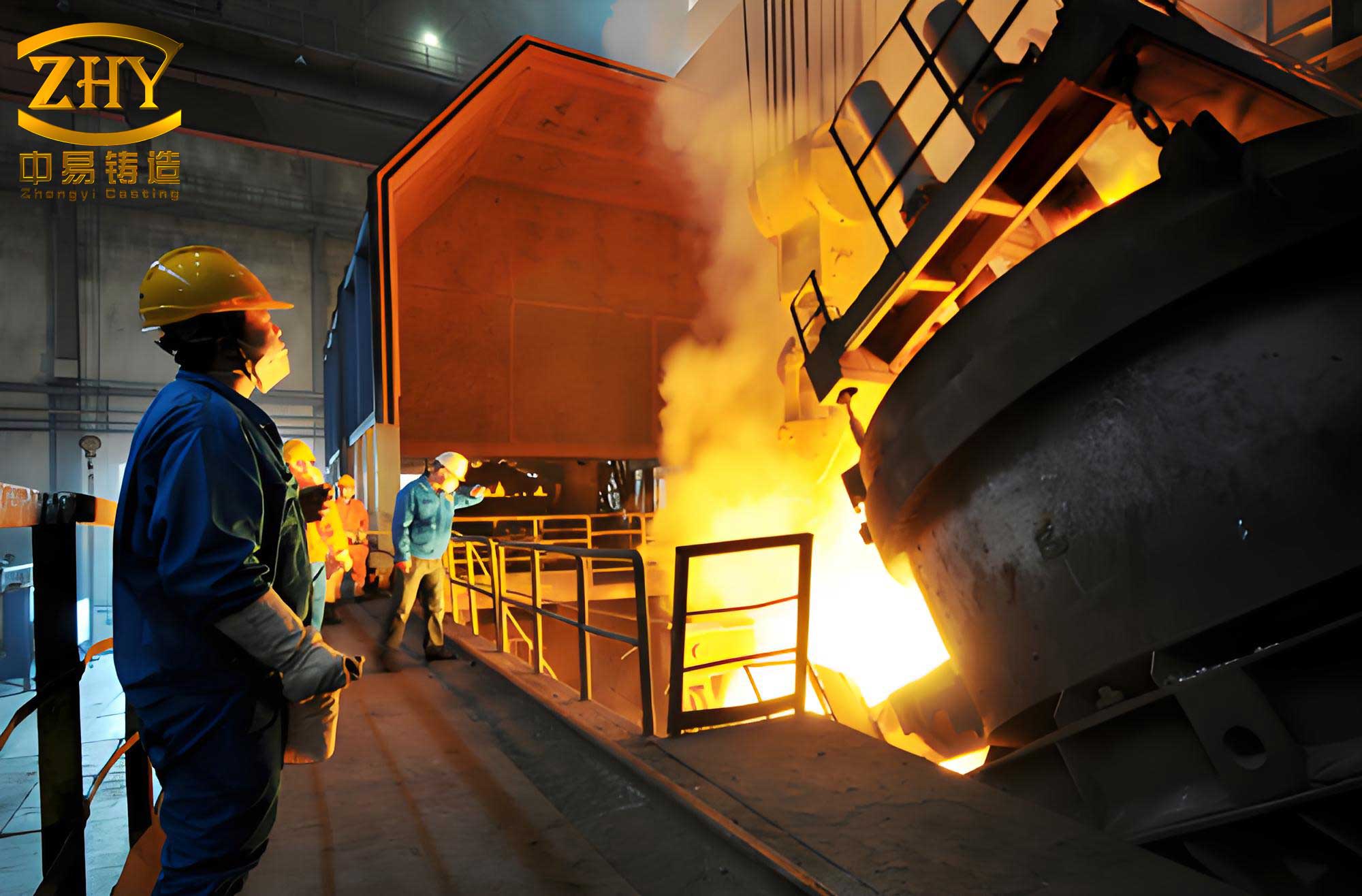
The image above illustrates a typical cast iron part that might require such repair, showcasing the complexity involved.
When dealing with the alignment and adjustment of components like couplings during repair, I always ensure that measurement fixtures are fixed on a reference shaft that does not require adjustment, such as a semi-coupling. For tilt correction, I center the process on the end face of the coupling being adjusted, moving it up, down, left, or right relative to the motor to achieve horizontal or parallel alignment. Vertical adjustments for the axis are typically done by adding or subtracting shims, while horizontal shifts involve moving the machine base. These steps are foundational when preparing cast iron parts for advanced repair methods like metal locking.
The metal locking method, in my experience, offers several advantages for restoring cast iron parts. Firstly, it ensures reliable quality, as the strength of the repaired part is not compromised. Secondly, the repair is conducted at room temperature, avoiding distortions and internal stresses that can arise from heating, thereby preserving the original precision of the cast iron parts. Thirdly, it allows for on-site repairs, simplifying logistics and reducing costs—no complex equipment is needed, and the process is quick. Lastly, it maintains the aesthetic appearance of the cast iron parts; after painting, repair marks are nearly invisible. I recall applying this technique in the past to repair cracks in the立柱 of a large air hammer, which demonstrated its effectiveness for bulky, complex cast iron parts.
Metal locking encompasses three primary techniques: the strong locking method, the tight-seam locking method, and the superior locking method. Each is tailored to different requirements for cast iron parts. The strong locking method is used for thin-walled cast iron parts where strength is the primary concern. It involves machining wave-shaped grooves perpendicular to the crack or fracture, into which pre-made wave keys are inserted and cold-riveted. The plastic deformation of the keys fills the grooves, securely bonding the damaged sections. For cast iron parts that must also prevent fluid leakage, the tight-seam locking method is employed. This adds a row of stitching pins along the crack line between wave key grooves, which are also riveted. Alternatively, liquid materials can be cast into dovetail grooves for sealing. The superior locking method, or reinforced locking, is for thick-walled cast iron parts under heavy loads. Here, steel reinforcements are embedded perpendicular to the crack, often combined with stitching pins and wave keys to enhance strength. The design must account for load type, magnitude, direction, and stress distribution to determine the reinforcement’s shape, cross-section, and material.
To better summarize the design parameters for wave keys and grooves, which are central to repairing cast iron parts, I have developed the following formulas and tables. The geometry of wave keys and grooves is critical: let \(d\) be the diameter of the convex part, \(b\) the width, \(l\) the distance between convex parts, \(t\) the key thickness, \(h\) the groove depth, and \(n\) the number of key layers. The fit between key and groove should allow gentle hammering, with a maximum clearance of 0.1 mm. Based on my practice, dimensions are calculated as:
$$ d = (1.4 \text{ to } 1.6)b $$
$$ l = (2.0 \text{ to } 2.2)b $$
$$ t \leq b $$
$$ h = (0.65 \text{ to } 0.75)t $$
The number of convex parts typically ranges from 5 to 9. The quantity and spacing \(a\) of wave keys are determined by equating the strength of the keys to that of the original cast iron parts, using the formula:
$$ n = \frac{\sigma_b \cdot S}{\sigma_{bk} \cdot b \cdot t} $$
where \(S\) is the wall thickness of the cast iron part in mm, \(\sigma_{bk}\) is the tensile strength limit of the wave key material after riveting in MPa, and \(\sigma_b\) is the tensile strength limit of the cast iron part material in MPa. This ensures that the repaired cast iron parts maintain structural integrity.
| Parameter | Symbol | Typical Value Range | Unit |
|---|---|---|---|
| Key Width | \(b\) | 5–20 | mm |
| Convex Diameter | \(d\) | 1.4b–1.6b | mm |
| Convex Spacing | \(l\) | 2.0b–2.2b | mm |
| Key Thickness | \(t\) | ≤ b | mm |
| Groove Depth | \(h\) | 0.65t–0.75t | mm |
| Number of Convex Parts | \(n\) | 5, 7, 9 | – |
Material selection for wave keys and stitching pins is crucial in repairing cast iron parts. I prefer materials with low initial strength that harden upon cold working, such as austenitic nickel-chromium steels or low-carbon chromium-manganese-silicon steels (e.g., 1Cr18Ni9 or 20CrMnSi). These offer good cold workability and high mechanical properties after riveting. For cast iron parts operating at high temperatures, materials with similar thermal expansion coefficients are essential to prevent loosening or thermal stress. Nickel-based alloys, for instance, provide low expansion and adequate hardening, making them suitable for high-temperature cast iron parts.
| Material Type | Typical Applications | Key Properties |
|---|---|---|
| Austenitic Nickel-Chromium Steel | General repair of cast iron parts | High cold workability, good hardening |
| Low-Carbon Chromium-Manganese-Silicon Steel | Heavy-duty cast iron parts | Enhanced strength after riveting |
| Nickel-Based Alloys | High-temperature cast iron parts | Low thermal expansion, good hardening |
The metal locking process involves several steps that I meticulously follow for cast iron parts. First, wave keys are manufactured; due to their complex shape, I often standardize dimensions and use sheet metal stamping for efficiency. Second, wave grooves are machined. For small to medium cast iron parts, I use milling machines for precision, but for large, immovable cast iron parts, on-site tools like electric drills or portable milling heads are employed. Before machining, I ensure cracks are tightly closed. Third, riveting is performed at room temperature with a handheld riveting gun. I use two types of hammer heads: one for the central area and another for the edges. The riveting tightness should prevent松动 during operation. This process reinforces the bond in cast iron parts effectively.
In addition to metal locking, I have explored other methods for repairing cast iron parts, such as thermal spray welding. For example, in cases where cast iron parts like machine slide blocks suffer from scoring, thermal spray welding can be applied. The steps include leveling the damaged area, cleaning with acetone, preheating to about 200°C, using nickel-based alloy powders for spray welding, and finishing with grinding and spark erosion to create a reinforced layer. This method is quick and cost-effective for cast iron parts with surface damage, though it is less suited for deep structural repairs compared to metal locking.
To further illustrate the engineering principles behind repairing cast iron parts, I often rely on stress analysis formulas. For instance, the stress distribution in a repaired cast iron part can be modeled using beam theory. Consider a cracked cast iron part subjected to a bending moment \(M\); the stress \(\sigma\) at a distance \(y\) from the neutral axis is given by:
$$ \sigma = \frac{M \cdot y}{I} $$
where \(I\) is the moment of inertia. After repair with wave keys, the effective moment of inertia changes, and the new stress \(\sigma’\) can be calculated to ensure it remains below the material’s yield strength \(\sigma_y\) for cast iron parts:
$$ \sigma’ = \frac{M \cdot y}{I’} \leq \sigma_y $$
Here, \(I’\) accounts for the added wave keys. Similarly, for leakage prevention in cast iron parts, the pressure \(P\) in a sealed system relates to the groove design. The force \(F\) on a stitching pin is:
$$ F = P \cdot A $$
where \(A\) is the cross-sectional area. The pin must withstand this without failure, which involves checking its shear stress \(\tau\):
$$ \tau = \frac{F}{A_s} \leq \tau_{\text{allowable}} $$
with \(A_s\) as the shear area. These calculations are integral to designing durable repairs for cast iron parts.
My experience shows that the success of repairing cast iron parts hinges on careful planning and execution. For large cast iron parts, I always conduct a thorough inspection to assess crack depth and orientation. Non-destructive testing methods, such as ultrasonic testing, can help evaluate the integrity of cast iron parts before repair. Once the metal locking technique is chosen, I prepare detailed work plans, including safety protocols, as working with heavy cast iron parts poses risks. The use of jigs and fixtures is essential to hold cast iron parts in place during machining and riveting.
Moreover, environmental factors can affect the repair of cast iron parts. For instance, humidity or temperature fluctuations may influence the riveting process or material properties. I recommend conducting repairs in controlled environments when possible, especially for precision cast iron parts. Post-repair, I perform quality checks, such as load testing or leak tests, to validate the repair. This ensures that the cast iron parts meet operational standards and can withstand future stresses.
In terms of economics, metal locking offers significant savings for cast iron parts compared to replacement. The cost \(C_{\text{repair}}\) of repairing a cast iron part can be estimated as:
$$ C_{\text{repair}} = C_{\text{materials}} + C_{\text{labor}} + C_{\text{downtime}} $$
where \(C_{\text{materials}}\) includes wave keys and pins, \(C_{\text{labor}}\) covers skilled work, and \(C_{\text{downtime}}\) accounts for production losses. For large cast iron parts, \(C_{\text{downtime}}\) often dominates, making quick repairs like metal locking advantageous. In contrast, replacement cost \(C_{\text{replace}}\) involves new cast iron parts, shipping, and installation, which can be prohibitive. Thus, repairing cast iron parts is not only technically sound but also financially prudent.
| Cost Factor | Repair (Metal Locking) | Replacement |
|---|---|---|
| Materials | Low (standardized keys) | High (new cast iron parts) |
| Labor | Moderate (on-site work) | High (disassembly/installation) |
| Downtime | Short (days) | Long (weeks to months) |
| Total | $$ C_{\text{repair}} \approx \text{low} $$ | $$ C_{\text{replace}} \approx \text{high} $$ |
Looking ahead, advancements in materials science may improve the repair of cast iron parts. For example, composite wave keys or smart materials that adapt to stress could enhance the longevity of repaired cast iron parts. Additionally, automation in machining and riveting might streamline the process for large-scale cast iron parts. I am actively researching these areas to further optimize the restoration of cast iron parts in industrial settings.
In conclusion, the metal locking technique is a versatile and reliable method for repairing cast iron parts, especially large and complex ones. By following the design principles, material selections, and工艺 steps outlined here, engineers can effectively restore cast iron parts to full functionality. The repeated emphasis on cast iron parts in this article underscores their importance in machinery and the need for sustainable repair solutions. Whether through metal locking or complementary methods like thermal spray welding, maintaining cast iron parts is key to industrial efficiency and safety.