
In my extensive experience in foundry operations, the proper design of gating and risering systems stands as a cornerstone for producing high-quality cast iron parts. The strategic control of solidification is not merely a technical step but an art that directly impacts yield, mechanical properties, and economic viability. For decades, the principles of “directional solidification” and “simultaneous solidification” have guided practitioners. However, the introduction of the “balanced solidification” theory in the 1980s provided a more nuanced framework, especially for complex geometries. This article synthesizes my practical insights, bolstered by mathematical models and empirical data, to elaborate on these principles for optimizing the production of cast iron parts.
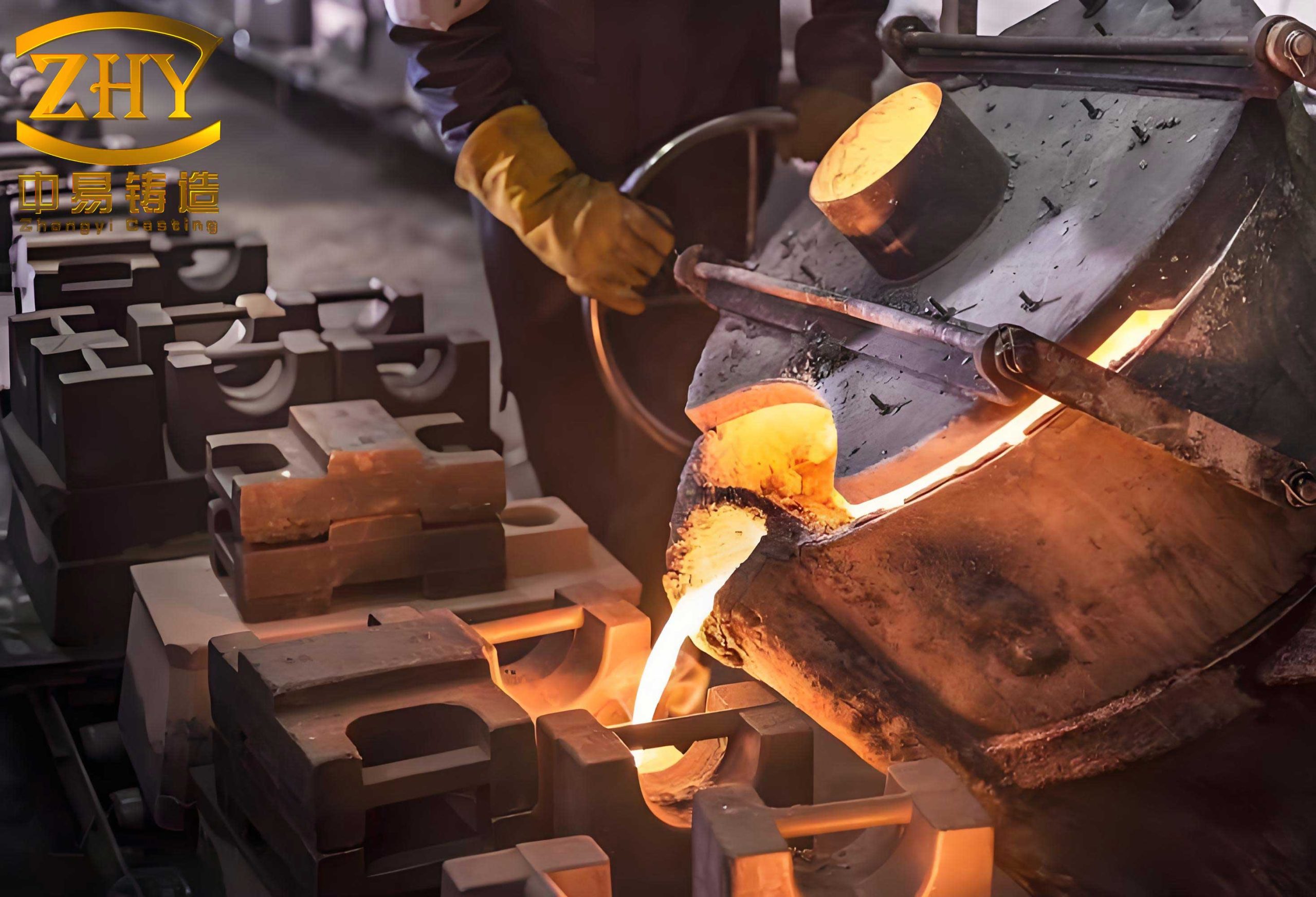
The fundamental challenge in casting lies in managing the phase change from liquid to solid. For cast iron parts, this is further complicated by the graphite precipitation process, which introduces expansion forces that can counteract shrinkage. The primary goal is to feed liquid metal to sections undergoing contraction to prevent defects like shrinkage porosity, cavities, or cracks. The choice of solidification principle hinges on the geometry, wall thickness, and required integrity of the cast iron parts. Let me delve into each principle with detailed technical exposition.
Directional Solidification: The Sequential Approach for Heavy Sections
The directional solidification principle, also known as progressive solidification, mandates that the cast iron parts solidify sequentially from the farthest point from the riser toward the riser itself. This creates a positive temperature gradient, ensuring the riser remains liquid longest to feed shrinkage. This method is paramount for thick-walled or sectionally varying cast iron parts where thermal mass dictates slow cooling. The governing thermal dynamics can be expressed using Fourier’s law and the heat transfer equation during phase change.
The local solidification time \( t_f \) for a section is often approximated by Chvorinov’s rule:
$$ t_f = B \left( \frac{V}{A} \right)^n $$
where \( V \) is the volume of the casting section, \( A \) is its surface area, \( B \) is a mold constant dependent on material and mold properties, and \( n \) is an exponent typically around 1.5 to 2 for sand molds. For directional solidification to be effective, we must ensure:
$$ t_{f,\text{far}} < t_{f,\text{near}} < t_{f,\text{riser}} $$
where the subscripts denote times for regions far from the riser, near the riser, and the riser itself.
In practice, for cast iron parts like heavy-duty pulleys, the gating is designed so that molten metal enters through the riser, flowing toward thinner sections. This preheats the mold along the path, moderating the cooling rate. The riser, often a necked or padding type, is placed on the heaviest thermal center. A critical parameter is the modulus \( M = V/A \), which guides riser sizing. The required riser modulus \( M_r \) should satisfy:
$$ M_r \geq 1.2 \times M_c $$
where \( M_c \) is the modulus of the casting’s hot spot. However, a pitfall is the “contact hot spot” created at the riser-neck junction, which can become the last point to solidify, leading to subsurface shrinkage. Therefore, for many cast iron parts, riser neck design is as crucial as riser size.
Table 1 summarizes key design parameters for directional solidification in typical thick-section cast iron parts.
| Cast Iron Part Type | Typical Max Wall Thickness (mm) | Recommended Riser Type | Riser Modulus Factor (M_r/M_c) | Gating Approach |
|---|---|---|---|---|
| Heavy Pulley | 40-60 | Side Riser with Padding | 1.3 – 1.5 | Through Riser, Slow Pour |
| Gear Blank | 50-80 | Top Riser | 1.4 – 1.6 | Multiple Gates via Riser |
| Valve Body | 30-70 | Exothermic Riser | 1.2 – 1.4 | Bottom Gating into Riser |
From my observation, for a cast iron pulley weighing 51 kg with a 44 mm thick rim, using a flanking riser with a narrow choke (6-8 mm gap) and a tapered sprue of 30 mm diameter proved effective. Initially, a riser height of 120 mm led to shrinkage; adding a 35 mm insulating riser sleeve and controlling pour rate increased yield to 95%. The thermal analysis for such cast iron parts can be modeled by solving the transient heat conduction equation:
$$ \rho C_p \frac{\partial T}{\partial t} = \nabla \cdot (k \nabla T) + L \frac{\partial f_s}{\partial t} $$
where \( \rho \) is density, \( C_p \) specific heat, \( k \) thermal conductivity, \( L \) latent heat, and \( f_s \) solid fraction. This equation, when solved with boundary conditions for riser contact, predicts the thermal history.
Simultaneous Solidification: Uniform Cooling for Thin-Walled Cast Iron Parts
For cast iron parts with relatively uniform wall thickness or thin sections, the simultaneous solidification principle is advantageous. The objective is to minimize temperature gradients across the casting, causing all sections to solidify at approximately the same time. This reduces thermal stresses, thereby minimizing distortion and hot tearing—common defects in intricate cast iron parts. The gating strategy involves multiple ingates at thin sections or the use of chills at thick spots to equalize cooling rates.
The heat extraction rate must be balanced. For a plate-like cast iron part of thickness \( d \), the Fourier number \( Fo = \alpha t / d^2 \) determines the temperature uniformity, where \( \alpha \) is thermal diffusivity. Simultaneous solidification requires \( Fo \) to be similar across sections. Practically, this is achieved by designing the gating system to distribute heat evenly. The total heat content \( Q \) introduced by molten metal is:
$$ Q = m \left[ C_p (T_{\text{pour}} – T_{\text{liquidus}}) + L \right] $$
where \( m \) is mass. For simultaneous solidification, the heat input per unit volume should be roughly constant, or external cooling via chills compensates for thicker areas.
In production of thin-walled cast iron parts like machine bushings, I often use multiple tapered ingates directly from the sprue well, eliminating runners to reduce heat loss. For a 6 kg HT200 bushing with 27 mm average wall thickness, four ingates with triangular cross-section (18 mm side) yielded 100% sound castings. The key is to ensure the last metal to enter is at the thickest section, which is cooler, while the thinner sections, being near gates, are hotter but cool faster due to higher surface-area-to-volume ratio. This self-regulating effect promotes uniform solidification.
Table 2 contrasts the characteristics of directional versus simultaneous solidification for cast iron parts.
| Aspect | Directional Solidification | Simultaneous Solidification |
|---|---|---|
| Applicability | Thick, uneven sections | Thin, uniform sections |
| Temperature Gradient | High, controlled | Low, minimized |
| Primary Defect Risk | Shrinkage cavities | Micro-porosity, stress cracks |
| Riser Role | Active feeding, large | Minimal, often for venting |
| Gating Design | Through riser, single gate | Multiple gates, dispersed |
| Residual Stress | Higher due to differential cooling | Lower, more uniform |
Mathematically, the condition for simultaneous solidification can be expressed by ensuring the solidification time difference \( \Delta t_f \) between the thickest and thinnest section is within a tolerance \( \epsilon \):
$$ \Delta t_f = | t_{f,\text{thick}} – t_{f,\text{thin}} | \leq \epsilon $$
where \( \epsilon \) depends on the alloy’s sensitivity to stress. For gray cast iron parts, \( \epsilon \) can be relatively large due to graphite expansion, but for ductile iron, it is stricter.
Balanced Solidification Theory: Harnessing Graphite Expansion for Thick Cast Iron Parts
The balanced solidification theory revolutionized the approach for heavy-section cast iron parts. It recognizes that gray cast iron experiences two opposing volumetric changes: liquid contraction and graphite expansion during eutectic solidification. For thick cast iron parts, the slow cooling allows sufficient time for graphite precipitation expansion to compensate for shrinkage, potentially enabling riserless casting or the use of small risers. The net volume change \( \Delta V_{\text{net}} \) can be approximated as:
$$ \Delta V_{\text{net}} = \Delta V_{\text{shrinkage}} – \Delta V_{\text{expansion}} $$
where \( \Delta V_{\text{shrinkage}} = \beta V_0 (T_{\text{pour}} – T_{\text{solidus}}) \) with \( \beta \) as the volumetric shrinkage coefficient, and \( \Delta V_{\text{expansion}} = \eta V_0 f_g \) with \( \eta \) as the expansion coefficient due to graphite and \( f_g \) the graphite fraction. When \( \Delta V_{\text{net}} \approx 0 \), feeding requirements vanish.
The theory emphasizes avoiding risers directly on hot spots because the junction creates an enlarged thermal mass, delaying solidification and causing shrinkage. Instead, risers are placed slightly away from the hot spot, or off-riser techniques are used. For a 57 kg HT150 bend plate with a 70 mm hot spot, I employed a flanking riser with an 8 mm choke gap, set away from the geometric center. This eliminated the contact hot spot, achieving 95% yield. The thermal analysis involves modeling the expansion pressure \( P_{\text{exp}} \) generated by graphite:
$$ P_{\text{exp}} = E_g \cdot \frac{\Delta V_{\text{expansion}}}{V_0} $$
where \( E_g \) is a modulus related to the mold rigidity and alloy properties. This pressure can counteract the metallostatic pressure and capillary pressures driving shrinkage.
Table 3 outlines guidelines for applying balanced solidification to different classes of cast iron parts.
| Cast Iron Grade | Typical Section Size for Risering | Expansion Compensation Factor (η) | Recommended Riser Placement | Expected Yield Improvement |
|---|---|---|---|---|
| Gray Iron (HT150) | >50 mm | 0.4 – 0.6% | Off-hot spot, side riser | 10-15% |
| Gray Iron (HT250) | >40 mm | 0.3 – 0.5% | Small top riser with chill | 5-10% |
| Ductile Iron | >30 mm | 0.6 – 0.9% | Minimal riser, use of mold stiffness | 15-20% |
The solidification sequence under balanced conditions can be modeled using a coupled thermal-stress analysis. The governing equation includes a source term for expansion:
$$ \rho C_p \frac{\partial T}{\partial t} = \nabla \cdot (k \nabla T) + L \frac{\partial f_s}{\partial t} – S_{\text{exp}} $$
where \( S_{\text{exp}} \) represents the heat release or absorption due to expansion effects. For practical design, the modulus extension principle is used: the feeding distance \( L_f \) for cast iron parts without risers can be estimated as:
$$ L_f = K \sqrt{t_f} $$
where \( K \) is a material constant. For gray iron, \( K \) is higher due to expansion, allowing longer feeding distances compared to steels.
Advanced Integration: Mathematical Modeling and Empirical Correlations for Cast Iron Parts
To truly optimize gating and risering for cast iron parts, I integrate fundamental physics with empirical data. The process begins with categorizing the cast iron parts based on geometry complexity, weight, and required soundness. Computational simulations are invaluable, but simple analytical models provide quick insights.
One critical aspect is the gating system design, which controls the initial temperature distribution. The pouring time \( t_p \) for cast iron parts is often determined by empirical formulas:
$$ t_p = C \sqrt{W} $$
where \( W \) is the casting weight in kg, and \( C \) is a coefficient (typically 1.5-2.5 for iron). The choke area \( A_c \) of the gating system is sized to achieve a desired pouring rate:
$$ A_c = \frac{W}{\rho \cdot t_p \cdot v_c} $$
where \( v_c \) is the flow velocity at the choke, controlled by the sprue height. For cast iron parts, a slow pour is often beneficial to reduce turbulence and temperature loss.
The riser efficiency \( \eta_r \) is defined as the fraction of riser volume that actually feeds shrinkage:
$$ \eta_r = \frac{V_{\text{feed}}}{V_{\text{riser}}} $$
For top risers on cast iron parts, \( \eta_r \) is around 14-20%, while for exothermic risers, it can reach 30-35%. The required riser volume \( V_r \) can be calculated if the total shrinkage volume \( V_{\text{sh}} \) is known:
$$ V_r = \frac{V_{\text{sh}}}{\eta_r} $$
But for cast iron parts, \( V_{\text{sh}} \) is reduced by expansion, so a more accurate form is:
$$ V_r = \frac{ \beta V_c – \eta V_c f_g}{\eta_r} $$
where \( V_c \) is casting volume. This equation highlights why risers can be smaller for cast iron parts with high graphite content.
Table 4 provides a comprehensive design checklist for gating and risering systems tailored to cast iron parts.
| Design Step | Key Parameters | Equations/Relations | Typical Values for Gray Iron |
|---|---|---|---|
| Solidification Mode Selection | Section modulus ratio (Thick/Thin) | If \( M_{\text{max}}/M_{\text{min}} > 2 \), use directional | Directional if >2, Simultaneous if <1.5 |
| Pouring Time Calculation | Casting weight, pouring temperature | \( t_p = 1.8 \sqrt{W} \) (seconds) | For 100 kg part, \( t_p \approx 18 \) s |
| Choke Area Sizing | Sprue height, density, flow rate | \( A_c = \frac{W}{\rho t_p \sqrt{2gH}} \) | \( A_c \approx 4-6 \, \text{cm}^2\) per 100 kg |
| Riser Modulus Determination | Casting modulus at hot spot | \( M_r = 1.2 \times M_c \) (directional) | For \( M_c = 1 \) cm, \( M_r = 1.2 \) cm |
| Expansion Compensation Estimate | Graphite fraction, cooling rate | \( \Delta V_{\text{exp}} = 0.005 \times V_c \) for HT200 | 5% volume expansion possible |
| Feeding Distance Validation | Section thickness, alloy type | \( L_f = 5 \times T \) for gray iron plates | For 20 mm thick, \( L_f = 100 \) mm |
In practice, I have found that for complex cast iron parts, hybrid approaches work best. For instance, a valve body with both thick flanges and thin walls might use directional solidification for the flanges via risers and simultaneous solidification for the body via chills. The thermal interactions can be modeled using finite difference methods. Consider a 2D axisymmetric model for a cylindrical cast iron part. The temperature field \( T(r,z,t) \) obeys:
$$ \frac{\partial T}{\partial t} = \alpha \left( \frac{\partial^2 T}{\partial r^2} + \frac{1}{r} \frac{\partial T}{\partial r} + \frac{\partial^2 T}{\partial z^2} \right) $$
with boundary conditions accounting for riser contact and mold interface. Solving this numerically helps visualize isotherms and solidification fronts.
Furthermore, defect prediction models are crucial. The Niyama criterion, adapted for cast iron parts, helps predict shrinkage porosity. The criterion states that porosity is likely if:
$$ \frac{G}{\sqrt{\dot{T}}} < C_{\text{ny}} $$
where \( G \) is the temperature gradient, \( \dot{T} \) is the cooling rate, and \( C_{\text{ny}} \) is a threshold. For gray iron, due to expansion, the threshold is higher, allowing more leeway in design.
Practical Case Studies and Lessons from Production of Cast Iron Parts
Over the years, I have encountered numerous scenarios that underscore the importance of tailored gating and risering. Let me elaborate on a few expanded case studies beyond the original examples, focusing on the mathematical and empirical takeaways.
Case A: Large Gear Blank (Weight: 200 kg, Material: HT250) This cast iron part had a hub thickness of 80 mm and a rim thickness of 40 mm. Initially, using a top riser on the hub with directional solidification led to hot tearing in the web. Analysis showed a high thermal stress \( \sigma_{\text{therm}} \) estimated by:
$$ \sigma_{\text{therm}} = E \alpha_{\Delta T} \Delta T $$
where \( E \) is Young’s modulus, \( \alpha_{\Delta T} \) is thermal expansion coefficient, and \( \Delta T \) is the temperature difference between hub and rim. By switching to a balanced approach with two side risers off the hub and using insulating sleeves to slow cooling, the temperature difference reduced. The redesigned system used a riser modulus calculated from:
$$ M_r = \frac{D_r}{6} \quad \text{for cylindrical riser} $$
with \( D_r = 1.5 \times \text{hot spot diameter} \). The result was a sound casting with minimal stress.
Case B: Thin-Walled Enclosure (Weight: 15 kg, Material: HT150) This cast iron part had uniform 8 mm walls but long spans. Simultaneous solidification was chosen with multiple ingates. To prevent mistruns, the pouring temperature \( T_{\text{pour}} \) was optimized using the fluidity length formula:
$$ L_f = a + b (T_{\text{pour}} – T_{\text{liquidus}}) $$
where \( a \) and \( b \) are constants. We set \( T_{\text{pour}} \) at 1380°C, and used four ingates with total area \( A_g = 3.2 \, \text{cm}^2 \). The solidification time was approximately:
$$ t_f = \frac{(V/A)^2}{\pi \alpha} $$
which came to about 90 seconds, sufficient for feeding via capillary action without risers.
Case C: Thick Block with Internal Passages (Weight: 80 kg, Material: Ductile Iron) Ductile iron cast iron parts exhibit higher expansion but are prone to shrinkage if not properly fed. Here, the balanced theory was essential. The mold rigidity factor \( \Phi_m \) was increased by using high-pressure molding to contain expansion pressure. The riser was designed as a small washburn riser with neck modulus:
$$ M_n = 0.67 \times M_c $$
to encourage earlier neck freezing after feeding. The expansion compensation was calculated as:
$$ \Delta V_{\text{exp}} = 0.008 \times V_c $$
allowing a riser volume only 8% of the casting volume, compared to 20% for directional solidification.
These cases illustrate that no single principle universally applies; rather, a deep understanding of the interplay between geometry, alloy behavior, and process parameters is required for cast iron parts. Table 5 summarizes defect-root cause correlations and corrective actions based on my experience.
| Defect Observed in Cast Iron Parts | Likely Cause Related to Gating/Risering | Diagnostic Check | Corrective Measure | |
|---|---|---|---|---|
| Shrinkage Cavity near Riser | Contact hot spot, riser too small | Check \( M_r/M_c \) ratio | Move riser off hot spot, increase riser size or use exothermic | |
| Distortion or Warping | High thermal gradients (directional overdone) | Measure temperature differential across casting | Switch to simultaneous, use chill on thick sections, lower pour temp | |
| Micro-porosity in Thick Sections | Insufficient feeding pressure, inadequate expansion compensation | Calculate Niyama criterion value | Increase mold stiffness, optimize riser placement per balanced theory | |
| Cold Shuts or Mistruns | Pouring too slow, gating area too small | Verify \( t_p \) and \( A_c \) against empirical norms | Increase choke area, raise pouring temperature | |
| Hot Tears in Junctions | High stress during solidification due to constraint | Evaluate thermal stress via simulation | Modify geometry with fillets, use flexible mold coatings, reduce cooling rate |
Future Perspectives and Concluding Synthesis for Cast Iron Parts
The evolution of gating and risering for cast iron parts continues with advancements in simulation software and material science. However, the core principles remain rooted in understanding heat transfer, phase transformations, and fluid dynamics. From my perspective, the key to success lies in a systematic approach: categorize the cast iron parts, select the appropriate solidification strategy, perform calculations using the formulas and tables provided, and validate with practical trials.
To encapsulate, let me present a unified design equation that incorporates elements from all three principles for cast iron parts. The required riser volume \( V_r^* \) can be estimated as:
$$ V_r^* = \max \left(0, \frac{ \beta_{\text{eff}} V_c – \eta_{\text{eff}} V_c }{\eta_r} \right) $$
where \( \beta_{\text{eff}} \) is the effective shrinkage coefficient accounting for cooling rate, and \( \eta_{\text{eff}} \) is the effective expansion coefficient dependent on graphite morphology and mold yield. For directional solidification, \( \eta_{\text{eff}} \) is low; for balanced solidification, it is high; for simultaneous solidification, \( V_r^* \) often approaches zero.
In conclusion, the production of sound cast iron parts demands a judicious blend of theory and practice. Whether employing directional, simultaneous, or balanced solidification, the objective is to control the thermal history to minimize defects. The numerous cast iron parts I have encountered reinforce that flexibility and continuous learning are essential. By leveraging mathematical models, empirical correlations, and the rich experience shared in this article, foundry engineers can significantly enhance the quality and yield of cast iron parts, driving efficiency and innovation in the industry.