
As an experienced agricultural machinery technician, I have spent decades working with various harvesting equipment, from combine harvesters to straw returning devices. Through trial and error, I’ve developed a comprehensive approach to maintenance and repair, particularly focusing on the longevity of critical components like cast iron parts. This guide consolidates my hands-on knowledge into a detailed, first-person perspective, aiming to help fellow technicians and farmers ensure their machinery remains in peak condition. I will cover post-harvest maintenance procedures, storage protocols, and specialized repair techniques for cast iron parts, using tables and formulas to summarize key points for clarity and practicality. The goal is to provide an in-depth resource that exceeds 8000 tokens, ensuring thorough coverage of every aspect.
Maintaining harvesting machinery is not just about cleaning; it involves a systematic process to prevent wear, corrosion, and failure. I often emphasize that neglect during the off-season leads to costly breakdowns during harvest. In this article, I’ll walk you through my step-by-step methods, starting with post-operation cleaning and moving into long-term storage. I’ll also delve into the intricacies of repairing cast iron parts, which are prevalent in many agricultural machines due to their durability and cost-effectiveness. By incorporating tables and mathematical models, I aim to make the information accessible and actionable. Let’s begin with the initial cleaning phase, which sets the foundation for effective maintenance.
After the autumn harvest, the first task is to thoroughly clean the machinery. I always start with the combine harvester and its straw returning attachment. Using water, I rinse off all external and internal mud, paying special attention to removing fragmented corn stalks and tangled debris. For detachable components like chains, screws, and flail hammers (or blades), I soak them in diesel to dissolve grease and sludge, followed by a 5–10 minute immersion in engine oil. Finally, I apply a lubricant and wrap them in kraft paper or plastic bags for dry storage. This process prevents rust and ensures easy reassembly. To quantify the cleaning efficiency, I use a simple formula for residue removal: $$ R = 1 – \frac{W_f}{W_i} $$ where \( R \) is the removal ratio, \( W_i \) is the initial weight of debris, and \( W_f \) is the final weight after cleaning. Aim for an \( R \) value close to 1, indicating near-complete removal.
| Step | Procedure | Key Tools/Materials | Recommended Time |
|---|---|---|---|
| 1. Rinse | Wash with water to remove mud and debris | Water hose, brush | 30-60 minutes |
| 2. Disassemble | Remove chains, screws, flail hammers | Wrenches, pliers | 20-30 minutes |
| 3. Soak | Immerse in diesel, then engine oil | Diesel, engine oil, container | 10-15 minutes total |
| 4. Preserve | Coat with lubricant and wrap | Lubricant, kraft paper, plastic bags | 10 minutes per component |
Once cleaned, I move the machinery into a dedicated shed. If no shed is available, I construct a simple shelter to shield it from rain and sun. I seal openings like fuel and oil fill ports, air filters, and exhaust pipes with plastic bags to keep out dust. This step is crucial for preventing environmental damage. I often calculate the required shelter dimensions based on machine size: $$ L_s = L_m + 0.5 \, \text{m}, \quad W_s = W_m + 0.5 \, \text{m} $$ where \( L_s \) and \( W_s \) are shelter length and width, and \( L_m \) and \( W_m \) are machine dimensions. Adding 0.5 meters provides ample clearance for air circulation.
Next, I drain all fluids to avoid freezing and degradation. After shutting down the engine, I release the oil from the crankcase and diesel from the fuel tank while they’re still warm. Once the coolant temperature drops, I open all drainage valves for the radiator and engine block to empty the cooling system. This prevents cracking in cold weather. I model the drainage time using: $$ t_d = \frac{V}{A \cdot v} $$ where \( t_d \) is drainage time, \( V \) is fluid volume, \( A \) is valve cross-sectional area, and \( v \) is flow velocity. For typical engines, \( t_d \) ranges from 5 to 10 minutes.
Disassembly is a meticulous process. I remove all belts, clean them, and inspect for wear. I note their positions with markers and dust them with talcum powder before hanging them in a cool, ventilated area. Electrical components like generators and headlights are detached and stored safely. The battery is taken indoors, charged, and kept warm in winter to prevent freezing. I use a table to track belt conditions:
| Belt Type | Inspection Criteria | Replacement Threshold |
|---|---|---|
| Drive Belts | Cracks, fraying, elongation | If elongation exceeds 5% of original length |
| V-Belts | Wear on sides, glazing | If depth loss is over 2 mm |
| Timing Belts | Tooth damage, hardening | Any visible damage |
A thorough inspection follows. I check for worn or deformed parts, especially those that caused issues during operation. I prioritize repairing or replacing faulty components to avoid future failures. For quantitative assessment, I measure wear using: $$ W = \frac{d_i – d_f}{d_i} \times 100\% $$ where \( W \) is wear percentage, \( d_i \) is initial dimension, and \( d_f \) is final dimension. If \( W \) exceeds 10%, replacement is usually necessary.
To combat corrosion, I apply paint or spray to exposed surfaces. I coat adjustment screws, gears, and chains with oil or grease. This is vital for cast iron parts, which are prone to rust. I estimate paint coverage with: $$ A_p = \frac{C}{T} $$ where \( A_p \) is area painted per liter, \( C \) is paint concentration, and \( T \) is thickness. Typically, 1 liter covers 10 square meters at 0.1 mm thickness.
I then relieve tension on springs and hydraulic cylinders to maintain their integrity. Springs are left uncompressed, and hydraulic pistons are retracted. This reduces material stress over time. The force relaxation can be expressed as: $$ F(t) = F_0 e^{-kt} $$ where \( F(t) \) is force at time \( t \), \( F_0 \) is initial force, and \( k \) is a decay constant based on material properties.
Lubrication is performed according to the machine’s manual. I use a detailed chart to ensure every point is addressed, from bearings to joints. The lubrication interval can be optimized with: $$ L_i = \frac{V_l}{R_u} $$ where \( L_i \) is interval in hours, \( V_l \) is lubricant volume, and \( R_u \) is usage rate. For combine harvesters, \( L_i \) is often 50–100 hours.
For storage, I implement fire safety measures and monthly maintenance. I add a small amount of oil to engine cylinders and rotate the crankshaft 1–2 times, while operating hydraulic controls dozens of times to prevent seizing. I also elevate the frame with blocks to lift wheels off the ground, and place components like the header and straw returner on padded surfaces. The elevation height \( h \) is calculated as: $$ h = \frac{W}{k \cdot A} $$ where \( W \) is machine weight, \( k \) is soil bearing capacity, and \( A \) is block area. Usually, \( h \) is 10–20 cm.
Transitioning to general harvesters, similar principles apply. Post-harvest, I clear all accumulated mud, dirt, and debris, focusing on the conveyor and thresher internals. I loosen tensioners and belts, replacing any that are burnt or overly stretched. Worn rake teeth on conveyors are swapped out. I clean and inspect cutting blades, headers, and augers, tightening or fixing loose parts. Damaged items like knife sections or guards are replaced and coated with anti-rust oil. Thin-walled parts such as header plates and chutes are checked for deformation or cracks and repaired if needed.
| Component | Maintenance Action | Frequency |
|---|---|---|
| Cutting Blades | Sharpen, replace if chipped | After each harvest season |
| Augers | Clean, check for bending | Monthly during storage |
| Bearings | Re-grease, replace if noisy | Every 200 hours of operation |
| Hydraulic Lines | Inspect for leaks, flush | Annually |
I meticulously clean and examine all bearings and gears, replacing those that are severely worn. Lubrication points are re-greased to prevent rust. The threshing mechanism, including spike teeth and sieve plates, is assessed for wear and reshaped or replaced. The wear rate for threshing components can be modeled as: $$ \text{Wear rate} = \frac{\Delta m}{t \cdot A} $$ where \( \Delta m \) is mass loss, \( t \) is operating time, and \( A \) is contact area. High wear rates indicate need for upgrade.
For painted surfaces that have chipped, I remove rust and apply fresh anti-corrosion paint. Organized storage is key: large parts are grouped, small ones boxed, and assemblies like threshers are stabilized with blocks. Headers are supported on wooden beams along the auger axis to avoid pressure on cutting edges. I enforce a strict no-clutter policy on stored machinery. The shed is kept ventilated and dry, with lime packets to absorb moisture; during wet seasons, I increase inspection frequency. The moisture control can be quantified with: $$ RH_{\text{target}} = 50\% \pm 10\% $$ where RH is relative humidity, monitored with hygrometers.
Now, let’s delve into the repair of cast iron parts, which are integral to many agricultural machines. Welding cast iron parts requires precision due to their brittleness and susceptibility to cracking. Based on my experience, I follow a structured approach. First, preparation is critical: I clean the welding area of all impurities like rust, oil, and paint. For cracks, if the wall thickness is under 25 mm, I drill stop holes of about 4 mm diameter to prevent propagation. I also bevel edges for thicker sections to ensure proper fusion. The bevel angle \( \theta \) is given by: $$ \theta = 60^\circ \text{ for } t > 10 \, \text{mm} $$ where \( t \) is thickness.
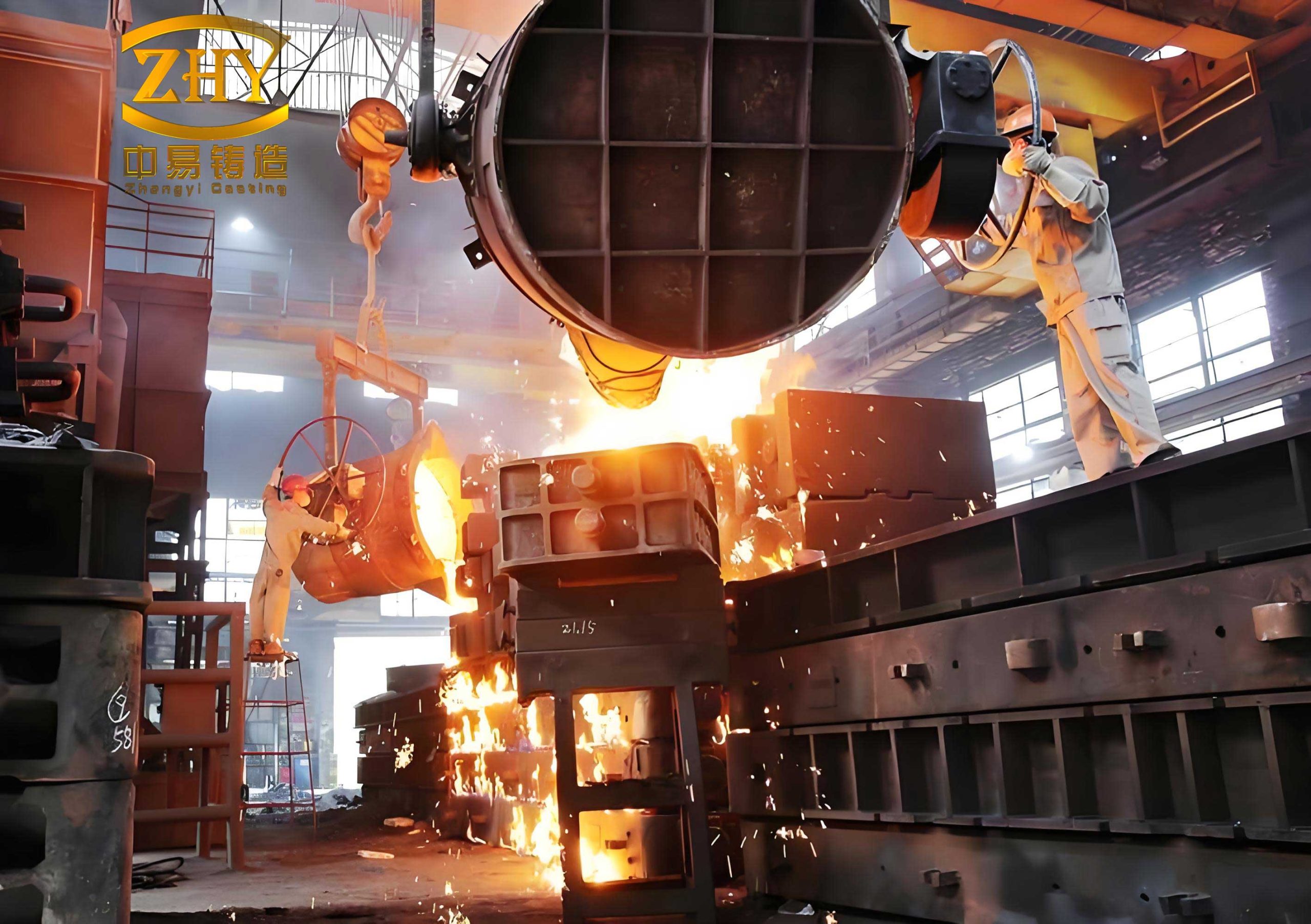
Selecting the right electrode is vital for cast iron parts. I match the electrode type to the cast iron grade—for example, nickel-based rods for gray iron. Diameter \( d \) is chosen based on thickness \( t \): $$ d = \frac{t}{3} \text{ mm, with a minimum of 2.5 mm} $$ This minimizes heat input, reducing the risk of white iron formation. I prefer small diameters to limit the heat-affected zone.
When using DC arc welding, I opt for reverse polarity (electrode positive, workpiece negative) to control penetration and overheating. The current intensity \( I \) is set according to: $$ I = (30 \text{ to } 40) \times d $$ where \( I \) is in amperes and \( d \) is electrode diameter in mm. For instance, a 3 mm rod uses 90–120 A. This balances arc stability and defect prevention.
During welding, I avoid localized overheating by employing intermittent, skip-segment techniques for long cracks. I maintain a short arc and low current to reduce melt depth. For ductile electrodes like nickel or copper-iron, I immediately peen the weld with a round-nosed hammer to relieve stress and eliminate pores. I ensure weld beads don’t bridge the entire groove at once, allowing free contraction. Layering is done to anneal underlying passes, improving machinability. The interpass temperature \( T_i \) is kept below 150°C to prevent cracking: $$ T_i \leq 150^\circ \text{C} $$
| Welding Parameter | Recommendation for Cast Iron Parts | Formula/Value |
|---|---|---|
| Electrode Diameter | Small, based on thickness | \( d = t/3 \) mm |
| Current Intensity | Moderate, to avoid defects | \( I = 35d \) A (average) |
| Polarity | Reverse (DCEP) | Workpiece negative |
| Preheat Temperature | Optional, but beneficial | 200–300°C for thick sections |
| Post-weld Cooling | Slow, in insulating material | Cooling rate < 10°C/min |
To expand on cast iron parts repair, I often consider the metallurgical aspects. Cast iron parts have a high carbon content, which leads to graphite formation and affects weldability. The carbon equivalent (CE) is a useful index: $$ \text{CE} = \%C + \frac{\%Si + \%P}{5} $$ For cast iron parts, a CE above 4.3 indicates high crack sensitivity, necessitating preheating. I typically preheat to 200–300°C for thick cast iron parts to reduce thermal shock.
In my practice, I’ve developed a formula to predict weld integrity: $$ S = \frac{\sigma_w}{\sigma_b} $$ where \( S \) is safety factor, \( \sigma_w \) is weld strength, and \( \sigma_b \) is base material strength. For cast iron parts, I aim for \( S \geq 1.2 \) to account for brittleness. This involves selecting electrodes with tensile strength matching the cast iron grade.
Another key aspect is distortion control. During welding of cast iron parts, I use clamping jigs to minimize movement. The angular distortion \( \alpha \) can be estimated as: $$ \alpha = \frac{k \cdot Q}{t^2} $$ where \( k \) is a material constant, \( Q \) is heat input, and \( t \) is thickness. By reducing \( Q \) through low currents and fast travel speeds, I keep \( \alpha \) below 1 degree.
For maintenance scheduling, I integrate cast iron parts inspection into routine checks. I recommend a probabilistic model for failure prediction: $$ P(f) = 1 – e^{-\lambda t} $$ where \( P(f) \) is probability of failure, \( \lambda \) is failure rate (higher for worn cast iron parts), and \( t \) is time. Monitoring \( \lambda \) helps prioritize repairs.
Lubrication of cast iron parts is also crucial. I use high-viscosity oils to penetrate porous surfaces. The lubrication frequency \( f_l \) is derived from: $$ f_l = \frac{1000}{v \cdot \rho} $$ where \( v \) is operating speed in rpm, and \( \rho \) is load pressure. For cast iron parts in sliding contact, \( f_l \) might be every 50 hours.
In storage, I pay extra attention to cast iron parts by coating them with vapor-phase inhibitors. The corrosion rate \( r_c \) is given by: $$ r_c = A e^{-E_a/(RT)} $$ where \( A \) is a constant, \( E_a \) is activation energy, \( R \) is gas constant, and \( T \) is temperature. By keeping \( T \) low and using inhibitors, I reduce \( r_c \) to negligible levels.
To summarize, maintaining harvesting machinery involves a holistic approach from cleaning to storage, with special emphasis on cast iron parts repair. By applying these methods and using the tables and formulas provided, you can extend equipment life and reduce downtime. I hope this guide, drawn from my personal experience, serves as a valuable resource for your agricultural operations. Remember, consistent care is the key to reliability, especially for those critical cast iron parts that form the backbone of many machines. If you have any questions or need further details, feel free to adapt these principles to your specific context—though I’ve aimed to cover all essentials here.