
The pursuit of a ‘one mold, multiple castings’ methodology for heavyweight cast iron parts necessitates a paradigm shift in molding material philosophy. My extensive experience has been dedicated to developing and refining loam mold processes specifically for the small-batch production of large-scale cast iron components. The core objective is to engineer a mold system capable of withstanding repeated thermal shocks from molten iron, extraction forces, and the severe thermal cycling inherent in production, all without succumbing to deformation, cracking, or erosion. This demands materials exhibiting exceptional refractoriness, high strength at elevated temperatures, minimal thermal expansion, and superior thermal shock resistance. Furthermore, for large cast iron parts requiring substantial volumes of molding material, the selected components must be readily available, cost-effective, and easy to process. This practical economic consideration is paramount for widespread adoption, even if it means forgoing theoretically superior but expensive and scarce materials like asbestos or graphite powder.
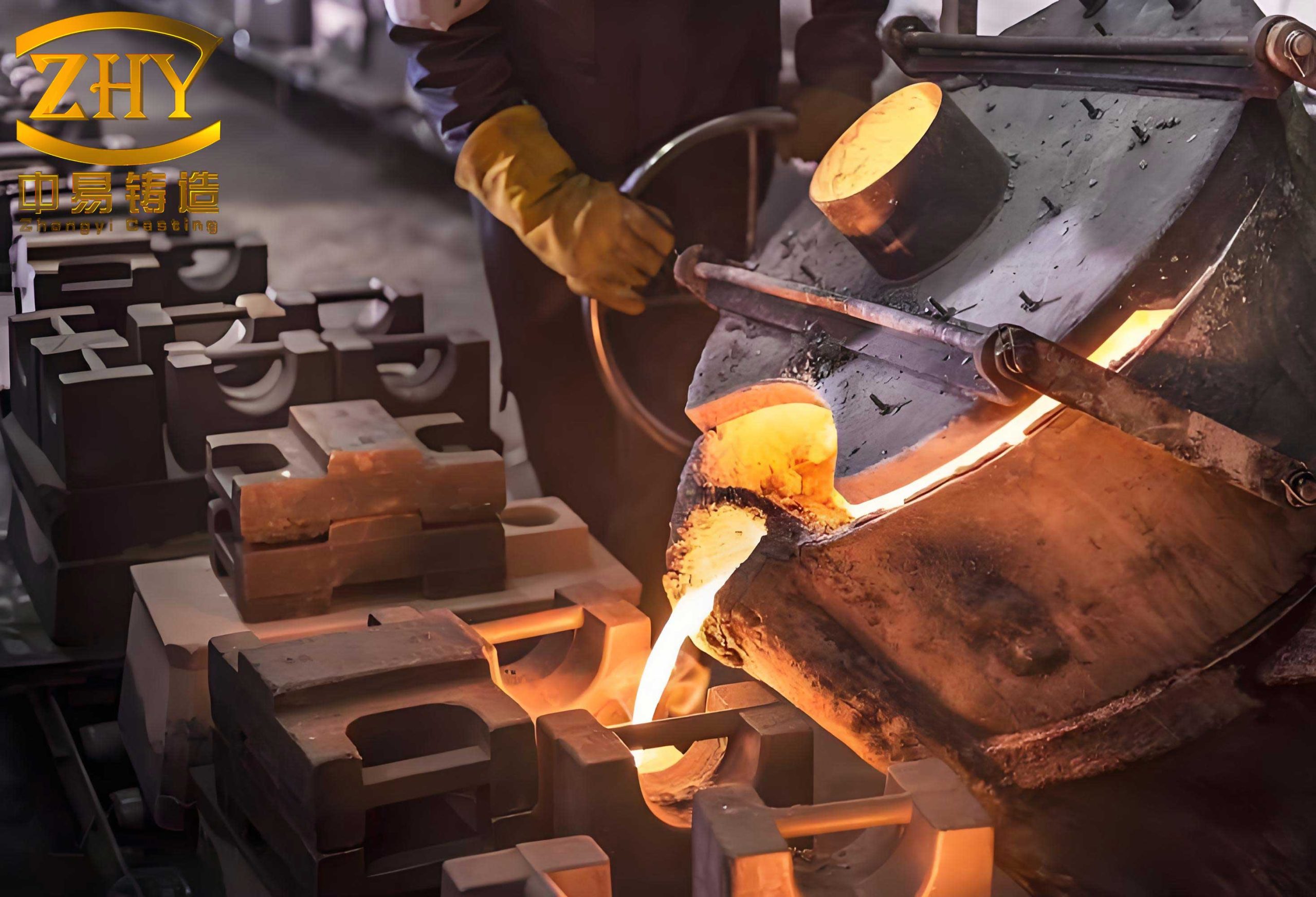
Selecting the foundational raw materials is the first critical step in creating a durable mold for cast iron parts. Quartz sand, while inexpensive, highly refractory, and abundant, has a significant drawback: its high coefficient of thermal expansion. Excessive use can compromise mold life. Therefore, its application must be judiciously controlled. We have successfully utilized a natural silica sand, the performance characteristics of which are summarized below. Notably, a coarser grain size was selected, which not only enhances permeability and durability of the mold but also contributes to a relatively lower overall expansion.
| Property | Value / Description |
|---|---|
| Refractoriness (°C) | > 1750 |
| Clay Content (%) | < 0.5 |
| Color | Light Yellow |
| Main Grain Composition (Mesh) | 12, 20, 30, 40 |
| Uniformity Coefficient | < 60% |
The chemical composition of this sand is equally important, as shown in the following breakdown.
| Component | SiO2 | Al2O3 | Fe2O3 | CaO | MgO | K2O + Na2O | LOI |
|---|---|---|---|---|---|---|---|
| Content (%) | 98.90 | 0.25 | 0.30 | 0.05 | 0.05 | 0.10 | 0.35 |
Fireclay serves as the primary binder in conventional mixes. For molds destined for cast iron parts, the requirement leans towards ‘lean’ clays with high refractoriness, avoiding bentonites or highly plastic clays which have greater drying shrinkage and are more prone to cracking under thermal stress. A lean clay promotes better dimensional stability during the drying and thermal cycling phases. The properties of a suitable clay are tabulated here.
| Property | Value |
|---|---|
| Refractoriness (°C) | > 1750 |
| Green Compressive Strength (kgf/cm²) | 0.6 – 0.9 |
| Dry Compressive Strength (kgf/cm²) | > 5.0 |
For the matrix of the mold body, materials with inherently low thermal expansion are paramount. Coke granules emerge as an ideal candidate for cast iron parts molding. They possess high strength, excellent refractoriness, and most critically, a very low thermal expansion coefficient (approximately $0.5 \times 10^{-6} /^\circ C$). They can be sourced economically as screened waste from furnace operations. The typical grain size used is 3-5 mm. Refractory brick grog is another excellent material, sharing similar advantages of high refractoriness and low expansion. It can be produced by crushing used furnace or ladle linings, making it a very cost-effective recycled material. A grain size of 2-3 mm is common. The advent of mechanical crushers has drastically reduced its processing cost, enhancing its viability for producing molds for cast iron parts.
The true innovation for small-batch production of heavy cast iron parts lies in the binder system. The widespread adoption of asphalt-based binders has proven revolutionary for achieving multiple casts from a single mold. The formulation and technical specifications of this binder, crucial for the integrity of molds for cast iron parts, are detailed below.
| Material Name | Technical Condition | Proportion (%) |
|---|---|---|
| Petroleum Asphalt | No. 4 or 5, Softening Point 70-90°C | 50 |
| Diesel Oil | Light Diesel | 50 |
The facing sand applied directly against the mold cavity is critical for surface finish and mold life. A blend of black graphite powder and coke powder, both passing a 200-mesh sieve, provides a highly refractory, thermally conductive, and lubricating layer that protects the main mold body from direct metal attack and facilitates easier casting removal for cast iron parts.
| Property | Black Graphite Powder | Coke Powder |
|---|---|---|
| Moisture Content (%) | < 1.0 | < 1.0 |
| Ash Content (%) | < 10 | < 15 |
| Fixed Carbon (%) | > 85 | > 80 |
The development of the loam sand mixture itself requires careful balancing of components to achieve the desired green, dry, and thermal properties. For small-batch production of heavy cast iron parts, the conventional, labor-intensive loam preparation is impractical due to long lead times. Our approach centers on an asphalt-bonded sand, the properties of which we have systematically investigated.
The key variables controlling this sand’s performance are the asphalt binder and clay addition rates. The relationship between binder content and key mold properties can be expressed conceptually. The dry tensile strength ($\sigma_d$) increases dramatically with asphalt content ($C_a$), approximately following a power-law relationship, while the permeability ($P$) decreases only modestly:
$$
\sigma_d \propto k_1 \cdot C_a^{n} \quad \text{and} \quad \Delta P \propto -k_2 \cdot C_a
$$
where $k_1$, $k_2$, and $n$ are empirical constants specific to the base sand mix. This results in a composite material possessing significantly higher dry strength than traditional loam, coupled with superior permeability—a critical combination for preventing gas defects in cast iron parts.
The influence of clay content ($C_c$) is more pronounced on permeability and green strength ($\sigma_g$). Permeability declines sharply with increased clay, while green strength rises. The dry strength also receives a contributory boost from the clay, which remains after the organic components of the asphalt burn off during pouring. We posit the combined strength effect as:
$$
\sigma_d = f(C_a, C_c) \approx \alpha \cdot C_a^{n} + \beta \cdot C_c^{m}
$$
where $\alpha, \beta, n, m$ are constants. This understanding allows us to confidently include higher clay percentages to bolster the matrix while relying on asphalt for the primary bond, a synergy ideal for molds producing cast iron parts.
Based on this analysis and testing, we formulated a standard mix for small-batch production of heavy cast iron parts, as specified in the following table. This sand is notably easier to mull and handle than traditional loam.
| Sand Composition (%) | Physical Properties | ||||||
|---|---|---|---|---|---|---|---|
| Silica Sand | Coke Granules (3-5mm) | Asphalt Binder | Clay | Water Content (%) | Green Comp. Strength (kgf/cm²) | Dry Tensile Strength (kgf/cm²) | Permeability |
| 50 | 30 | 7 | 13 | 4.0 – 5.0 | 0.8 – 1.2 | > 18 | 90 – 130 |
Mulling Sequence: Sand + Coke Granules (dry mix) → Add Asphalt Binder → Add Clay → Add Water → Mull to homogeneity.
The wash or coating applied to the mold cavity is vital for surface finish and durability. We employ a two-layer system. The primary layer, rich in quartz flour for high refractoriness, protects the mold body. A secondary layer, rich in graphite, provides lubrication and a smooth finish for the cast iron parts. This combination has proven effective in extending mold life and ensuring easy stripping.
| Coating No. | Quartz Flour | Graphite Powder | Clay | Water | Specific Gravity | Application |
|---|---|---|---|---|---|---|
| 1 | 100 | – | – | Appropriate | ~1.6 | First Layer |
| 2 | 30 | 70 | – | Appropriate | ~1.3 | Second Layer |
A practical application exemplifying this process is the production of a large lathe bed headstock spindle, a significant cast iron part. The casting has an approximate轮廓尺寸 of φ500 mm x 3000 mm, a rough weight of 3 tons, and is poured in grey iron (HT20-40) at around 1280°C. The mold is built in a large flask. The pattern is segmented longitudinally and transversely for ease of molding. Key process steps include: 1) Ramming the drag with the lower half-pattern, incorporating chills and a gate system, using a facing sand layer about 40 mm thick. 2) Positioning the cope half-pattern with sprue, runners, and risers, applying facing sand, and ramming the cope. Reinforcement is critical; substantial mold hooks (φ25 mm) are used in large quantities (30-40 pieces) within the cope and drag to prevent sagging or collapse of the large sand mass—a point far more crucial than iron nails for large molds for cast iron parts. Nails are used sparingly only for reinforcing edges and corners. 3) After drawing the pattern, the entire cavity is coated with the two-layer wash system. 4) The mold is dried according to a controlled schedule, reaching a peak temperature of 400-450°C and holding for sufficient time to fully cure the asphalt binder. 5) After cooling to below 200°C, the mold is closed and poured. 6) Shakeout is carefully timed at about 8 hours post-pour, when the casting temperature is approximately 500°C, to prevent casting distortion or cracking. An important technique is to lift the cope slightly (equal to the flange height) early in the cooling stage and fill the gap with dry sand to prevent the solidifying flange from mechanically stressing and damaging the cope.
Post-shakeout, the mold cavity is inspected and repaired. Damaged areas (often from casting shrinkage on vertical surfaces) are cleaned, brushed with clay slurry, patched with fresh sand of the same composition, pinned, and finished. The entire cavity is then brushed with a molasses solution (SG ~1.3) to restore surface strength. After drying again per a modified schedule, a fresh coating of wash is applied before the next pour. This particular mold for these cast iron parts has been successfully used for four cycles, stored for over a month, and used twice more, with an estimated total life exceeding ten pours.
The practical benefits of this approach for small-batch heavy cast iron parts are substantial. The use of asphalt-bonded sand offers distinct advantages: achieving multiple pours (e.g., 6 casts) from one mold saves significant material costs; it drastically accelerates production cycles, saving hundreds of man-hours per casting on molding and core knockout; it is easily mulled and amenable to mechanical handling; it is simpler to ram than traditional loam; it is easier to shake out eventually due to lower clay content; it uses common, low-cost raw materials; and its high permeability minimizes gas-related defects common in denser traditional loam molds. The initial application of a quartz-based primary wash followed by a graphite-based finish significantly enhances mold life and casting release for these large cast iron parts.
The principles of durable mold-making extend beyond cast iron parts. The adoption of loam molds for copper alloy castings presents its own set of challenges and material requirements, driven by the higher pouring temperatures and different metallurgy of copper. The demands on the mold material are even more stringent: higher refractoriness to resist molten copper erosion, better thermal conductivity to extract heat rapidly, greater thermal stability to withstand more severe thermal gradients, and sufficient hot strength with minimal gas generation. Common materials include high-alumina fireclay and refractory grog as the base, supplemented by flake graphite or carbonaceous materials to enhance refractoriness and thermal conductivity. While silica sands are sometimes used, their phase transformation at around 573°C limits their utility for high-duty copper casting molds. Magnesite offers high refractoriness and conductivity but poor thermal shock resistance. Fiber materials like hemp are often added to the mixture to provide a reinforcing network that burns out, creating channels that improve the overall permeability and crack resistance of the mold for these demanding applications. The successful formulation of mixes for copper castings follows a similar philosophy of balancing refractoriness, expansion, and strength, but with a greater emphasis on carbonaceous additives and high-grade refractory aggregates to withstand the aggressive conditions posed by pouring copper alloys, much like the advanced formulations developed for high-performance molds for cast iron parts.