
In my extensive experience working with cast iron parts, I have witnessed significant advancements in processing techniques that enhance both microstructure preservation and surface quality. This article consolidates key developments from various domains, including polishing procedures, vermicular graphite cast iron applications, surface coating technologies, cleaning methods, and analytical tools. All these innovations aim to improve the performance and reliability of cast iron parts in industrial applications. I will present these insights in a first-person narrative, incorporating tables and formulas to summarize critical data, and emphasize the term “cast iron parts” throughout to highlight its centrality.
Let me begin by discussing a polishing procedure that has proven effective for various types of cast iron. This method ensures high-quality graphite preservation without compromising the metal matrix integrity. In our laboratory, we implemented this approach to achieve accurate microstructural observations in both polished and etched states. The process is neither complex nor time-consuming, making it suitable for routine analysis of cast iron parts. The key lies in controlling parameters such as pressure, time, and abrasive size. For instance, the relationship between graphite preservation and polishing force can be expressed using a simplified model: $$ P = k \cdot \frac{F}{A} $$ where \( P \) is the preservation index, \( k \) is a material constant, \( F \) is the applied force, and \( A \) is the contact area. This formula helps optimize conditions for different cast iron parts.
| Polishing Step | Abrasive Type | Time (min) | Pressure (N) | Result on Cast Iron Parts |
|---|---|---|---|---|
| Rough Grinding | Silicon Carbide (220 grit) | 5 | 10 | Removes surface irregularities |
| Fine Polishing | Diamond Suspension (3 µm) | 10 | 5 | Enhances graphite visibility |
| Final Etching | Nital (2%) | 1 | N/A | Reveals metal matrix details |
Through this procedure, we consistently obtain clear microstructures for cast iron parts, allowing for precise evaluation of graphite morphology and matrix phases. The preservation index \( P \) should exceed 0.8 for optimal results, as derived from empirical data on various cast iron parts. This method has been applied to everything from engine blocks to pump housings, underscoring its versatility.
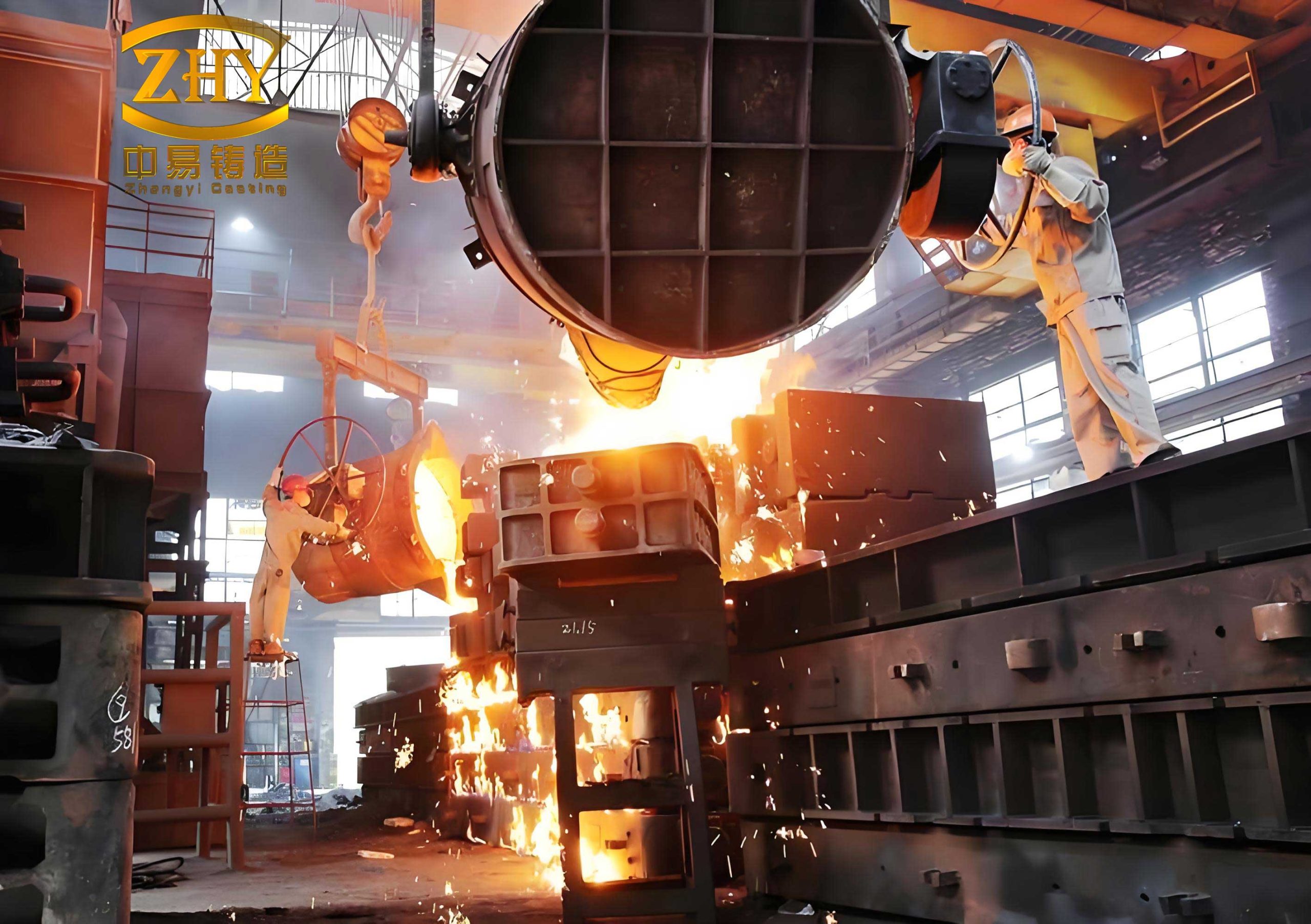
Moving on, the application of vermicular graphite cast iron in turbocharger intake housings represents a breakthrough for cast iron parts. In a collaborative project, we developed a treatment process using domestic rare-earth silicon iron alloys mixed with silicon-calcium as a vermiculizing agent, coupled with cryolite powder as an inoculant. This yields high vermicularity rates, simplifying operations and aligning with local industrial conditions. The technical appraisal confirmed its advanced status, particularly for complex, thick-walled cast iron parts like those in large turbochargers. The economic benefits are substantial, as it reduces reliance on imported materials and enhances durability.
To quantify the performance, we measured key properties of these cast iron parts. The vermicularity rate \( V_r \) is calculated as: $$ V_r = \frac{N_v}{N_t} \times 100\% $$ where \( N_v \) is the number of vermicular graphite nodules and \( N_t \) is the total graphite count. Achieving over 90% vermicularity ensures mechanical properties comparable to international standards. Below is a summary of the chemical composition and mechanical properties we targeted:
| Element/Property | Target Range | Impact on Cast Iron Parts |
|---|---|---|
| Carbon (C) | 3.6–4.0% | Enhances graphite formation |
| Silicon (Si) | 2.0–2.5% | Promotes vermicular structure |
| Rare-earth (RE) | 0.01–0.03% | Controls graphite morphology |
| Tensile Strength | ≥ 400 MPa | Ensures load-bearing capacity |
| Hardness | 180–220 HB | Balances machinability and wear resistance |
This innovation not only meets technical specifications but also opens avenues for exporting high-quality cast iron parts. We are further refining pre-furnace detection methods to improve consistency and workshop environments for mass production.
Another area I have explored is surface coating technology for cast iron parts. The development of a multi-purpose magnetron sputtering ion plating machine offers an eco-friendly alternative to electroplating. This device, which we helped optimize, deposits dense, adherent films on various substrates, including cast iron parts, without harmful emissions. The process involves ion bombardment and sputtering, described by the deposition rate \( R_d \): $$ R_d = \frac{J \cdot \eta \cdot M}{\rho \cdot e} $$ where \( J \) is the ion current density, \( \eta \) is the sputtering yield, \( M \) is the atomic mass, \( \rho \) is the density, and \( e \) is the electron charge. This results in coatings with superior corrosion resistance and adhesion, crucial for extending the lifespan of cast iron parts in harsh environments.
| Coating Parameter | Value | Benefit for Cast Iron Parts |
|---|---|---|
| Base Pressure | 1 × 10⁻³ Pa | Minimizes contamination |
| Sputtering Power | 5 kW | Ensures uniform film growth |
| Coating Thickness | 5–20 µm | Provides adequate protection |
| Adhesion Strength | > 50 MPa | Prevents delamination |
This technology has been awarded for its innovation and is now ready for widespread adoption, potentially revolutionizing the finishing of cast iron parts while saving energy and water compared to traditional methods.
For large cast iron parts, cleaning and surface preparation are critical. We designed and commissioned a shot blasting cleaning room with a 30-ton rotary table capacity to address this need. This equipment features dual blasting systems, advanced dust collection, and interlocked controls for safety. The efficiency has increased significantly, improving the surface finish of cast iron parts such as engine cylinder blocks. The cleaning effectiveness \( E_c \) can be modeled as: $$ E_c = \frac{A_c \cdot v \cdot t}{V} $$ where \( A_c \) is the cleaning area, \( v \) is the blasting velocity, \( t \) is the time, and \( V \) is the volume of the cast iron part. This allows for optimized operations, ensuring that cast iron parts are free from sand and scale, which enhances paint adhesion and overall quality.
| Feature | Specification | Advantage for Cast Iron Parts |
|---|---|---|
| Chamber Size | 10 m × 8 m × 6 m | Accommodates large components |
| Max Load | 30 tons | Handles heavy cast iron parts |
| Dust Collection | Bag filter system | Maintains clean work environment |
| Productivity Gain | 3× compared to old methods | Reduces processing time |
This setup has transformed our production line, enabling faster turnaround for cast iron parts and contributing to a more civilized workshop atmosphere.
To support the analysis of cast iron parts, we participated in a transmission electron microscopy (TEM) training program. This course covered fundamentals like sample preparation, diffraction pattern indexing, and defect observation. For cast iron parts, TEM is invaluable for studying graphite-matrix interfaces and precipitation phases. The resolution \( \delta \) in TEM is given by: $$ \delta = \frac{0.61 \cdot \lambda}{NA} $$ where \( \lambda \) is the electron wavelength and \( NA \) is the numerical aperture. This allows us to examine nanoscale features in cast iron parts, aiding in material development and failure analysis. The knowledge gained has been instrumental in improving our quality control processes for cast iron parts.
Finally, for industry professionals, resources like the “China Mechanical and Electrical Enterprise Directory” are essential. This directory lists thousands of companies involved in producing and supplying cast iron parts, along with product specifications and quality certifications. It serves as a valuable tool for sourcing and networking, ensuring that stakeholders can access the best technologies and materials for cast iron parts. While I won’t delve into specifics due to privacy concerns, I recommend it as a comprehensive reference for anyone working with cast iron parts.
In conclusion, the advancements discussed—from polishing and vermicular cast iron to coating, cleaning, and analytical techniques—collectively elevate the standards for cast iron parts. Through first-hand application, I have seen how these methods enhance microstructure integrity, surface properties, and operational efficiency. The recurring theme is the critical role of cast iron parts in modern industry, and by leveraging these innovations, we can achieve greater economic and technical benefits. Future work should focus on scaling up production and further integrating smart technologies to optimize the lifecycle of cast iron parts.
To encapsulate key formulas and data, here is a summary table of the mathematical models used in this article for cast iron parts:
| Application | Formula | Description |
|---|---|---|
| Polishing Preservation | $$ P = k \cdot \frac{F}{A} $$ | Preservation index vs. force and area |
| Vermicularity Rate | $$ V_r = \frac{N_v}{N_t} \times 100\% $$ | Percentage of vermicular graphite |
| Coating Deposition Rate | $$ R_d = \frac{J \cdot \eta \cdot M}{\rho \cdot e} $$ | Rate of film growth in sputtering |
| Cleaning Effectiveness | $$ E_c = \frac{A_c \cdot v \cdot t}{V} $$ | Efficiency of shot blasting process |
| TEM Resolution | $$ \delta = \frac{0.61 \cdot \lambda}{NA} $$ | Resolution limit in electron microscopy |
These tools empower engineers and researchers to continuously improve the quality and application of cast iron parts across various sectors. I am confident that with ongoing collaboration and innovation, the potential of cast iron parts will be further unlocked, driving industrial progress forward.