
In my experience at a major heavy machinery manufacturing facility, the heat treatment of high and medium pressure outer casing cast iron parts for steam turbines is a critical process that ensures the integrity and performance of these essential components. These cast iron parts, specifically made from cast steel, serve as pressure vessel components in turbine systems, demanding exceptionally high technical standards. Beyond requiring excellent comprehensive mechanical properties—including both room temperature and elevated temperature performance—these castings must undergo thorough non-destructive testing such as magnetic particle inspection on all surfaces and ultrasonic testing internally. Dimensional tolerances are stringent, adhering to second-grade precision casting specifications. Achieving these requirements hinges on precise heat treatment, which I have been deeply involved in developing and optimizing. This article delves into the methodology, challenges, and outcomes of heat treating these cast iron parts, with a focus on practical insights and data-driven analysis.
The performance specifications for these cast iron parts are rigorous, encompassing room temperature tensile properties, high-temperature instantaneous strength, and creep rupture strength. For room temperature tests, the mechanical properties must meet specific thresholds for yield strength, tensile strength, elongation, and reduction of area. High-temperature performance is evaluated at operating conditions, with data serving as a reference for design. Creep rupture strength is particularly vital for long-term reliability under stress and temperature. To summarize, I have compiled key requirements in tables below, which guide the heat treatment process. These cast iron parts are fabricated from a cast steel grade similar to ZG15Cr1Mo1V, with chemical composition and residual element limits strictly controlled. The composition ensures weldability, toughness, and high-temperature stability, critical for turbine applications.
| Property | Yield Strength (MPa) | Tensile Strength (MPa) | Elongation (%) | Reduction of Area (%) |
|---|---|---|---|---|
| Room Temperature | ≥ 345 | ≥ 515 | ≥ 18 | ≥ 35 |
| High Temperature (540°C) | ≥ 275 | ≥ 440 | ≥ 15 | ≥ 30 |
For high-temperature creep rupture strength, the requirements are as follows, with tests conducted at 540°C under specific stress levels:
| Test Temperature (°C) | Test Stress (MPa) | Minimum Rupture Time (h) | Elongation (%) |
|---|---|---|---|
| 540 ± 5 | 245 ± 5 | > 100 | ≥ 5 |
| 540 ± 5 | 275 ± 5 | > 100 | ≥ 5 |
The outer casing cast iron parts are sizable, with dimensions varying between high-pressure and medium-pressure sections. In production, they are divided into upper and lower halves for both high-pressure and medium-pressure casings, totaling four pieces. Typical dimensions include lengths up to 4000 mm, widths around 2000 mm, and heights of 1500 mm, with wall thicknesses ranging from 100 mm to 300 mm. These cast iron parts are heat-treated in batches using car-type furnaces with maximum operating temperatures of 1050°C. For instance, a high-pressure outer casing and a medium-pressure outer casing are processed separately in two furnaces to ensure uniformity. During loading, the cast iron parts are positioned with the flange mating surface facing upward, supported on dedicated column-type pedestals with heights adjustable from 500 mm to 1000 mm. This arrangement minimizes distortion and promotes even heating. For high-pressure casings, 8 support points are used, while medium-pressure casings employ 6 points. During normalizing, forced cooling is achieved with multiple fans to accelerate the cooling rate, which is crucial for microstructural refinement.
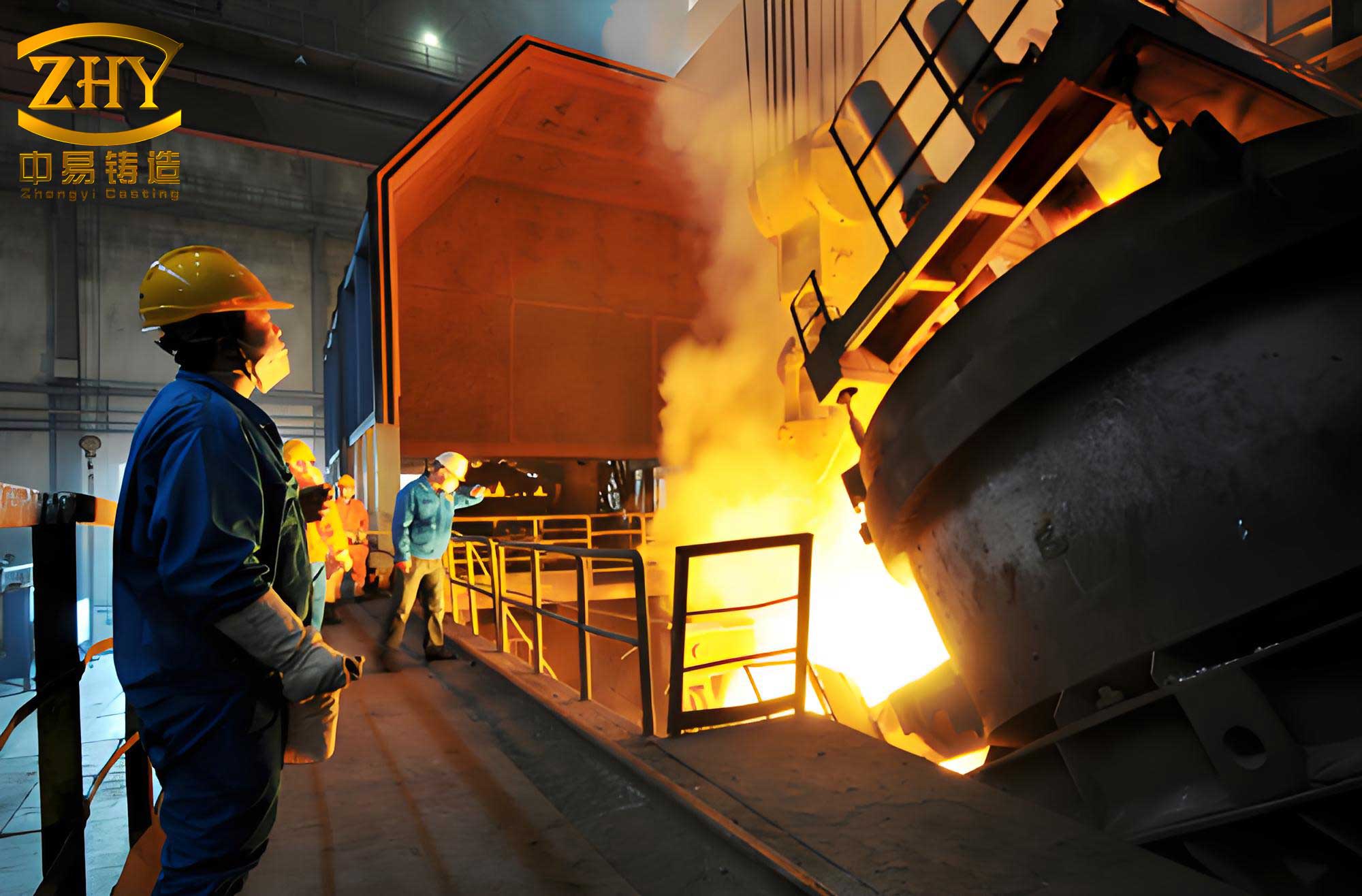
Developing the heat treatment protocol involved extensive simulation tests to optimize parameters. We used medium-frequency induction furnaces to melt the steel, casting it into plum blossom test bars with compositions matching the target. These samples were heat-treated in laboratory-scale box furnaces. The preliminary process included stress relief annealing at 600°C for 5 hours, followed by normalizing at 960–980°C for 5 or 8 hours, and high-temperature tempering at 720°C. Normalizing employed three cooling methods: (1) cooling to below 600°C within 1 hour after furnace exit, then to below 400°C before tempering; (2) cooling to below 500°C within 1 hour, then to below 400°C; and (3) cooling to below 400°C within 1 hour, then to room temperature. The results, summarized in Table 3, showed that all methods met mechanical property requirements, but cooling rate significantly affected ferrite content and grain size. Faster cooling reduced ferrite precipitation, enhancing strength and toughness—a key consideration for these cast iron parts.
| Cooling Method | Ferrite Content (%) | Grain Size (ASTM) | Yield Strength (MPa) | Tensile Strength (MPa) | Elongation (%) |
|---|---|---|---|---|---|
| Method 1 | 15–20 | 5–6 | 360 | 530 | 20 |
| Method 2 | 20–25 | 4–5 | 350 | 520 | 22 |
| Method 3 | 10–15 | 6–7 | 370 | 540 | 19 |
Based on these findings, the production heat treatment process was refined. To improve comprehensive mechanical properties and reduce ferrite formation, we adopted a faster cooling rate via fan-forced cooling and lowered the tempering temperature from 720°C to 700°C. The actual process curve, as implemented, is depicted in Figure 1 (described textually): stress relief at 600°C for 5 h, normalizing at 970 ± 10°C for 8 h with forced cooling, and tempering at 700 ± 10°C for 8 h. The cooling rate during normalizing is critical; we aim to cool the cast iron parts below 600°C within the first hour to achieve desired microstructure. The heat transfer during cooling can be modeled using Newton’s law of cooling: $$q = h \cdot A \cdot (T_s – T_\infty)$$ where \(q\) is the heat transfer rate, \(h\) is the convective heat transfer coefficient, \(A\) is the surface area, \(T_s\) is the surface temperature of the cast iron part, and \(T_\infty\) is the ambient temperature. By increasing \(h\) through forced convection with fans, we enhance \(q\), leading to faster cooling and finer microstructures.
Operational details are vital for quality. During loading, the cast iron parts are仰装 (face-up) on columnar pedestals to ensure stability and prevent warping. Fans are positioned to align with the lower pedestals, promoting uniform cooling across thick sections like flanges. Temperature monitoring uses externally attached sheathed thermocouples for accuracy. For these cast iron parts, we also consider thermal stresses during cooling, which can be estimated via the formula for thermal stress: $$\sigma_{thermal} = E \cdot \alpha \cdot \Delta T$$ where \(E\) is Young’s modulus, \(\alpha\) is the coefficient of thermal expansion, and \(\Delta T\) is the temperature gradient. Controlled cooling minimizes \(\Delta T\) to avoid cracking in these large cast iron parts.
The results from actual production were promising. Chemical analysis confirmed that the cast iron parts met specification limits, with elements like carbon, chromium, molybdenum, and vanadium within required ranges. Room temperature mechanical properties, as shown in Table 4, exceeded minimum standards, demonstrating the efficacy of the heat treatment for these cast iron parts.
| Sample Location | Yield Strength (MPa) | Tensile Strength (MPa) | Elongation (%) | Reduction of Area (%) |
|---|---|---|---|---|
| High-Pressure Upper | 375 | 550 | 21 | 40 |
| High-Pressure Lower | 370 | 545 | 22 | 42 |
| Medium-Pressure Upper | 380 | 555 | 20 | 38 |
| Medium-Pressure Lower | 365 | 540 | 23 | 41 |
High-temperature instantaneous properties at 540°C also satisfied requirements, with yield strengths around 300 MPa and tensile strengths above 460 MPa. Creep rupture tests at 540°C under 245 MPa stress showed rupture times exceeding 120 hours, well above the 100-hour threshold, indicating excellent long-term performance for these cast iron parts. Microstructural examination revealed tempered sorbite with minor ferrite, and grain sizes ranged from ASTM 5 to 7, depending on cooling rate. Faster cooling resulted in finer grains and less ferrite, aligning with simulation data. For instance, in high-pressure casings, surface regions showed tempered sorbite with 10–15% ferrite and grain size 6–7, while center regions had slightly coarser structures. This heterogeneity underscores the importance of optimized cooling for uniform properties in cast iron parts.
Further analysis indicates that cooling speed profoundly influences the microstructure of cast iron parts. The transformation kinetics during cooling can be described using the Avrami equation for phase transformation: $$X = 1 – \exp(-k t^n)$$ where \(X\) is the transformed fraction, \(k\) is a rate constant, \(t\) is time, and \(n\) is an exponent. For ferrite formation, faster cooling reduces \(t\), decreasing \(X\) and limiting ferrite precipitation. We observed that in cast iron parts cooled via Method 3, ferrite content was below 15%, whereas slower cooling (Method 2) led to over 20% ferrite. This impacts mechanical properties; higher ferrite can reduce strength but improve ductility. However, for turbine cast iron parts, a balance is sought, and our process aims for minimal ferrite to enhance high-temperature strength.
Challenges in heat treating these large cast iron parts include non-uniform cooling due to variable section thicknesses and environmental factors. To address this, we modified process parameters: for high-pressure casings, tempering temperature was increased to 700 ± 10°C (matching medium-pressure casings) and holding time extended to 8 hours, which improved plasticity and slightly reduced strength for better overall performance. Additionally, we optimized support pedestal arrangements to minimize contact points while ensuring stability, and adjusted fan positions dynamically based on pedestal height and location. This enhances cooling uniformity and speed, further refining the microstructure of cast iron parts. The relationship between cooling rate \(V_c\) and ferrite content \(F\) can be approximated linearly for these cast iron parts: $$F = a – b \cdot V_c$$ where \(a\) and \(b\) are material constants. By boosting \(V_c\) through forced convection, we reduce \(F\), achieving desired properties.
In conclusion, the heat treatment process for high and medium pressure outer casing cast iron parts, involving normalizing at 970 ± 10°C and tempering at 700 ± 10°C, is proven effective. Rapid cooling during normalizing, especially within the first hour down to 600°C, is crucial to minimize ferrite precipitation and refine grain structure. Operational practices such as仰装 loading, strategic fan placement, and minimized supports are key to success. These cast iron parts, after treatment, meet all mechanical and non-destructive testing standards, ensuring reliability in steam turbine applications. Future work may explore advanced quenching techniques or computational modeling to further optimize heat treatment for such critical cast iron parts. The integration of these methods underscores the importance of tailored thermal processing in manufacturing high-performance cast iron parts for energy systems.
Throughout this endeavor, I have emphasized that cast iron parts—despite being cast steel in this context—require meticulous heat treatment to achieve their full potential. The lessons learned here apply broadly to heavy-section castings in power generation, where performance under extreme conditions is paramount. By sharing these insights, I hope to contribute to the advancement of热处理 technology for cast iron parts worldwide.